
Will AI Replace Your Agency in 2026? Here Is the Honest Answer
AI is not replacing agencies, it is reshaping them. The agencies winning are bolting ready AI offers onto existing services and leading with an AI audit offer, because being seen as AI-first is now as valuable as the AI itself.

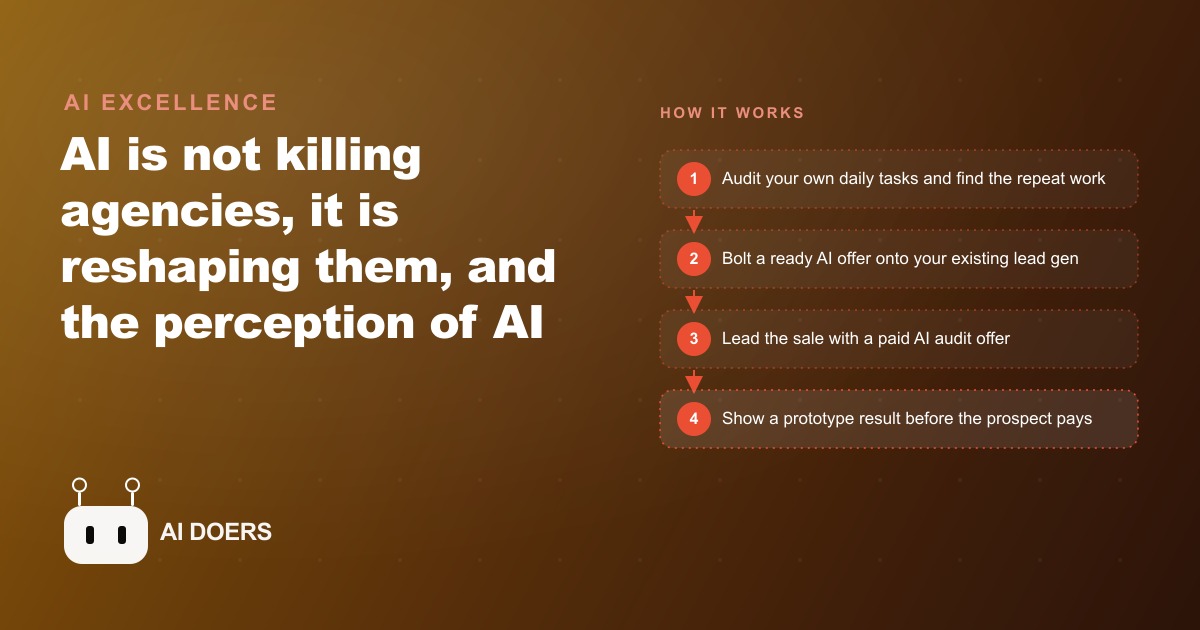
The agencies losing work to AI in 2026 were already losing before AI arrived, and the disruption has only made their failure visible faster. An agency built on slow delivery, commodity content, and manual reporting was never protected by anything except the absence of a better option, and AI is now the better option.
The Agencies Losing to AI Were Already Losing Before AI Arrived
The agencies most threatened by AI share a specific profile. They competed on labor hours. Their deliverables were word counts, social posts, and monthly reports. Their pricing reflected the time their team spent producing those deliverables, not the outcomes those deliverables produced. That model worked when the only way to produce a thousand words of reasonable marketing copy, a performance report, or an initial creative brief was to pay a human being to spend hours on each one.
That constraint is gone. A capable AI tool produces a usable first draft of any of those things in seconds. The agency that was charging for the hours spent producing the draft is no longer selling a scarce resource. It is selling a commodity at the price of something that is no longer scarce.
The honest read is that this was always the structural weakness of those agencies, and AI did not create it. What AI did was remove the friction that kept competitors from exploiting it. A challenger agency used to need a large team to undercut the incumbent on volume. Now it needs a smaller team with better tooling. The incumbent agencies panicking about AI are mostly panicking about the removal of the friction that was hiding their actual competitive position, which was never as strong as they thought.
The agencies winning right now have a different profile. They compete on judgment: the ability to decide which AI outputs to keep and which to discard, how to interpret data in ways specific to one client's market, and what to recommend when the data is ambiguous. Those skills did not become worthless when AI arrived. They became more valuable, because the commodity work that used to crowd out judgment-intensive work can now be handled by a tool, and the time freed up goes to the work clients actually need.
One dental-focused agency in conversations circulating across the space went from zero to roughly 130,000 dollars a month by wrapping existing services in an AI-first story and delivering one or two visible, fast wins at the start of every engagement. The underlying skills were the same. The packaging and the speed were different. That is the whole story. The agencies that do not update the packaging and the speed are competing against the version of this agency that has, and that is a competition they will lose on price, pitch, and delivery speed simultaneously.
Perception Is Already More Valuable Than the Technology Itself
One of the sharpest observations from conversations happening across the agency space right now is that the perception of being AI-first is currently as valuable as the AI itself, perhaps more so. A buyer who sees an agency as AI-first perceives lower costs, faster delivery, and more sophisticated capabilities before a single proof point has been offered. An agency seen as traditional perceives the opposite, regardless of the actual quality of its work.
This dynamic is not permanent. It reflects the current moment, where AI capability is still new enough in services markets that the label carries a premium. As AI integration becomes standard across the industry, the label will stop being a differentiator and start being a minimum expectation. The agencies that move now get the positioning advantage while it is still worth something. The agencies that wait get to implement AI after it has become table stakes, and nobody is impressed by table stakes.
The perception gap has a concrete effect on deals. Two agencies competing for the same client, one positioned as AI-first and one positioned as traditional, are not competing on equal footing even when their underlying capabilities are similar. The AI-first positioning signals a different kind of operation: faster iteration, lower production costs, more testing per dollar, and more sophisticated tooling. Buyers believe that signal before they have seen any evidence for it, because the signal is consistent with the stories they have already absorbed about what AI makes possible.
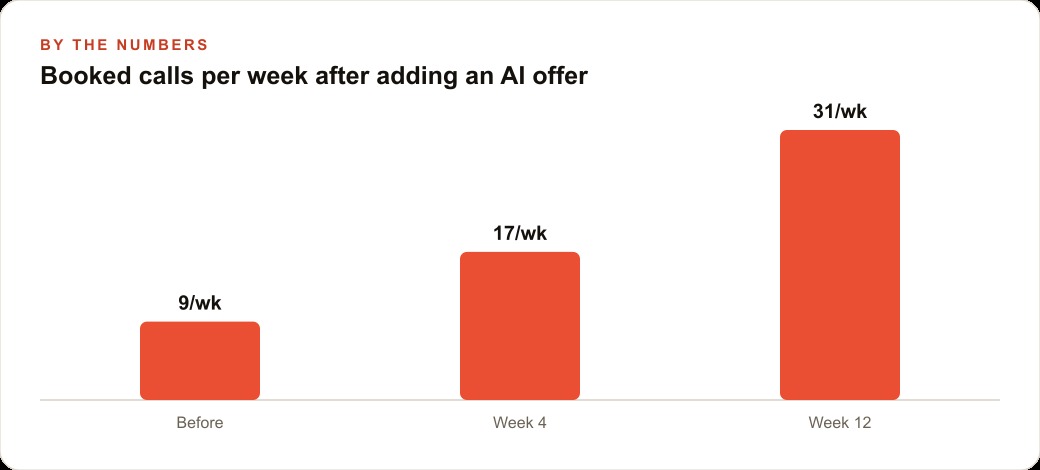
Getting the perception right before the pitch starts is a real commercial advantage. The way to build that perception is not to retrain the entire team or rebuild every delivery system before the next proposal goes out. It is to pick one visible AI application, implement it well, and lead with it in every client conversation. Adding AI-powered speed-to-lead to an existing lead generation service takes a few days to implement and changes the story the agency tells about itself. The client's booked-call rate goes up, the agency has a concrete result to point to, and the positioning as AI-first is now backed by evidence rather than assertion.
The comparison that captures this moment well is early social media. Social media created a generation of agencies that did not exist before, because the new channel was real, buyer awareness was high, and the first agencies to specialize locked in long-term advantages. The same dynamic is active right now with AI, but the cultural spread is far greater because AI is a household name across every industry, not just technology. A dentist asking about their marketing wants to know if their agency uses AI. A construction company owner has seen enough headlines to raise the question in the first meeting. The positioning window is open, and it will close.
Building Custom Automation Kills More Agencies Than AI Does
A significant number of agencies that set out to become AI-enabled end up building the wrong things. They identify a process that should be automated and commission a custom build: a bespoke appointment setter, a proprietary reporting pipeline, a custom AI that does something a ready-made tool already does better.
Custom automation built on top of fast-moving AI models is expensive to maintain. When an underlying API changes, the custom build breaks. When the model is updated, the behavior changes and needs to be re-evaluated. The team that built it needs to be retained to support it. The custom build that looked like an investment in capability becomes a recurring engineering cost that grows over time.
The right default is to buy rather than build. Off-the-shelf AI tools for appointment setting, content drafting, performance reporting, and client communication are widely available and maintained by vendors whose entire business is keeping them functional as underlying models evolve. The agency that buys these tools spends nothing on maintenance and gets the benefit of vendor product improvements without any engineering effort.
The version of this that applies to ad creative is specific. A marketing agency that builds a custom tool for generating and testing ad copy is solving a problem that several well-funded products already solve better than a custom build will. The better move is a custom knowledge base: a tool configured with the best-performing ads for each client, loaded with that client's target cost per acquisition and the creative patterns that work in their specific vertical. That is not a custom build. It is a configuration that takes a few hours per client and produces genuine leverage because the AI outputs are calibrated to real performance data.
Time-tracking two weeks of actual team work and categorizing tasks by type reveals the automation targets worth pursuing. The tasks that appear every day and take more than twenty minutes each are where AI saves the most time. A team that time-tracks honestly typically surfaces three to four automations that together recover significant capacity across a ten-client book. Running this analysis against a real agency book, four automations recovered roughly forty hours per month. At a blended rate of eighty dollars per hour for team time, that is roughly 3,200 dollars per month in recovered capacity, fully returned in the first month of operation. The automations took a combined three days to configure.
The key principle is to build only from workflows that actually run inside the real business today. Most AI automation content online automates a process that exists only in a demo. Build only from documented, current workflows and you avoid the most common and most expensive trap in the space.
The Audit Offer Is the Most Honest Sale You Can Make
The most useful commercial move in the current moment is an AI audit offer, and it is the most honest sale an agency can make because it leads with a diagnosis rather than a promise.
The discovery version starts small: a structured intake session, two or three hours of analysis, and a written findings document delivered within 48 hours. The scope is simple: which repeatable processes in the client's marketing, sales, or operations could be improved or partially automated with AI tools available today, and what would that improvement be worth. A 300-dollar price point is low enough that a serious buyer does not need internal approval. It is high enough to filter out people who are not actually interested in taking action.
The comprehensive version scales to a full engagement scope: an eight-week deep audit of a company with a real marketing operation, mapping every repeatable process across customer acquisition, lead handling, content production, and performance reporting. That engagement prices at five figures and is a credible, high-value deliverable at that range because the output is a specific, prioritized roadmap with enough detail to implement.
Both versions convert well into ongoing engagements because the client ends the audit with a diagnosis and a roadmap, and no one to implement it. The agency that did the audit is the obvious implementer, and it arrives at that conversation having already demonstrated that it understands the client's actual operation at a process level. That is a fundamentally different sales dynamic than cold outreach followed by a capabilities presentation.
An agency that runs twelve discovery audits in a calendar year in one vertical builds a pattern library. The second audit in that vertical is faster to scope because the common failure modes are already known. The twelfth audit produces a findings document in half the time of the first, because the template is calibrated to what actually matters in that specific kind of business. Niche compounding is real, and it is the reason to pick one vertical for the audit offer rather than offering it across every industry indiscriminately.
The audit offer also reframes the initial sales conversation away from price and toward value. An agency pitching services competes on rate cards. An agency offering a diagnosis competes on insight. The buyer who pays 300 dollars for a discovery session and receives a specific, credible findings document is in a different buying state than the buyer who received a proposal. They have already experienced the agency's ability to understand their business, and they are evaluating whether to extend that relationship.
The AI-First Label Has a Closing Window and Most Agencies Are Still Debating Whether to Act
The positioning advantage of being visibly AI-first is real right now and will diminish as AI integration becomes standard. Most agencies are either ignoring the window or debating it, which is the same outcome from a competitive perspective.
The agencies that act and the agencies that debate land in different positions twelve months from now. The ones that act have client testimonials from AI-assisted engagements, a refined audit offer they have run multiple times, a set of automations they know work because they have measured them, and a positioning story backed by evidence. The ones that debate have a more considered view of the risks and a weaker competitive position than the ones who moved.
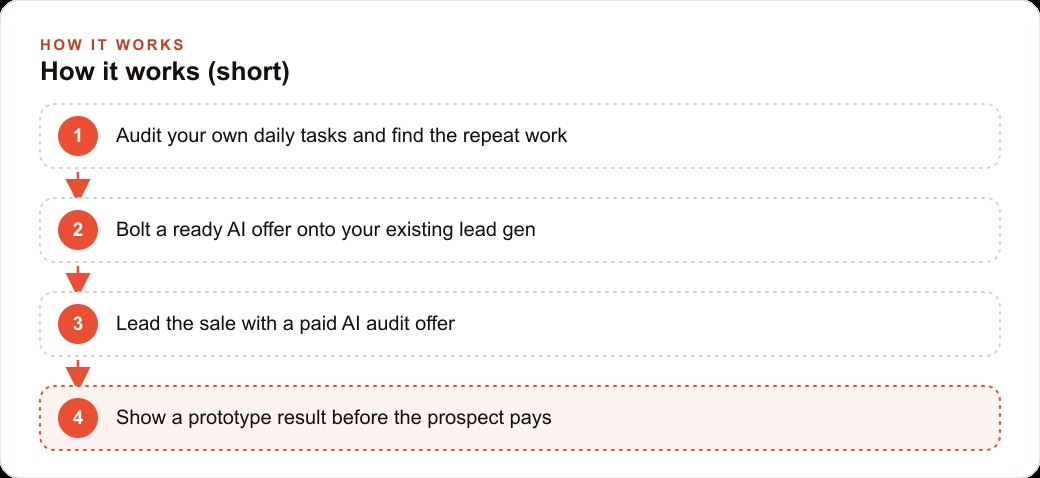
The entry point is not a strategic transformation project. It is a single visible move. Time-track the team's work for two weeks to find the highest-value automation targets. Build a custom knowledge base for each active client using their best-performing ads and target metrics. Offer a discovery audit on the next five new business conversations. Show a prototype or a set of deliverables before the pitch rather than after the client signs.
That last move carries the highest immediate leverage. Because AI cuts the cost of delivery so sharply, building a prototype landing page or a batch of ad creatives for a prospect before the pitch is now viable for almost every opportunity. The cost of showing real output before asking for a signature has dropped to near zero, and the close rate on a pitch that shows actual work is materially higher than one that only promises future results.
The window for leading with AI as a differentiator is open. Most agencies are still inside it. The ones who close a deal, land a client, or run their first audit in the next thirty days will have a case study and a refined process by the time the window starts to narrow. The ones who wait will be implementing AI under the same conditions as everyone else, which is the definition of not having an advantage. The agencies that deserve to survive this transition are treating it as an opportunity rather than a threat, and they are moving now.
That is exactly what we do at AI DOERS. Book a private 30-minute call with Madhuranjan Kumar and we will map the fastest path to it for your specific business.
Book your call →
Madhuranjan Kumar
Madhuranjan Kumar brings 20 years of performance-marketing experience and has managed over $200 million in Facebook ad spend for brands across the United States and beyond. His expertise spans the full modern marketing stack: Meta, Google Ads, TikTok, email automation, CRM, and the websites that hold it together. At AI DOERS he turns that track record into lead-generation systems for businesses across every industry.