
Why US Open-Source AI Is Losing to China (And It Is Not About Talent)
US open-source AI is failing because no business model pays for it, so a lab spends millions and competitors serve it free at higher margins, while China subsidizes the loss as national strategy. For buyers, the lesson is to map the work first, then pick the cheapest model that clears the bar.

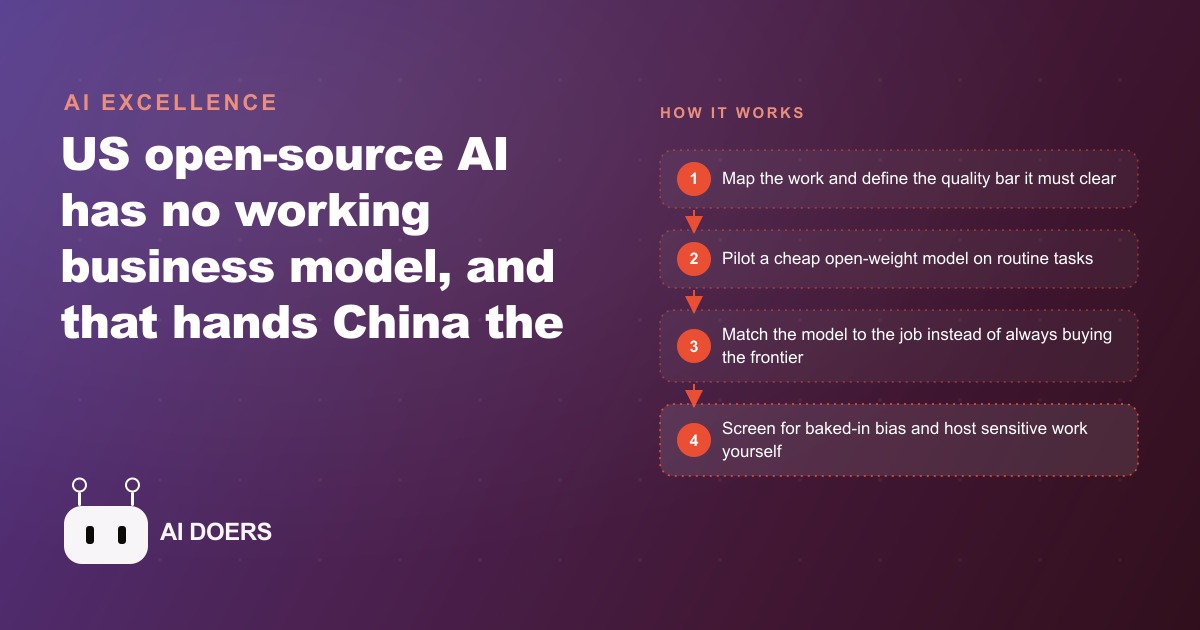
The narrative that US tech dominates AI is built on closed-model benchmarks and company valuations. It is not built on who is winning the open-weight race, which is a different and arguably more important contest. The case I want to make is that US open-source AI is losing that race, the reason is not talent or chips, it is a broken business model, and the implication for a business buying AI today is that the cheapest capable option for most work already comes from a lab that is not US-based, and pretending otherwise is an expensive way to feel patriotic.
I am Madhuranjan Kumar. Let me explain why I think the mainstream AI optimism misreads the structural problem.
The business model that is broken by design
Open source in AI means a lab shares both the model architecture and the trained weights. Any company, developer, or government can download the weights, run the model on its own hardware, fine-tune it for its own use case, and serve inference without paying the original lab a dollar. That is the deal, and it is a good deal for users.
The economic problem for the lab is obvious once you name it. A US research organization spends months and tens of millions of dollars running experiments, renting compute, iterating on architecture, training the final model, and evaluating it before release. The moment the weights are public, every competitor can serve inference from them at fatter margins, because they never paid the training bill. The reward for doing the expensive original research is watching every downstream inference provider capture the monetization. The lab captured nothing except goodwill and reputation.
That is a viable model in software, where a company ships open-source infrastructure and sells support, cloud hosting, or enterprise features on top. It is a much harder model in AI, because the weights themselves are the product. There is no equivalent to managed hosting for most inference use cases. Users just run the weights. The lab ends up funding a public good for competitors.
China does not have this problem because it runs a different economy
A Chinese AI lab does not need to solve this economic equation the same way, because the state solves it at a national level. The government picks which AI companies to subsidize, provides compute access at preferential rates, and can absorb the loss of giving a model away because the strategic payoff is measured at a national scale rather than a company P&L.
When you are behind in a technology race, the rational move is to compete on price, not quality. A model that is very good and dramatically cheaper takes market share faster than a marginally better model at premium price. For the 99 percent of business tasks that are drafting, summarizing, coding, and scheduling, the quality bar is low. A model that clears it and costs a fraction of the frontier option wins the volume.
That is exactly what has happened. A model from a Chinese lab is available for a fraction of the cost of the leading closed US options and performs comparably on most real business tasks. For a business making a practical procurement decision today, the math is simple. The only argument against using it is not quality and not cost. It is risk, which is a different and more nuanced calculation.
The US labs have each independently retreated from open source
The mainstream AI coverage focuses on which model topped a benchmark this week. It does not focus on what happened to the open-source commitments of the major US labs over the past eighteen months. The trajectory is consistent across all three of the major players.
One of the largest US tech companies championed open weights loudly and then went quiet. The model releases slowed. The public advocacy stopped. The economics of giving away expensive models simply stopped making sense on a balance sheet that needs to justify the spend to investors. When the math did not work, the commitment faded.
Another major lab ships open weights occasionally but treats them as a PR gesture rather than a core strategy. The flagship products, the ones that generate revenue, are fully closed. Open source is what you release when you want press coverage, not what you build the business model around.
A third lab, the one currently running the largest revenue flywheel in the industry, has never released open weights and has no stated intention to do so. The entire bet is on a closed frontier model that is differentiated by capability at the highest level. For that strategy, open source is actively counterproductive. It helps the ecosystem that competes with them.
The one US actor investing seriously in open models is a chip company. It can afford to fund open-weight research at scale because it sits upstream: every cloud that serves those free weights still buys its chips. The open model investment is a demand-generation strategy for hardware, not a model monetization play. It is the right business model for a chip company and it does not exist for anyone else.
The risk in standardizing on Chinese models is real but misunderstood
The argument against running Chinese open-weight models in production is usually framed as a data security argument. It is almost always wrong as stated. If you self-host the weights on your own infrastructure, your data never leaves. The security argument applies only to API-based access where requests go to a Chinese server. Self-hosted weights are no more a data security risk than self-hosted software from any other origin.
The real risk is influence and dependency, which is a slower and more diffuse concern. A model trained on a particular corpus carries the assumptions and priorities embedded in that corpus. For most business tasks, those assumptions are invisible and irrelevant. For tasks that involve sensitive cultural, legal, or political context, the embedded assumptions can produce subtly skewed outputs that are hard to identify and harder to correct. A black-box model is opaque about what drove a given output, and that opacity is harder to manage when the training process and data curation happened outside a regulatory framework you can audit.
There is also a standards risk. If a majority of enterprise AI runs on weights from one country's labs, that country's technical preferences become the de facto industry standard. Chip optimization decisions, file format choices, API conventions, and fine-tuning practices all reflect the priorities of whoever wrote the weights. Over a long enough horizon, that shapes the ecosystem in ways that are difficult to reverse.
None of that means the models should not be used. It means they should be evaluated with awareness of the risk, self-hosted where practical, and not used for tasks where the embedded assumptions are likely to matter. For most routine business work, the risk is negligible and the cost savings are immediate.
Most businesses are buying frontier capability they do not need
The downstream business implication of this structural shift is that most businesses are overpaying for AI capability they cannot use. The frontier model gap between the best and second-best closed US option is narrow and shrinking. The gap between the best frontier model and a capable cheap open-weight model is large on benchmarks that measure frontier research tasks and nearly zero on the tasks most businesses actually perform.
A business that uses AI to draft follow-up emails, summarize intake forms, write ad copy, and organize reporting data does not need the model that can solve graduate-level mathematics. It needs the model that writes a natural-sounding email and does not hallucinate basic facts. That bar is cleared by a wide range of models at a wide range of price points.
For a business running Facebook and Instagram advertising that needs to generate creative variations quickly, the quality bar for a fifth caption option is not the same as the quality bar for a scientific literature review. Routing the creative work to the cheapest model that produces usable output and reserving the more capable model for the analysis tasks that actually benefit from it is a sensible cost discipline.
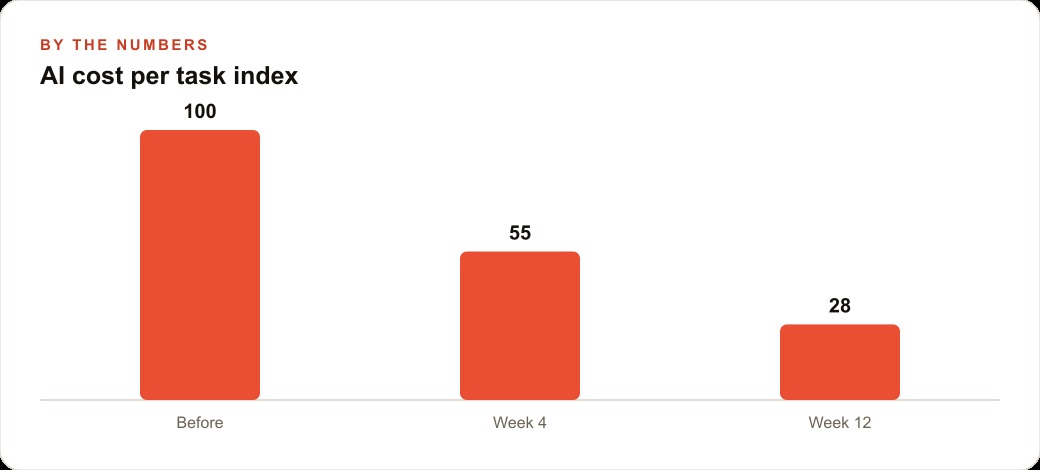
For a business managing Google Ads and needing frequent ad copy variations, the same routing logic produces meaningful savings at scale. The volume of routine copy tasks makes the per-token cost meaningful. A two to five times cost reduction on that volume is a real budget impact.
The practical move for a business making a model choice today
The practical response to this landscape is to make the model selection based on task requirements rather than brand and to build the decision into an explicit process rather than leaving it as a default.
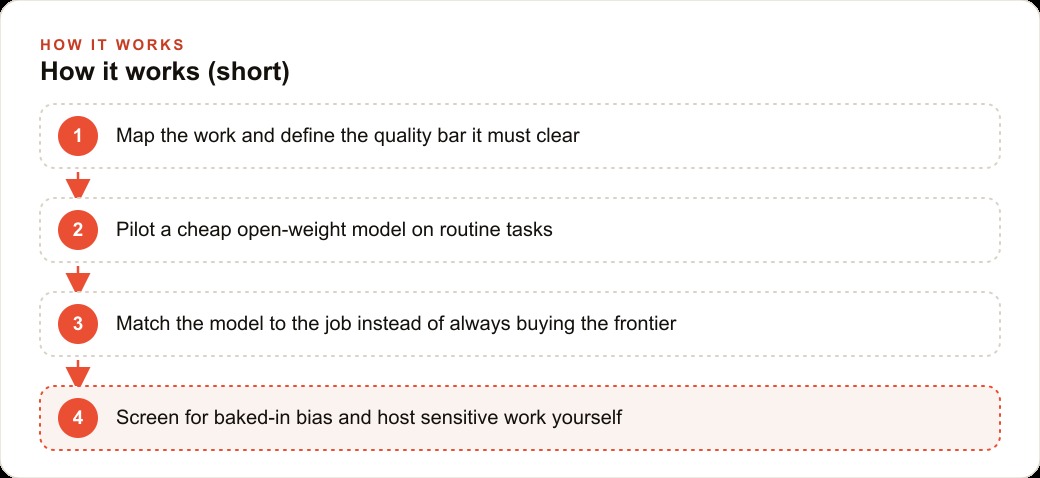
The process starts with mapping the actual work that will go to an AI system. For each task category, define the quality bar it must clear. What does a good output look like? What does an unacceptable output look like? That definition, written down, is the evaluation criterion for any model.
Next, test the cheapest capable option against that bar before assuming the frontier model is necessary. Most organizations discover that eighty percent of their AI tasks are handled adequately by a model that costs a fraction of their current spend. That finding changes the procurement decision.
For SEO content and web copy work that runs at scale, the cost difference between a frontier model and a capable cheaper alternative compounds quickly. A thousand content pieces at five cents per piece versus fifty cents per piece is a four hundred and fifty dollar difference on that batch alone. The quality bar for web copy does not require the most expensive model on the market.
For any business managing client relationships and operations through a CRM and website stack, the AI tasks that touch that system, drafting follow-ups, categorizing leads, generating summaries, are almost entirely in the routine category. The model selection for those tasks should be based on cost per task at the required quality, not on which model tops the leaderboard for tasks the business never performs.
The geopolitical concern about Chinese open-weight models is worth taking seriously for businesses that handle sensitive data, operate in regulated industries, or have government clients with specific procurement requirements. For everyone else, the practical instruction is to self-host if you want full control, evaluate the output quality on your actual tasks rather than benchmarks, and make the cost reduction available to reinvest in the parts of the business where human judgment matters more than model capability. That is a more durable AI strategy than brand loyalty to whichever lab had the best press release last month.
That is exactly what we do at AI DOERS. Book a private 30-minute call with Madhuranjan Kumar and we will map the fastest path to it for your specific business.
Book your call →
Madhuranjan Kumar
Madhuranjan Kumar brings 20 years of performance-marketing experience and has managed over $200 million in Facebook ad spend for brands across the United States and beyond. His expertise spans the full modern marketing stack: Meta, Google Ads, TikTok, email automation, CRM, and the websites that hold it together. At AI DOERS he turns that track record into lead-generation systems for businesses across every industry.