
Why Top LLMs Still Fail the ARC-AGI Puzzle Challenge
Top models stumble on ARC-AGI because the puzzles are deliberately novel, so the benchmark tests adaptation rather than memorized recall. The methods that close the gap, structured prompting, agent loops, and active inference, are the same patterns that make AI safe to trust on new problems.

Show a person a small colored grid and the same grid transformed beside it, and most of the time they work out the rule in seconds and apply it to a fresh case. Show the same puzzle to a frontier language model and it often falls apart. That gap, roughly eighty-four percent for average humans against far lower scores for the strongest AI systems, is the entire point of the ARC-AGI benchmark, and it is the single clearest way I know to answer the question every business eventually asks: is this thing actually reasoning, or is it a very good autocomplete? Pulling that gap apart tells you exactly where AI will quietly fail on your work, and what to do about it.
The puzzle a child solves and a frontier model fumbles
ARC-AGI was introduced in 2019 in a paper on measuring intelligence, and its design is deliberately hostile to memorization. Each task is a colored grid that requires no prior knowledge, only the ability to generalize from one or two examples. The framing behind it is worth sitting with: intelligence is what you use when you do not know what to do. That sentence belongs next to every AI deployment decision, because it names precisely the situation where models break, and it is a situation that looks nothing like the polished demos that get businesses excited in the first place.
The reason a plain model call struggles is structural, not a bug to be patched. A large language model predicts the next token from probabilities learned across enormous amounts of text, and it answers most logic and math questions by recognizing the shape of problems it has seen before. ARC removes that crutch on purpose by guaranteeing every puzzle is novel and out of every training set. Strip away the ability to recall, and what is left is the ability to adapt, which is exactly what the benchmark isolates and measures.
Why memory looks like intelligence until the task is new
This is the facet that matters most for business, because it explains a failure mode that is invisible right up until it costs money. Strong recall and genuine adaptation feel identical when the inputs resemble the training data. A model that has effectively seen thousands of examples of a problem type will answer confidently and correctly, and it is easy to conclude the system reasons well. Then a genuinely new case arrives, one that does not match anything in its experience, and the same confident tone produces a wrong answer. The confidence never wavered. The reliability did.
Every business runs into novel cases constantly without labeling them as such. Every unusual customer complaint, every edge-case transaction, every contract clause phrased in a way the firm has not seen before is, by definition, a novel puzzle for the model. If your AI performs beautifully on the familiar and breaks on the unfamiliar, you do not find out on the easy cases that dominate day-to-day volume. You find out when the cost arrives and someone asks why the system missed it. ARC-AGI is a controlled way to see that failure before it reaches production, which is why it deserves more attention than a leaderboard usually gets.
The score gap is a map of where models still recall
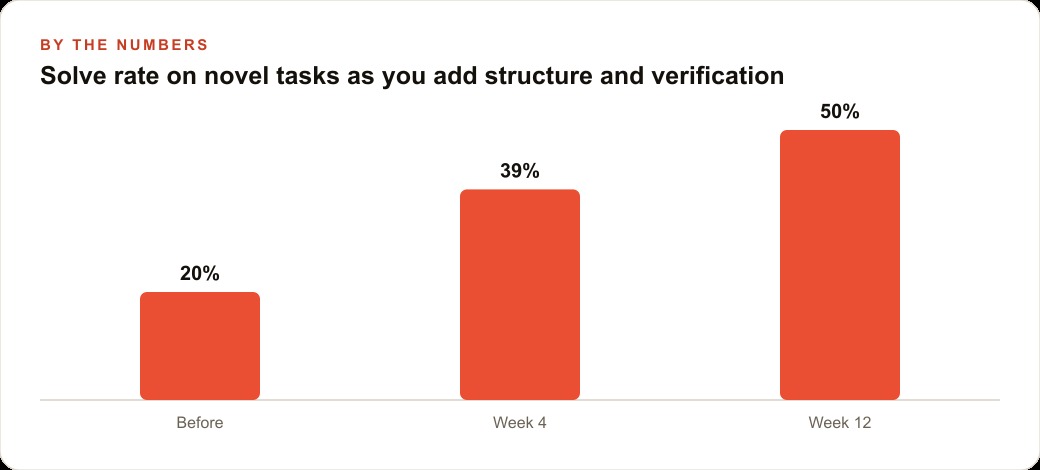
The numbers tell a story of real progress that still leaves a large gap. In 2020 the best AI system solved about twenty percent of tasks. By mid-2024 the best reached roughly thirty-nine percent. One research approach using discrete program search pushed to around fifty percent under certain conditions, though at compute costs that are impractical outside a lab. Average humans sit at eighty-four percent, which is also the contest target. The headline is not the specific percentage. It is that a wide zone still exists where models recall rather than reason, and that zone is exactly where your hardest business problems live, because your hardest problems are the ones that do not look like anything you have handled before.
The seriousness of the problem is underlined by a one-million-dollar prize pool on Kaggle, where anyone can submit predictions against the public test set. When that level of public investment targets a specific failure mode, the sensible move is to understand it in depth rather than assume your particular deployment is somehow exempt. Most deployments are not exempt. They simply have not met their novel case yet.
Structure is the lever: splitting identify from solve
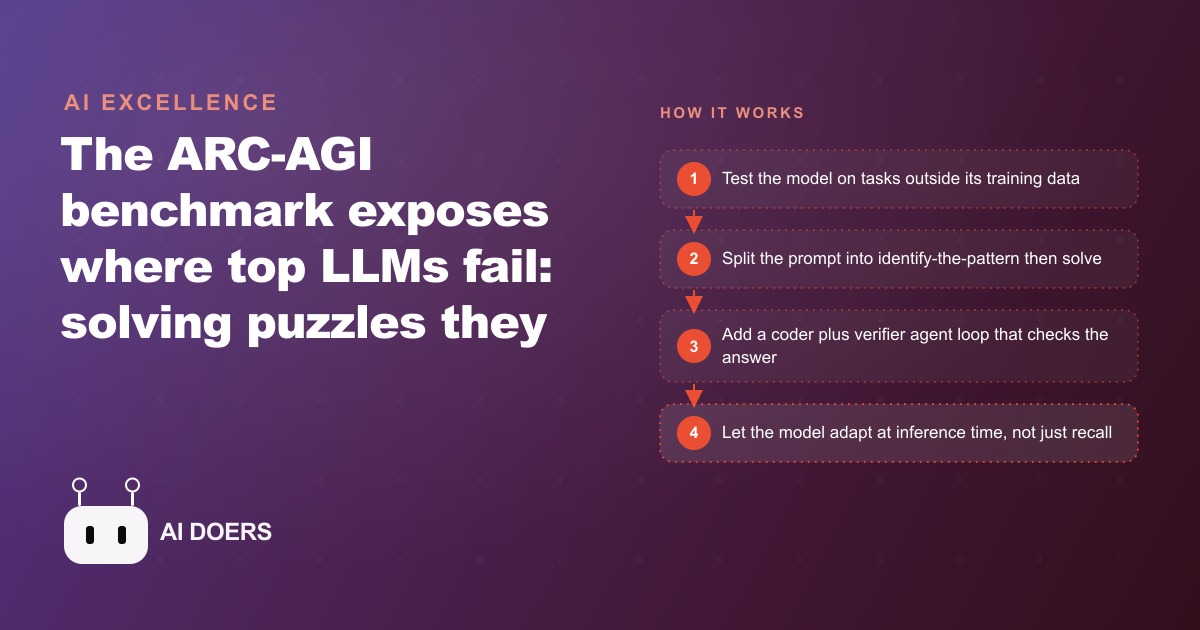
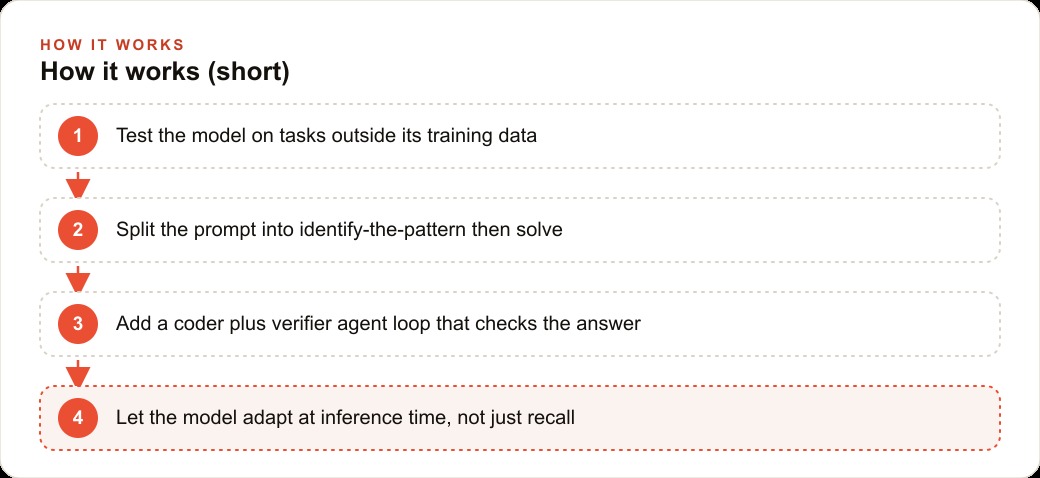
Here is where the explainer turns useful, because the research points at concrete methods that close the gap, and each one maps onto how a careful business should deploy AI. The first is two-step prompting. Instead of one combined request, split the task into two: first identify the pattern, then solve the problem. A plain model call in testing solved the first sample task and then got the next one wrong on both shape and color, because a single call forces the model to plan and execute in the same breath. Separating the steps made models stop skipping rules they would otherwise gloss over, and the improvement is large relative to how little effort the change takes.
The value of the split is not only accuracy. It is that the identify step produces a reasoning trace you can inspect before anything acts on it. When the model states the pattern it thinks it sees, a human gets a natural checkpoint to catch a bad read before it becomes a bad decision. That inspectability is worth as much as the raw score improvement, especially anywhere the cost of a confident error is high.
Verification is the safety net: the coder and the checker
The second method is a multi-agent loop, and it is the most transferable idea in the whole benchmark. One agent writes a small transformation program. A second agent runs it against the known examples. When the output does not match, the failure feeds back and the first agent tries again. That internal cycle proved more reliable than asking a single model to plan and execute in one pass, because it forces the system to check its own work rather than committing to its first answer. The related discrete-program-search approach takes the same principle further, generating three to five thousand candidate programs, keeping the best dozen, and verifying them, which is how it reached around fifty percent.
You do not need thousands of candidates to use this. The underlying principle, generate a solution and then verify it against your real criteria before trusting it, is practical at any scale. A single checker agent that reviews the first agent's reasoning against your written rules is the highest-leverage reliability upgrade available, and it costs a tiny fraction of what a single missed error costs in a regulated context. The same pattern protects work well outside puzzles, from a model scoring leads in your CRM and website stack to one flagging anomalies in a ledger.
Adaptation at runtime is the real unlock
The most powerful method in the research is active inference: fine-tuning the model on the specific task at evaluation time, using the small set of examples in front of it, so it genuinely learns from the new situation rather than relying entirely on past training. Frozen models do not update the way people do. When the system can adapt at runtime from a handful of fresh examples, performance on novel cases improves substantially. This is the deepest lesson of the benchmark, because it names the exact difference between a system that recalls and a system that adapts, and it shows that the difference is addressable rather than fundamental.
You will not fine-tune a model mid-task in most business settings, but the softer version of this is available to everyone and closes a meaningful portion of the gap: give the model the few relevant examples in the moment, at inference time, rather than assuming what it absorbed in training covers the case. Even a small amount of task-specific context provided right when the decision is made changes the quality of the output on genuinely new inputs. That is active inference in spirit, and it is free to apply.
A worked example: anomaly detection at an accounting firm
Put all of this together for an accounting firm that wants AI to flag unusual transactions before a human reviewer sees them, with illustrative numbers. The dangerous cases are exactly the novel ones: new vendor relationships, unusual payment structures, first-time currency combinations, and fraud patterns the firm has not encountered. A single direct model call is the worst possible architecture here, because one call cannot separate pattern recognition from decision-making and leaves no audit trail.
Step one splits the task. The first prompt takes a transaction and asks only what rule or pattern it might break, given three historical examples of anomalies the firm has flagged, and it produces a reasoning trace rather than a decision. The second prompt takes that analysis and asks, given the identified pattern and the firm's compliance rules, what action to recommend. Two focused steps produce far clearer reasoning than one, and the split creates a checkpoint where a human can intervene. Step two adds the verifier: once the first pass produces a flag, a second agent checks the reasoning independently against the firm's written criteria before anything reaches a reviewer, mirroring the coder-checker loop and catching confident-but-wrong reads while documenting a trail for every flag.
Step three is the stress test. Before touching live data, run the system against five to eight transactions specifically invented to be unlike anything in the history. If it only flags anomalies that resemble past examples, it is recalling, not reasoning, and those categories stay with a human. Step four is a parallel run of four to six weeks alongside the existing review, tracking three numbers: false positive rate, false negative rate, and the time reviewers spend reconsidering AI flags. If the structured loop produces fewer overturns than a direct call would, that is the evidence the model is reasoning rather than pattern-matching, and it becomes the case for expanding coverage. On the money, the model call itself costs fractions of a cent per transaction, while the real investment is the three to five weeks of groundwork defining rules and organizing examples. Framed simply, if the cost of one missed edge-case error in a year exceeds the cost of building the loop, the math is obvious. The same reasoning discipline scales beyond finance, from a marketing team reading early signals off a new run of Facebook and Instagram ad campaigns to an operations team routing around an unusual disruption.
The one habit that separates trust from the appearance of trust
The through-line of the entire benchmark is a single discipline: test the model where it will actually face the unfamiliar, not on the easy cases that make it look reliable. The costly mistakes cluster in four places. Trusting performance on familiar examples and assuming it holds on novel ones, which is exactly what ARC was built to disprove. Skipping the verifier, which turns a single agent into a single point of failure. Treating data quality as someone else's problem, because the identify step is only as good as the examples you feed it, and a verifier working from the same contaminated examples will not catch structural noise. And skipping the stress test, which is the one step that tells you where a human still needs to stay in the loop before a wrong answer reaches a real decision.
Do those four things and you have a deployment you can genuinely trust, not one that merely looks trustworthy until its first novel case. The methods that close the ARC gap, structured prompting, a verification loop, and adaptation from fresh examples at decision time, are the same patterns that make AI safe to point at new problems, and they carry over to any content or analysis workflow that also feeds SEO and organic search. You can build much of this yourself with careful scoping and patient stress-testing. If you would rather have someone design the identify-solve-verify workflow, stress-test it against the cases that actually break models, and tell you honestly where a human still needs to stay in the loop, that is exactly the kind of work I do for clients, and you can bring me in to handle it.
That is exactly what we do at AI DOERS. Book a private 30-minute call with Madhuranjan Kumar and we will map the fastest path to it for your specific business.
Book your call →
Madhuranjan Kumar
Madhuranjan Kumar brings 20 years of performance-marketing experience and has managed over $200 million in Facebook ad spend for brands across the United States and beyond. His expertise spans the full modern marketing stack: Meta, Google Ads, TikTok, email automation, CRM, and the websites that hold it together. At AI DOERS he turns that track record into lead-generation systems for businesses across every industry.