
Why the Pace of AI, Not Any Single Launch, Is the Real Story
The biggest signal in AI is the rate of change itself. Capabilities arrive early, agents move from demo to real work, and costs fall, so the smart move is to track capability over hype and build for the next model, not today's.

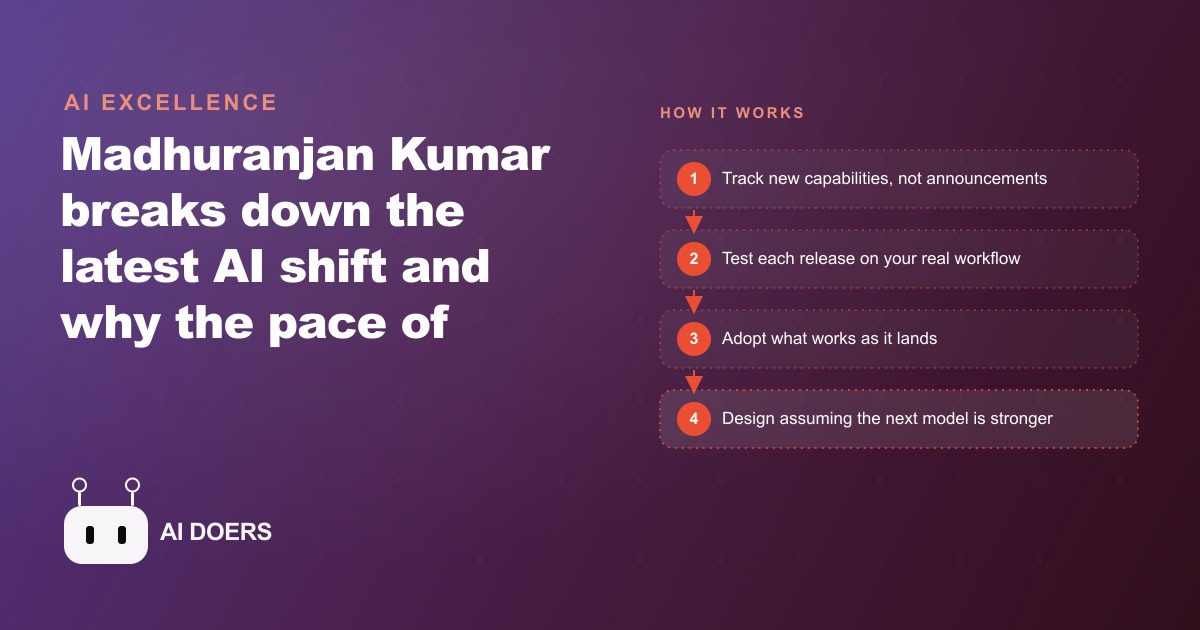
Every month another batch of AI capabilities arrives ahead of schedule and every month a different set of businesses discovers that the thing they were waiting to become real already happened quietly while they were watching. I am Madhuranjan Kumar, and the most important thing happening in AI right now is not any specific product release. It is the rate at which these releases keep compressing the timeline between "this is theoretically possible" and "this is deployed in production." That compression is the real story, and missing it is the real risk.
The big story in AI right now is not a product, it is a rate of change that keeps compounding
In the past 18 months: text-to-image quality crossed the threshold where generated images are indistinguishable from photography to most viewers. Text-to-video went from 4-second clips with obvious motion artifacts to 10-second clips with physical accuracy good enough for professional b-roll. Code generation went from autocomplete assistance to multi-file application scaffolding with working tests. Reasoning capability on complex multi-step problems improved by a factor that AI researchers describe as equivalent to a decade of human research compressed into a single year.
Each of these improvements would have been a headline-defining moment if it had arrived in isolation with a five-year lead time. Instead they arrived in rapid succession, often without major announcements, often by being quietly included in a model version update that most users did not notice until they accidentally used a capability they did not expect to have.
The businesses that are being repositioned by AI are not the ones that had the most advanced AI strategy two years ago. They are the ones with the most adaptive operating culture: the ones where the team actually tries new tools, builds small tests, and incorporates what works into standard operations. The strategic advantage in AI right now is not a technology advantage. It is a learning velocity advantage. The businesses that learn faster, test faster, and incorporate faster are compounding their advantage every month, while the businesses waiting for a clear signal to act are watching the gap widen.
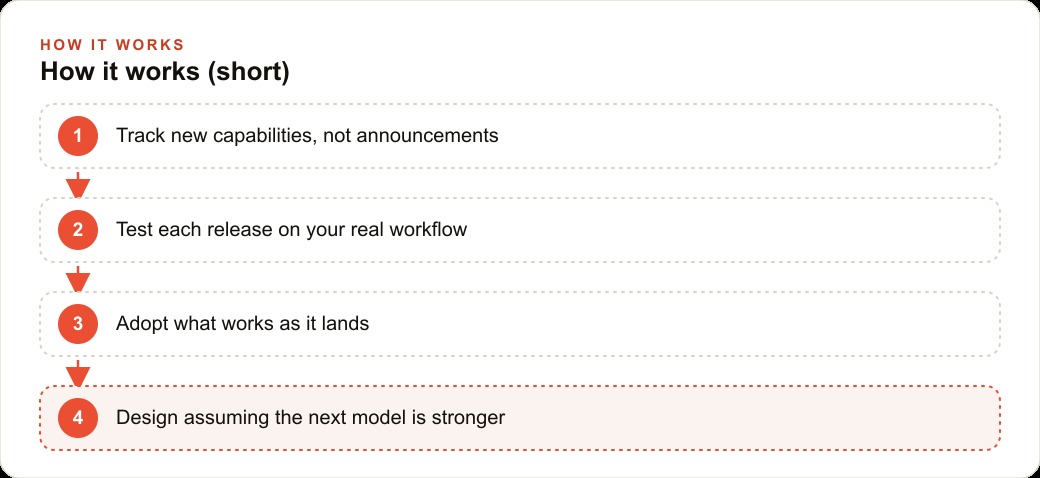
Agents crossed from demo territory into multi-step real work this year and most businesses missed it
There was a clear moment when AI agents crossed from demonstrations into real production work, and most businesses did not notice it when it happened. The demos had been going on for years: AI that could theoretically browse the web, run code, manage files, and chain multiple tasks together. The demos were impressive. The production deployments were fragile.
That changed this year. The specific improvements that made the difference were not model intelligence in the abstract. They were tool call reliability, error recovery, and context persistence. A demo agent fails gracefully and the demo moves on. A production agent encounters an error at step four of an eight-step process and needs to recover without losing the context of steps one through three, log the failure clearly enough that a human can understand what happened, and either complete the remaining steps or stop cleanly and request intervention.
These properties are mundane compared to headline capabilities like reasoning about complex problems. But they are what make the difference between an agent you can trust with a real task and one you have to supervise constantly. The reliability improvements that arrived in production models this year, across both the frontier closed-source models and the leading open-weight options, crossed a threshold where agents handling multi-step real work is no longer a statement about what AI might eventually do. It is a statement about what AI is currently doing in production deployments at businesses that are paying attention.
The businesses that missed this transition are not unintelligent. They were applying a sensible heuristic from previous years: wait until the technology is proven. In previous technology cycles, that heuristic was correct. The proof period took years and early adopters paid a high price for unreliability. In the current AI cycle, the proof period is compressing to months. The heuristic that protected businesses from premature investment in earlier cycles is now causing them to miss windows that close faster than the heuristic was built to handle.
Falling token cost plus rising capability is the specific combination that opens new use cases
The rate of change in AI capability gets most of the attention. The rate of change in AI cost gets less, and it is the combination of the two that opens entirely new use cases rather than just improving existing ones.
Token costs for frontier models have fallen by roughly 80 percent in the past 18 months for comparable capability. Tasks that were economically viable only for large enterprises with significant AI budgets 18 months ago are now viable for small businesses with $50 per month in API spend. The specific implication is not just that existing AI use cases are cheaper. It is that use cases which were not viable at higher costs become viable at current costs, and the set of newly viable use cases is larger than the set of already-viable use cases.
An example: 18 months ago, running AI-powered personalization on every customer email a small e-commerce brand sends, where the email copy is dynamically generated based on the customer's purchase history, browse behavior, and lifetime value segment, cost approximately $0.08 to $0.12 per email generated. For a brand sending 10,000 emails per week, that was $800 to $1,200 per week in AI inference costs on top of email platform costs. Not viable for most small brands.
At current frontier model pricing, the same personalization workflow costs $0.012 to $0.025 per email. For the same 10,000-email weekly send, that is $120 to $250 per week. Still a real cost, but now within range for a mid-size e-commerce brand if the personalization delivers even a modest improvement in open rate or conversion. The capability did not change. The cost did. And the cost change opened a use case that was previously closed.
This pattern is repeating across hundreds of business workflows. The correct question to ask about any AI capability you dismissed 12 to 18 months ago because it was too expensive is not "is it technically possible now?" It almost certainly is. The correct question is "does the current cost make it viable in my specific context?" Answer that question quarterly, not annually.
Open-weight models are closing the frontier gap faster than almost anyone expected
Twelve months ago, the consensus view among AI researchers and practitioners was that open-weight models, models whose weights are publicly released and can be run locally or on self-hosted infrastructure, were roughly two generations behind the closed-source frontier models from OpenAI, Anthropic, and Google. On most tasks that matter for business use, the closed-source models produced noticeably better outputs, especially on complex reasoning, code generation, and instruction following.
That gap has closed faster than almost anyone predicted. DeepSeek released V3 and then R1 in rapid succession, both of which perform at or near frontier-model levels on a wide range of benchmarks while being open-weight and dramatically less expensive to run. Meta's Llama series has continued to improve. Mistral has released models that perform significantly better than their parameter count would historically have predicted. The frontier is no longer a moat that only three companies can access.
For businesses, the practical implication is infrastructure choice. A business that runs its own AI-powered workflows on open-weight models hosted on a cloud GPU instance or on-premise hardware pays no per-token costs after the infrastructure investment. For high-volume workflows, this cost structure becomes dramatically more attractive than per-token pricing, especially as the capability gap between open-weight and closed-source continues to narrow.
The more important implication is for businesses building proprietary data advantages. Running an open-weight model on your own infrastructure means your data does not leave your systems. For a law firm, a medical practice, a financial advisory firm, or any business handling sensitive client information, this is not just a cost consideration. It is a compliance and liability consideration that previously would have required a significant enterprise AI investment. Current open-weight models make local deployment viable for businesses that could not have considered it 18 months ago.
A benchmark score is not a capability shift, your actual workflow is the only test that matters
Every major model release arrives with a benchmark announcement. MMLU scores, HumanEval scores, MATH benchmark scores, GPQA scores. These benchmarks measure specific capabilities on specific tasks in specific conditions. They are useful for comparing models against each other in a controlled setting. They are not useful for predicting whether a given model will improve a specific business workflow.
I have made this mistake myself: reading a benchmark announcement, concluding that a new model would be substantially better at a task I needed help with, and being surprised when the real-world performance in my specific context was similar to the previous model. I have also been surprised in the other direction: treating a model as inadequate based on benchmark comparisons and then discovering it performed excellently on the exact task I needed.
The only test that matters for a business decision is a test on your actual workflow with your actual data. Take the specific task you are evaluating AI for. Define a set of 20 to 30 representative examples with known good outputs. Run each candidate model on those examples. Score the outputs against the known good outputs using criteria specific to your workflow. Make the decision based on those results.
This sounds obvious. Most businesses do not do it. They read the benchmark announcement, form a view, and either adopt or reject the model without a workflow-specific test. The businesses that run workflow-specific tests before deployment avoid the two categories of errors: deploying a high-benchmark model that performs poorly on their specific task, and rejecting a modest-benchmark model that would have worked well.
The rate of AI capability change makes this discipline more important, not less. As models improve quickly, the competitive landscape of options for any specific workflow changes quarterly. Running workflow-specific tests quarterly, not just at the initial adoption decision, keeps your AI stack current without requiring you to track every benchmark announcement or switch models on every release cycle.
The HVAC company that moves this quarter is not in the same race in twelve months
I want to be specific about what compounding capability advantage looks like in a concrete business context, because the abstract discussion of AI rates of change is easier to defer than a concrete example.
An HVAC company that serves residential customers in a competitive metro market has a specific high-value problem: after-hours inquiries. Roughly 40 percent of customers who need HVAC service call after hours or on weekends when the office is closed. The conversion rate on after-hours inquiries is historically low because response time is slow, response quality is inconsistent, and competitors who respond faster get the appointment.
An HVAC company that wired AI into its after-hours inquiry handling this quarter is doing something specific: every after-hours inquiry received by web form or voicemail triggers an AI response within three minutes that confirms receipt, asks three qualifying questions about the nature of the problem and the customer's availability, and books a preliminary appointment in the scheduling system pending technician confirmation. The same AI response system follows up the next morning with appointment confirmation and prep instructions.
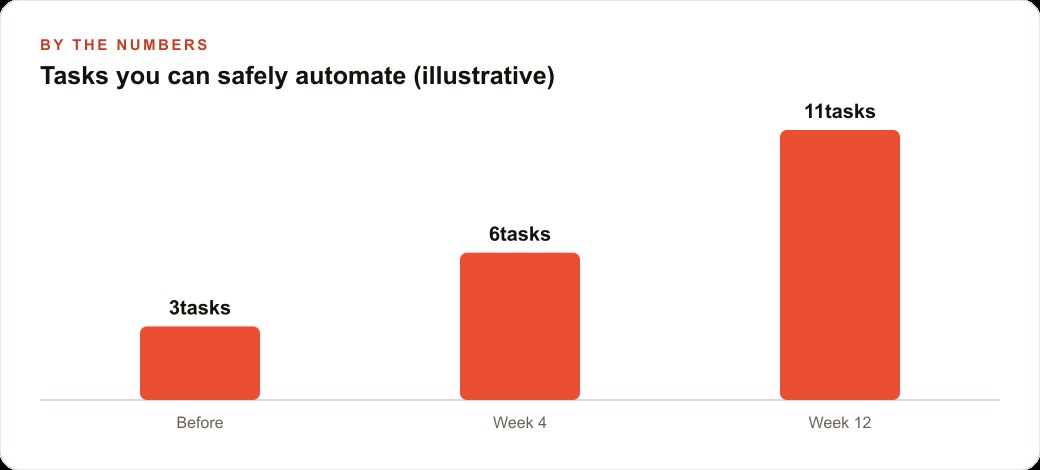
I will give you the illustrative numbers based on what I have seen implemented. Before: 40 after-hours inquiries per week, average response time 14 hours (next morning), close rate on those inquiries 22 percent, resulting in roughly 9 jobs per week from after-hours contact. After AI response: average response time 3 minutes, close rate on those inquiries improved to 37 to 40 percent, resulting in 15 to 16 jobs per week from the same inquiry volume. Over a busy season of 20 weeks, the difference is 120 to 140 additional jobs. At an average job value of $400 to $600, that is $48,000 to $84,000 in additional revenue from a single workflow change.
The company that implemented this in Q1 of this year has now spent nine months calibrating the response system: which questions to ask for which inquiry types, which response tone produces the highest engagement, which follow-up timing maximizes conversion. The competitor that starts the same implementation next year is nine months behind on that calibration. The gap is not just the workflow. It is the accumulated knowledge about how the workflow performs that compounds every month it runs.
Every capability improvement I described earlier, falling token costs, more reliable agents, better open-weight models, improved prompt adherence in generation tools, each one makes the HVAC company's AI workflow cheaper to run, more reliable in production, and more capable of handling edge cases. The company that built the workflow earlier benefits from every improvement automatically. The company that waits starts the compounding from a later date. That gap does not stay constant. It widens.
That is exactly what we do at AI DOERS. Book a private 30-minute call with Madhuranjan Kumar and we will map the fastest path to it for your specific business.
Book your call →
Madhuranjan Kumar
Madhuranjan Kumar brings 20 years of performance-marketing experience and has managed over $200 million in Facebook ad spend for brands across the United States and beyond. His expertise spans the full modern marketing stack: Meta, Google Ads, TikTok, email automation, CRM, and the websites that hold it together. At AI DOERS he turns that track record into lead-generation systems for businesses across every industry.