
Why a Media Founder Bet Everything on AI Transformation
An AI transformation firm grew like a rocket ship by being honest about the hard part. Around 80 percent of what executives ask for is plain software, most project time goes to data prerequisites, and the only moat that does not trend to zero is training humans to actually adopt the tools.

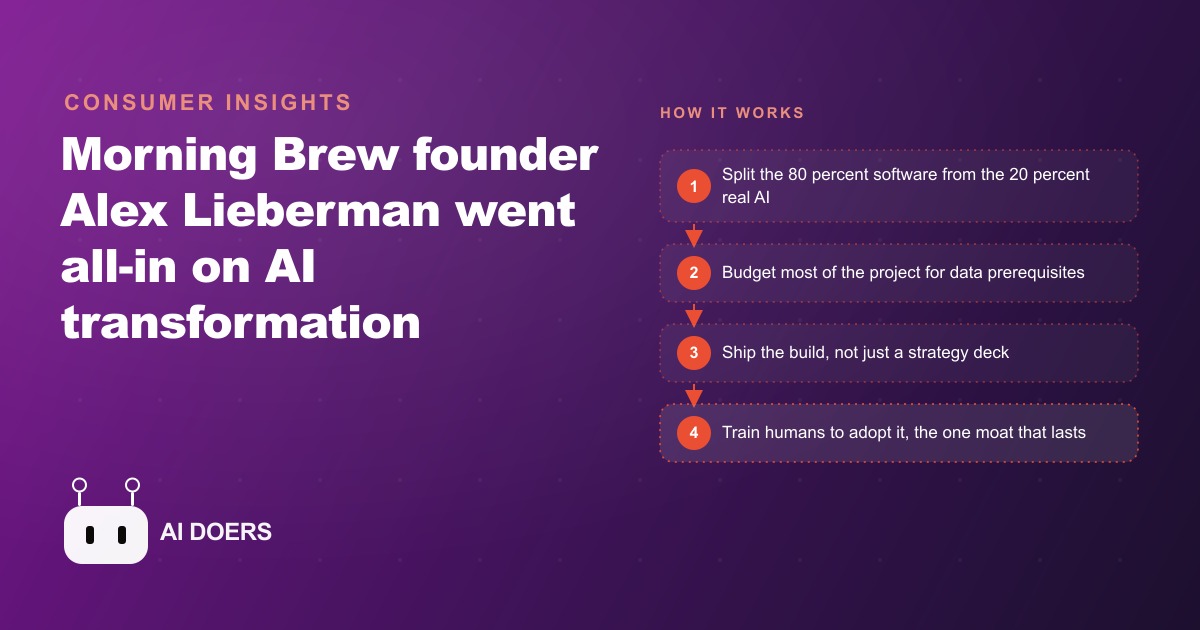
A media founder who sold a well-known newsletter company planned to run a venture studio, then watched one of his bets, an AI transformation firm, grow like a rocket ship from sheer market pull and went all-in on it instead. That is a familiar startup arc. The part worth paying attention to is why the firm grew, because the reason cuts against almost everything the AI sales conversation tells you. His pitch is not that AI is magic. It is that the hard part is almost never the technology, it is human adoption, and roughly eighty percent of what executives ask for is not even AI. That honesty is the whole story, and it changes how any established business, a law firm very much included, should approach the AI vendors lining up at the door.
Most of what executives call AI is just software
Here is the claim that reorders everything. When executives list their AI use cases, about eighty percent turns out to be traditional software and only about twenty percent genuinely needs generative AI. That is not a knock on AI. It shows how much ordinary software can still do, and it exposes the real ceiling, which is human creativity. People struggle to imagine outside the box that legacy systems built around them decades ago, so they label every improvement AI when most of it is a well-built system with clean data. Surfacing that split early in an engagement is itself valuable, because it points the budget at what will actually create leverage instead of a headline.
Why this matters right now is that every established business is being approached by AI vendors, consultants, and internal champions insisting transformation is urgent, and most of those conversations start in the wrong place. They start with the AI. The honest starting point is the data and the eighty-twenty reality, and a firm that names that order of operations up front is rare. That rarity is precisely what separated the rocket-ship firm from the crowd, and it is the filter you should apply the next time someone pitches you an AI project.
The one API call sits on two months of plumbing
The shape of a real project is the second thing the news reveals, and it is nothing like the demo. The impressive AI-ification is often a single API call, one line of code that makes jaws drop in a room. Underneath it sits roughly two months of building a data pipeline so the data is clean enough for that one call to work reliably. Every client recommendation carries a large prerequisites section, and the team spends about seventy percent of its time on that unglamorous groundwork before any AI magic can land. A real part of the value is simply holding up a mirror and showing a business how weak its data foundations actually are, because most organizations have never audited that honestly.
This matters to a buyer because it tells you where a project actually succeeds or fails. If a vendor's pitch is all about the model and silent on the data, the pitch is describing the last five percent and hiding the seventy percent. The firms that ship working systems are the ones that budget for the plumbing, and the ones that leave a graveyard of dead pilots are the ones that skipped it. There is also a candid admission baked into the model worth respecting: the AI label is partly a Trojan horse, the sizzle that gets executives interested and the recruiting magnet that attracts elite engineers the firm otherwise could not hire. That honesty is a strength, because it means the work is built on a realistic understanding of why clients buy rather than a flattering story that collapses when the prerequisites take longer than the slide suggested.
Training humans is the only moat that does not trend to zero
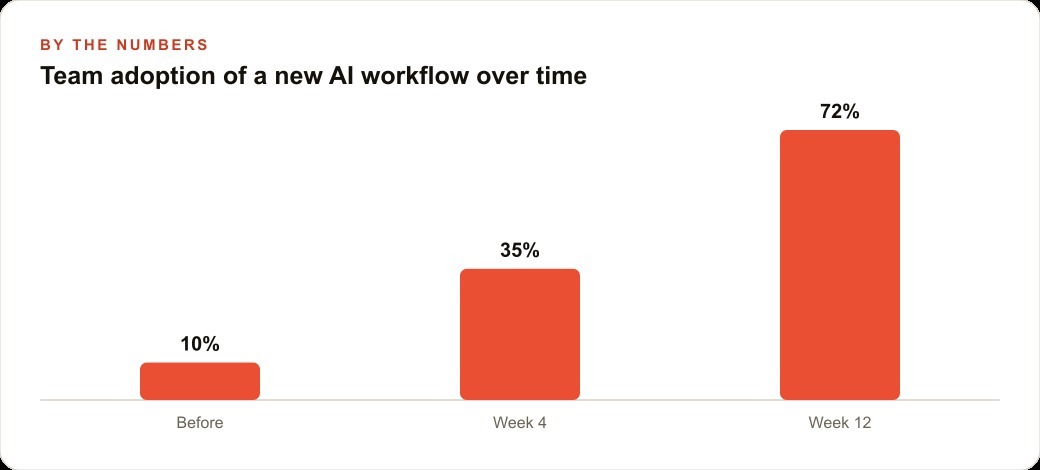
The most important line in the whole story is a claim about durability. Software development trends toward zero as coding tools improve, and even consulting strategy can be partially automated, but training humans to adopt and actually use a new system does not trend to zero. That is the last real moat. Mid-market companies doing serious revenue can still be running on-premises servers and spreadsheets, which tells you adoption moves only as fast as people will change their behavior. You can hand a team a flawless system and watch it sit idle six months later if no one trained them to trust it in the right places and distrust it in the wrong ones.
For any business, not just a firm selling AI services, this reframes where the effort belongs. The build is becoming the cheap part. The adoption is the expensive, durable, human part, and it is where a project either creates value or quietly dies. This is the same reason the leads and records already sitting in a firm's CRM and website stack are only worth what the team's habits make them worth: the tooling is necessary, but the behavior around it is what actually moves the number.
Recurring revenue over ad money is the business-model tell
There is a business-model lesson in the news that is portable to any service business. The firm deliberately avoided advertising revenue, where a strong hundred-million-dollar year can reset to a fraction of that the next when advertisers pull back, and chose recurring revenue instead: engineering as a service with twelve-month contracts and client relationships that run five to ten years. That structure changes every decision, from hiring to pricing to how scope changes get handled, because the long relationship is the asset rather than the individual project. A monetization spectrum runs from taking cash to build a thing, to a middle position that shares the upside, to co-owning the outcome and carrying the full risk and reward, and any service business can choose where to sit on purpose instead of landing somewhere by accident. The competitive backdrop makes the timing pointed: the number of AI transformation firms doing meaningful revenue could expand dramatically in the next year, most of them specializing by vertical, because no decision-maker gets fired for hiring the firm that has solved this exact problem in this exact industry before.
The concrete move: run the eighty-twenty audit on a law firm
Translate all of this into a specific play for a law firm, with illustrative numbers. Partners often arrive with a vision of an AI that reviews contracts, predicts outcomes, and surfaces precedent before anyone asks. That vision is real in principle and requires far more groundwork than the demo suggests. The first move is the eighty-twenty audit. Sit with the partners and associates and sort every task they want AI to help with into two piles: fundamentally a software problem, or genuinely needing generative AI. The software pile includes document organization, intake-form processing, searchable template libraries, time-entry summarization, and deadline tracking, none of which need a language model, only a well-built system with clean data. The generative pile includes drafting first-pass clause summaries, identifying unusual provisions in a new contract type, summarizing a deposition for a busy partner, and generating initial research memos. This split alone prevents the firm from funding a moonshot when what it needs is organized infrastructure.
The second move is the prerequisites inventory. For each item in the generative pile, document what the model needs to do the task reliably: what data, in what format, how current. A contract-summary tool only works if the firm's contracts are digitized, named consistently, and stored where the model can reach them, and most firms discover in this step that their document management is not where they assumed. The third move is building in the right order, sequencing the work so the software infrastructure comes before the AI layer, which means the first two to three months of a twelve-month engagement look like unglamorous data work, and the AI demo lands far better later because the groundwork is done. The fourth move treats training as the deliverable, not an afterthought: every attorney and paralegal needs a clear mental model of what the system does well and where it makes confident-sounding errors, because the firm that trains for that distinction uses the system correctly and the firm that assumes people will figure it out finds the tool abandoned within months. The fifth move structures the relationship as recurring, reviewing and expanding quarterly, assessing new practice areas against the same eighty-twenty framework and evaluating new models against the firm's actual use cases rather than benchmark scores.
Put rough numbers on the return. Building the software infrastructure and data prerequisites for a single high-value workflow typically takes eight to twelve weeks, most of it groundwork rather than the AI call, which is cheap. If associates can produce a first-pass contract summary in minutes rather than hours, partners review faster, clients get answers faster, and the firm handles more matters without adding headcount at the same rate, while a model that consistently checks for unusual provisions catches things a tired associate might miss before a filing deadline. A mid-size firm where associates lose a meaningful slice of each week to work the software and AI layer could carry is paying highly trained people to do tasks that cost a fraction of their hourly rate to automate, so the value is not replacing lawyers, it is redirecting billed hours toward judgment and relationship work. That efficiency also frees capacity to invest in growth channels the firm has neglected, whether that is content that improves SEO and organic search or targeted Facebook and Instagram ad campaigns for a specific practice area.
The mistakes that kill these projects
The failures cluster in four predictable places. The first is starting with the AI before auditing the data, which drops a language model onto poorly organized repositories and produces confident answers that are wrong because the model is reasoning over inconsistent information. The eighty-twenty audit and the prerequisites inventory exist to prevent exactly this. The second is treating the AI call as the deliverable when the real deliverable is a workflow people actually use, because a polished demo that never gets adopted is not an implementation, and training, change management, and a clear mental model of where the system can be trusted are what decide whether the build creates value or sits idle.
The third mistake is building a one-time project instead of a recurring relationship, when the tools are changing fast enough that an implementation designed for today's capabilities will need revisiting within six to twelve months. The fourth is letting the AI label set the scope, walking in as an AI transformation partner when the honest work is often more software engineering and data organization than model prompting. Being upfront about that ratio is what builds the trust that makes a five-year relationship possible, and it is the same trust that separates a vendor worth hiring from one selling sizzle.
What to do about it
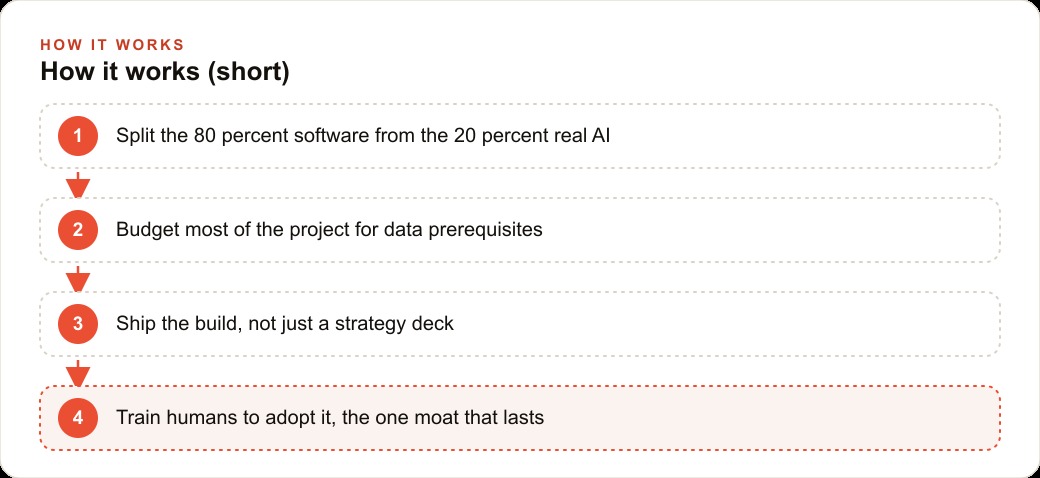
The takeaway for any business owner is to invert the usual approach. Sort every AI idea into the software pile and the genuine-AI pile, and expect most of it to land in the software pile, which is fine. Budget most of your time and money for the prerequisites, cleaning and organizing your data and connecting your systems, rather than for the final AI step everyone wants to show off. Treat human training and adoption as the actual deliverable, because that is what determines whether the system gets used at all. Design for a recurring engagement rather than a project that resets every year, and if you are building a service around this, choose a spot on the monetization spectrum on purpose. The news here is not a product you can buy. It is a corrected set of expectations that will save you from funding the twenty percent while ignoring the eighty, and you can run this sequencing yourself if you stay disciplined about the split and the order. If you would rather have someone audit your workflow, separate the real AI from the plain software, do the data groundwork, and train your team so the system actually gets adopted and stays in use, that is exactly the kind of work I do for clients, and you can bring me in to handle it.
That is exactly what we do at AI DOERS. Book a private 30-minute call with Madhuranjan Kumar and we will map the fastest path to it for your specific business.
Book your call →
Madhuranjan Kumar
Madhuranjan Kumar brings 20 years of performance-marketing experience and has managed over $200 million in Facebook ad spend for brands across the United States and beyond. His expertise spans the full modern marketing stack: Meta, Google Ads, TikTok, email automation, CRM, and the websites that hold it together. At AI DOERS he turns that track record into lead-generation systems for businesses across every industry.