
Why The Job Market Broke And What Actually Still Works
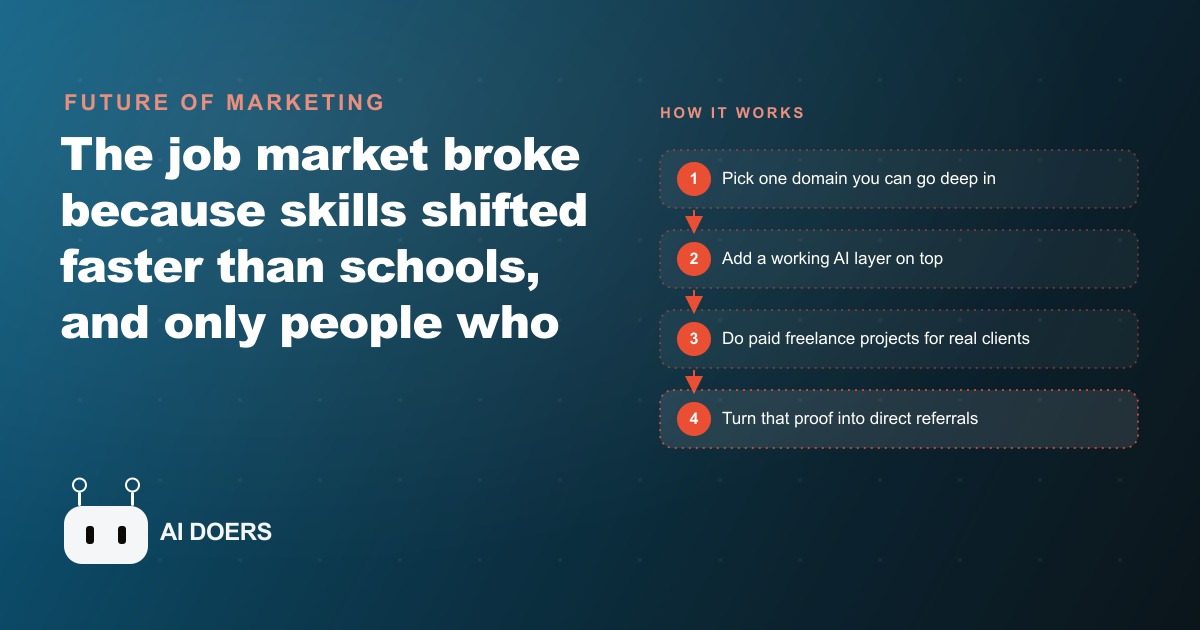
In-demand skills now change faster than schools can teach them, so companies stopped training new hires and hold roles vacant rather than gamble on the unprepared. The people who still win take initiative, prove they can do the work today, and bolt an AI layer onto one real skill.

The Harvard Business School class of 2024 reported 23% unemployment at one point during their graduation year. These are not people who made bad decisions about education. They are people who made the exact decisions the system told them to make, and the system was wrong about what those decisions would produce.
The job market did not break because AI replaced workers. It broke because companies stopped taking development risk on unskilled people, and the people who still win understand they were never entitled to that risk in the first place. That is a harder diagnosis than "AI took the jobs," but it is also a more useful one, because it points to a path forward that does not depend on waiting for companies to change their behavior.
Companies Stopped Paying for the Learning Curve Long Before AI Became a Factor
The World Economic Forum's 2025 Future of Jobs report identifies two forces driving current labor market disruption: the high cost of living and the rise of AI and data technology. The first force is the one that gets less attention. When the cost of hiring and retaining an employee rises, every hiring decision carries more financial risk. Companies respond to financial risk the same way they always have: they reduce it by raising the bar. They stopped hiring people who needed onboarding, training, and supervised development time. They started hiring only people who could contribute from week one.
This shift predates the AI wave by at least a decade. Companies across technology, finance, consulting, and marketing began cutting training programs in the 2010s as a cost reduction measure during lean quarters. The programs never came back. What remained was a hiring market that expected experience from candidates who had no mechanism to get that experience without a first employer willing to take the development risk.
The AI narrative obscures this dynamic by providing a convenient explanation that removes corporate agency from the equation. If AI is the reason fresh graduates are not getting hired, then nothing can be done except wait for society to adapt. If companies stopped funding development, then individuals have a set of concrete responses that do not require waiting for anyone else.
McKinsey's 1% Statistic Points to a Different AI Risk Than Most People Are Discussing
McKinsey research indicates that only approximately 1% of companies have a mature AI strategy. The implication is that 99% of companies are still figuring out what AI means for their operations. That should be good news for workers concerned about AI replacement. The practical reality is more complicated.
The perception of AI replacement has already affected hiring decisions at companies that have not yet implemented serious AI systems. A hiring manager who believes AI will handle analytical work within two years makes different hiring decisions today than a manager who does not hold that belief. The speed of perception change outpaces the speed of actual implementation, and workers are caught in the gap. They are competing against an imagined future that has not arrived while the actual tools that could give them a competitive advantage remain underutilized.
McKinsey's data also suggests that the companies investing seriously in AI right now have an opportunity to build durable advantages over the 99% that are not. The businesses making those investments are the businesses that will need employees who can work alongside AI systems effectively. That is a different skill profile than either "tech specialist" or "AI-replaced worker," and it is the profile that the current educational system is not producing at scale.
Tech Degrees Solved a Problem That No Longer Exists
The employment data on technology graduates is counterintuitive and important. Tech graduate unemployment runs approximately 27% higher than the general unemployment rate by some measures. The credential that was supposed to guarantee employment is underperforming the average. The explanation is that a computer science degree in 2026 is solving a problem that existed in 2015: the shortage of people who could write software.
That shortage was addressed through multiple channels simultaneously. Global outsourcing expanded the supply of software labor. Bootcamps produced large cohorts of trained junior developers. AI coding assistants reduced the per-developer productivity floor, meaning existing teams could do more with fewer people. The frameworks and tools that reduced the expertise required to ship functional software became increasingly accessible. The supply of software labor caught up to demand faster than education systems updated their value proposition.
Skills change faster than universities can teach them. A student who entered a computer science program in 2022 and graduated in 2026 studied a curriculum designed when the market needs looked different from what they are today. The degree signals persistence and baseline technical capability. It does not signal current-market relevance.
The T-Shaped Profile Is the Shortest Path to Being Hireable Right Now
Madhuranjan Kumar's analysis of the fastest-growing skills from WEF 2025 data is instructive. AI and big data literacy leads the technical category. Cybersecurity is second. Then the list turns decisively non-technical: resilience, flexibility, leadership, and lifelong learning occupy the top positions in the soft-skills category.
This pattern describes a specific type of professional the market currently values: someone with enough technical depth to work with AI systems, the vertical bar of the T, layered on top of enough operational and leadership capability to direct those systems toward business outcomes, the horizontal bar. Neither piece alone is sufficient. A pure technical specialist who cannot direct their own work toward business value is replaceable by a cheaper technical specialist offshore. A pure generalist who cannot operate any AI tool is losing ground to every competitor who can.
The T-shape is achievable without a new degree. The vertical bar can be built through demonstrated project work in a specific domain. The horizontal bar can be built through any context where decisions with real consequences are made: freelance client management, running a side business, or taking ownership of outcomes in a current role. The combination signals to employers what a degree no longer reliably signals: that the person can produce useful output in today's environment.
Some practitioners talk about an M-shaped profile, where someone manages hybrid workflows that combine human judgment with AI execution across multiple domains. The M-shape is the evolution of the T-shape: it applies the same depth-plus-breadth logic across more than one technical area. It is a more demanding profile to build, but it is also more defensible, because the combination of skills is harder to replicate and less susceptible to being undercut by a single AI capability advance.
Freelancing Builds the Proof That Employment Applications Cannot
The hiring market has an asymmetry that most job seekers work against without realizing it. Employers hiring full-time employees are making a high-commitment, low-information decision. They are committing significant resources to someone they have interacted with for a few hours across a hiring process designed to filter candidates, not reveal them. The risk of that decision going wrong is why companies have raised their experience requirements so high.
Freelancing inverts the information structure. A client hiring a freelancer for a defined project scope makes a low-commitment, high-information decision. The deliverable is specified. The timeline is defined. The financial exposure is bounded. The risk is small enough that the client is willing to hire someone without an extensive track record in the exact role. The freelancer delivers. The client observes. A track record is created that the hiring market will weight heavily.
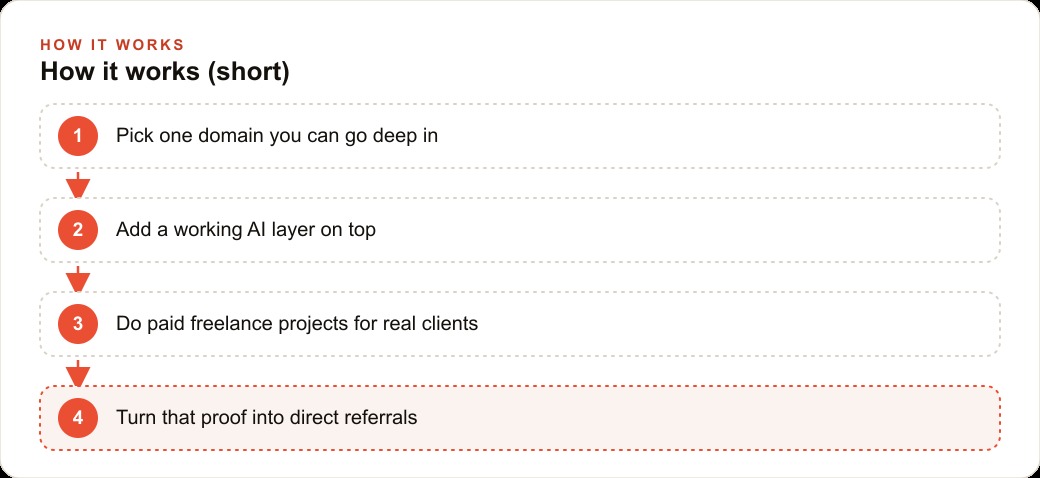
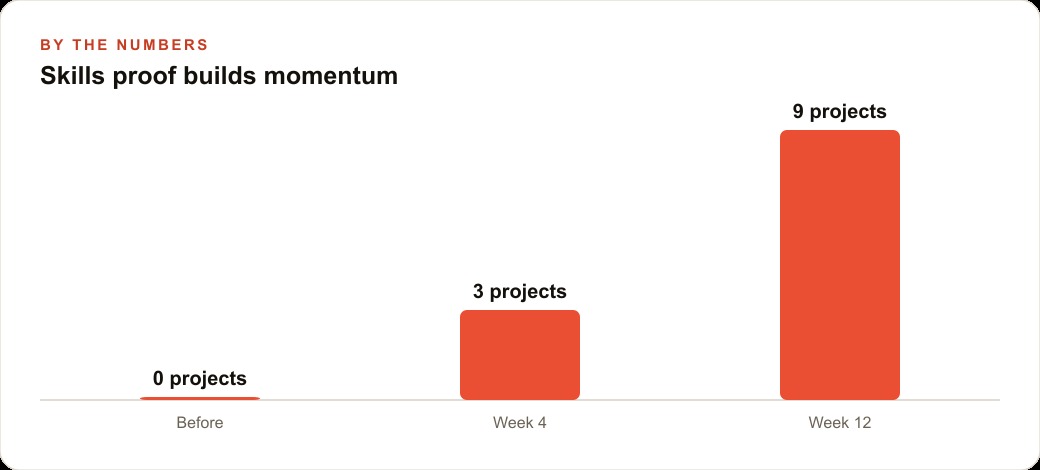
For someone who cannot land a full-time position because they lack demonstrable experience, freelancing is the fastest path to getting that experience in a market-visible form. Three or four freelance projects in a specific domain, with documented outcomes and references, carry more weight in most hiring decisions than a credential from an institution that awarded that credential without verifying the graduate's practical capability.
Working with Facebook and Instagram ad campaigns for small local businesses as a freelancer, for example, gives someone immediate exposure to real budgets, real performance data, and real client expectations, none of which a classroom simulation can replicate. Managing SEO and organic content for a handful of clients produces a portfolio of measurable outcomes that a degree program cannot manufacture. The work also forces development of the resilience and client management skills the WEF identifies as the fastest-growing soft-skill category, because freelance projects fail in ways that classroom projects do not.
The other benefit of freelancing as a credentialing path is that the credential is verifiable. A prospective employer can see the clients, ask for references, and review the work. A degree is a certified claim that the holder studied a curriculum. A freelance portfolio is documented evidence that the holder produced results.
The Global Labor Shortage Is Real and It Coexists With High Unemployment
One of the most disorienting facts about the current market is that a genuine global labor shortage has persisted since the pandemic, running simultaneously with elevated unemployment among recent graduates and career changers. Employers cannot fill roles. Workers cannot get hired. Both statements are true at the same time.
The explanation is skill mismatch, not aggregate labor shortage. The roles employers cannot fill require specific combinations of technical capability and domain knowledge that the available candidate pool does not have in sufficient quantity. The candidates who are unemployed have credentials or experience in areas where supply exceeds demand. The market is not failing to connect workers with employers in general. It is succeeding for workers who have the right skill profiles and failing for workers who do not.
This means the labor shortage is actually good news for workers willing to develop the skills that are in short supply. Those skills are not obscure. They are the skills that appear at the top of the WEF's fastest-growing list: AI and data literacy combined with operational leadership. A worker who builds that combination has access to a market with more open roles than candidates to fill them.
The Entitlement Assumption Is the Thing to Shed First
The most common framing of the job market problem centers on what systems have failed recent graduates: education systems that did not prepare them, companies that stopped investing in talent development, economic conditions that raised costs faster than wages. All of those things are true. None of them are useful to hold onto as explanations for individual inaction.
Companies made a rational decision to reduce development risk. That decision is not reversing. Waiting for it to reverse is a strategy for sitting out the next several years of the market. The workers who are building track records now, in whatever form that track record can take: full-time employment in adjacent fields, freelance projects, independent business operations, AI-tool competency demonstrated through public work, are the ones who will not need the market to change its behavior.
The job market is harder for people who assumed the credential was enough. For people who understand that the credential was always just an indicator of the real thing, and who build the real thing directly, the market has more open doors than the aggregate unemployment statistics suggest. The path is not easy, but it is clear, and it does not require anyone else's permission to start.
One more observation worth holding onto: the workers who are winning in this market are not waiting for institutions to change. They are treating their career as a portfolio of demonstrated outcomes rather than a sequence of certified credentials. Each freelance project is a case study. Each AI tool mastered is a documented capability. Each client served is a reference. The portfolio approach to career development is not new, but the speed at which it can now be built has changed substantially. A motivated person with a clear skill focus can build a credible, verifiable track record in six months of deliberate project work. That is faster than any degree program and more market-responsive than any institutional curriculum. The businesses that hire on portfolio are the same businesses that are building the AI-augmented workflows that will define the next decade. They are looking for the same thing: evidence that the person can produce useful output in today's environment, not proof that they studied yesterday's curriculum.
That is exactly what we do at AI DOERS. Book a private 30-minute call with Madhuranjan Kumar and we will map the fastest path to it for your specific business.
Book your call →
Madhuranjan Kumar
Madhuranjan Kumar brings 20 years of performance-marketing experience and has managed over $200 million in Facebook ad spend for brands across the United States and beyond. His expertise spans the full modern marketing stack: Meta, Google Ads, TikTok, email automation, CRM, and the websites that hold it together. At AI DOERS he turns that track record into lead-generation systems for businesses across every industry.