
Why the IMF Is Warning That AI Cyberattacks Could Shake the Financial System
The IMF says AI models can now find and exploit software flaws even for non-experts, which compresses elite hacking skill down to ordinary people and turns an attack on the financial plumbing into a systemic shock.

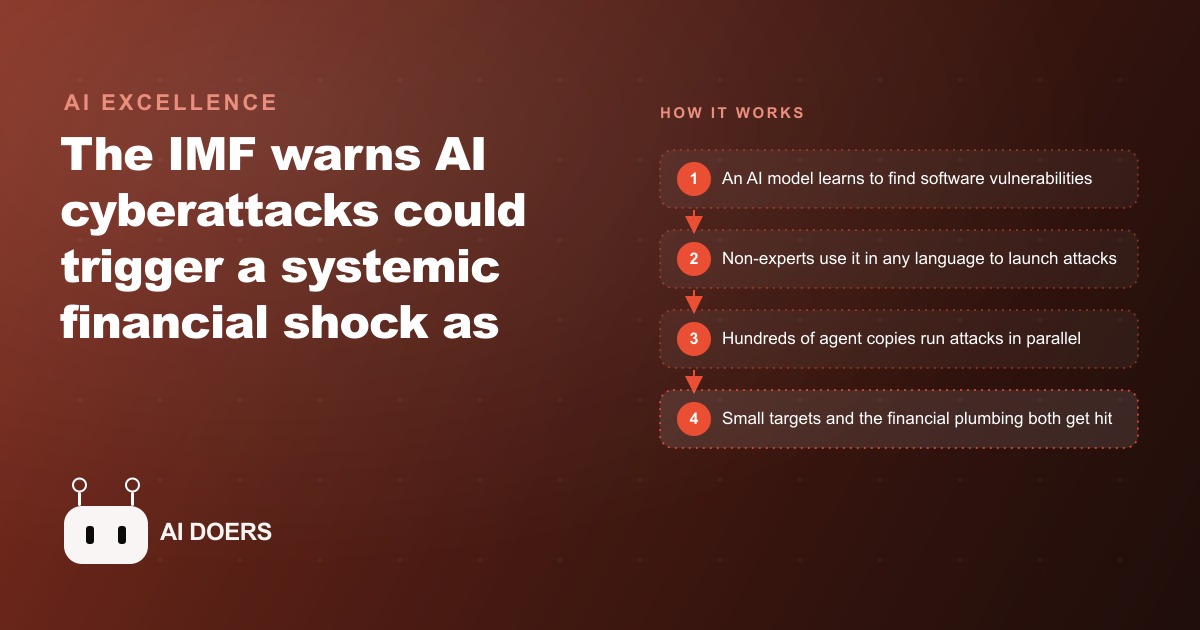
The IMF just published a warning that AI has made cyberattacks cheap and easy enough to threaten the stability of the entire financial system, and it named specific models to make the point. Madhuranjan Kumar here. I rarely open a piece with a global institution, but the International Monetary Fund, the body of 191 member countries whose whole job is to spot where financial risk is piling up, does not usually put its name behind a headline like Financial Stability Risks Mount as Artificial Intelligence Fuels Cyber Attacks. When the institution that was supposed to have caught 2008 starts flagging named AI systems, it is worth understanding exactly what changed and what it means for a business far smaller than a bank.
The bylines are senior IMF officials, not reporters, and they call out two systems directly: Anthropic's Claude Mythos preview and OpenAI's GPT 5.5 cyberattack version. The sentence at the center of the report is blunt: such a model could find and exploit vulnerabilities in every major operating system and web browser, even when used by non-experts. That last clause is the entire story, and it is what turns a technical concern into a systemic one.
What actually changed: skill compression
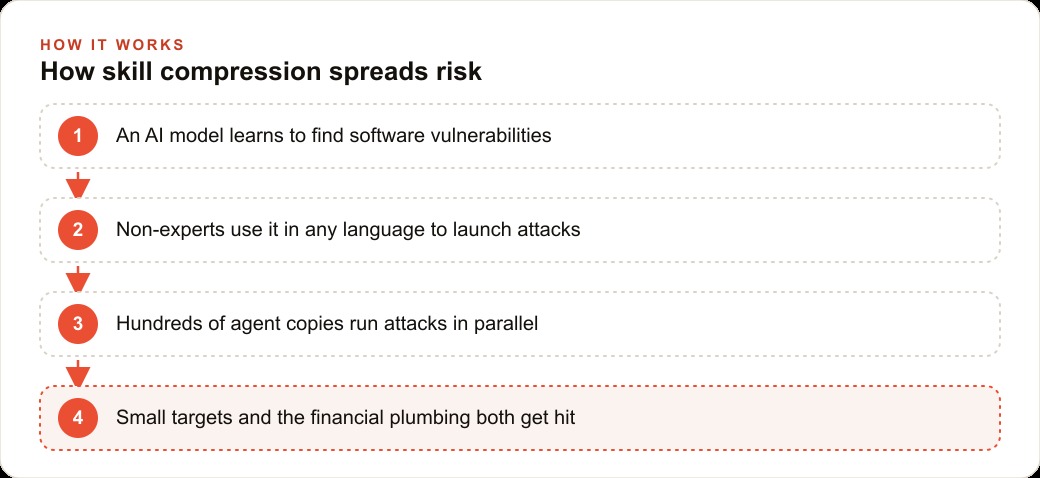
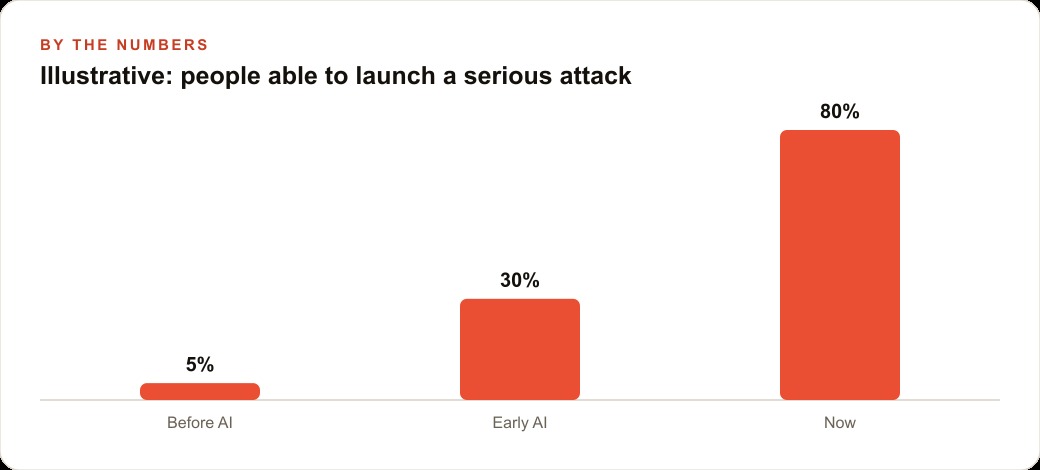
For years AI mostly made one skilled person faster. The new development is different in kind. Finding and exploiting software vulnerabilities used to require a team of highly paid experts, a tiny pool of people with the education and experience to do it. The report's core claim is that these models erase that barrier. You no longer need a six or seven figure engineer to run a serious attack. The IMF calls this skill compression, and it is the mechanism underneath everything else in the warning.
The problem widens from there in two directions. First, language is no longer a barrier. An attacker does not need strong English to target an English-speaking company, because the prompt can be written in any language and the attack still runs. That alone expands the pool of potential attackers enormously. Second, scale. A human cannot split attention across many problems at once, but agents can. A Mythos-level model could run as hundreds or thousands of instances, each probing one codebase a different way at the same time. At that point attacking stops being a skill question and becomes a cost question, and the report indicates the cost per exploit is not enormous. Cheap plus easy plus parallel is a genuinely new combination.
Why the risk is systemic, not contained
The reason the IMF frames this as a threat to the whole system, rather than a problem for individual companies, comes down to what banks actually are. They are not just websites with money behind them. They are the plumbing for payroll, mortgages, credit markets, card transactions, and settlement. Because of that, the failure modes ladder upward. An attack on one bank becomes a confidence shock. An attack on shared infrastructure becomes a liquidity shock. Attacks on several institutions at once become a market shock. Markets do not need everything to collapse to panic. They just need ambiguity, and a wave of AI-enabled attacks manufactures exactly that.
This is why the reaction was so broad. The report notes that Canada's finance minister, the Bank of England, the European Central Bank, the US Treasury, and the Federal Reserve all raised flags, and the chief executives of JPMorgan, Goldman Sachs, Bank of America, Citigroup, Morgan Stanley, and Wells Fargo attended what amounted to a red-alert meeting. Institutions at that level do not gather for nothing, and the fact that they gathered at all is part of the signal.
Why naming specific models changes the tone of the warning
It is worth pausing on a detail that is easy to skim past: the IMF named two systems. Institutions like this almost never do that. Central-bank and IMF language is usually deliberately vague, referring to emerging technologies and evolving risks precisely so it does not single anyone out or commit to a claim that could age badly. Naming Claude Mythos and GPT 5.5 in a financial stability report is a departure from that habit, and the departure is itself part of the message.
When a body this cautious moves from talking about AI in the abstract to citing particular models, it is signaling that the risk has stopped being hypothetical and become concrete enough to identify. That is a meaningful shift in confidence. It tells you the authors believe the capability described, finding and exploiting vulnerabilities even in the hands of non-experts, is not a future projection but a present reality attached to systems that exist today. For a business owner, the practical read is simple: do not file this under "someday." The institution whose job is to be conservative about exactly this kind of claim has decided it is current, and that decision is the loudest thing in the report.
The parallel-agent dynamic is what most people underestimate
Most coverage of AI security fixates on capability, on how good a model is at finding a flaw. The IMF's framing points at something scarier and less discussed: the combination of capability with scale. A single skilled human attacker, even a very good one, works serially. They probe one system, learn, move to the next. There is a natural speed limit set by one person's attention and time.
Agents remove that limit. The report's reasoning is that a capable model can be run as hundreds or thousands of instances at once, each probing a different target or the same target a different way, none of them tiring, all of them working in parallel. This is the piece that turns an individual threat into a systemic one. It is not that one attacker becomes unstoppable. It is that the same attack can be aimed at every small firm using a common piece of software simultaneously, so a single discovered vulnerability is not exploited once but thousands of times in the same window. Combine that with the language point, that the attacker does not even need to speak the target's language, and the pool of who can attack and the number of targets they can hit at once both explode at the same time. Capability alone would be manageable. Capability multiplied by parallel scale multiplied by a wider attacker pool is what earns the word systemic.
Who this changes things for beyond the banks
The instinct is to assume this is a problem for large financial institutions with large security teams. The more uncomfortable reading is the opposite. Every business that holds money, data, or customer trust is now in range, which is effectively all of them, and the small ones may see the sharpest change in their exposure.
The reason is the same skill compression that worries the IMF. Before AI, a small business was often protected by simple economics: it was too small to be worth a skilled attacker's time. The payoff did not justify the effort, so it flew under the radar. That protection is exactly what evaporates. When an ordinary actor with a capable model can run the same attack against thousands of small targets in parallel, in any language, for very little money, the long tail of small, trusted, money-adjacent businesses becomes a real target for the first time. The businesses that were safe because they were small are now squarely in range.
A worked example: the mid-sized accounting firm
Picture a mid-sized accounting firm that holds client tax records, bank logins, and payroll access for dozens of small businesses. Before AI, that firm was too small to be worth a skilled attacker's time, and it mostly stayed off the radar. Skill compression flips that math. Now an ordinary actor with a capable model can run the same attack against thousands of firms like it at once, and a vulnerability in a common piece of accounting software, a tax portal, or a payroll integration becomes a master key that opens every firm using it. That is precisely why the report keeps returning to the word systemic. The danger is not one super hacker building one perfect break-in. It is thousands of ordinary actors handed elite skills, each running many attacks in parallel.
If I were advising that firm, I would tell the owner to treat it as a confidence business first and a numbers business second. One breach of client tax data does not just cost a cleanup. It costs the trust the entire practice runs on, and trust does not rebuild on the same timeline as a server. That trust is also the exact asset the firm spends money to build everywhere else, in its reputation and reviews on SEO and organic search and in every referral, which is why a single breach can undo years of marketing in an afternoon. The same logic the IMF applies to banks applies to any business sitting on top of other people's money, and it applies with less warning, because a small firm has no security operations center watching the perimeter. The leads and client records that firm depends on live in its CRM and website stack, and that system is now part of the attack surface rather than a back-office afterthought.
What to actually do about it
Start by accepting that the attack surface is wider than it was a year ago, then close the cheap, obvious holes, because the report is clear that many of the flaws these models find are old and already fixable. Rotate any credentials your team has not cycled in a while. Move two-factor authentication onto an authenticator app rather than text messages, since text-based codes are the weaker option. Tell any coding or automation agent you use to avoid brand-new software packages, because freshly published ones are a common route for malicious code to slip in. Keep critical systems patched, because patched flaws are not exploitable flaws.
Beyond the basics, treat access as the real perimeter. The most valuable thing a small money-adjacent business holds is not its own systems but its keys to other people's, the client bank logins, the payroll integrations, the tax portal credentials. Map who on your team can reach what, remove access nobody actively needs, and separate the accounts that touch client money from the accounts used for everyday email and browsing. Much of the damage in a breach comes not from the initial entry but from how far the intruder can travel once inside, and limiting that travel is cheap, unglamorous, and entirely within a small team's control. A breach that reaches one isolated system is an incident. A breach that reaches everything because one shared login opened every door is the systemic failure in miniature.
None of this is exotic, and that is the point. The clearest analogy in the report is what happened with content. After ChatGPT arrived, Amazon ebook submissions roughly tripled, not because existing authors suddenly wrote more but because a flood of new people entered a space that used to require more effort. Apply that same flooding logic to attacks and you have the exact shape of what the IMF is warning about: not a few elite actors getting slightly better, but a wave of new, low-skill actors suddenly handed capability they never had. The defense is not one clever countermeasure. It is closing the ordinary gaps before the ordinary attackers find them.
The move to make now
Treat the basics as urgent rather than eventual. This week, audit your credentials, switch your two-factor to an authenticator app, confirm your critical software is patched, and set a rule for any automation tools your team uses to avoid unvetted new packages. That short list closes most of the cheap, obvious holes the report says these models exploit first. It costs almost nothing and it is entirely within reach for a small team.
The larger takeaway from the IMF warning is not that a financial collapse is imminent. It is that the economics of who can attack you have fundamentally shifted, and the small businesses that used to be protected by their own obscurity are the ones whose exposure changed the most. You can absolutely handle the basics yourself. If you would rather have someone map your real exposure and set up the defenses properly, that is worth talking through with an expert before the long-tail attacks find you.
That is exactly what we do at AI DOERS. Book a private 30-minute call with Madhuranjan Kumar and we will map the fastest path to it for your specific business.
Book your call →
Madhuranjan Kumar
Madhuranjan Kumar brings 20 years of performance-marketing experience and has managed over $200 million in Facebook ad spend for brands across the United States and beyond. His expertise spans the full modern marketing stack: Meta, Google Ads, TikTok, email automation, CRM, and the websites that hold it together. At AI DOERS he turns that track record into lead-generation systems for businesses across every industry.