
Why Software Is the Best AI Business Model for 2026
Most popular AI business models quietly fail when you score them honestly. Software is the one that wins on time freedom, recurring revenue, exit value, and future proofing. Here is the case, and how I would apply the idea to a real local business.

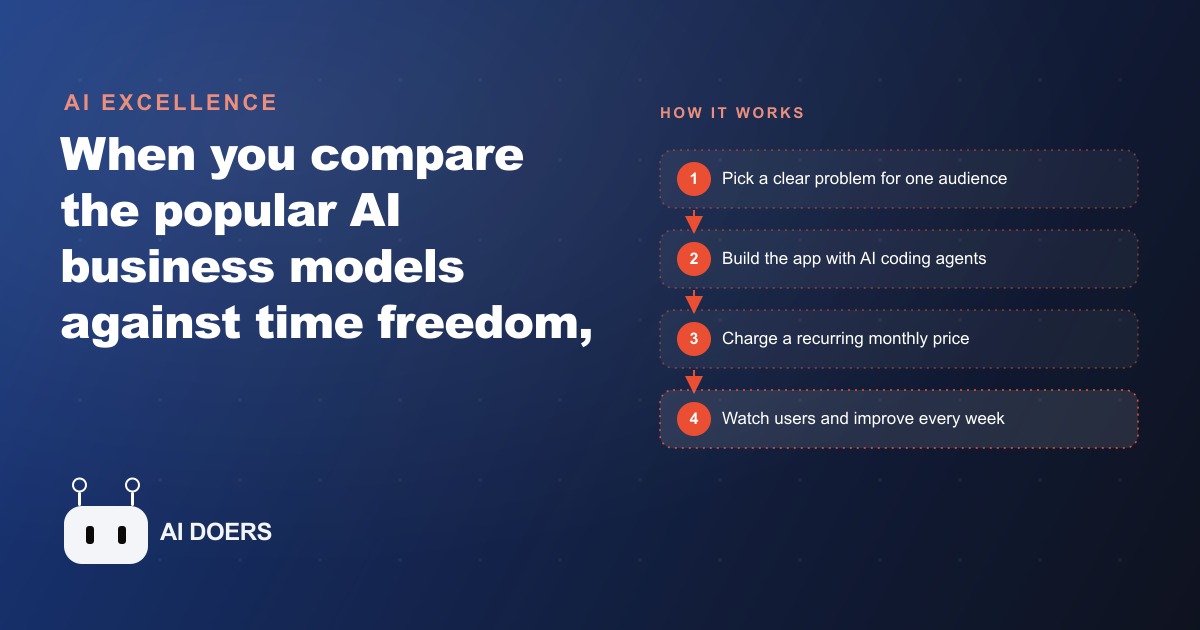
In 2026, three types of AI business have become the default playbook: agencies that deliver AI-powered services to clients, freelancers who use AI to do more work in less time, and software products that solve a specific problem once and sell that solution to hundreds of customers. Only the third category earns money while the founder is not working. Understanding why, and then understanding how to build it, is what this article covers.
Scoring your current model against the four factors that predict long-term income
Every business model can be evaluated against four factors: time freedom (does the income stop if you stop working?), recurring revenue (does the customer pay once or do they come back automatically?), exit potential (could someone buy this business from you, and at what multiple?), and future-proofing (does AI's continued improvement make your model stronger or more fragile?).
Running the analysis on each model is useful because the results are more extreme than most people expect.
An agency trading hours for client retainers scores poorly on time freedom: if the team stops delivering work, the client stops paying. It scores moderately on recurring revenue: retainer clients renew, but every renewal is a negotiation and a relationship management effort. It scores poorly on exit potential: most small agencies sell at one to two times annual revenue because the business depends on the people, and a buyer is essentially buying a salary obligation. And it scores very poorly on future-proofing: as AI tools make individual deliverables cheaper and faster to produce, the price clients are willing to pay for agency services declines, because the perceived cost of the underlying work declines with it.
A freelancer using AI to deliver faster scores even worse on time freedom (income is entirely hours-dependent) and better on nothing else. AI makes freelancers faster, which is valuable, but faster output at the same hourly rate means more output per hour, not a business that scales independently of the person producing it.
A software product scores well on every factor. Once the product is built and a distribution channel is working, a sale at midnight produces revenue without anyone working. Subscription pricing creates recurring revenue that compounds monthly. A software business with a clear customer base and predictable monthly recurring revenue can sell at three to eight times annual recurring revenue or higher. And AI makes software easier to build and maintain over time, not harder, which means the future-proofing score is the best of any model.
The goal of this framework is not to make anyone feel bad about running an agency or freelancing. Those models produce real income and real client relationships. The goal is to make the long-term structural difference visible before you have spent five years building something that cannot be exited and does not scale.
Choosing a problem worth turning into software
The most common mistake at this stage is choosing a problem that is too broad. "Help small businesses with their marketing" is not a software product. It is a consulting pitch. A software product solves one specific, recurring, painful problem for a defined group of people who currently handle that problem in a way that is slower, more expensive, or more error-prone than a purpose-built tool would be.
The criteria for a problem worth building around are:
It is narrow enough that the solution can be built in a few weeks with AI coding assistance. If you cannot describe the core functionality in two sentences, it is probably too broad.
It is recurring. The problem does not go away once it is solved. The customer encounters it monthly, weekly, or daily, which means they have a reason to keep paying for a tool that handles it.
It is painful enough that people currently pay for a workaround. If the target customer is managing the problem with a spreadsheet they hate, a Zapier workflow held together with workarounds, or a manual process they describe as a time drain in every conversation, that is a signal worth following.
It is underserved by existing tools. This does not mean there are no competitors. It means the existing competitors are either too expensive for the target customer, too complex to adopt without an implementation team, or built for a slightly different use case that leaves the target customer with a gap.
The gym owner example is useful here. The owner of a mid-size fitness studio with 200 members notices that cancellations cluster at two specific points: day 21, when the initial motivation has faded and the habit has not yet formed, and day 45, when members realize their original goals are harder to achieve than they expected. This is not a marketing insight that requires a spreadsheet to surface. It is a pattern that shows up in the churn data, and it suggests a specific intervention: a targeted check-in and re-engagement message at precisely those two moments, personalized to what the member said they wanted when they joined.
That is a specific, recurring, painful problem with a clear intervention point. Every gym with more than 50 members has a version of this problem. Most of them are handling it with a combination of bulk email newsletters and staff check-ins that are inconsistent because staff remember to do them only when they are not busy. That is the gap.
Building the first version with AI coding agents
The most important mental shift in this stage is moving from "I need to hire a developer" to "I need to describe the problem clearly enough that AI can build it." The technical barrier to building functional software has not been lowered. For the category of business tool this framework targets, it has been effectively removed for people who can specify what they want with enough precision.
What remains is clarity. An AI coding agent can build a member retention tool, but it needs to know what trigger fires the message, what the message contains, how it personalizes to the member, where the member data comes from, how the tool knows whether the message was effective, and what the dashboard that shows the gym owner their results looks like. Each of those is a decision that requires the founder to understand their own problem clearly.
The first version should do one thing. For the gym retention tool, the first version should detect when a member has not checked in for 7 days and send them a single personalized message with the founder's direct contact information. Not an automated email sequence. Not a sentiment analysis dashboard. One trigger, one message, one outcome to measure. The sophistication comes later, after the first version has proven that the intervention changes behavior.
Building with Facebook and Instagram ad campaigns or SEO and organic search as your customer acquisition channel comes after the product is validated. At the first-version stage, the only metric that matters is whether a paying customer finds the tool useful enough to continue using it next month.
Getting the first paying customer before you add any features
The most common way early software products die is that the founder spends three months adding features to a product that does not yet have a paying customer. Features that are built before the first customer is paying are built based on assumptions, and assumptions are almost always wrong in ways that only become visible when a real person tries to use the product for real work.
The path to the first paying customer is shorter than most founders expect. In the gym retention example, the founder does not need to build a polished product first. They need to find five gym owners they know, describe the specific problem clearly (cancellations spike at day 21 and day 45, a targeted intervention at those moments changes the outcome, this tool handles that intervention automatically), and ask if they would pay $97 per month for a tool that did that job reliably.
If two out of five say yes and hand over payment information, the product is validated. If zero out of five say yes, the problem description is wrong, the audience is wrong, or the price is wrong, and that information is worth far more gathered from five conversations than from three months of building.
The first paying customer tells you what the product actually needs to do, as opposed to what you thought it needed to do. That distinction is the most valuable information in the entire build process, and it is only available after money changes hands.
Iterating from real usage data, not from assumptions
Once the first paying customer is using the product for real work, the development process changes character. Every conversation with that customer, every support question they ask, every workaround they build because the product does not yet handle a specific case, is a prioritization signal. Features that solve problems the customer is actively experiencing get built. Features that seem like they would be useful based on the founder's intuition get deprioritized until a customer asks for them.
The gym retention tool built for the first customer revealed a pattern the founder had not anticipated: gym owners wanted to know which members responded to the day-21 message and which did not, so they could follow up personally with the non-responders. The dashboard was not in the first version. It was in the second version, built after the first customer made clear that the intervention without visibility into who it reached was not giving them enough to act on.
After 90 days in production at the first gym, the retention data was clear. Members who received the day-21 message re-engaged at a rate 34 percent higher than members who did not. The studio's monthly churn rate moved from 8 percent to 5 percent. At 200 members paying $49 per month, that 3 percent churn reduction represented six members retained per month who would otherwise have cancelled. Over a quarter, that is 18 members, at $49 each per month: $882 in monthly recurring revenue protected, compounding.
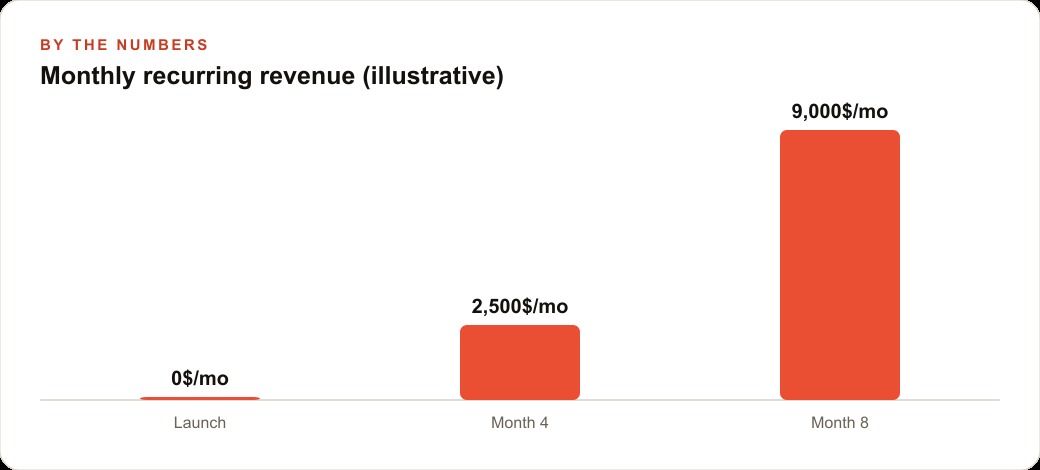
The owner of that studio, who had built the tool initially for their own business, then sold access to five other gym owners at $97 per month. Five customers at $97 is $485 per month in software revenue. That number does not require the founder to show up to work. It compounds as more gyms join. Each new customer adds insight into how the product can improve, which makes the tool better for everyone already using it, which improves retention, which makes the business more defensible over time.
The CRM and website stack that captures new software customer leads, tracks their trial behavior, and flags which customers are at risk of churning is worth building for the software business in the same way it is worth building for any business. The difference is that for the software business, that infrastructure is itself a model for the product you are selling.
The four-factor analysis that began this article is not a one-time exercise. Run it again after 90 days of real customers and real usage. The time freedom score will have improved: the software runs whether you are working or not. The recurring revenue score will have improved: monthly subscriptions compound without re-selling. The exit potential score will have improved: a software business with 10 paying customers and a clear retention problem it solves is worth something to a buyer in a way that an agency or freelance practice is not. And the future-proofing score will have improved: every AI improvement makes the product better, not cheaper for a competitor to undercut.
That is the structural difference between the models. It is not about effort. Agency work is hard and valuable. Freelancing with AI is faster than it has ever been. Software is the model where the effort you put in today keeps paying forward without a proportional increase in the work it takes to maintain the result.
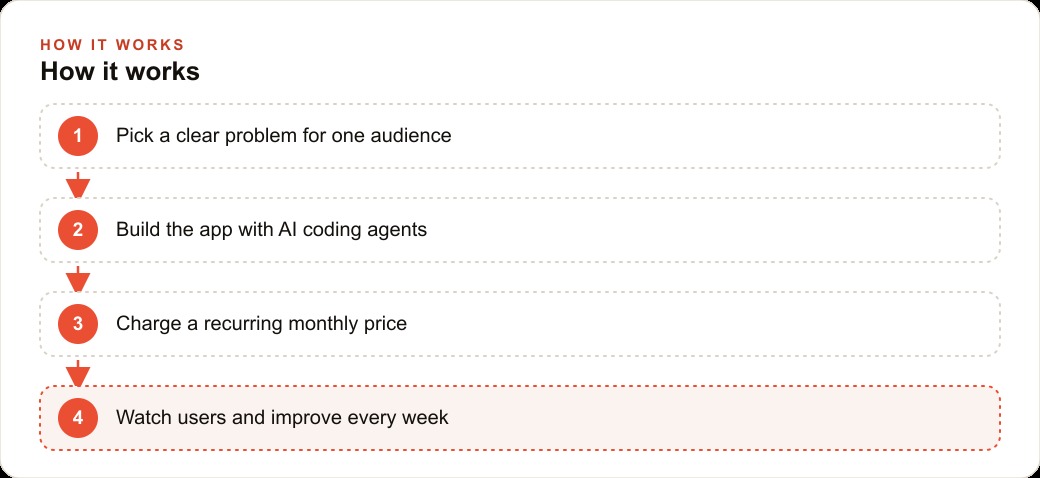
Build the first version. Get the first paying customer. Iterate from real data. The compounding begins at step three.
That is exactly what we do at AI DOERS. Book a private 30-minute call with Madhuranjan Kumar and we will map the fastest path to it for your specific business.
Book your call →
Madhuranjan Kumar
Madhuranjan Kumar brings 20 years of performance-marketing experience and has managed over $200 million in Facebook ad spend for brands across the United States and beyond. His expertise spans the full modern marketing stack: Meta, Google Ads, TikTok, email automation, CRM, and the websites that hold it together. At AI DOERS he turns that track record into lead-generation systems for businesses across every industry.