
Why Owning Its Own Chips Lets Google Power Rivals and Still Win
Google is not compute-constrained because it owns its TPUs end to end, which keeps margins strong however it sells compute. The same ownership lesson scales down to any small business.

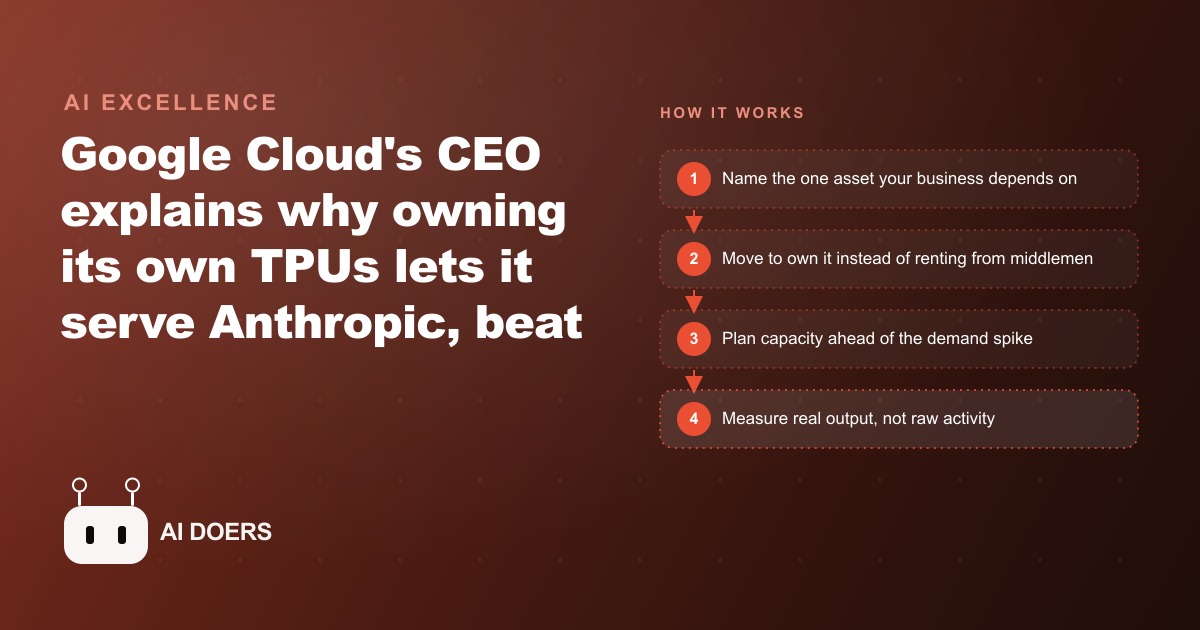
Google's CEO spent a recent interview explaining why owning its own chip manufacturing gives the company margin resilience that competitors who depend on external silicon cannot replicate. The strategic principles behind that explanation scale directly to any business, from a cloud computing giant to a single-location HVAC company. I am Madhuranjan Kumar, and here are five lessons from Google's chip strategy that apply to building a more defensible small business.
1. Owning the critical input protects your margins when supply gets tight
Google designed and manufactures its own Tensor Processing Units rather than sourcing them from external vendors. This means that when chip demand spikes globally and supply becomes constrained, as it has repeatedly over the past several years, Google's ability to serve its own models is not at the mercy of allocation decisions made by suppliers who are also serving Google's competitors.
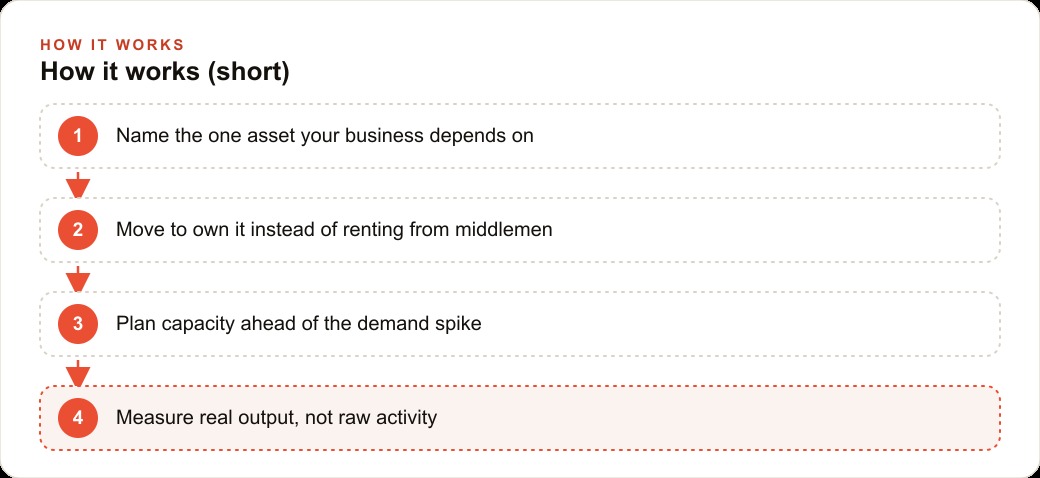
The business translation is immediate. Every small business depends on a critical input: leads, skilled labor, a specific supplier's product, a distribution channel, or a proprietary relationship. The businesses that own those inputs structurally, rather than renting them from third parties, maintain margins and operational stability when the inputs become scarce or expensive.
The HVAC company that generates its own demand through owned digital channels, a direct customer list, and a reputation that produces referrals without paid middlemen, is in the Google chip position. The HVAC company that depends on lead-generation platforms that resell the same lead to three competitors is in the position of a cloud company that has to buy all its chips from a single external supplier. When the lead platform raises prices or tightens availability, there is no alternative.
Building the owned input does not happen instantly. Google has been building TPUs for eleven or twelve years and is on the eighth generation. The HVAC company that starts building its direct customer base and owned demand channels now will have a meaningfully stronger position in three years than one that waits until the lead platform economics force the decision.
2. Planning capacity ahead of demand spikes is worth more than reacting well to them
Google planned its data center capacity, energy procurement, and manufacturing capability years in advance of the demand surge that materialized when generative AI became mainstream. That advance planning is what enabled Google to serve the demand when it arrived rather than scrambling to catch up. The companies that planned reactively had to make expensive decisions under pressure.
For a seasonal service business, this principle is more concretely actionable than it might first appear. An HVAC company that orders replacement equipment in January for the summer season, at off-peak pricing, is doing the same thing as Google locking in energy contracts and real estate before the AI buildout drove costs up. An HVAC company that waits until June to figure out whether its crew and inventory can handle the volume of summer service calls is making expensive decisions under pressure.
The practical discipline is to plan capacity at the moment when you have the most time and the least urgency: the slow season, the beginning of the year, the period immediately after the peak. Decisions made with lead time produce better outcomes and lower costs than decisions made under the pressure of immediate demand.
3. Serving your direct competitors is a sign of platform strength, not a strategic inconsistency
One of the most counterintuitive facts about Google's chip business is that it runs the inference workloads for Anthropic, the maker of Claude, one of Google's direct AI competitors. Google also maintains NVIDIA as a core hardware partner even as it builds competing internal silicon. These relationships are not strategic compromises. They are evidence that Google has built a platform valuable enough that competitors choose to use it even when they have alternatives.
The small business equivalent is any product or service that others in your category would use because it is simply the best option available. A cleaning company that develops a proprietary staff scheduling method and then licenses that method to other cleaning companies in non-competing markets is building a platform business within a service business. A landscaping company that builds exceptional supplier relationships and provides access to those relationships to non-competing landscapers in adjacent territories is doing the same thing.
The signal to watch for is whether your competitors or adjacent businesses ever ask to buy your infrastructure rather than your deliverable. When that question starts coming up, it is evidence that you have built something platform-worthy, and the strategic question becomes whether to monetize it as a platform rather than only as a direct service.
4. Split your investment between building capability and monetizing it from the beginning
Google separated its eighth-generation TPU into two chips for the first time: one optimized for training workloads and one optimized for inference workloads. The training chip gets better at building new models. The inference chip gets better at serving those models to customers at scale and at a price that covers the cost of building them. This split reflects a structural insight: you cannot fund the building of capability indefinitely without also generating revenue from deploying it.
For a small business, this translates to the discipline of generating revenue from your existing capabilities while investing a portion of that revenue in building the next capability. A pest control company that runs its current service routes profitably while investing some of those profits in building a digital presence, a customer database, and a referral program is allocating between inference and training correctly. The company that reinvests everything in building new capabilities without monetizing the existing ones runs out of runway before the new capabilities pay off.
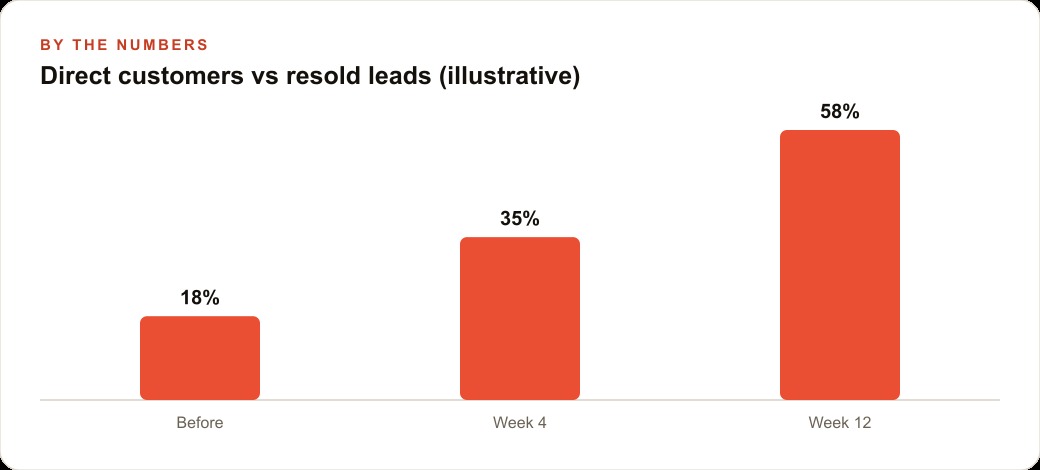
The monitoring metric that makes this concrete: the percentage of new customers that come from owned channels versus paid acquisition. A company where that percentage is growing, where each month a slightly higher share of new customers come from referrals, organic search, or direct reputation rather than from paid lead platforms, is building training capacity while running inference profitably. The business that optimizes exclusively for current-period revenue without any investment in owned channels is running inference only, and when the paid lead platforms change their pricing or terms, it has no alternatives already working.
5. Measure the output that reflects value, not the input that generates activity
Google does not measure AI engineering progress by counting lines of code written per week. It measures by functions shipped and the speed at which those functions reach production. A senior engineer who writes compact, clean code that accomplishes more in fewer lines than a junior engineer produces more per hour by any meaningful measure, yet counting lines of code would rank the junior engineer higher.
This lesson is the most transferable of the five because every small business has at least one activity-based metric it uses as a proxy for value creation when a closer output-based metric exists. An HVAC company that measures technician performance by number of service calls completed per week is measuring activity. The same company that measures performance by completed installations, first-call resolution rate on repair calls, and maintenance contract conversion rate is measuring the outputs that actually determine whether the business is growing in a healthy direction.
The practical step is to audit the metrics you currently track and ask whether each one measures activity or output. Replace activity metrics with the closest output metric available, then track both in parallel for a quarter to verify the new metric moves in the direction you expect when performance improves. After a quarter of verification, drop the activity metric that you are confident the output metric has replaced.
For an HVAC company, the transition might look like this: trucks dispatched per day becomes maintenance contracts converted per month. Hours billed becomes customer satisfaction score on completed jobs. Revenue per period becomes revenue per customer across the relationship lifetime. Each of these shifts from a number that can be gamed without delivering value to a number that requires actual value delivery to move in the right direction.
The Google chip story is fundamentally a story about a company that built ownership, planned ahead, maintained platform strength, balanced building with monetizing, and measured the right things. None of those principles require a semiconductor fabrication facility to apply. They require a disciplined owner, a clear-eyed view of where the business currently rents what it should own, and the patience to build toward the owned position rather than optimizing indefinitely for the rented one.
That is exactly what we do at AI DOERS. Book a private 30-minute call with Madhuranjan Kumar and we will map the fastest path to it for your specific business.
Book your call →
Madhuranjan Kumar
Madhuranjan Kumar brings 20 years of performance-marketing experience and has managed over $200 million in Facebook ad spend for brands across the United States and beyond. His expertise spans the full modern marketing stack: Meta, Google Ads, TikTok, email automation, CRM, and the websites that hold it together. At AI DOERS he turns that track record into lead-generation systems for businesses across every industry.