
Why OpenAI Shut Down Sora and Pointed the Team at Robots
OpenAI is retiring Sora as a consumer video app and moving the team to world simulation research, the kind of high-fidelity environment engine you build to train robots, not to make clips. Here is what that signals and how a local business should read it.
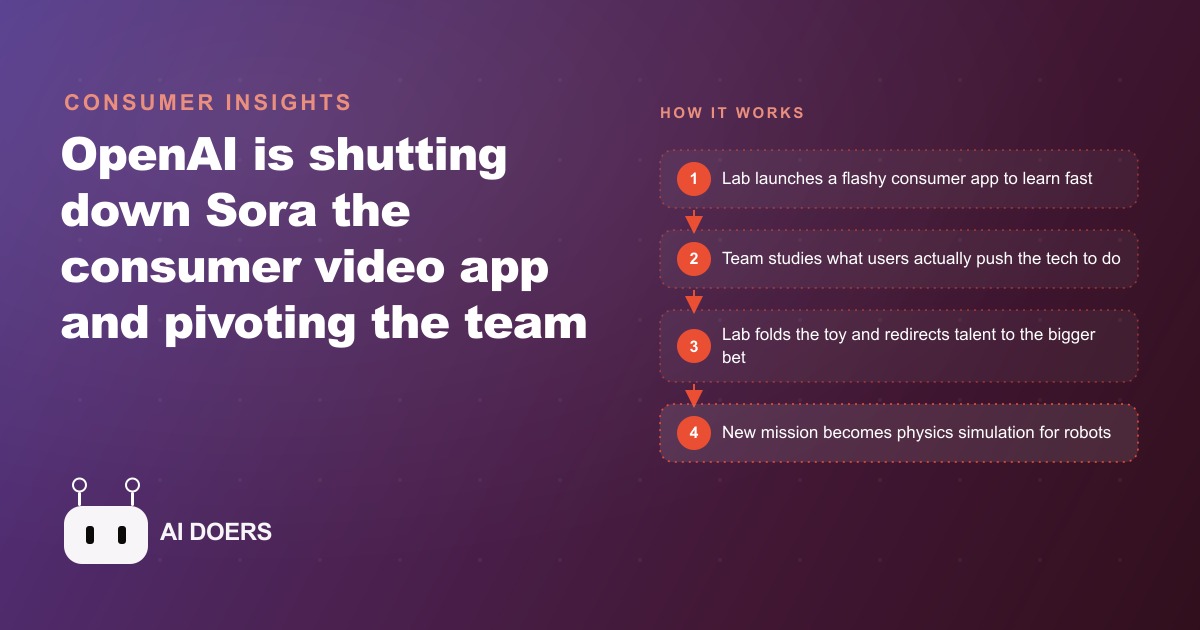
OpenAI is shutting down Sora as a consumer video app and redirecting the team to world simulation research, the kind of high-fidelity environment engine you build to train robots, not to make clips. That is the news. The shutdown of a popular toy will get the headlines, but the headline is the least interesting part. The interesting part is where the people are going, because a frontier lab does not pull a talented team off a viral product unless it has decided something bigger is worth their time. I am Madhuranjan Kumar, and I read this move as one of the clearest strategy signals of the year for anyone running a business on top of tools they do not own.
What actually shipped: a shutdown that is really a redirect
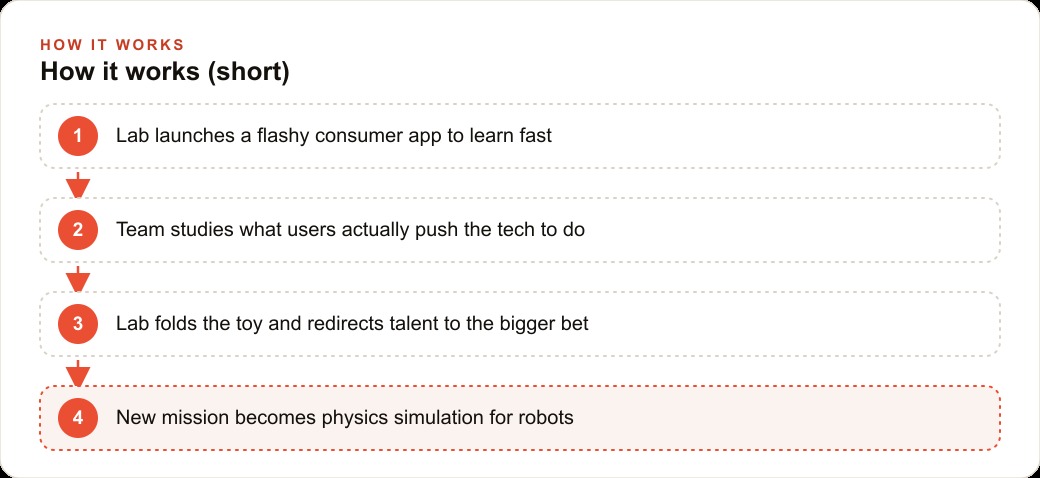
Sora was the product where you could drop your own likeness, or someone else's, into a generated scene and make them do almost anything. It produced a flood of surreal, funny, and occasionally uncomfortable clips. Now the consumer experience is going dark. The framing that matters is that this is a pivot, not a failure. A frontier lab spins up a flashy experiment to learn quickly, watches what users actually push the technology to do, and then folds the toy the moment a bigger opportunity comes into focus. Read this way, Sora did its job. It taught the lab an enormous amount about what generative video wants to be, and the lab is now spending that lesson somewhere else.
The clearest evidence is talent, not the press release. Sora's lead described the team's new mission as building systems that deeply understand the world by simulating arbitrary environments at high fidelity. That is the language of a research engine, not a consumer feature. Sam Altman backed it, saying the focus is world simulation research, especially as it relates to robots. When the people move, believe the people. Where a company sends its best talent tells you what it actually thinks will matter next, far more reliably than anything it announces.
Why the pivot makes sense: physics beats pixels
A simulator that genuinely models how environments behave is exactly what you need to train robots safely and cheaply, long before they touch the real world. So a video toy is quietly becoming a physics engine, and the bet is that modeling how things behave, not just how they look, unlocks far more value than entertainment ever could. That is a serious, industrial ambition, and it lines up with OpenAI increasingly framing its future around the economy and saying upcoming models will automate large parts of it. Pulling a team off a consumer video app and pointing it at robot world-simulation fits that heavier agenda perfectly.
There is a second, quieter reason the shutdown reads as rational rather than surprising, and it is a lesson about product risk. The most magnetic feature of Sora was likeness, the ability to drop a recognizable face into a directed scene, and that same feature was its biggest source of legal and reputational exposure. People staged narrated walkthroughs of iconic game maps, generated absurd everyday skits, and made self-aware clips that joked about the AI itself, and the common thread was always that real-world framing colliding with an impossible scene. When the single most-used feature of your viral toy is also the one generating the most legal risk, folding it and redirecting the talent is not a shock. It is a company deciding the exposure is not worth the upside when a bigger, cleaner bet is available.
Who this changes things for: anyone running on a tool they do not own
Here is the part I want every owner to sit with, because it has nothing to do with robotics. The lesson is about how to behave when a vendor controls something you rely on. Local shops, agencies, restaurants, clinics, and stores increasingly run on outside platforms, whether that is an AI app, a scheduling tool, or a social network. Sora just demonstrated, in public and on short notice, that a consumer app you love can sunset with little warning, and that the reasons will have nothing to do with how much you depended on it. The decision is made in a boardroom optimizing for the company's next bet, not for your workflow.
Two habits protect you, and both are the direct takeaway from this news. First, export and back up anything you care about, because the notice period on a consumer sunset is not something you control. Second, watch where a company moves its money and its people, because that early signal, a team getting redirected, a feature getting deprioritized, a public statement about a new mission, is your cue to test a backup before you are forced to. The owners who get hurt by shutdowns are the ones who noticed only after the app disappeared. The owners who barely flinch are the ones who read the direction of travel months earlier.
The concrete move: an ownership audit, with a worked example
Picture a busy auto repair shop that leaned hard on one trendy app to film quick before-and-after clips of brake jobs and detailing, posting them to pull in local customers. If that app announced it was shutting its consumer side tomorrow, the shop that planned ahead would barely flinch, and here is how I would have set it up for that owner. Every clip the shop publishes gets saved to its own storage too, not just the app, so the content library survives the platform. Customer reviews and contact details live in the shop's own CRM and website stack, never only inside a third-party tool, so the relationships survive the platform. And the marketing plan never rests on a single channel, so if one goes dark, the phone still rings.
Put illustrative numbers on why that matters. Say that app drove roughly a third of the shop's new-customer calls. A shop with its content backed up and its customer list owned reroutes that third onto other channels in days, running the same clips through Facebook and Instagram ad campaigns and email, and the dip is a bad week. A shop that kept everything inside the one app loses the content, the audience, and the channel at once, and that third of new calls does not come back until it rebuilds from zero, which can take months. Same event, wildly different outcome, and the only variable is whether the shop owned its own assets going in.
The audit itself is simple. List every outside tool your business runs on, then mark which ones hold something you cannot easily recreate, your content, your customer list, your booking history. For each of those, set up an export or backup that lives somewhere you control. Then build the habit of watching your key vendors, so that when one announces a pivot, a price change, or a new direction, you treat it as a prompt to test an alternative while you still have time. Never let one platform become a single point of failure for getting customers. There is even a version of the physics-over-pixels idea in the work itself: a shop that understands why a repair holds up, not just that it looks finished, keeps customers coming back, and the recurring questions those customers ask are exactly the material that feeds SEO and organic search you own outright.
The pattern this is not the first of, and will not be the last of
It helps to zoom out, because Sora is not a one-off event. It is the latest instance of a pattern that every business owner should now expect on a regular schedule. A frontier lab launches a splashy consumer product, it goes viral, a lot of people build habits and even small workflows around it, and then the lab decides its resources are better spent on a bigger, more industrial bet and winds the consumer product down. This has happened before with other AI features and standalone apps, and it will happen again, because the incentives that drive it are structural. These companies are racing toward a much larger prize than any single consumer app, and a viral toy is often just a fast, cheap way to learn what the technology can do before the real bet gets funded.
Once you see the pattern, you stop being surprised by any individual instance of it, and that changes how you build. You start treating every consumer AI product you adopt as temporary by default, useful now, gone eventually, and you organize your business so that assumption costs you nothing. The content you make with a tool lives in your own storage. The audience you build through a platform has its contact details in your own system. The workflow a tool enables has a documented fallback you have actually tested, not just imagined. When you operate this way, a shutdown announcement is a mild inconvenience you handle in an afternoon rather than an emergency that threatens your pipeline.
There is a sharper version of this for anyone spending real money on paid channels. If your lead flow depends on creative made in one app, or on one platform's ad tools, a pivot there hits your revenue directly, which is why the smart move is to keep your creative assets and your audience data portable across your Facebook and Instagram ad campaigns and Google Ads rather than locked to whatever tool produced them. The lab's decision to chase physics and robots is not your problem to solve. Your job is to make sure that whatever any single vendor decides next, your content, your customers, and your ability to reach them all survive intact, sitting in systems you control. That is the entire practical takeaway, and it is worth revisiting every time a new must-have consumer AI app appears, because the appearance of the next one is really just the countdown to its eventual sunset.
The broader message of the Sora shutdown is not to fear the robots. It is to notice the direction of travel. The tools you use are being built by companies chasing physics and automation, and the winners will keep getting more capable, which is good news if you stay portable and keep your own data, and risky only if you let a single outside product hold the keys to your whole operation. It is worth pausing on the timing signal too, because it is the part most owners miss until it is too late. The moment to act is not when the shutdown is announced. It is when the direction of travel first becomes visible, when a team gets redirected, when a favorite feature stops getting updates, when the company starts talking about a new and more serious mission. Those are the early tremors, and they usually arrive months before the formal notice. An owner watching for them tests a backup channel calmly, on their own schedule, while the tool they rely on still works perfectly. An owner who waits for the announcement scrambles under pressure, migrating in a panic, often losing content or customers in the rush. Reading the signals early is not paranoia. It is the cheapest insurance a business can buy, because acting early costs an afternoon and acting late can cost a quarter of your new-customer flow.
The owners who stay calm through these shifts share one habit: they never let a tool they love become a tool they cannot leave. Enthusiasm for a great app is fine. Dependence on it, with no backup and no owned copy of your data, is the vulnerability. Keep the enthusiasm and remove the dependence, and no announcement from any lab can knock your business off its feet, no matter how big the pivot or how short the notice.
None of this is complicated, but it takes a clear plan and the discipline to follow it. You can map your own tool risks and backups yourself, or you can bring in someone who has done this for plenty of local businesses and wants to get it right the first time.
That is exactly what we do at AI DOERS. Book a private 30-minute call with Madhuranjan Kumar and we will map the fastest path to it for your specific business.
Book your call →
Madhuranjan Kumar
Madhuranjan Kumar brings 20 years of performance-marketing experience and has managed over $200 million in Facebook ad spend for brands across the United States and beyond. His expertise spans the full modern marketing stack: Meta, Google Ads, TikTok, email automation, CRM, and the websites that hold it together. At AI DOERS he turns that track record into lead-generation systems for businesses across every industry.