
Why One AI Educator Calls OpenClaw the First Real Personal Agent
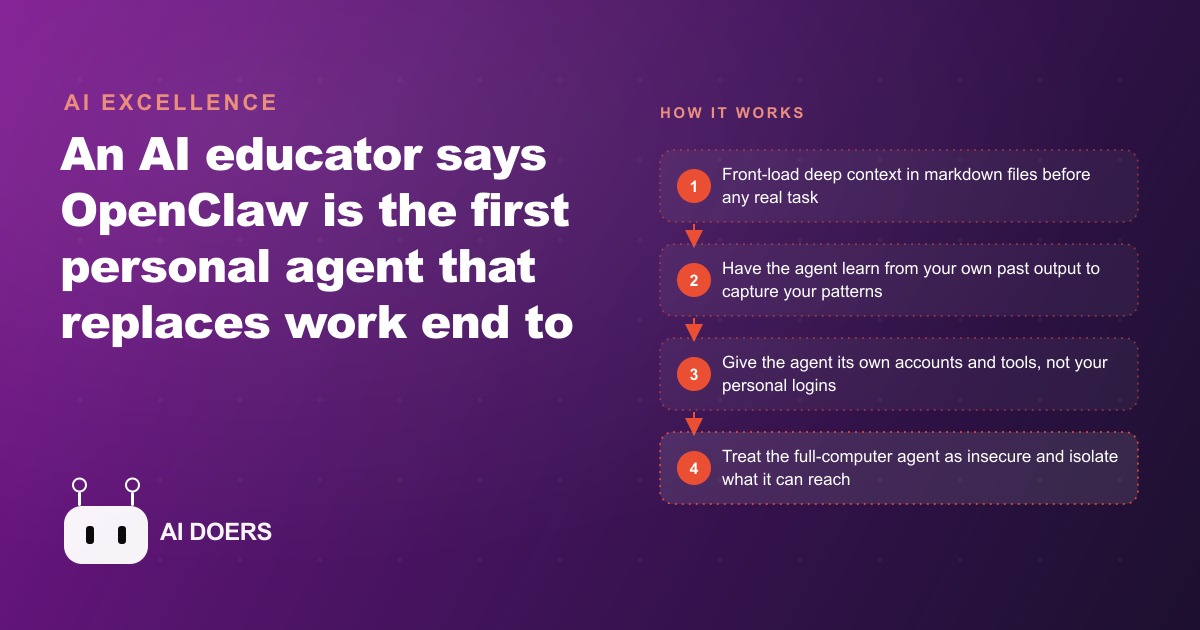
After weeks of experimentation, an AI educator concluded that OpenClaw is the first agent that replaces work end to end rather than supplementing it, but only because he fed it a dozen pages of deep context and gave it its own accounts and tools.

The most dangerous position in AI adoption is not ignorance. Ignorance is correctable. The dangerous position is confident misplacement: believing you are operating at level four when your actual infrastructure keeps you permanently at level two. The difference between those positions is not a function of which model you subscribe to, which integrations you have assembled, or how sophisticated your prompts have become. It is almost entirely a function of how much the AI knows about your specific world before it touches work that matters.
Madhuranjan Kumar spent time tracing exactly where this insight leads. The experiment that made it concrete came from an AI educator who spent the better part of a day building what may be the most rigorously contextualized personal agent setup documented for a general audience. The cost was three hundred dollars in API usage on that single day. Sustained at the scale he described, the full configuration would run approximately nine thousand dollars per month. Those numbers matter not because they define a threshold every business must cross, but because they reveal the category of investment that genuine autonomous operation actually requires, and because the gap between that reality and what most people believe they have already built is wider than anyone is comfortable admitting.
The five-level framework the educator laid out is most useful as a diagnostic, not a roadmap. Level one is everyday answers: AI as a faster, more conversational search engine. Level two is daily work assistance: drafting, summarizing, reducing friction on tasks that used to take longer than they deserved. Level three is prototyping: using AI to sketch a demo, test an idea, or mock up something that previously needed specialized skills or weeks of dedicated time. Level four is building real applications: functional automations, connected systems, working products that process real data and produce real outputs. Level five is the personal agent: the system operates on a schedule without waiting for your prompt, handling a defined class of work while you are doing something else entirely.
What the diagnostic reveals, when applied honestly, is that most people stop at level two. They just do not realize it.
Context Is the Whole Mechanism, Not the Model
Every level from one through four shares a structural feature that separates all of them from level five. In each of those levels, a human must be at the trigger point of every meaningful action. Even at level four, where you are building real products and connecting real APIs, you are still the one who decides when to start, what to ask, and when to stop. The model waits. You are the engine. The AI is powerful, but you are still the operator who initiates every cycle.
Level five is categorically different. At level five, the system does not wait for a prompt.
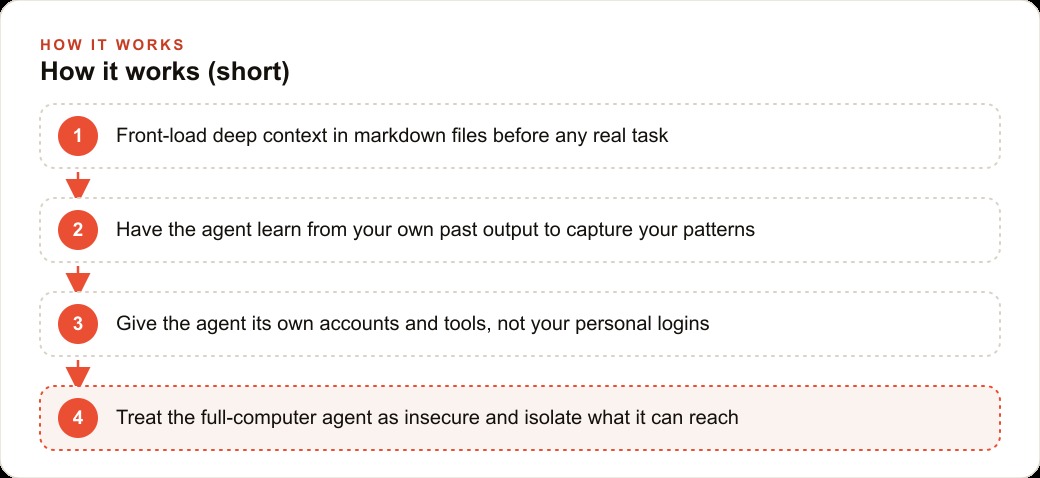
Before running a single real task, the educator spent most of the day loading context. Approximately a dozen multi-page markdown files covering his personal background, the structure of his company, his long-term vision, his editorial voice, his audience profile, his distribution strategy, and his competitive positioning. Then he went further: he loaded the transcripts of his last forty videos into the system so the agent could understand not just what he claimed to believe about his work, but what he actually produced when doing it in front of an audience. The difference between those two things, between articulated belief and documented working output, is exactly the kind of institutional knowledge that no paragraph-long system prompt can transfer.
Consider what it actually means to hand a task to a highly capable person with no institutional knowledge of your business. They will produce something. Often something that looks technically competent at a surface level. But technically competent output from a stranger requires you to spend nearly as much time correcting it as you would have spent producing it yourself. The model does not know which framing your audience has learned to distrust. It does not know that a particular topic category quietly stopped generating the right engagement six months ago. It does not know your pricing logic, the specific objections your best prospects raise before they become customers, or the competitive positioning that earns credibility with the people you are actually trying to reach. Without that context, every output is a draft from a stranger, and you are the editor.
With a properly built context layer, the agent operates from something genuinely close to your accumulated judgment. Not identically. Not without the occasional misfire that requires a correction. But close enough that a meaningful share of outputs clear your threshold without a rewrite. When outputs clear your threshold without intervention, you are not in the loop on those tasks. Being out of the loop is what level five actually means in practice.
The investment most people skip is not the subscription. It is the up-front context work. A one-page system prompt is a job listing. Twelve markdown files built from real documents, combined with forty transcripts of working output, is something closer to the institutional knowledge transfer you give a senior hire during their first two weeks of onboarding. The difference in downstream output quality is not incremental. It is categorical. And almost no organization has done this work with any seriousness.
Why Most Teams Are Stuck at Level Two Without Knowing It
When looking honestly at how most businesses use AI after a year or two of regular engagement, the pattern is consistent. They have daily workflows. They draft with AI, summarize with it, use it to reduce friction on tasks that used to demand more attention than they deserved. Some have connected automations that touch multiple tools and fire on defined conditions. They have put in the time and built real habits. They describe themselves as serious AI adopters. In the five-level framework, the overwhelming majority of these teams are operating at level two.
The diagnostic question that surfaces this is not "do you use AI every day?" It is "does your AI know enough about your specific business, in durable and persistently accessible form, to substitute for your judgment on a defined class of work without requiring your supervision at every step?" If the answer is no, you are at level two regardless of how many integrations you have wired together or how detailed your individual prompts have become.
This is worth dwelling on, because the two populations, teams that believe they are at level four and teams that are actually there, look nearly identical from the outside. Both use AI daily. Both have built automations. Both are materially faster at certain categories of work than they were two years ago. The difference is invisible in any single session and only becomes visible over time, as the compounding gap between the two groups widens.
Here is what that gap looks like in practice. When you are at level two, every interaction starts from zero. You restate your voice, your constraints, your audience, your competitive position, your editorial exceptions, every time you open a session. Sometimes you do it efficiently. Sometimes you spend the first ten minutes of a working session reconstructing context that should have been held persistently. The friction is not dramatic enough to feel like a bottleneck in any given interaction. Across months of daily AI use, it accumulates into something significant: a persistent cognitive tax on every session, paid by the user, because the system is not holding the knowledge that would eliminate it.
The teams that have moved from level two toward something closer to level five are not generally using more powerful models than everyone else. Many of them are using the same frontier models available to any paying subscriber. What they did differently was treat context as infrastructure rather than as something to be assembled freshly each session. They made the up-front investment that converts context from a burden the user carries into a durable asset the system holds. That shift is the entire mechanism. The model is the same. The context is what changed.
What Autonomous Operation Actually Requires, and What the Business Takeaway Is
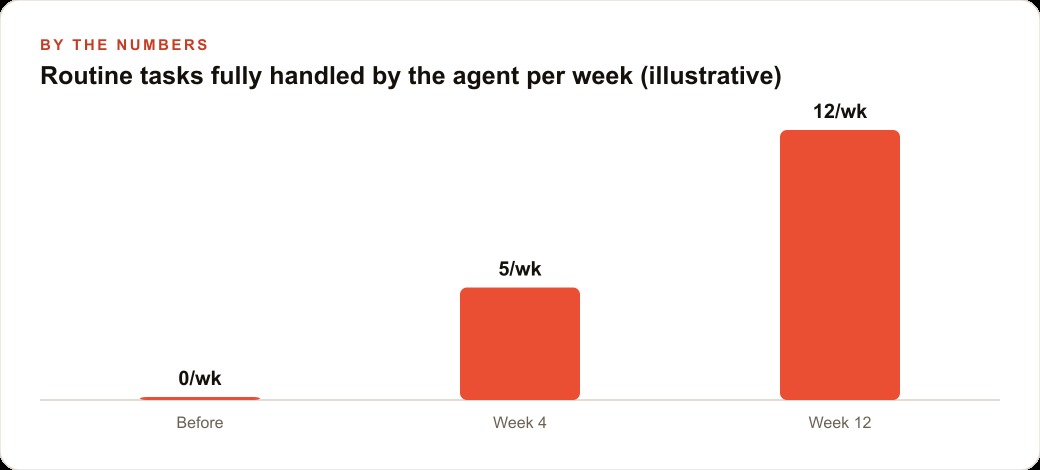
Once a real context layer exists and the scheduling infrastructure is in place, the agent's daily behavior becomes something genuinely difficult to describe using conventional software or productivity language. In the educator's setup, the agent runs an afternoon cycle without any human prompt: it scans a defined set of sources, filters by criteria it has internalized from the context files, emails a structured summary to the research team, updates the shared workspace with new material, and generates formatted assets for the production queue. No human input triggers any of those steps. A scheduled time trigger does.
The closest real-world analog most people have encountered is a reliable research associate who operates in a different time zone, works a consistent shift, and delivers a structured handoff without being asked. Except this one does not lose track of the format on a busy week. It does not forget that a particular topic category was deprioritized several months ago because of how the audience responded. It does not miss the distinction between topics you amplify and topics you engage with critically. Those distinctions are in the files. The files persist.
Security at this level of autonomous access deserves genuine architectural weight. Granting an agent autonomous send authority on email, write access to shared workspaces, and operational scheduling permissions is a qualitatively different risk profile than granting a human assistant those same permissions. A human assistant can recognize an unusual request and pause to ask. An agent executing autonomously cannot, by design. Dedicated accounts with carefully scoped permissions are not optional caution at this level. They are the architecture. The agent should access exactly what it needs to do its job, and nothing adjacent to that.
The technical overhead also deserves honest acknowledgment. Building this kind of pipeline requires comfort with terminal environments, API key management, reading error logs, and iterative debugging loops. This is still an engineering discipline. A non-technical operator cannot absorb it in an afternoon. That gap is real, and it defines where autonomous agent deployment currently sits in the maturity curve. Pretending otherwise helps no one make a sound decision.
But none of that changes the central lesson, which applies at every level of AI use from daily writing assistance through autonomous scheduling. The ceiling on what AI can do for your business is almost never set by the model. It is set by how much that model knows about your business before it does work that matters.
The practical implication is a shift in where you invest time when building with AI. Less time optimizing prompts for individual tasks. More time building the context documents that make every future interaction start from a position of genuine institutional knowledge. Your editorial voice in concrete and specific terms. Your audience's particular sensitivities and what they find credible versus what makes them tune out. Your pricing logic and how you explain trade-offs to different types of buyers. The categories where your expertise is real and the ones where you defer. Your track record with past campaigns, with clear attribution for what worked, what failed, and the specific reasons for each outcome.
If none of that exists in structured and persistent form, every AI interaction you run starts over from nothing. You are the context layer, manually assembled at the start of every prompt. As long as you are the context layer, you cannot be out of the loop. Which means, by definition, you are not at level five.
The businesses that compound their advantage over the next two to three years will not be the ones that adopted the newest model the fastest. They will be the ones that built durable context infrastructure and let it compound over time. The model is a commodity available to anyone with a payment method. The context layer is the moat. That is the real lesson from the three-hundred-dollar day, and unlike nine thousand dollars a month in API spend, it does not require a large budget to begin building.
That is exactly what we do at AI DOERS. Book a private 30-minute call with Madhuranjan Kumar and we will map the fastest path to it for your specific business.
Book your call →
Madhuranjan Kumar
Madhuranjan Kumar brings 20 years of performance-marketing experience and has managed over $200 million in Facebook ad spend for brands across the United States and beyond. His expertise spans the full modern marketing stack: Meta, Google Ads, TikTok, email automation, CRM, and the websites that hold it together. At AI DOERS he turns that track record into lead-generation systems for businesses across every industry.