
Why Keeping Up With AI Is Making You Fall Behind
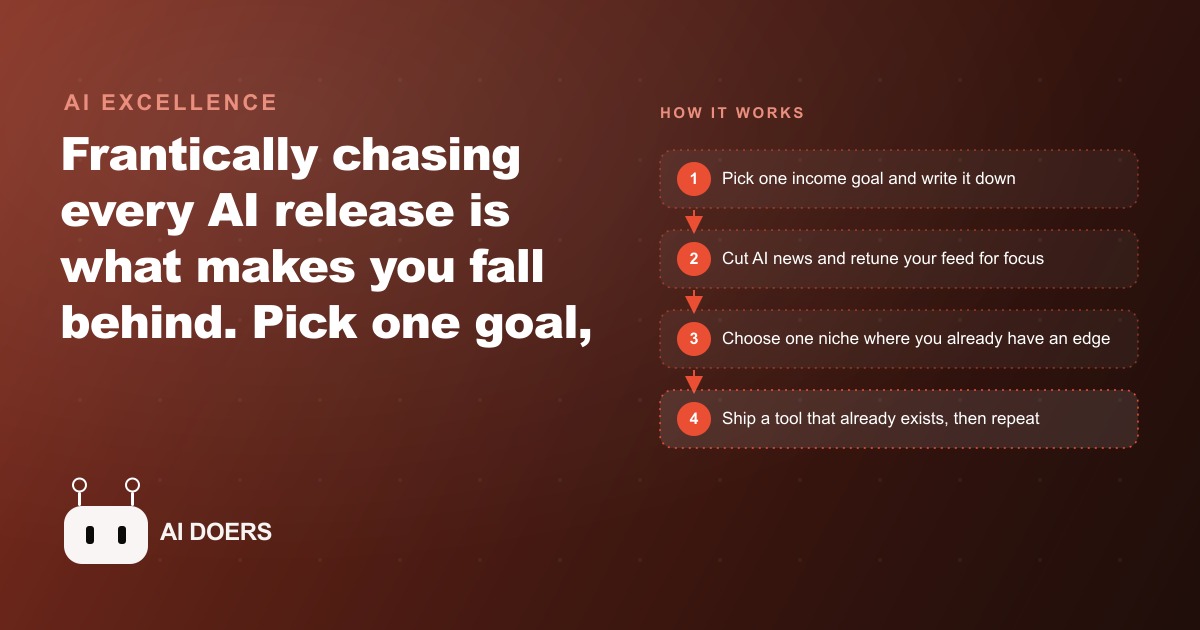
Chasing every AI release traps you in a fear and FOMO loop that blocks action. The way out is to pick one clear goal, niche down on tools that already exist, and deliberately cut your AI news intake.

Andrej Karpathy, the researcher who coined the term "vibe coding" and spent years at the frontier of machine learning, recently said something that stopped me when I read it. He said he has never felt more behind as an engineer. Not less behind. More. And he is one of the people who helped build the systems that are making everyone else feel the same way.
I am Madhuranjan Kumar, and I want to use that admission as a starting point, because it reveals something important about what the "keep up with AI" instinct is actually doing to the people who follow it. If someone standing at the technical frontier of this field feels more behind than ever, then "keeping up" is not a strategy. It is a treadmill. The faster you run, the faster it moves. And the feeling of falling behind is not a sign that you are failing. It is the natural output of a system specifically designed to produce that feeling in you, because that feeling is what keeps you watching.
The anxiety is real. I do not want to dismiss it. But I think most people who experience it are misattributing the cause. They believe the discomfort comes from the pace of the technology. In my experience working with business owners and developers, it comes almost entirely from an unresolved decision about what they are actually trying to build.
The decision gap that keeps you glued to the feed
Here is the mechanism. When you have not committed to a specific direction, every new announcement becomes potentially relevant. A new model releases and you need to know if it changes your plans, but since your plans are not concrete, you cannot evaluate whether it does. So you consume the coverage, feel briefly informed, and then the next announcement arrives and the cycle resets. The anxiety is not about any individual announcement. It is about the background noise of an unmade choice echoing forward into every piece of content you encounter.
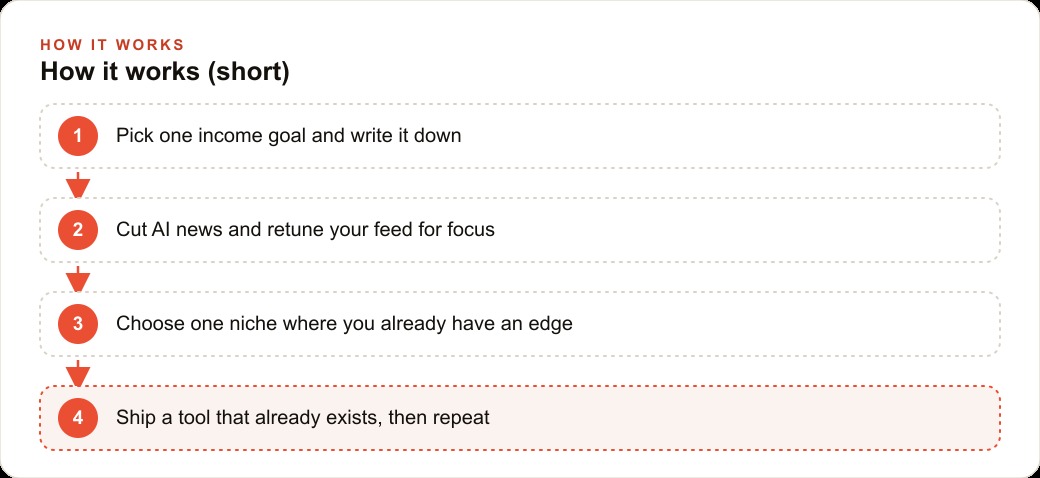
The moment you commit to a specific goal, a concrete income target, a particular business problem you are going to solve, a defined customer type you are going to serve, the content landscape changes instantly. You can evaluate each new release against a clear question: does this change what I am doing in the next ninety days? Most of the time the answer is no, and you can dismiss the announcement and move on in thirty seconds. The rare time the answer is yes, you know exactly what to do with it. The decision is the filter. Without the decision, there is no filter, and every piece of content competes equally for your attention regardless of its actual relevance to you.
Two people can read the same announcement about a new AI model. One of them, who has committed to building a specific automation tool for a specific type of business, reads it in two minutes, concludes it does not change anything this quarter, and returns to building. The other, who has not committed to anything concrete, spends an hour reading about it, watching a video, reading a thread, and ends the session feeling more behind than when they started. Same information. Different experience. Entirely because of the presence or absence of a made decision.
The algorithm engineered to make the anxiety worse
The decision gap would be manageable on its own. The reason it feels unmanageable is that the content distribution ecosystem is specifically calibrated to exploit it.
Recommendation algorithms do not optimize for your learning. They optimize for your engagement, which means they optimize for the emotional state that keeps you watching. The emotions that drive the most engagement in a technology content category are fear and FOMO: fear that you are missing something critical, fear that someone else is moving faster, fear that the tool you have been using will be obsolete before you finish building with it. Every click on an AI news video tells the algorithm that this category produces engagement from you, and the algorithm responds by surfacing the most emotionally charged version of that category. The videos that perform best in this space are the ones with the most alarming framing, which means the more you consume, the more alarmed the next recommendation becomes.
This is not a conspiracy. It is an optimization function doing exactly what it was designed to do. But the output for an undecided person trying to figure out what to build is genuinely destructive. You end up with a mental model of the AI landscape that is shaped by what was most emotionally compelling to produce and distribute, not by what is most relevant to your actual situation. You develop detailed knowledge of capability announcements and benchmark comparisons and hypothetical future scenarios, and very little knowledge of the practical, already-tested question of which tools from two years ago are still not deployed in most businesses and how to close that gap profitably.
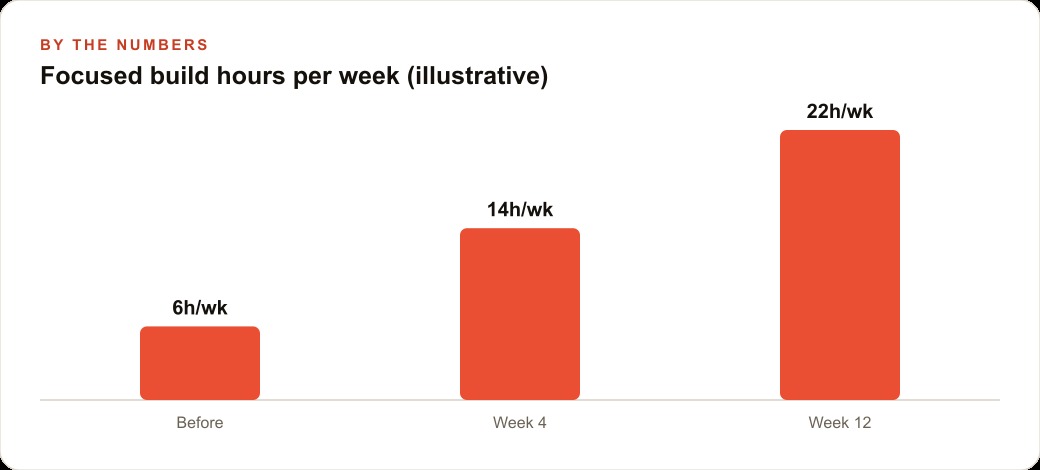
The fix is deliberate and it works quickly. Retune your content inputs toward people who are building and operating rather than analyzing and predicting. History and biography are particularly valuable because they give you exposure to how durable advantages were built in previous technology cycles, which trains your pattern recognition on what lasts rather than on what is newest. Swap two hours of AI news per week for one long-form operator interview or one business case study from a category you want to enter, and your quality of thinking about what to build will improve faster than it does from any benchmark comparison you could read.
The adoption lag that makes keeping up irrelevant
Here is the fact that makes the "keep up" instinct most clearly counterproductive: tools that existed in 2024 are still not implemented in the majority of businesses. Not slightly underdeployed. Barely deployed at all.
The technology is sprinting. The adoption is walking. The gap between what is technically possible today and what the average business is actually running is measured in years, not months. That gap is where the opportunity lives, and it is accessible using tools that already exist and have already been tested and already have established use cases, documentation, and communities around them. You do not need to be at the frontier to win. You need to be at the frontier of implementation for businesses that are still at the starting line.
This reframing changes everything about how to allocate your time. An hour spent learning to deploy a two-year-old automation tool that no business in your target category has implemented is more valuable than an hour reading about a new model that will not be available to most developers for months and will not be deployed in real business workflows for years after that. The value is not in knowing about the latest release. The value is in being the person who has actually built something with what already works and can point to a running result in a real business.
There is also a specific danger in forward-focused consumption that is easy to miss. The more you read about future capabilities, the more your own planning drifts forward too. You start designing for tools that do not exist yet and waiting for features that might arrive next quarter. Meanwhile, someone with less theoretical knowledge than you is deploying what already works and collecting the first-mover advantage in the implementation gap. The gap does not stay open forever. The businesses that move into it first extract the most value from it. Every month you spend reading about what might be possible is a month you are not building the thing that closes the gap for a real paying customer.
The niche compounding effect that rewards focus
Pick one valuable chunk of the implementation gap. Build something that solves one specific problem for one type of business. Take it to a real customer. Observe what breaks, what the customer actually cares about, what the right sequence of steps is. Then build a second version for a second customer, where the hard decisions from the first engagement are already answered.
This is the niche compounding effect, and it is the most powerful argument against trying to stay current across everything. When you solve the same type of problem for the second time, you are not starting from zero. You are starting from a template that already works, with the mistakes already made and the edge cases already handled. The third delivery is faster than the second. The tenth is faster than the fifth. Over time you develop a delivery system that is both higher quality and lower effort than what a generalist can offer, and the pricing power that comes with genuine specialization compounds the economics further.
The two cleanest positions in the current AI implementation market are: the transformation partner who audits a business and rolls out specific automations on top of what it already runs, and the partner who builds the AI-first version of a business from the ground up, starting with the assumption that every repetitive job should be automated and a human should only be in the loop when genuine judgment is required. Both positions are better served by deep, repeated experience in one category than by broad, shallow awareness of everything. A general awareness that AI can automate many things is worth almost nothing in a client conversation. A specific operating system for a dental practice or a landscaping company, built from real deployments and real failure modes and handed over running, is worth a great deal.
One practical example of this compounding: a developer who builds an AI operating system for client reputation management at local service businesses, covering review monitoring, draft response generation, and complaint pattern reporting, does the hard design work once. The first client teaches them what breaks, what the owner actually cares about, and what the right intervention timing is. The second client gets those lessons baked in from day one. The system becomes more capable and the delivery becomes faster with each repetition, and the developer builds an advantage that is very difficult for a generalist to replicate even with access to superior tools.
The unfair advantage audit you should run this week
Before you decide what to niche into, run one structured audit of where you already hold an advantage that most people entering the AI implementation space do not have.
Ask yourself: where have I spent the most hours in my career before today? Where do I already understand the language, the workflows, the pain points, the decision makers, and the failure modes? Where could I walk into a business and immediately recognize what is wrong and why, without having to spend months learning the domain? That domain is your unfair advantage, and it is almost certainly undervalued by you because it feels ordinary from the inside. The knowledge accumulated from years of working in a specific industry feels like background noise to the person who has it. To someone trying to build AI tools for that industry with no domain knowledge, it is an enormous competitive moat that would take years to replicate.
The AI capability set is available to everyone. The domain knowledge is not. A developer with deep knowledge of dental practice operations who builds AI tools for dental offices is competing against a very small number of people, because most AI developers do not have that domain knowledge and most dental practice operators do not have the technical capability to build and deploy. The intersection is where real advantages live.
Study the history of technology adoption cycles before you study the next benchmark comparison. The patterns that matter, the ones that predict which early movers extract durable value versus which ones get commoditized quickly, are visible in how previous technology transitions played out across two or three decades. Those histories reward reading time in a way that AI predictions almost never do. Predictions are mostly wrong. History is mostly instructive. Trade some of your prediction diet for history, choose your niche deliberately using the unfair advantage audit, commit to it completely, and build. The people earning real money from AI right now are not the people who read the most announcements. They are the people who shipped the most things using tools that already existed, to customers who needed those things done.
That is exactly what we do at AI DOERS. Book a private 30-minute call with Madhuranjan Kumar and we will map the fastest path to it for your specific business.
Book your call →
Madhuranjan Kumar
Madhuranjan Kumar brings 20 years of performance-marketing experience and has managed over $200 million in Facebook ad spend for brands across the United States and beyond. His expertise spans the full modern marketing stack: Meta, Google Ads, TikTok, email automation, CRM, and the websites that hold it together. At AI DOERS he turns that track record into lead-generation systems for businesses across every industry.