
Why Groq's LPU Makes Real-Time Voice AI Finally Feel Human
Groq's LPU is a chip built only for inference, and its near zero latency finally makes real time voice AI feel natural. Here is the pipeline and a plumbing company example.

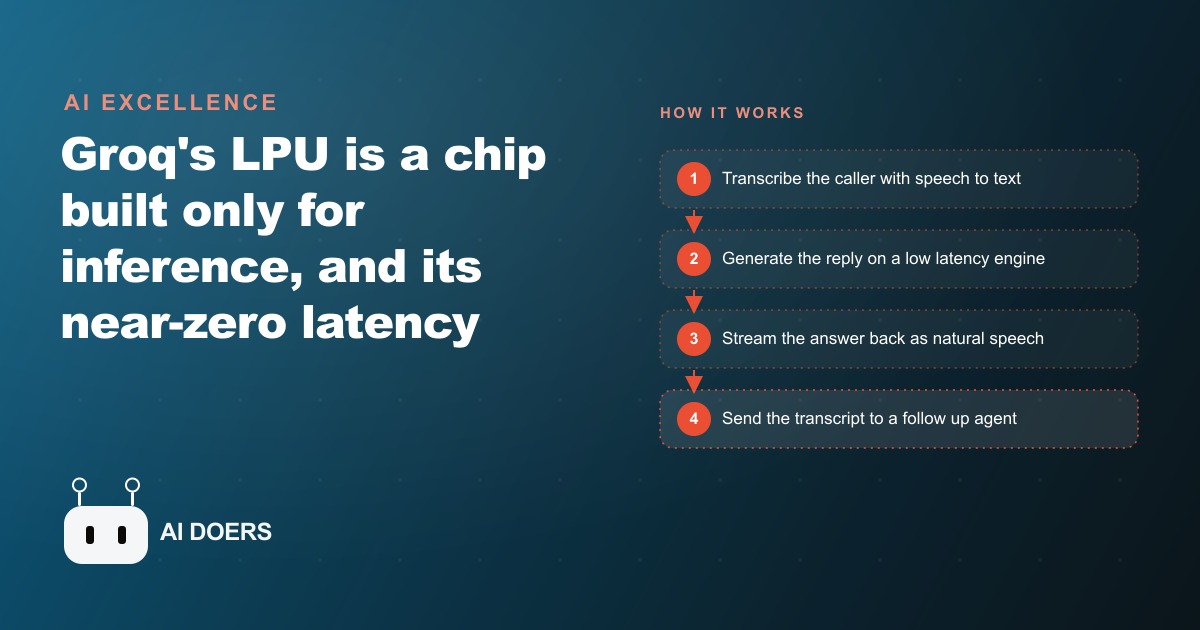
There is a chip architecture designed to do exactly one thing: run AI inference as fast as physics allows, with predictable latency on every single token. That chip is called an LPU, and the reason it matters for voice AI is that natural conversation has a tolerance for silence measured in milliseconds, not seconds. I am Madhuranjan Kumar, and this is the playbook for building a voice AI agent on Groq's LPU infrastructure, with a concrete worked example for a plumbing company. By the end you will know the three-part pipeline, how each piece connects, and what a realistic deployment looks like for a business running inbound call volume.
The Shift From CPU to GPU to LPU Tracks What AI Needed at Each Stage
Understanding why an LPU exists requires a quick map of how AI compute needs changed over the past twenty years. CPUs are designed for general-purpose sequential computing. They are excellent at executing long chains of conditional logic where each step depends on the result of the previous step. They are not well suited for the parallel matrix multiplications that neural networks require at every layer during both training and inference. When deep learning research produced models that needed those parallel computations at scale, the industry moved to GPUs.
GPUs were designed for graphics rendering, which requires computing many pixel values simultaneously from the same underlying geometry and lighting data. That parallel structure made GPUs effective for neural network training, where the same matrix operation needs to be applied simultaneously across thousands of weight parameters. The shift from CPU to GPU for AI workloads produced the training infrastructure that made large language models possible. But training and inference are different computational problems. Training computes the same forward pass and backward pass repeatedly across large batches of data, which maps well to the parallelism GPUs provide.
Inference is the process of generating one output at a time, with each new token depending on all previously generated tokens. That dependency structure means the generation cannot be parallelized within a single sequence the way training batches can be. The result is that GPUs, which are optimized for parallel batch operations, are not the most efficient architecture for the sequential token-by-token generation that inference requires. They can run inference, and they do at massive scale, but they carry overhead from the parallel architecture that does not benefit the sequential generation task.
GPUs Stall on Inference Because Their Architecture Was Designed for a Different Problem
The specific failure mode of a GPU on inference is memory bandwidth. During inference, the model's weights must be loaded from memory for every single token generated. For a model with billions of parameters, this means moving a very large amount of data from GPU memory to compute units for every token in the output. GPUs are built with wide memory buses designed to move large batches of data efficiently for parallel operations. When the access pattern is sequential rather than parallel, the wide memory bus provides less advantage and the latency per token climbs above what natural conversation tolerates.
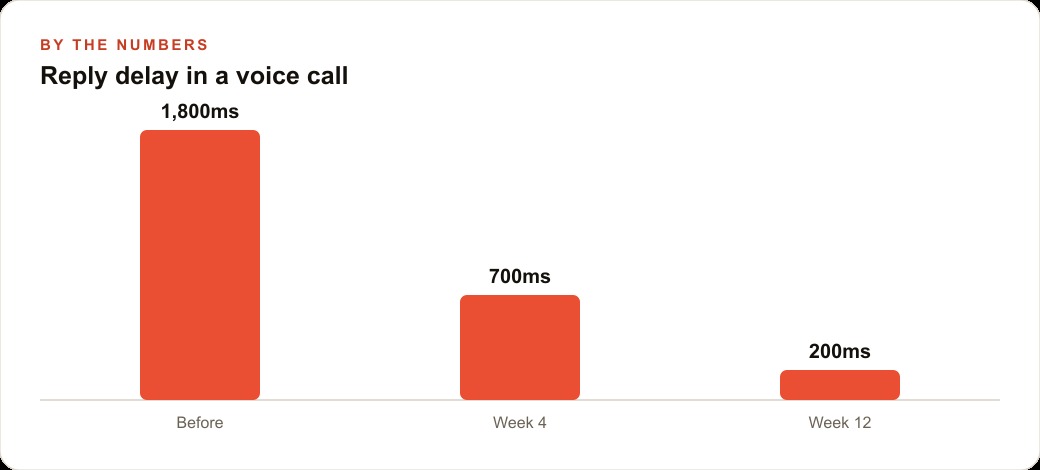
The first token latency, the time between submitting a prompt and receiving the first word of the response, is where this stall shows up most visibly. For conversational voice AI, the first token latency determines how long the caller hears silence after speaking before the AI begins responding. A pause of two seconds is barely acceptable in a text interface. In a phone conversation, two seconds of silence sounds like a dropped call or a system error. Users hang up or ask "hello, are you there" before the system has had a chance to respond. That experience destroys the value of the voice AI completely.
The LPU Is Built Specifically for the Sequential Inference Problem That GPUs Were Not Designed For
Groq's LPU architecture makes a different set of design choices than a GPU. Instead of optimizing for parallel batch operations across many simultaneous queries, the LPU optimizes for deterministic sequential execution of a single inference pass with the minimum possible time between each token. The memory architecture is designed to move model weights to the compute units on a predictable schedule that is matched to the token generation cadence, eliminating the variable latency that comes from GPU memory access patterns under inference workloads.
The result is a first token latency in the range of milliseconds rather than hundreds of milliseconds or seconds. For voice AI specifically, this changes the conversational feel from a system that clearly has a processing delay to a system that feels like it is listening and thinking in real time. The difference in user experience is not incremental. It is the difference between a conversational interaction and a form-filling interaction with voice input. Users tolerate the second. They actually prefer the first when the latency is low enough that they stop noticing it.
The tradeoff is that the LPU is not designed for training workloads or for the kind of large parallel batch inference that cloud providers use to serve many simultaneous requests on shared GPU infrastructure. Groq's hardware is specialized for inference speed at the cost of training capability and some types of batch efficiency. For applications where the latency requirement is the binding constraint, as it is for real-time voice AI, the specialization is a feature rather than a limitation.
GPUs Still Win at Training and High-Throughput Batch Inference
It is worth being explicit about where the LPU does not have an advantage, because the right architecture choice depends on the actual workload. Training large language models requires processing massive batches of data through forward and backward passes in parallel, which is exactly what GPUs do efficiently. An LPU is not a training chip. Similarly, for applications where throughput of simultaneous requests matters more than per-request latency, serving many requests in parallel on GPU infrastructure remains more cost-effective than routing each through LPU hardware.
The LPU advantage is specific to applications where individual request latency is the constraint, and those applications are becoming more numerous as AI moves from text-based interfaces to real-time voice and interactive environments. For a voice AI that handles inbound calls, each call is a separate conversational session where latency determines the quality of the interaction. That use case maps directly onto the LPU's strength.
The Three-Part Voice Pipeline Connects STT, Language Model, and TTS Into a Single Conversation Loop
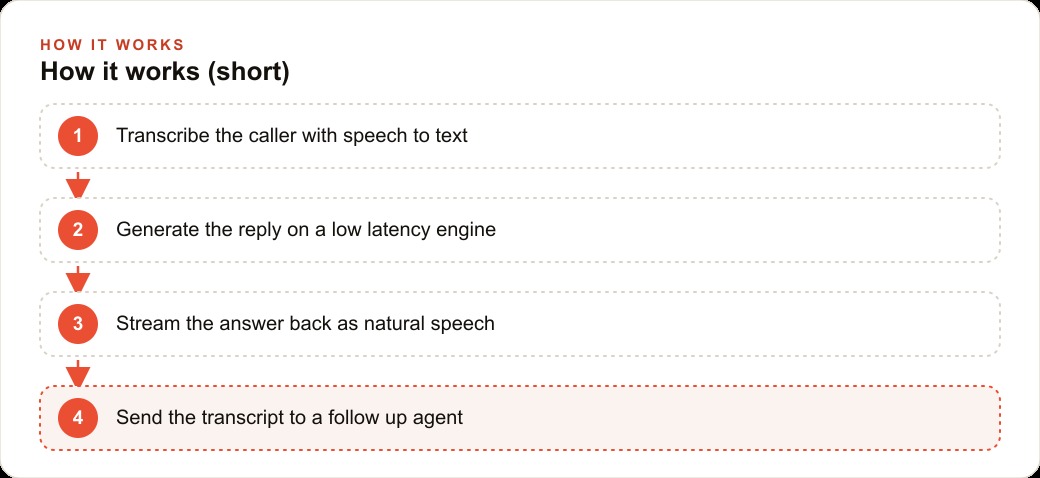
The voice AI pipeline that delivers a natural conversation experience has three components that must work together with minimal latency between them. The first component is speech-to-text transcription, which converts the caller's audio into a text representation that the language model can process. The quality of transcription directly affects the quality of the AI's response, because a transcription error in the caller's question produces a response to the wrong question. For a plumbing company handling inbound service calls, a transcription that mishears the caller's address or misidentifies the type of problem described creates a booking error that sends a technician to the wrong location or with the wrong equipment.
The second component is the language model itself, running on the LPU, which receives the transcribed text, processes it in the context of the full conversation history, and generates the next response. This is where the LPU's latency advantage is most directly felt, because this step is the one that creates the conversational pause the caller notices while speaking.
The third component is text-to-speech synthesis, which converts the model's text output back into audio that the caller hears. The quality of the TTS voice determines how natural the conversation sounds and whether callers recognize they are speaking with an AI system. For a service business where part of the value of a human receptionist is projecting professionalism and warmth, a synthetic voice that sounds robotic undermines that value.
Vapi Handles the Heavy Lifting and Reduces the Integration Work to Configuration
Vapi is a voice AI infrastructure platform that handles the technical integration of these three components so that a business deploying a voice AI agent does not need to manage WebSockets, audio streaming pipelines, and latency optimization independently. The platform connects to Groq's LPU for inference, to a choice of transcription providers for the STT layer, and to a choice of TTS providers for the voice synthesis layer, and exposes a configuration interface that lets a business define the agent's persona, knowledge base, and decision logic without writing the streaming infrastructure from scratch.
For a plumbing company, the configuration work consists of defining what the agent knows about the business, including service areas, types of jobs handled, pricing structure, and booking process, and specifying how the agent should handle different categories of inbound calls. The technical infrastructure is Vapi's responsibility. The business-specific knowledge and decision logic is the operator's responsibility.
A Plumbing Company Can Capture After-Hours Calls and Pre-Qualify Emergency Bookings Automatically
The concrete use case for the plumbing company is this: the majority of plumbing emergencies do not happen during business hours. A burst pipe at 11pm, a backed-up sewer line on a Saturday morning, and a water heater failure on a holiday weekend all produce calls that go to voicemail if the company does not have after-hours coverage. Of the callers who reach voicemail, a significant portion call the next business on the list rather than waiting for a callback. The voice AI agent captures those calls and converts them into booked appointments rather than lost leads.
The agent takes the call, confirms the type of problem through a structured conversation, collects the address and contact information, asks about the urgency and current impact, and either books an appointment slot or dispatches an emergency callback to the on-call technician depending on the severity. The call cost is a fraction of a human dispatcher, and the agent handles any call volume simultaneously without adding staffing cost for peak periods. For any business running lead capture and client intake through its website or phone system, building a voice AI layer on top of the existing contact process is the next step in converting the traffic and call volume already arriving into a higher percentage of booked and qualified appointments. The infrastructure for building this exists today at a cost that any service business can sustain.
The Playbook in Order for a Business Ready to Deploy
The sequence for building this capability starts with choosing a Vapi account and connecting it to Groq's inference endpoint for the language model step. Next, configure the agent's knowledge base with the business's service information, booking process, and common questions. Write the agent's conversation flow covering the common call types: new customer inquiry, existing customer scheduling, emergency call, and general information request. Test the agent with at least twenty mock calls covering different accents, problem descriptions, and edge cases before connecting it to a live phone line. Monitor the first month's calls, review transcripts weekly, and refine the agent's responses based on the patterns in where conversations stall or where callers express frustration. By month two, the agent handles routine call types reliably and the review workload shifts from catching errors to improving quality on edge cases the agent still handles less confidently than routine calls.
What Happens When the Volume Grows and the Agent Scales Without Proportional Cost
The property of a voice AI agent that is most different from a human staffing solution is the cost structure under variable volume. A human receptionist costs a fixed amount per hour regardless of call volume. An AI agent costs per call or per minute of audio processed, which means the cost scales with usage and the cost per call at high volume is a fraction of the cost per call at low volume. For a plumbing company that runs high seasonal volume during winter freeze events, the voice AI handles fifty simultaneous calls at the cost of fifty individual call charges while the human staffing alternative requires either a standing team large enough for peak volume or a reactive scramble that results in missed calls during the surge.
The compound benefit over twelve months of operation is that the agent accumulates a performance record that can be analyzed. Which call types produce the most confusion in the transcript? Which questions does the agent handle confidently versus where does it hedge or misidentify the problem? Which callers end the call without completing a booking, and what was the last thing the agent said before they dropped off? That performance record is the training data for improving the agent's responses over time, and it is automatically available as a byproduct of normal operation rather than requiring a separate evaluation effort. The businesses that analyze and act on that data monthly are the ones whose voice agents get meaningfully better over the first year of operation, while the businesses that deploy and leave the agent unchanged are the ones whose competitors eventually offer a noticeably better phone experience to the same pool of potential customers.
That is exactly what we do at AI DOERS. Book a private 30-minute call with Madhuranjan Kumar and we will map the fastest path to it for your specific business.
Book your call →
Madhuranjan Kumar
Madhuranjan Kumar brings 20 years of performance-marketing experience and has managed over $200 million in Facebook ad spend for brands across the United States and beyond. His expertise spans the full modern marketing stack: Meta, Google Ads, TikTok, email automation, CRM, and the websites that hold it together. At AI DOERS he turns that track record into lead-generation systems for businesses across every industry.