
Why GPT 5.5, Grok, and Google's Code Red Are All Reactions to Anthropic
Each move traces to one cause, Anthropic's lead in coding. GPT 5.5's front-end push, the Grok build and Grok computer launch, and Sergey Brin's Google strike team are all attempts to catch a coding flywheel that compounds an early lead into a widening gap.

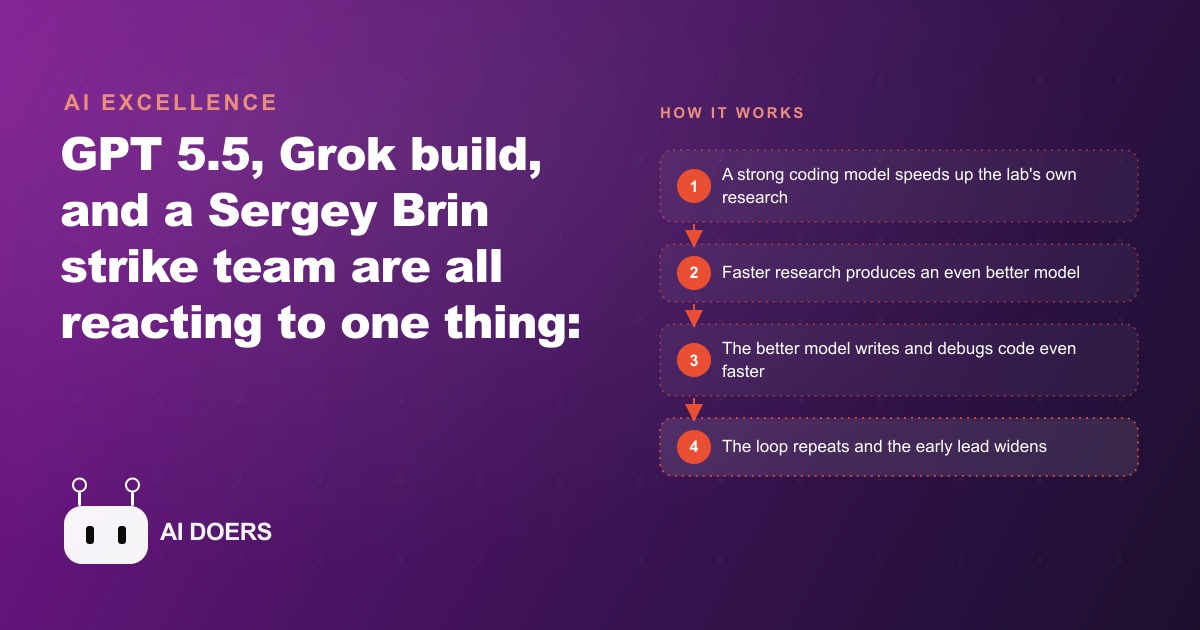
Every major AI lab is now running at maximum effort to close one gap: Anthropic's lead in coding. GPT 5.5 shadow-dropped targeting front-end and image-to-code work, xAI announced Grok Build alongside Grok Computer, and Google reportedly convened a strike team led by co-founder Sergey Brin with the DeepMind chief technology officer. For any business team trying to build an AI stack that still works well six months from now, the question is how to evaluate models correctly and stay modular enough to adapt as the race keeps running.
I am Madhuranjan Kumar, and the practical problem this competitive sprint creates is real. If you commit your team's workflows to whichever model won last week's benchmark, you will be rebuilding around a different model next quarter. The answer is not to delay choosing. It is to build a stack that evaluates models on the right dimensions and remains flexible enough to swap the underlying model when the rankings shift, without disrupting the work that has been built on top of it.
Understand the Flywheel Before Picking Any Tool
Before selecting a model or committing to a platform, it is worth understanding why coding specifically has become the central battleground. A model that can reliably write, debug, and complete long-horizon coding tasks is not just a useful product feature. It becomes a research accelerator for the lab that built it.
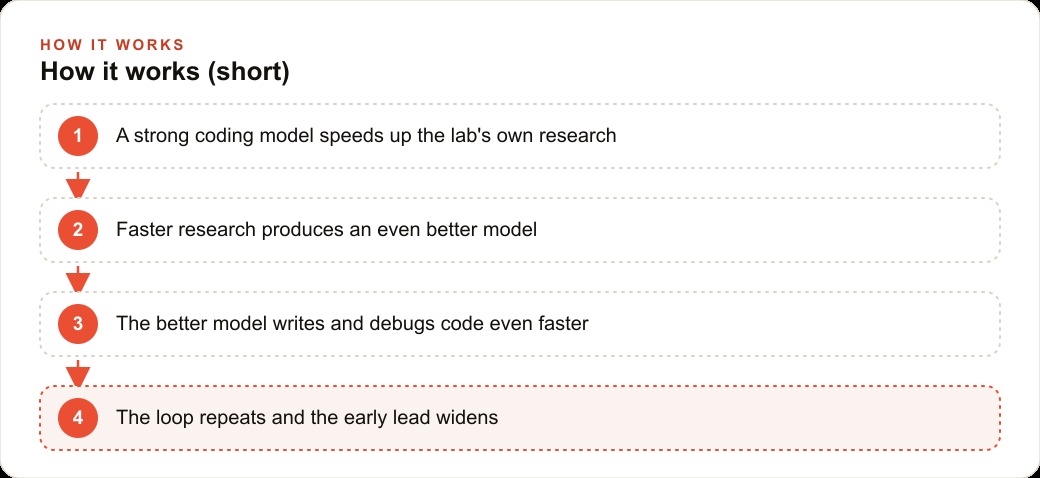
A strong coding model lets the lab's own engineers run more experiments with less manual work. More experiments produce faster progress on the next generation of models. The next generation codes better, which again accelerates the lab's own research cycle. That loop, sometimes called the coding flywheel, means an early coding lead tends to widen over time rather than converge toward parity. The lab with the best coding model is simultaneously building the best engine for producing its next model. The incumbents are not treating this as an acceptable situation.
GPT 5.5 is reported to be particularly strong at front-end work and image-to-code conversion, turning a design screenshot into a near-accurate replica, which is a capability directly competitive with what Claude currently does well. The timing follows Anthropic's releases rather than OpenAI's own internal roadmap, which reveals where the competitive pressure is coming from. Grok Build and Grok Computer from xAI are expected to launch together, with local and remote versions, targeting the same coding workflows from a different angle. The Google strike team, with a DeepMind chief technology officer involved alongside Sergey Brin, is a top-level resource allocation rather than a background project. Google reportedly now factors AI usage into engineer performance reviews and runs mandatory AI training sessions, with Brin reportedly writing that every Gemini engineer must be pushed to use internal agents on complex tasks.
The detail that cuts through the noise most usefully is the NSA situation. The Pentagon reportedly placed Anthropic on a supply chain risk list, yet the NSA reportedly continued using its Mythos model regardless, with operational needs outweighing the geopolitical complication. When institutions of that scale and risk-sensitivity override a formal supply chain blacklist to keep using a model, the performance difference they are preserving is real.
For a business team, the practical lesson from the flywheel is to judge models on the work that compounds, which is coding and long-horizon task completion, rather than on the work that is already commoditized, which is short text generation and basic question answering. That is the capability frontier where the race is being run, and that is where your evaluation should focus.
Map Your Actual Work to the Capability Categories That Matter
The second step is specific to your business: mapping your real workload to the task categories where model performance actually differs at the current frontier. Generic evaluation against benchmark charts does not tell you whether a model will handle the specific kinds of tasks your team does daily.
For an accounting firm, the relevant task categories are document-heavy, precision-dependent, and often require maintaining context across long and complex source materials. Drafting client memos that summarize tax positions requires accurate synthesis of long regulatory documents, which is a long-horizon reasoning task. Building internal tools for tracking client deadlines and filing statuses requires reliable code generation. Extracting specific figures from financial statements and checking them against a calculation requires both numerical precision and the ability to hold context across a long document without losing track of which number belongs to which entity. Generating checklists and structured workflows for standard engagement types requires consistent formatting fidelity across many output fields.
Each of those categories has a different performance profile across the current generation of models. Long-horizon reasoning and precise document synthesis is where o3 Pro with extended thinking produces the strongest results for work where the reasoning chain matters as much as the conclusion. Code generation for internal tools, deadline trackers, data extraction scripts, and simple automation is where Claude Opus 4.1 currently leads. Short-form structured output, client-ready checklists, meeting agendas, formatted summaries, and standard correspondence, is where GPT-5 handles the task reliably.
Numerical verification is the category where no current AI model should be the final check. Independent confirmation against the source document is required regardless of which model generated the number. That is not a gap specific to one model. It is the current state of the field for precision-dependent numerical claims.
The firms that extract the most consistent value from AI tools have done this mapping explicitly rather than picking one tool and routing everything through it. They are also the ones who update the map when new models arrive, because the performance rankings across these task categories are genuinely shifting with each major release.
Test Models on Your Real Tasks, Not Published Benchmarks
Vendor benchmarks are marketing documents. Academic benchmarks measure the capability the benchmark was designed to measure, which may or may not correspond to what your team actually does. The evaluation that produces useful results is running the current leading models on a set of actual tasks drawn from the last month of real work.
For an accounting firm, this means selecting fifteen to twenty real work items and submitting each one to the models under evaluation with identical prompts. Not simplified or sanitized versions. The actual client memo draft, the actual regulatory passage that needs summarizing, the actual financial statement with a specific figure to extract, the actual engagement checklist for a standard tax planning matter. Each task goes to each model. The output is evaluated by the team member who does that work every day, because they have the judgment to distinguish useful output from output that looks complete but requires significant correction to be usable.
The criteria for an accounting firm are specific: accuracy of factual claims verifiable against the source document, whether any statutory reference or figure can be confirmed without extensive investigation, structural clarity of the output before editing, and the number of revision cycles required before the output can go to a client or into a filing. Those criteria produce a comparison that measures the things that cost the firm real time and real credibility when they go wrong.
Running the evaluation over two weeks rather than two days matters because it captures variation across task types. A model might produce strong output on the first five tasks in the set and fail on the sixth in a way that would not appear in a one-day test. Two weeks of real workload diversity surfaces the failure modes alongside the strengths.
For firms that are also managing client development through digital channels, including any paid search campaigns through Google Ads or content-driven acquisition through SEO, the evaluation should include the client-facing writing tasks as well as the analytical ones. A proposal for a new engagement, a summary of tax savings delivered to an existing client, a brief article on a regulatory change sent to prospects: these are output types where model selection matters for tone and precision in addition to structure.
Set Up a Modular Stack That Separates Work From the Underlying Model
The most important architectural decision for a team building AI into professional workflows is keeping the work portable rather than embedding it into a specific model's behavior. This has a specific practical meaning: the prompts your team writes, the output formats you have agreed on, the integration points with your practice management software, and the evaluation criteria for each task type should not be properties of one AI vendor. They should work with any reasonably capable model.
For an accounting firm, portability means writing prompts that describe the task and the desired output format without relying on model-specific memory or behavior quirks. A prompt that says: review this regulatory memo and list every provision that applies to closely held S-corporations, with each provision on its own line followed by the specific section reference, is a portable prompt. It produces structured, useful output from Claude, from GPT-5, and from whatever model arrives next quarter. A prompt that says: continue from our last discussion on the deferred income question, relies on session memory behavior that varies by tool and breaks when the model is swapped.
The architectural test for any workflow decision is simple: if the underlying model is replaced tomorrow, does this process still work? If yes, the workflow is portable. If no, it has created a dependency that will cost time to rebuild when the swap comes, and in the current competitive environment, the swap will come.
For the accounting firm, the modular stack looks like this. The prompt library lives in a shared folder where any team member can read and refine the prompts. The output formats for common deliverable types are documented as templates the firm uses regardless of which model generated the draft. The connection between AI output and the firm's practice management software goes through the software's own API rather than through a vendor-specific plugin that might be discontinued. The model allocation is documented, dated, and carries a scheduled review date.
For firms that manage client communication through web CRM systems or run Meta Ads campaigns to acquire new clients, the AI stack powers both the operational work and the growth work. Keeping that stack modular means that when a better model for proposal drafting ships in Q3, adopting it does not require rebuilding the campaign copy workflow or the CRM integration.
Allocate Tasks to Models Based on Current Evidence, Not Vendor Loyalty
With the evaluation complete and the stack designed for portability, the allocation decision follows from the evidence rather than from brand preference or familiarity. Each major task category goes to the model that performed best for it in the evaluation.
For the accounting firm, a current evidence-based allocation looks like this. Long-horizon document reasoning, summarizing regulatory documents, synthesizing multiple tax positions, building a comprehensive client memo from a set of source materials, routes to o3 Pro with extended thinking because the careful multi-step reasoning on precision-dependent professional work is where that model currently leads. Code-based internal tools, deadline tracking systems, data extraction scripts, structured workflow builders, go to Claude Opus 4.1. Short-form structured output, client checklists, engagement letters, formatted summaries for standard matter types, routes to GPT-5 where the synthesis speed and consistency are appropriate for the task.
Numerical work stays off AI generation entirely. Any figure, calculation, or date that will appear in a client document or a filed return is verified against the primary source by a person. This is not a gap in the AI stack. It is a deliberate policy that reflects the current state of model reliability on precision-dependent quantitative claims, and when the evaluation at a future quarterly review shows that a model has crossed the threshold for trustworthy accuracy on the specific numerical types the firm works with regularly, the policy updates.
The Google situation reinforces the case for explicit allocation. Mandatory AI usage across a firm without task-level evaluation produces inconsistent results because teams default to the nearest available tool for every task rather than the right tool for each task type. An accounting firm with a small team and an explicit, evidence-based allocation is extracting more consistent value than a large organization running a mandatory-adoption mandate without the underlying workflow design. The size of the resource commitment does not determine the quality of the allocation. The quality of the evaluation does.
Schedule the Next Review Before the Current One Closes
The last step, and the one most often skipped, is building the review cadence into the calendar before closing the current evaluation. The labs are shipping major releases multiple times per year. GPT 5.5 shadow-dropped without a major announcement. Grok Build and Grok Computer are in active development. Google's strike team is operating with top-level resources. The model that leads a specific task category in the current evaluation may not lead it in four months.
For the accounting firm, the quarterly review is a structured half-day exercise. Take the current task-to-model allocation map. Run five representative tasks from each category against the current models. Compare results against the previous quarter's baseline. Update the allocation map where the rankings have shifted. Brief the team on any changes. Update the shared prompt library if any prompts need adjustment for the new allocation.
Four structured reviews per year keeps the firm's stack within one model generation of the current frontier without dedicating significant overhead to tracking every release and benchmark report. The evaluation cost is the time of the review. The output is a current, explicitly justified allocation that the whole team follows rather than an outdated one that everyone is quietly working around or gradually drifting away from.
The coding flywheel means that whoever leads on coding at each review date is also building the research engine that will shape the next review. For a business team, that does not change the review process but it does change how to weight the results. A model that leads on coding and long-horizon task completion in a given quarter is likely to maintain or extend that lead by the next review because the flywheel is self-reinforcing. Weighting those capabilities slightly above others when allocations are close is a reasonable policy that reflects how the race is actually running.
Building a resilient AI stack does not require predicting which lab wins the coding race over the next two years. It requires mapping real work to real current performance, keeping the stack modular enough to swap when the map changes, and reviewing the map on a schedule that matches the pace at which the map changes. The flywheel will keep running. The firms with a system for updating their allocation as it runs will keep extracting value from whichever model is currently ahead, regardless of which vendor name is on the label.
That is exactly what we do at AI DOERS. Book a private 30-minute call with Madhuranjan Kumar and we will map the fastest path to it for your specific business.
Book your call →
Madhuranjan Kumar
Madhuranjan Kumar brings 20 years of performance-marketing experience and has managed over $200 million in Facebook ad spend for brands across the United States and beyond. His expertise spans the full modern marketing stack: Meta, Google Ads, TikTok, email automation, CRM, and the websites that hold it together. At AI DOERS he turns that track record into lead-generation systems for businesses across every industry.