
Why Everyone Turned On Anthropic This Week
Anthropic was caught charging Claude Code subscribers extra and refusing requests when their code mentioned rival agent tools, and it only refunded users after the complaints crossed a million views. The lesson for operators is to never bet everything on one AI vendor.

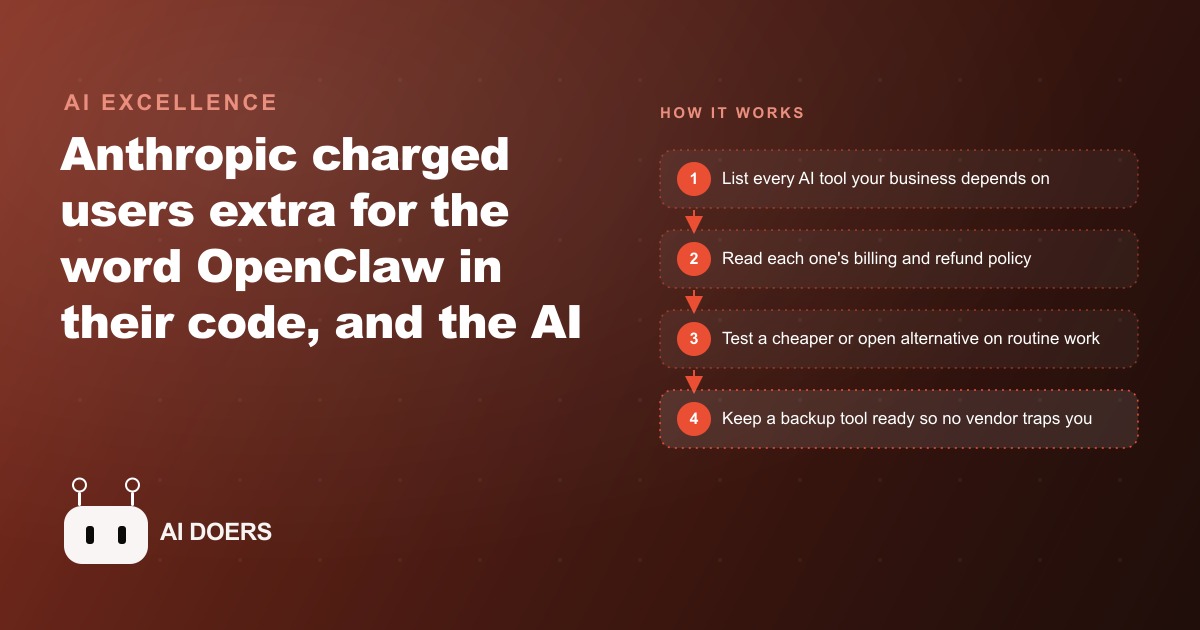
Here is a position that will annoy people on both sides of this week's drama: the outrage at Anthropic is mostly missing the point, and so is the defense of it. Yes, Claude Code was caught charging users extra and refusing requests when their code merely mentioned a rival tool like OpenClaw or Hermes. Yes, that is a bad look, and yes, the company only made it right after a complaint went viral. But if your takeaway is that Anthropic is uniquely villainous, you have learned the wrong lesson. The real story is about you, the operator, and a mistake you are probably making right now: betting your entire operation on a single AI vendor and trusting that their billing and their policies will always protect you. I am Madhuranjan Kumar, and I want to argue that the vendor is a sideshow. The dependency is the danger.
The billing story is worse than it looks, and that is the point
Let me lay out what actually happened, because the details matter for the argument. A developer on Anthropic's top tier, the plan that runs around two hundred dollars a month, was suddenly told he was out of extra usage while his own dashboard showed most of his plan completely untouched. He was billed roughly two hundred dollars on top of that. When he went hunting for the cause, he found it: a single file name sitting in a recent code note, a name that belonged to a competing tool, had triggered the charge. Another user reproduced the behavior on a completely empty project, set off by nothing more than a small block of text.
When the first developer reported it, support acknowledged the bug, thanked him for finding it, and then refused to give the money back. Only after his post crossed more than a million views did the company reverse course, call it a detection bug, and offer refunds plus a month of credit. Now, the common reaction is to be angry that the bug existed, or unsettled that private work was being scanned for specific words at all, and both reactions are fair. But sit with the timeline, because it contains the actual lesson. The refund happened because the story went viral. If that same glitch had hit a small operator with no audience, the extra charge would most likely have stuck. That is the uncomfortable truth I want to press on. Your cash flow should never depend on whether your complaint can trend online, and if you are all-in on one vendor, it quietly does.
Why blaming Anthropic specifically is a comfortable mistake
It is emotionally satisfying to make this about one company's behavior, and that is exactly why it is a trap. If the problem is Anthropic, then the solution is to be mad at Anthropic, and you can go back to your single-vendor setup feeling righteous and unchanged. But the pattern here is not unique to one company or even to AI. Any provider you cannot leave is a provider that can raise prices, throttle your account, change its policies, or ship a billing bug, and your only recourse is to hope you matter enough to get heard. The specific villain is interchangeable. The structural weakness, having no exit, is the thing that actually put that developer at the mercy of a viral post. Focusing your anger on the vendor lets you skip the harder work of fixing your own exposure, which is why it is the comfortable mistake.
The good news the drama buried
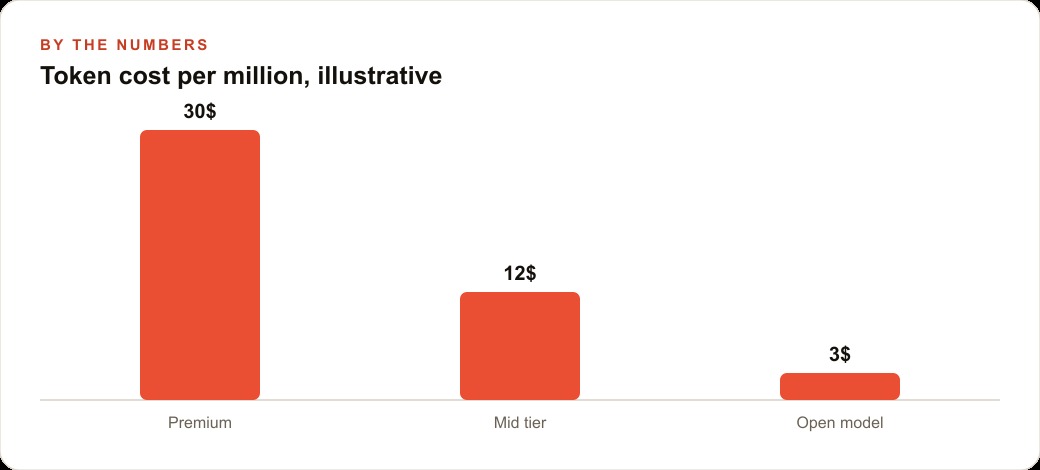
While everyone was busy being outraged, the week quietly made the contrarian case for portability all by itself, because the cheaper and open alternatives had a genuinely strong run. An open model called DeepSeek V4 shipped with a huge context window at a fraction of the price of the big premium models. NVIDIA put out an open model that handles images, audio, and text and runs on a machine you can keep in your own office. This is the part the anger obscured. For a large share of routine work, summarizing documents, answering common customer questions, drafting standard replies, the expensive frontier models are now often overkill, and running an open one locally means your only real cost is electricity and your data never leaves the building.
That reframes the whole episode. The lesson is not stop using Anthropic. Their premium models are genuinely excellent at the hard stuff. The lesson is stop being unable to use anything else. The moment you have a tested backup for your everyday work, a billing bug at any single vendor becomes an annoyance instead of an emergency, and you negotiate from a position of being able to walk.
What portability looks like inside a real business
Take a landscaping company whose office uses an AI tool to write proposal emails, draft seasonal maintenance plans, and answer the same pricing and scheduling questions all day long. That is real, daily value. It is also a single point of failure, and peak spring season is the worst possible time to discover that. If that one vendor changes its pricing, throttles the account, or ships a billing glitch like the one this week, the office grinds to a halt exactly when it can least afford to.
So here is how I would set it up, with a backup in place from the start. The everyday jobs, the quote emails and the standard replies, I would route to a cheaper or open model that costs very little per use. The heavier work, turning a full site walkthrough into a detailed planting proposal, can stay on a premium tool where the quality earns its price. I would keep a written note of exactly what each tool charges for and what triggers an overage, so a surprise bill never lands mid-season. And for anything touching customer addresses, property details, or payment notes, an open model running on the office machine keeps that information from ever leaving the building, which is both cheaper and safer. Put rough numbers on it: if the bulk of daily prompts are routine and you move them to a model that costs a fraction of the premium rate, you cut the exposure and the bill at the same time, while losing nothing on the handful of tasks that actually need the frontier model. The office gets the same output it relies on today with far less risk if any single provider has a bad week.
Where the resilient setup pays off beyond the AI bill
The interesting thing is that building this kind of portability does not just protect you from billing surprises, it makes the rest of the business steadier too. When your customer-facing copy is not hostage to one vendor's uptime, the messaging behind your Facebook and Instagram ad campaigns keeps flowing even if a provider has an outage, so your lead response time does not spike at the worst moment. Routing the routine drafting to a reliable, cheap model means the content that feeds SEO and organic search gets produced consistently rather than in fits and starts tied to one tool's mood. And keeping your lead handling inside a CRM and website stack you control, rather than deep inside a single AI vendor's ecosystem, means switching models never means rebuilding your follow-up. Resilience at the tool layer quietly becomes resilience across the whole operation.
The uncomfortable part is that the scanning worked as designed
Strip away the outrage and there is a detail worth sitting with soberly: the mechanism that charged people for mentioning a rival was not a random malfunction, it was a system doing roughly what it was built to do, just clumsily and in public. Whatever the exact intent, the episode revealed that the contents of private work can be inspected for specific terms and acted on. For an operator, the lesson is not to assume malice at every vendor. It is to remember that when you pour your business into a tool, you are also handing over visibility into your work, and you are trusting the provider's judgment about what to do with that visibility. That trust may be well placed most of the time. The mistake is forgetting it is trust at all.
This is exactly why portability and local options matter beyond the billing question. Running an open model on your own machine for anything sensitive is not paranoia, it is simply keeping your work in a place where no external system can inspect or price it based on what it contains. The customer addresses, the property details, the payment notes, the internal strategy, none of that needs to leave the building for the routine tasks, and keeping it in means one entire category of surprise is off the table permanently. Control over where your data lives is control over how exposed you are to a vendor's next policy decision.
Resilience is a posture, not a one-time project
The last thing I want to push back on is the idea that you handle this once and forget it. The AI landscape is moving too fast for a set-and-forget answer. Prices shift, policies change, new open models leapfrog old ones, and the vendor that is cheapest and safest today may not be in six months. So the real protection is not a single backup tool bolted on once, it is a posture of staying portable and paying attention. Keep your workflows loosely coupled to any one provider. Re-test the cheaper and open options every so often. Notice when a vendor's pricing or exclusivity terms drift in a direction that boxes you in.
None of that requires constant effort, just a habit of checking in a few times a year and refusing to let any single tool become load-bearing in a way you could not unwind. The businesses that get hurt by episodes like this one are the ones that went all-in years ago and never looked up. The ones that stay resilient treat vendor independence the way they treat any other operational risk: something you design for on purpose and revisit on a schedule, not something you react to in a panic the week a provider has a bad headline. Portability is cheap when you build it in early and expensive to retrofit in a crisis, which is the whole argument for doing it now.
The bigger tremors, and why they only reinforce the point
This was also the week the broader picture shifted in ways that make the argument stronger, not weaker. A lawsuit between two of the biggest names in AI went to trial. A major provider signed a defense contract that broke a promise it had made years earlier. Two giants quietly restructured the deal between them. None of that changes your Monday morning directly. But it is a steady reminder that the companies you rent these tools from are moving fast, chasing their own strategic interests, and not always acting in yours. You are not their priority. Your portability is the only thing that makes you resilient to their choices, and their choices are getting bigger and less predictable.
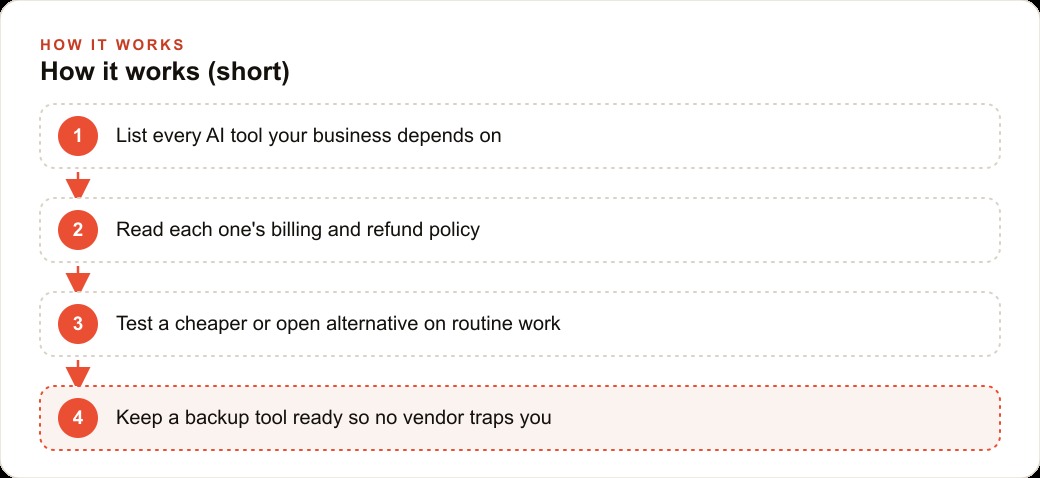
So my contrarian close is simple. Do not spend your energy deciding whether Anthropic was the villain this week. Spend it making sure no vendor can ever hold your business hostage again. Start by listing every AI tool you depend on and reading, just once, how each one handles billing and refunds. Test an open or cheaper model on your most routine task and see if you can even tell the difference. Where privacy matters, look at running a model locally so your customer data stays on your own machine. And watch where your providers are heading on price and exclusivity, not just what they charge today. None of this is hard, and you can do it yourself with a free afternoon. If you would rather have someone map your tools, find the cheaper swaps, and set up a backup so no single vendor can trap you, that is exactly the kind of work I do with owners, and it is worth doing before the next bad week rather than during it.
That is exactly what we do at AI DOERS. Book a private 30-minute call with Madhuranjan Kumar and we will map the fastest path to it for your specific business.
Book your call →
Madhuranjan Kumar
Madhuranjan Kumar brings 20 years of performance-marketing experience and has managed over $200 million in Facebook ad spend for brands across the United States and beyond. His expertise spans the full modern marketing stack: Meta, Google Ads, TikTok, email automation, CRM, and the websites that hold it together. At AI DOERS he turns that track record into lead-generation systems for businesses across every industry.