
Why Every AI Lab Is Racing to Personalize Your Experience
ChatGPT memories, Gemini personal intelligence that reads your YouTube and Chrome history, and even ads all trace back to one goal: knowing you well enough to tailor every answer. The business move is to feed AI real context so it amplifies what you already do well.

The AI tools the clinic owner had been using the same generic way for nearly two years started behaving differently in the spring, and the difference was that they were finally starting to know who they were dealing with.
The week the AI started knowing things
The shift was not dramatic. There was no announcement, no new interface. The owner of a small aesthetics clinic noticed it first on a Tuesday morning, prompting ChatGPT for a social media caption about a Botox promotion. The output it returned sounded more like the clinic than what the same prompt had produced three months earlier. The voice was closer to correct. The pricing framing matched what the clinic had been working out over the previous year. The offer language was more specific to the clientele.
The owner reread the prompt they had entered. It was the same general request they had used many times before. Nothing in the prompt had changed. What had changed was that ChatGPT had begun referencing the memories and conversation history from months of previous sessions, including all the times the owner had corrected its output, explained the clinic's pricing philosophy, described the target client, and refined the language it used. Those corrections had accumulated into something functional: a working model of who the clinic was and what its voice sounded like.
This was the beginning of what every major AI company is now racing to build, and Madhuranjan Kumar had been watching the pattern across clients for months before it became widely discussed. The race is not about features. It is about who the AI knows you are. Better memories, personal intelligence that reads usage history, even the ads that are starting to appear in AI interfaces: all of it traces back to the same goal. The lab that knows you best keeps you longest and serves you most precisely. The week the clinic owner noticed the shift was the week the race became practically visible in daily business use.
Turning on reference chat history and running the prompt
Once the owner understood what was happening, the natural move was to make it happen more deliberately rather than waiting for the model to gradually accumulate context from future sessions.
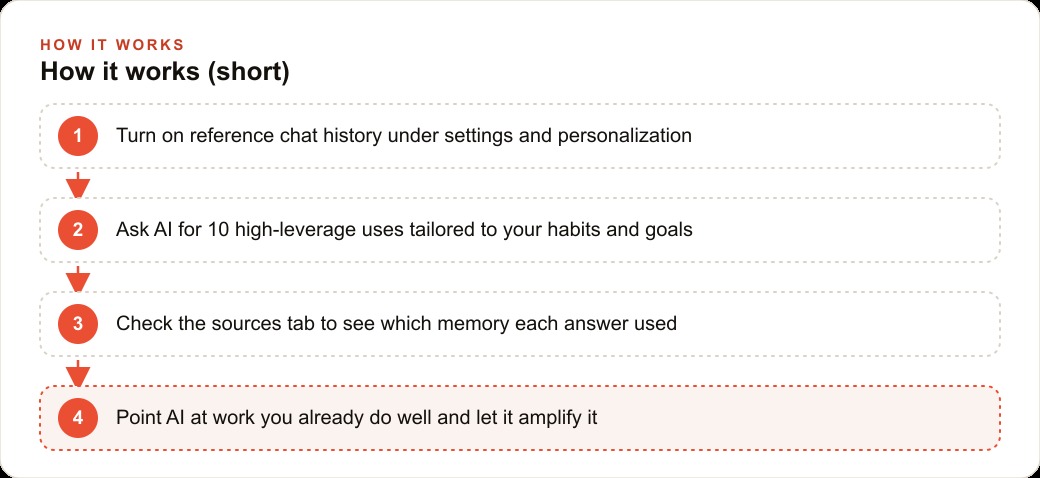
The first step was turning on reference chat history under ChatGPT's settings, in the personalization section. This setting tells ChatGPT to actively draw on a broader set of past conversations when generating responses, not just the few snippets it had saved as discrete memory notes. With that enabled, the model's awareness of past context expanded significantly. A new sources tab appeared in certain responses, showing exactly which past conversation or memory the model had drawn on for a given answer.
The prompt worth running after enabling reference chat history is this: ask ChatGPT for ten high-leverage ways you should be using AI in your specific work that you have not yet considered, based on everything it knows about you, your business, and your habits from previous sessions. With a year of conversation history and an active memory log to draw from, the output is not generic AI advice. It is tailored to the specific gaps in how this particular person is using AI relative to what their history suggests they could be doing.
For the clinic owner, two of the ten suggestions were genuinely surprising: a workflow for automating the pre-consultation intake summary that they had never considered, and a system for using AI to personalize after-care emails to individual clients based on the specific treatment each person received. Both were viable ideas the owner had not encountered in any general AI content. The prompt produced them because the model knew the clinic well enough to identify gaps that a generic response would not have surfaced.
What Gemini found in the search and YouTube history
While ChatGPT's memory improvements are driven by conversation history, Gemini's approach goes further into behavioral data. Google's Gemini personal intelligence feature reads your YouTube watch history and Chrome browsing history and uses both to inform how it responds to you in new conversations. It can also connect Google Photos and Gmail, building a substantially fuller picture of who you are from actual digital behavior rather than just what you have typed into the AI.
The clinic owner tested this with Gemini on a practical question: what treatments should the clinic consider adding to its menu given current market trends and the client demographics it typically served. The response that came back drew on YouTube videos the owner had watched about aesthetic medicine trends, Chrome searches for treatment protocols and equipment pricing, and past Gmail threads visible in the connected account. The answer was more informed than any generic market research prompt would have produced, because it was shaped by what this specific person had already been researching over the previous months.
The privacy trade-off is real and worth taking seriously. A YouTube video watched late at night because the algorithm served it does not represent genuine professional interest. Chrome searches done casually or for unrelated reasons become context that shapes future responses. Gemini has settings to control what it reads and which accounts it can access, and the clinic owner used those settings deliberately: connecting professional Gmail and allowing YouTube research activity, but disabling personal browsing history. The goal is a model that knows your professional context, not one that has accumulated a noisy representation of everything you have ever clicked.
One useful free tool that emerged from the same wave of AI updates: Google Trends now suggests comparison terms using AI, so you enter one term and it recommends relevant competitors or adjacent searches to compare against. For a clinic deciding which treatments to promote in a given quarter, this turns a one-dimensional trend lookup into a comparative analysis across several options in under three minutes.
Building a context document instead of waiting for the AI to guess
The memory features and personal intelligence systems are useful, but they work best when paired with intentional context. The clinic owner's most important realization during this period was that the AI's memory of past behavior was a useful starting point, but it was shaped by whatever had happened to occur in previous sessions. Some of that history was relevant; some was noise. Relying entirely on accumulated behavioral data to generate a personalized model meant accepting whatever picture that data happened to paint.
The better move was to write a context document: a single, clear document that captures who the business is, what its voice sounds like, who its clients are, what the pricing philosophy is, what kinds of content it produces, and a few examples of output that represent the quality standard it holds. The document does not need to be long. Three to four pages is enough to give any AI model a working understanding of the business that goes beyond what it would infer from behavioral patterns alone.
The context document the clinic owner built included a description of the typical client profile, a paragraph on pricing philosophy and how the clinic frames value relative to competitors, a section on the brand voice with examples of approved and rejected caption styles, the list of services offered with brief notes on which ones the clinic emphasized in current promotions, and three example social media posts representing the voice standard. Pasting that document into a ChatGPT session at the start of a working session, with reference chat history enabled, produced outputs that were immediately closer to usable than anything the clinic had generated in the previous two years of generic prompting.
This is the idea behind the memory features, automated: feed the model who you are, and it stops giving generic answers. The memory systems attempt to do this from behavioral inference. A deliberately written context document does it by direct instruction. The best setup uses both: the accumulated memory provides continuity across sessions, and the context document provides the explicit framing that memory alone might miss or distort. The context document takes about an hour to write and pays for itself on the first use.
The privacy line: what to share and what to keep back
Madhuranjan Kumar's consistent advice on this topic is to think about personalization as a professional tool and configure it accordingly. The features worth enabling are the ones that give the AI accurate professional context. The features worth limiting are the ones that feed it personal or irrelevant behavioral data that will lower the quality of professional outputs.
For most business owners, this means: yes to professional email access, because past client communications, proposals, and follow-up threads give the AI genuinely useful context about how the business operates. Yes to professional browsing activity in domains relevant to the work, because research sessions on industry topics shape useful professional context. No to personal browsing history, or at minimum keep it in a separate browser profile from professional research, because the noise from personal browsing degrades the professional signal.
The cleaner the context, the better the output. An AI that has a precise, accurate model of your professional situation outperforms one that has an enormous but noisy dataset of everything you have ever clicked. The personalization race the labs are running is a race toward more context, but the practical move for a business owner is to be selective about which context they allow in. The control settings on both ChatGPT and Gemini are granular enough to draw that line, and spending thirty minutes configuring them deliberately produces better results than leaving every setting at the default and hoping the AI figures out what matters.
There is also a forward-looking consideration worth naming. ChatGPT is rolling out ads on the free plan and the less expensive paid tier, partly to push users toward the full-price subscription and partly because a personalized ad product requires knowing who the user is. OpenAI is also testing age prediction based on chat behavior, which ties into ad delivery requirements around minors. These commercial pressures will push the labs toward collecting more behavioral context over time, which makes it more important, not less, to configure privacy settings actively rather than passively.
Four weeks later: outputs that sound like the clinic
Four weeks after enabling reference chat history, building the context document, configuring Gemini's personal intelligence settings deliberately, and adopting a workflow that started every working session by pasting the context document into the first message, the clinic owner had measurably different results.
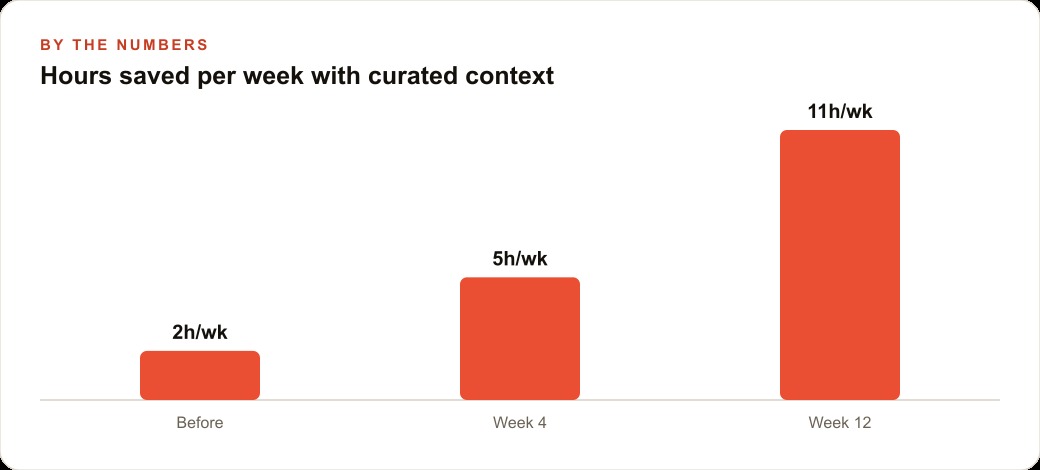
Before this process, generating a social media caption that sounded like the clinic required writing a detailed prompt, reviewing a generic output, rewriting it to match the voice, and sometimes going through two or three revision cycles before the result was usable. The editing cycle took roughly forty-five minutes per piece of content on average, and the owner was producing six to eight pieces per week. That was four to six hours per week of content editing, almost all of it correcting for the AI's lack of context about who the clinic was.
After four weeks with the personalized setup, the editing cycle per piece dropped to about fifteen minutes: a quick read, one or two targeted adjustments, done. The same six to eight pieces per week now take ninety minutes to two hours of total editing time instead of four to six hours. That recovery, roughly three to four hours per week, went back into client consultations and treatment planning work that only the clinic's practitioners could do.
The quality improvement was distinct from the time saving. The outputs were not just faster to edit. They were more accurate to the clinic's actual positioning and more useful as starting points for real content. Captions did not require complete rewrites. Email templates needed fine-tuning rather than reconstruction. Treatment explainers arrived with the right emphasis rather than generic medical description that had to be reoriented toward the clinic's specific approach.
This is what Anthropic's 2026 economic index pointed to when it described AI as working best as a force multiplier on work you are already doing well. The clinic owner was already skilled at understanding the business's voice and positioning. The AI's job was to accelerate the execution of that skill, not to replace the judgment underlying it. With accurate context, it fulfilled that role. Without accurate context, it produced content that required the owner to apply all the same judgment just to fix the output, removing most of the efficiency benefit.
The businesses that will benefit most from these personalization features are not the ones that hand everything to the AI and wait for it to guess correctly. They are the ones that invest thirty minutes in a context document, configure the memory settings deliberately, and treat the AI as a tool that amplifies a skilled professional rather than a system that can operate independently of that professional's knowledge. That investment compounds over time. The better the context, the better each output, and the better each output, the more efficiently the CRM and website stack that handles follow-up, scheduling, and client communication can make use of the content the AI helps produce.
For businesses running Facebook and Instagram ads alongside organic content, the same context document that improves organic social copy also improves ad creative copy. The clinic's ad creative draft quality improved on the same timeline as the organic content, not because the ads were changed separately but because the AI producing initial drafts for both was now working from accurate context about what the clinic's voice and offer looked like. One context document, applied consistently, raised the output quality across every channel simultaneously.
That is exactly what we do at AI DOERS. Book a private 30-minute call with Madhuranjan Kumar and we will map the fastest path to it for your specific business.
Book your call →
Madhuranjan Kumar
Madhuranjan Kumar brings 20 years of performance-marketing experience and has managed over $200 million in Facebook ad spend for brands across the United States and beyond. His expertise spans the full modern marketing stack: Meta, Google Ads, TikTok, email automation, CRM, and the websites that hold it together. At AI DOERS he turns that track record into lead-generation systems for businesses across every industry.