
Why Elon Musk Leasing Colossus 1 to Anthropic Is a Bigger Deal Than It Looks
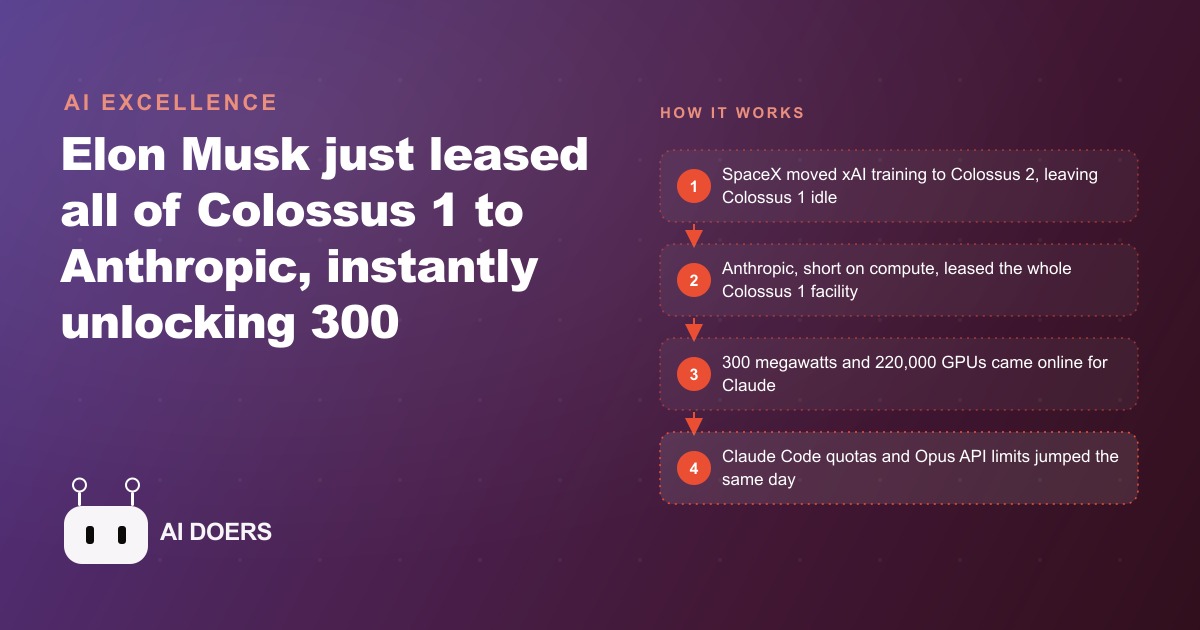
Elon Musk leased the entire Colossus 1 data center, over 220,000 Nvidia GPUs and 300 megawatts, to Anthropic, instantly unlocking compute that let Anthropic double Claude Code rate limits and raise Opus API limits the same day, despite Musk spending months attacking the company.

Elon Musk leased his rival's compute backstop to the company he has been attacking in public for months
The transaction makes commercial sense and reads as strange at the same time. SpaceX leased the entire Colossus 1 data center in Memphis to Anthropic. The facility holds more than 220,000 Nvidia GPUs and draws over 300 megawatts of power. Musk, who controls SpaceX, had spent months publicly calling Anthropic misanthropic and hypocritical. He runs xAI, which competes directly with Anthropic for the same enterprise AI customers. And then he handed them his idle data center.
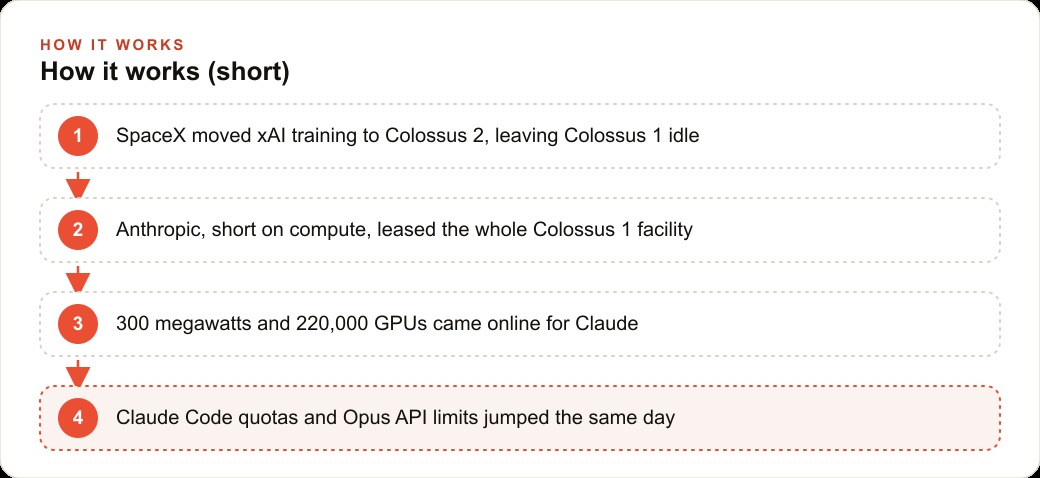
The logic becomes clear when you follow the machines rather than the public statements. SpaceX had already moved its xAI training work to Colossus 2, a newer facility. Colossus 1, with its 220,000-plus GPUs, was sitting idle. Idle GPUs at that scale cost real money every day with no revenue coming in. Leasing them to Anthropic is the business decision that stops the bleeding on a depreciating asset. Musk's own statement on the deal described Anthropic as having "no one who set off his evil detector," which reads like about as couched an endorsement as possible from someone who had been calling the company misanthropic for months.
The size of the deal is what matters most. This is not a modest capacity increase at the margin. It is one of the largest AI compute facilities in the world coming online for a single company in a single transaction, without a construction cycle, without a chip procurement wait, and without the multi-year infrastructure buildout that normally precedes a capacity addition of this scale.
Anthropic's 2021 GPU bet made sense at the time. AI demand outran it.
The backstory to this deal matters because it explains why Anthropic needed a fast fix rather than a gradual capacity ramp. When Anthropic was founded and through its early growth years, the leadership team made a deliberate choice to take a conservative approach to GPU acquisition. The argument was reasonable: AI demand was uncertain, GPU costs were high, and overextending financially to secure compute that might not be needed at scale would be a poor use of capital for a company still proving its models could compete.
The argument was wrong, not because it was poorly reasoned at the time, but because AI demand grew faster than even the most optimistic demand forecasts suggested. By late 2024 and into 2025, the gap between what Anthropic's users wanted to do with Claude and what the infrastructure could support had grown wide enough to produce visible friction in the product. Claude Code users were hitting rate limits during working hours. Opus API users were being throttled. Peak-hour restrictions were reducing what Pro and Max subscribers could actually get for their subscription fees.
Anthropic was compute-constrained in a market where the willingness to pay for capable AI was increasing faster than supply. That is a frustrating position to be in when the model quality is competitive and the product is strong. The infrastructure could not keep up with the demand the model quality was generating.
Colossus 1 is the fast path out of that constraint. A data center that already exists, already has power connections, and already has 220,000 GPUs racked and cooled does not need to be built. It needs to be leased. The operational implication of that distinction showed up in the timeline: rate limits changed the same day the deal was announced, not months later.
Rate limits doubled on the same day the deal was announced, not in a future roadmap
Three specific changes happened on the announcement date and each was visible to users immediately. Claude Code 5-hour rate limits doubled for Pro, Max, Team, and Enterprise plans. The peak-hour limit reduction was removed for Pro and Max accounts, meaning subscribers can use their full quota throughout the day rather than a reduced quota during busy hours. And Opus API limits jumped sharply at both the entry tier and higher tiers.
The timing of these changes is significant. When a company announces infrastructure capacity and then says rate limits will improve over the coming months, it is announcing a deal that will take time to operationalize. When rate limits change the same day as the announcement, the compute was already online and already serving requests before the press release went out. Anthropic did not announce Colossus 1 and then work to bring it online. The sequence ran the other way.
For any team that had adjusted its workflows around the old limits, the immediate improvement creates a practical review decision. The batching systems, retry logic, off-peak scheduling, and manual queuing arrangements that teams built to work around the old limits may now be unnecessary overhead. Unnecessary complexity in a production system has ongoing maintenance cost. This is a real architectural review worth doing now rather than carrying that complexity forward indefinitely.
What the Opus API jump from 30,000 to 500,000 tokens per minute means for teams that had built workarounds
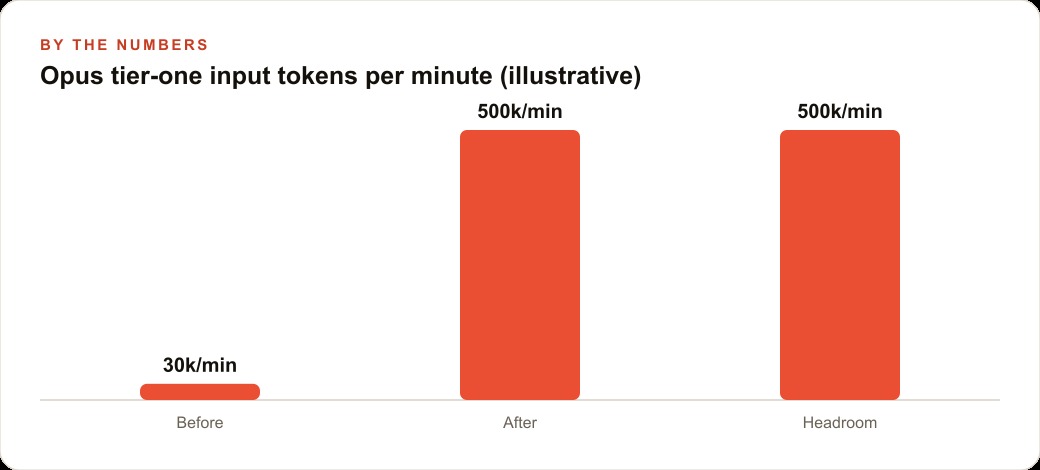
The Opus API change is the most significant for teams running production applications at scale. Before the Colossus 1 deal, the Opus tier-one limit was 30,000 input tokens per minute. After, it is 500,000 input tokens per minute. At tier four, the limit moved from 2 million to 10 million. These are not incremental adjustments. They are order-of-magnitude increases in what is practically accessible at each pricing tier.
For teams that had built workarounds to function within the old limits, the new numbers change both what is possible and what is necessary to maintain. A document review system that was batching work into overnight queues because 30,000 tokens per minute was not enough to process daily volume in real time can now run during business hours. A research tool that was rate-limited to a subset of its daily queries can now handle the full volume. A customer-facing application that was degrading gracefully when it hit the token ceiling now has meaningful headroom to serve peak usage without degradation.
The teams most affected by this change are the ones building on Opus specifically because its quality on complex tasks justifies the higher cost. The use cases that warrant Opus are the ones where the model quality difference matters enough to pay for it: long-form analysis, nuanced reasoning, high-stakes document review, and complex technical synthesis. Those are also the use cases most likely to generate high token volumes per day, which made the old limits a real constraint on the types of applications that would benefit most from Opus. The gap between what the product was capable of and what the infrastructure could serve is now substantially narrower.
The infrastructure lesson: supply can swing faster than any multi-year build cycle suggests
Anthropic's situation through 2024 and into 2025 was described by some observers as a structural problem: the company was behind on infrastructure and catching up would take years. The Colossus 1 deal demonstrates that the premise was wrong. Infrastructure supply in AI can swing significantly faster than a traditional construction cycle would suggest, because the compute already exists somewhere. The question is always whether there is a willing counterparty with idle capacity and a price at which the transaction makes sense for both sides.
Anthropic is also building across multiple supply sources simultaneously. Agreements with Amazon AWS cover as much as 5 gigawatts of compute capacity. A separate arrangement with Google and Broadcom is expected to add capacity starting in 2027. Microsoft, Nvidia, and Fluid Stack are also part of the infrastructure picture. And discussions about orbital AI compute are underway, with SpaceX and Anthropic expressing shared interest in developing multiple gigawatts of compute capacity in orbit. The scale of that idea is debated within the industry, but its presence in active planning discussions reflects how seriously the largest players are treating the long-term compute supply question as a strategic priority, not a solved problem.
The lesson for any business building on AI infrastructure is that the current state of any provider's capacity is not the permanent state. A provider that is visibly constrained today can unlock significant capacity through a single deal. A provider that appears well-supplied today can face unexpected demand that exhausts headroom faster than anyone projected. Building with some awareness of supply dynamics, and maintaining some portability between providers, is a more robust strategy than assuming the current infrastructure picture is static.
The fact that Anthropic now runs Claude across Amazon Trainium chips, Google TPUs, and Nvidia GPUs interchangeably signals something about where the infrastructure stack is heading. When a model maker can optimize across hardware architectures and serve from whichever is most available or cost-effective, the advantage of any single chip platform erodes. The historical pattern in software infrastructure suggests that when a layer becomes interchangeable, differentiation moves up. Database providers experienced this when SQL abstracted away storage engines. Cloud infrastructure experienced it when containerization made workloads more portable. The chip layer in AI may follow.
If chips commoditize and model quality continues to converge across leading providers as it has been doing, the real long-term constraint becomes the availability and cost of energy. Every GPU needs electricity to run. Every data center needs electricity to cool itself. The ability to add compute quickly is gated by whether power connections to the grid are available and whether the cost of securing them is workable. Orbital compute discussions, however preliminary they may be today, reflect a genuine industry-level acknowledgment that the energy constraint is real and that solving it will require thinking well beyond conventional data-center geography. Any business planning AI infrastructure over the next decade should be watching the energy layer as carefully as it watches model benchmarks.
The law firm example: 18 minutes instead of overnight
A law firm that had built a Claude document review tool illustrates the practical difference the Colossus 1 deal makes for a mid-size professional services operation. The firm used Claude Opus to analyze case files, draft routine correspondence, search a document archive, and flag contract clauses for attorney review. Under the old Opus API limits, the tool worked well during off-peak hours and hit throttling during the afternoon when multiple associates reached for it at the same time.
The workaround the firm had built was straightforward but costly in time. Work that needed Opus analysis was queued and processed overnight. Results arrived the following morning. Associates who needed analysis before an afternoon client meeting had to submit requests by 9 a.m. to be confident they would have results before the meeting. Work submitted after that window was often not available until the next morning.
Under the new limits, the same workload runs in real time. A document review that previously joined a three-hour overnight queue now takes 18 minutes from submission to results. An associate can submit a request at 2 p.m. and have the analysis before a 3 p.m. client meeting. The work that used to produce an "I need to check on that and get back to you" answer during a client call now produces the answer during the call.
At $350 per hour for attorney time and 30 minutes of follow-up time recovered per deferred answer, each instance of having the analysis in real time rather than the following morning is worth $175 in recovered attorney capacity. For a firm handling several such situations per day, the improvement in throughput is a real financial benefit that compounds across the year. The firm did not change its Claude contract, did not change its architecture, and did not pay more. The infrastructure change happened on the provider's side and the benefit landed in the firm's workflow the same day. For any team that built queuing infrastructure or off-peak scheduling specifically to work around the old Opus limits, the Colossus 1 capacity addition creates a real architectural review decision: some of that engineering complexity may now be unnecessary overhead worth removing, which simplifies the system and reduces the ongoing maintenance cost of supporting workarounds that no longer serve a purpose.
That is exactly what we do at AI DOERS. Book a private 30-minute call with Madhuranjan Kumar and we will map the fastest path to it for your specific business.
Book your call →
Madhuranjan Kumar
Madhuranjan Kumar brings 20 years of performance-marketing experience and has managed over $200 million in Facebook ad spend for brands across the United States and beyond. His expertise spans the full modern marketing stack: Meta, Google Ads, TikTok, email automation, CRM, and the websites that hold it together. At AI DOERS he turns that track record into lead-generation systems for businesses across every industry.