
Why DeepSeek V4 Is a Bigger Deal Than Its Benchmarks
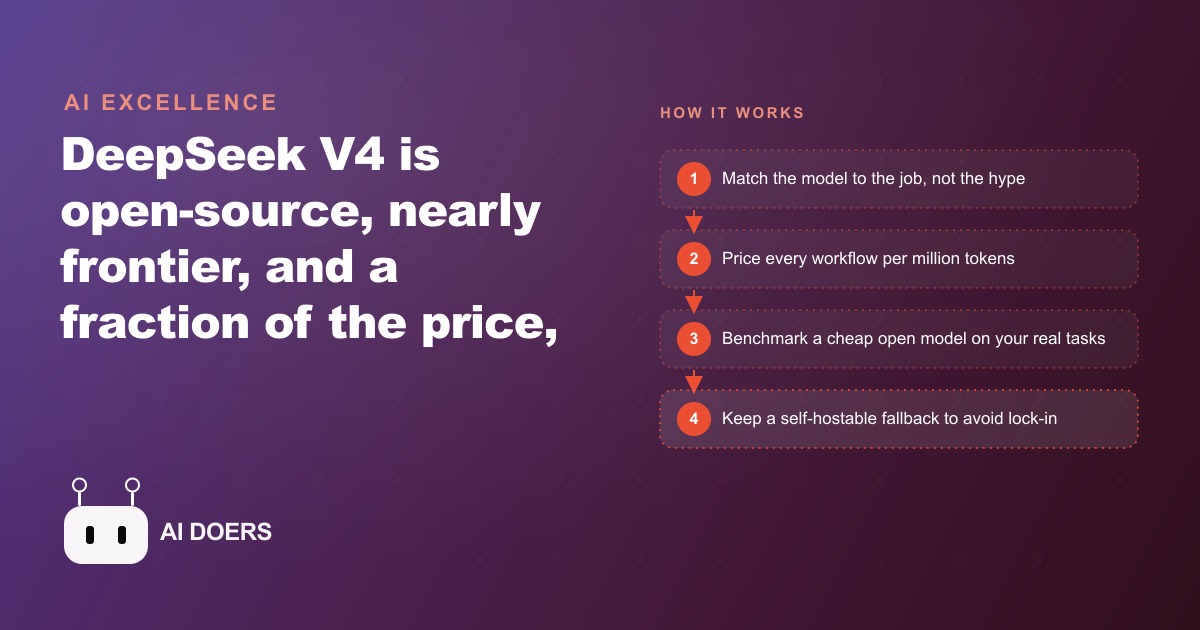
DeepSeek V4 is open source, nearly as capable as the top frontier models, and a fraction of the price. For most businesses that combination, not the leaderboard, is the real story.

The coverage of DeepSeek V4 defaulted immediately to benchmark charts. Which model scored higher on which reasoning task, which model trailed on which coding benchmark, who came first on the leaderboard. I am Madhuranjan Kumar, and I want to argue that the benchmark chart is precisely the wrong frame for understanding what this release actually means, and that the businesses getting the analysis right are the ones paying attention to a different number entirely.
The benchmark is not the story. The price is.
On the hardest reasoning benchmarks, V4 trails the top frontier models slightly. On coding and knowledge benchmarks it beats some of them. On the overall chart it sits in a cluster near the top without topping every category. If that is the whole picture, the conclusion is "strong but not the best, worth watching." That conclusion misses the only part that matters for a business making infrastructure decisions.
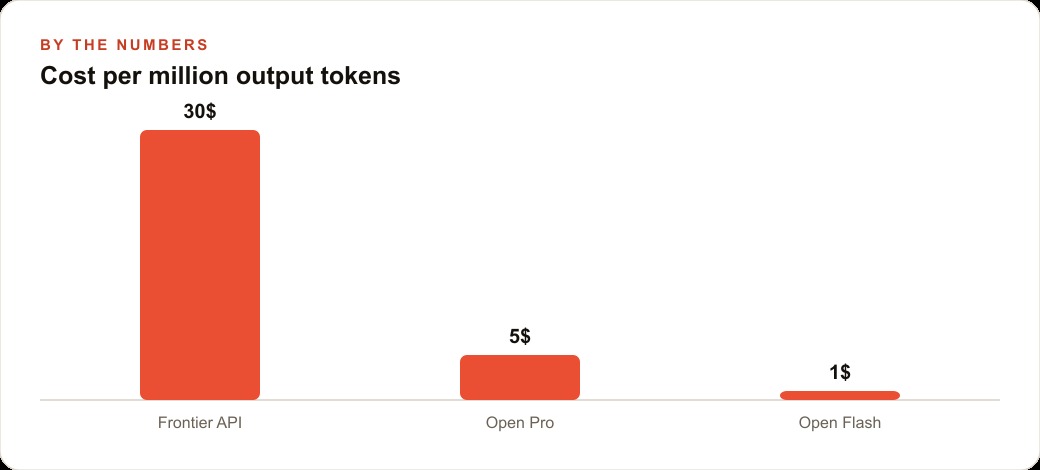
The price gap is not marginal. The top frontier APIs run around $30 per million output tokens. DeepSeek V4 delivers comparable results for a fraction of that. V4 Flash, the leaner version optimized for high-volume tasks, runs at pennies per million tokens. That is not a discount. It is a different cost structure entirely, one that makes economically rational a category of automation that was previously too expensive to justify at scale.
Most business AI workloads do not need the absolute best model in the world. They need a model that handles plain-language reading and writing reliably, classifies information correctly most of the time, and runs cost-effectively at the volume the business actually generates. Drafting customer emails, summarizing call notes, tagging support tickets, generating first-draft landing copy, powering an internal document search: none of these require frontier-level reasoning. They require reliable, adequate intelligence at a cost that makes running them all day every day economical. That is the slot this model fills.
Open weights changes the calculus in a way that closed models cannot match
The second part of the story that the benchmark framing misses is open weights. When a model is open-weights, a company can download it, run it on its own infrastructure, fine-tune it on its own data, and eliminate the ongoing per-token API bill. That is a fundamentally different relationship with the technology than renting access to a closed model at a price set by someone else.
The practical implications are significant. A company that fine-tunes V4 on its own customer service transcripts gets a model that handles its specific use cases, uses its specific terminology, and reflects its specific policies. A closed model at any price cannot be fine-tuned on private data to that degree without an enterprise agreement that costs far more than any per-token rate. Open weights brings that capability to any organization willing to invest the infrastructure time, and the infrastructure cost for a business with moderate AI volume is manageable.
The control dimension matters beyond fine-tuning. A company running its own deployment of an open model does not face price changes from a provider decision, capability restrictions from a policy update, or service interruptions from a provider outage. Those are real operational risks that businesses running critical workflows on closed APIs have learned to manage carefully. Running your own model eliminates them at the cost of running your own infrastructure.
The engineering story is what makes this defensible long-term
DeepSeek V4 was built under export controls that limited access to the best available NVIDIA chips. The team used a combination of Huawei Ascend processors and older NVIDIA hardware, and still produced a model that competes with the frontier. The white paper they published afterward documented the specific techniques: compressed sparse attention for long-context efficiency, low-precision FP4 and FP8 inference to reduce serving cost, smart mixture-of-experts routing that activates only the roughly 49 billion parameters relevant to each prompt despite the 1.6 trillion total parameter count.
That combination of architectural innovations under compute constraints is what makes this release qualitatively different from a budget model that simply trained for less time. A team that delivers frontier-adjacent results under those constraints has proven that its approach is robust and replicable. The next version from the same team will be at least as strong, probably stronger, because the same engineering insights applied to better hardware produce better models. The cost floor for capable AI is going to keep dropping, and this release is the evidence that makes that trajectory credible.
The businesses that win are the ones that match the model to the job
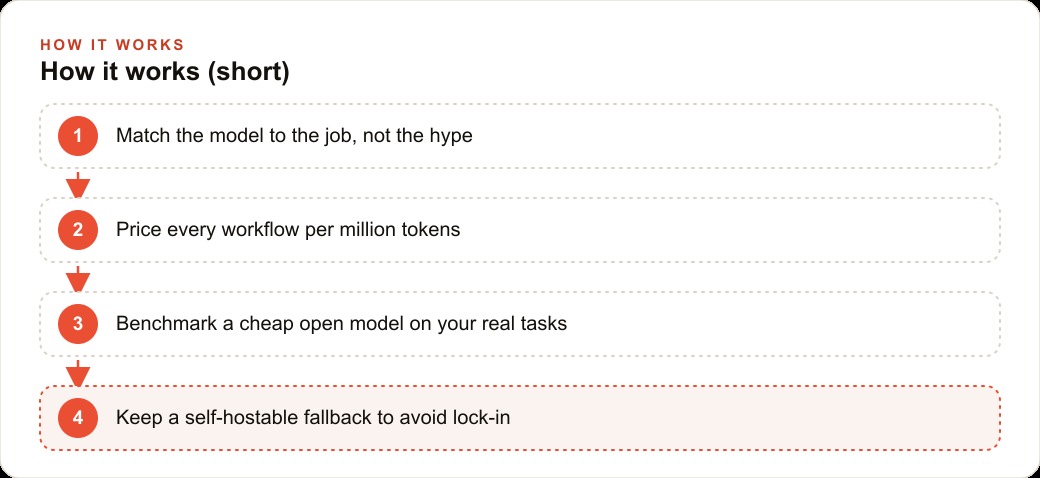
The correct strategy is not "switch everything to DeepSeek" and not "stay on the expensive model out of inertia." It is a deliberate hybrid: run the high-volume, routine work on the cheapest model that meets the quality bar, and keep a frontier model only for the specific tasks where the quality difference is large enough to justify the cost difference.
For a plumbing company handling 200 inbound customer messages a day, processing about 80,000 tokens per day in input and output, the monthly AI cost on a frontier API is meaningful. The same volume on a fraction-of-the-price open model is nearly negligible. The plumber's customers do not receive a detectably different answer from the cheaper model on the questions they actually ask, which are standard service inquiries, scheduling questions, and basic troubleshooting. A frontier model for those messages is spending thirty dollars per million tokens on a task that generates three dollars per million tokens of value differential. The math does not close.
For Facebook and Instagram ad campaigns where AI generates first-draft creative copy that a human reviews and edits before it goes live, the cost of generating twenty copy variations for testing is the primary variable cost in the process. At frontier prices, generating variations is a line item. At pennies per million tokens, generating variations is rounding error, which means you generate more of them and run more tests and learn faster what your specific audience responds to. That acceleration in the testing cycle has direct impact on cost per lead.
The honest limits of V4 are worth naming precisely. Performance on very long conversations degrades at around 128,000 to 200,000 tokens in a single session, so workflows that push a full document archive into one enormous context window will see quality drop before they hit the advertised ceiling. The correct response to that limit is to compact, chunk, or restart rather than stuff the window. For the routine business tasks that account for the bulk of AI usage, this limit is rarely reached in practice. The limit is real but not a blocker for the category of work this model is actually suited for.
The move is to run a structured test before making any infrastructure change: take your two or three highest-volume AI tasks, run a batch of real prompts through V4 alongside your current model, score the outputs on the criteria that matter to your business, and base the decision on your specific results rather than a public benchmark. The businesses that run that test in the next two weeks will have a concrete answer about whether the cost structure change is available to them. The businesses that skip it will keep paying frontier-model prices for work that does not require frontier-model performance, which is a straightforward overpayment that compounds across every month of delay.
That is exactly what we do at AI DOERS. Book a private 30-minute call with Madhuranjan Kumar and we will map the fastest path to it for your specific business.
Book your call →
Madhuranjan Kumar
Madhuranjan Kumar brings 20 years of performance-marketing experience and has managed over $200 million in Facebook ad spend for brands across the United States and beyond. His expertise spans the full modern marketing stack: Meta, Google Ads, TikTok, email automation, CRM, and the websites that hold it together. At AI DOERS he turns that track record into lead-generation systems for businesses across every industry.