
Why Claude Code Managed Agents Could Mint the Next Wave of AI Agency Owners
They move a fully loaded Claude agent into pay-per-runtime cloud infrastructure, and once you wrap it in a cognitive architecture of databases, documents, and nightly memory consolidation, you can package a continuously learning AI operating system that a client simply talks to.

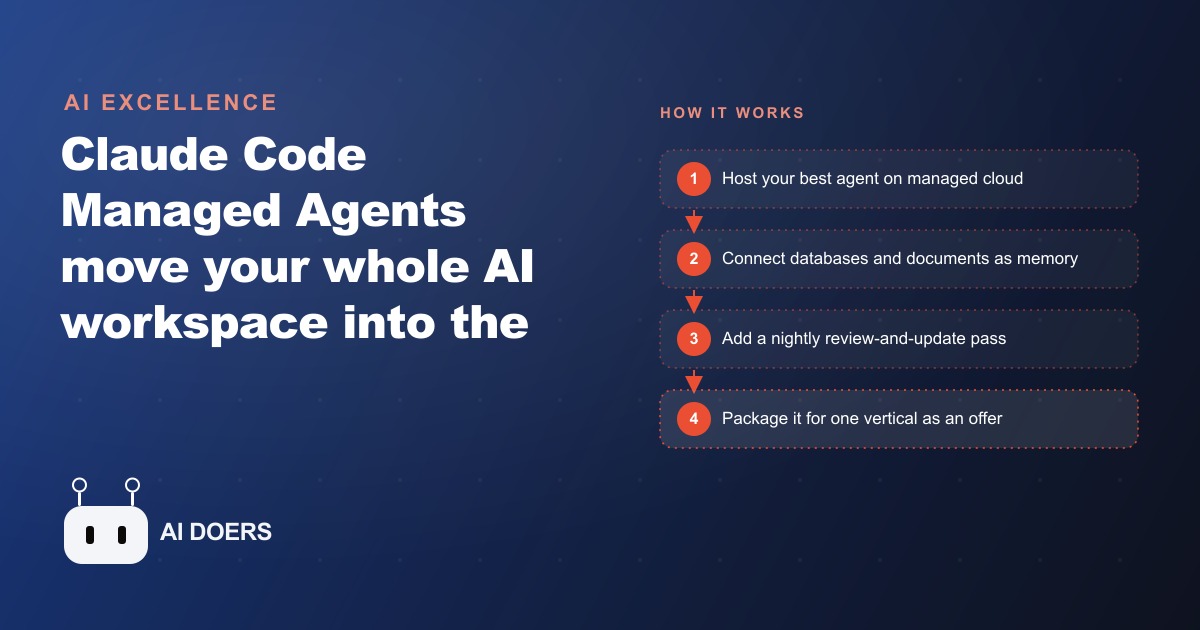
The difference between an AI assistant that forgets you every morning and one that feels like a long-term teammate is not a bigger model. It is an architecture, and it is now buildable on hosted infrastructure that only charges you when the agent actually runs. Claude Code Managed Agents take the same powerful agent you used to run on your own machine and host it in the cloud on a pay-per-runtime basis, so a fully configured agent can sit ready and spin up only when your application needs it. I, Madhuranjan Kumar, have spent years building and selling AI solutions to businesses, and I think the owners who learn to wrap these agents in real memory are going to package something clients will pay well for. This is the step-by-step playbook for building it.
The trap to avoid before you start: this is not about hosting alone, and it is not about spawning a swarm of agents. People bragging that two hundred agents are working for them are not being straight, because humans are the bottleneck. Even if only a tenth of those agents produce output you actually have to read, you drown. The winning move is fewer agents, tightly dialed in, wrapped in an architecture that gives them memory. Here is how to build that.
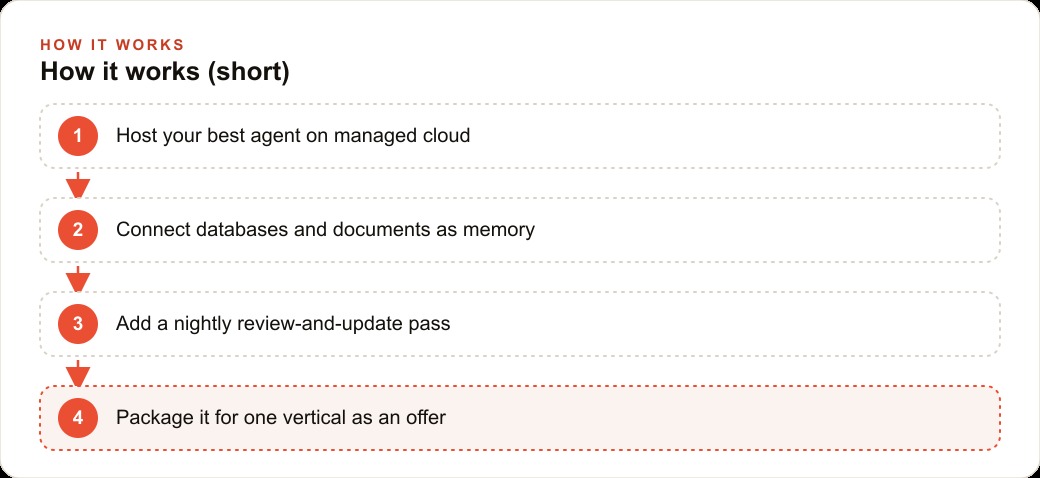
Step 1: Move your single best agent to managed cloud
Start by taking the one agent you already trust and moving it off your laptop onto managed cloud infrastructure. The immediate payoff is that you stop babysitting a machine and you only pay for actual runtime, so an idle agent costs nothing while a busy one scales up on demand. Managed Agents lean on the Claude Code side, which is more deterministic and predictable to build on than looser approaches, and that predictability matters the moment a client depends on the thing.
Do not over-configure at this stage. The goal is simply to get your best existing agent running reliably in a place that is always available and never tied to your personal computer being awake. Everything else in this playbook sits on top of this foundation.
Step 2: Give it long-term and short-term memory
This is the step that separates a toy from a system. Large language models do not learn continually on their own, and even a one-million-token context window eventually has to end. So you build memory around the model instead of expecting the model to hold everything. Connect the agent to a database that acts as its system of record, where it stores and pulls structured data, and give it a folder of markdown and text documents it reads to get up to speed on a topic. The database is the long-term memory. The documents and the current conversation are the short-term memory. Custom tools let it actually do work rather than just talk.
A million tokens lets an agent ramble through a long conversation, but headroom is not memory. Memory is a place to write things down and a habit of reading them back. Until you give the agent both, it starts cold every single session no matter how large its context window is.
Step 3: Add a nightly review-and-consolidate pass
Here is the most interesting piece, and the one most people skip. At the end of a day of someone chatting with the agent, you have it go to sleep like a brain. While asleep it reviews the entire day's conversation, updates the information across its databases, and revises its documents. Then, when a new session opens, the agent scans the last five to ten days of logged work and jumps back in already knowing the recent history.
That single routine is what makes the experience feel like one continuous relationship instead of an amnesiac starting over each morning. Without it, your database fills up but the agent never reflects on what happened, so nothing gets consolidated into usable knowledge. With it, every day's raw conversation gets distilled into updated records overnight, and every morning the agent wakes up caught up. Build this consolidation pass early, because it is the difference between an agent that accumulates chat logs and one that actually gets to know a business.
Step 4: Package it for one vertical as a clean offer
Now you turn the architecture into a product. Wrap the agent for one specific vertical or one painful problem and hand it to a client as a packaged AI operating system. The client should not experience databases and consolidation passes. They should experience one thing they talk to that is connected to everything they use, and it should be faster than juggling a dozen apps. This is where the honest warning from earlier pays off: resist the urge to give the client a swarm. Give them one focused, tightly-scoped agent that does a real job well.
To deploy it cleanly and repeatably, you can even build a slash new-employee command inside your own Claude Code setup that interviews you about the agent's job, applies best practices, then hosts and deploys the agent for you. That turns each new client build from a bespoke scramble into a repeatable process, which is exactly what you want if you plan to sell this more than once.
A worked example: an AI operating system for a med spa
Let me walk the whole playbook through one business so the steps feel concrete. A med spa runs on scattered systems: a booking calendar, a CRM of client histories, treatment notes, aftercare instructions, and a steady stream of inquiries about facials, injectables, and laser packages. Nobody at the front desk can hold all of that at once, so things slip.
Following step one, I move a single capable agent to managed cloud so it is always available and only bills for runtime. Following step two, I make the spa's own systems its memory: the client database becomes its system of record, the treatment and aftercare documents become the knowledge it reads, and booking and messaging become its custom tools. Now the front desk talks to one assistant that can answer a prospect's question about a treatment in the spa's exact tone, check the calendar, and hold a booking, all in one window.
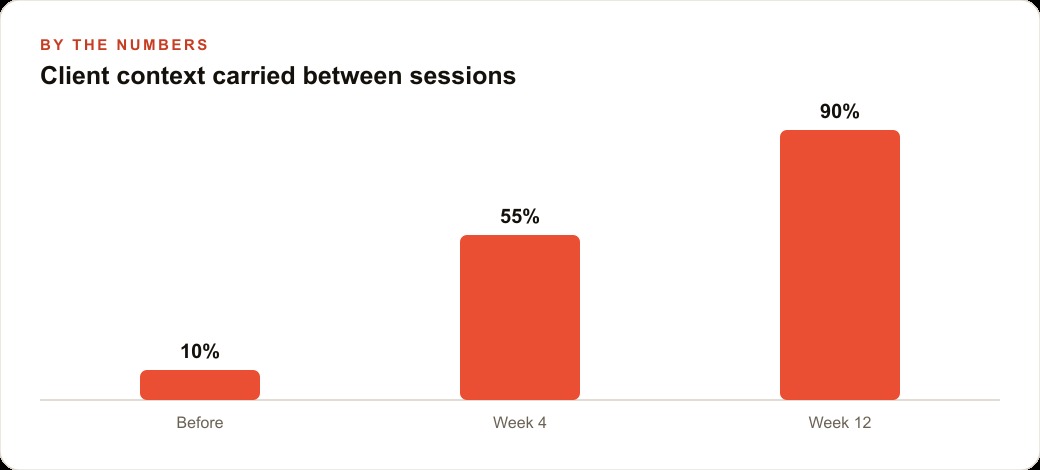
Step three is where it comes alive. Each night the agent sleeps and consolidates, updating client records with what happened that day and noting who is due for a follow-up. The next morning it scans the recent history, so when a returning client messages, the assistant already knows their last treatment and what aftercare they were given. Put illustrative numbers on the effect: in the first week the agent carries maybe ten percent of the context a human would between sessions, because the memory habit is still filling in. By week four, with the nightly pass running, it carries around fifty-five percent. By week twelve, it retains roughly ninety percent of the relevant client context week to week, which is when it stops feeling like a tool and starts feeling like a receptionist who never forgets a face.
Step four packages all of that as a single offer. The owner is not buying ten disconnected tools. They are getting one AI operating system that remembers their clients. And because the agent sits on top of the spa's real data, it strengthens the rest of the business too: the inquiries it captures and qualifies flow into the CRM and website stack where follow-up automation handles the next touches, the leads coming in from Facebook and Instagram ad campaigns get an instant, on-brand first response instead of waiting hours, and the treatment questions it answers all day become a well of real content for SEO and organic search that pulls in new clients without extra ad spend.
The failure that guts most of these builds
The step people skip is the nightly consolidation pass, and skipping it is why so many agent projects quietly disappoint. It is tempting, because hosting an agent and connecting a database feels like the finish line. You demo it, it answers questions from the documents, everyone is impressed, and then a week later the client notices it does not actually remember anything about their business beyond the current chat. The database is filling with logs, but nobody taught the agent to reflect on those logs and turn them into updated knowledge. Without the sleep-and-consolidate routine, you have built a search box with a nice personality, not a teammate.
The fix is to treat consolidation as a first-class feature, not an afterthought. Build the nightly review early, even before you add more tasks, because it is the mechanism that converts a pile of raw conversation into memory the agent can actually use tomorrow. When a returning client messages and the agent already knows their last interaction, that moment of continuity is the entire product, and it only exists if the consolidation pass ran overnight.
How to price and package what you build
Because the client experiences one thing they simply talk to, the packaging matters as much as the engineering, and it changes how you can charge. You are not selling a database, a hosting setup, and a consolidation script. You are selling an AI operating system for their vertical, a single assistant that remembers their customers and is wired into their tools. That framing supports a recurring relationship rather than a one-time build, because the value grows the longer the agent runs and the more it learns about the business.
The pay-per-runtime economics of managed cloud make this cleaner than the old always-on server model. A fully configured agent that sits idle costs almost nothing, so you can stand up a client's operating system and only incur real cost when it actually works. That means you can offer a client a genuinely capable assistant without carrying a heavy fixed infrastructure bill between uses, which protects your margin and lowers the risk of taking on the build in the first place. Price for the outcome, the continuous relationship the client gets, not for the compute, because the compute is now the cheap part.
Why narrow beats broad every single time
The last discipline is the one that protects both you and the client from the most seductive mistake in this space, which is scale for its own sake. Someone will always brag about running a swarm of agents, and it will always be tempting to match them. Resist it. Humans are the bottleneck, and a swarm that produces more output than any human can read is not leverage, it is noise you now have to sift. One agent, dialed in tightly on a real problem, wrapped in memory that makes it feel continuous, is worth more to a client than a dozen loosely aimed ones. Find the single painful problem, solve it completely, and let that be the whole offer.
The mindset that keeps this profitable
Two disciplines keep this from going sideways. First, build memory before you add tasks, because an agent with more to do and nowhere to remember just makes more forgettable output. Second, stay narrow. One vertical, one painful problem, one focused agent that a client can simply talk to. The temptation to impress people with a fleet of agents is the fastest way to bury yourself and your client in output nobody has time to read.
The bottleneck is human attention, so design around it
Everything in this playbook is downstream of one uncomfortable truth: the constraint on AI in a business is not the model, it is how much output a human can actually absorb and trust. That is why the winning design is not more agents, it is one agent whose memory and consolidation are good enough that the human barely has to supervise it after the first weeks. When the agent wakes up already caught up on the last several days of context, the owner is not re-explaining the business every morning, which is exactly the drain that makes most AI tools quietly get abandoned.
So build for the human's attention budget, not the machine's capacity. A single continuous agent that remembers a client week to week reduces the mental load on the owner, because they interact with one thing that already knows the history instead of re-briefing a fresh assistant each time. That reduction in supervision is the real product you are selling, and it is why the memory architecture matters more than raw model power. A less capable model with excellent memory and a nightly consolidation pass will out-serve a frontier model that forgets everything overnight, because the frontier model keeps spending the one resource you cannot scale, which is the owner's time and trust.
You can absolutely assemble this yourself, and moving one agent to managed cloud is a solid first step you can take this week. If you would rather have someone design the cognitive architecture, wire in the databases and documents, build the nightly memory consolidation, and package the whole thing as an AI operating system for your business, that is exactly the kind of work I do for clients, and you can bring me in to handle it.
That is exactly what we do at AI DOERS. Book a private 30-minute call with Madhuranjan Kumar and we will map the fastest path to it for your specific business.
Book your call →
Madhuranjan Kumar
Madhuranjan Kumar brings 20 years of performance-marketing experience and has managed over $200 million in Facebook ad spend for brands across the United States and beyond. His expertise spans the full modern marketing stack: Meta, Google Ads, TikTok, email automation, CRM, and the websites that hold it together. At AI DOERS he turns that track record into lead-generation systems for businesses across every industry.