
Why Better Prompts and Sharper Review Are What Actually Win With AI
AI is best understood as amplified intelligence, not a magic button. The two skills that decide your results are pointing the tool clearly and checking what it gives back. Here is how I would apply that inside a real accounting firm.

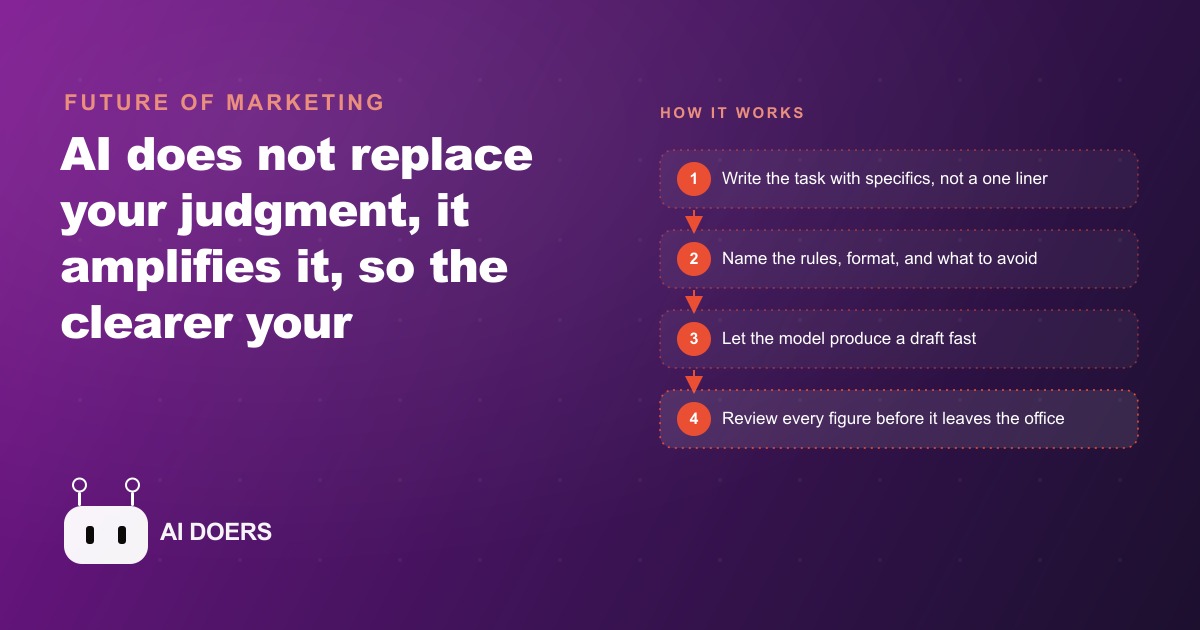
There is a way to understand AI tools that immediately raises the ceiling on what you can do with them, and it has nothing to do with which model you pick or which subscription tier you pay for. It is about recognizing that these tools amplify the intelligence of whoever is running them. A precise, well-briefed request produces a precise result. A lazy, vague request produces confident-sounding noise. The tool did not fail in either case. It reflected the quality of the input it received, accurately and at speed.
I am Madhuranjan Kumar. The analogy I return to with clients is pointing a very fast ship. The speed of a modern AI model is genuinely remarkable. A capable model can draft a proposal, summarize a complex document, extract key figures, or produce a first-pass analysis in seconds. But all of that speed travels in the direction you point it. A single clear sentence in a prompt is a surprisingly rich set of navigational coordinates. A fuzzy sentence produces a fast ship going somewhere you did not intend. Most of the frustration people have with AI tools traces directly to this mismatch: they expect the model to infer the right heading from a vague description, and the model does not. It picks a heading and runs.
Why the output quality ceiling is almost always set by the input
Access to a more powerful model does not automatically improve results. This is counterintuitive enough that it is worth stating plainly, because the instinct when outputs disappoint is to look for a better tool rather than a better prompt.
Upgrading to the most capable model available while keeping the same vague, one-line request style produces more fluent noise. The model generates language better. The problem was never the quality of the language generation. The problem was the absence of a clear enough heading for the model to navigate from. A brief, careful investment in the prompt before sending it produces noticeably better first drafts and requires fewer rounds of revision than chasing the next model release.
The ceiling on what AI produces for any specific task is set by the quality of the prompt and the rigor of the verification step, not the underlying model capability. Two people with identical tools and identical subscriptions get wildly different results depending on how precisely they describe what they want and how carefully they review what comes back. The person who treats the first output as final and copies it directly copies whatever quality the prompt produced. The person who writes a specific prompt and treats every output as a draft that requires checking uses the same tool to produce something they can actually rely on.
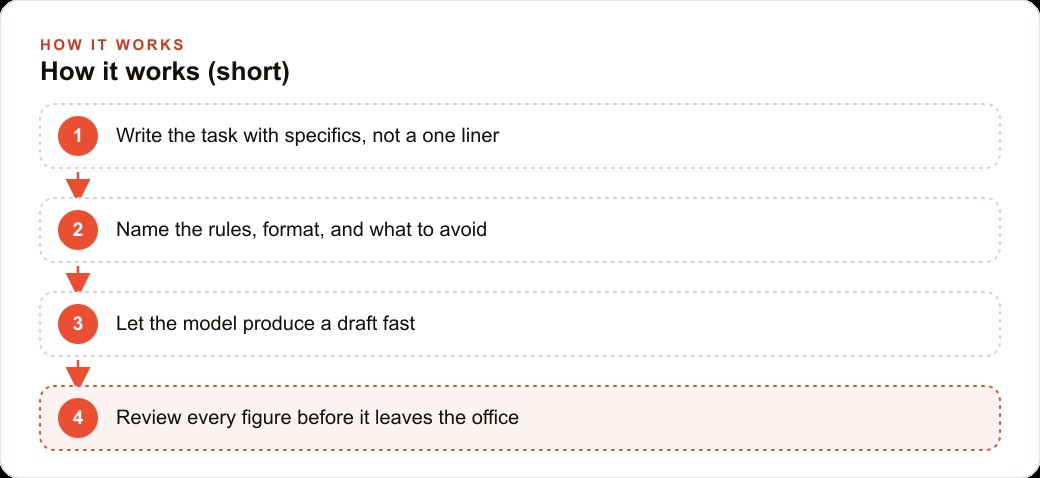
This means the most valuable investment for someone trying to improve their AI output quality is almost always in the input, not the tool. Write better prompts. Write them with more specifics. Name the output format, the constraints, the rules, and the things to avoid. Add a verification step that checks the substance rather than just the surface. Those two habits produce more improvement than any tool upgrade on the market right now.
The heading as the navigational metaphor that actually holds up under examination
A prompt is a heading, and the navigational metaphor earns its place because it captures something important about how language models work that more technical explanations tend to miss.
When you give a model a heading, it generates text that fits naturally from that starting point. The more specific the heading, the narrower the range of plausible continuations, and the more likely the first output lands close to what you needed. A heading that says "write me a website" is so broad that almost any website could be the output, and the model has to make hundreds of implicit decisions about framework, content, structure, and tone that you would have made differently if asked. A heading that specifies the framework, the data to present, the libraries to use, the tone, the things to include, and the things to leave out produces a result that lands close on the first try because the model's choices were already constrained by your specification.
The practical habit this produces is spending a little more time on the prompt before sending it. Not extended deliberation, but the thirty to sixty seconds it takes to ask yourself a few questions: Have I named the output format I want? Have I said what to include and what to leave out? Have I specified any constraints on length, tone, or content? Have I given the model the context it needs to know why this output matters, so it can make the right trade-offs between competing priorities? Those questions, answered briefly before sending, produce first drafts that need one round of revision instead of three.
The visibility asymmetry between layouts and logic
The verification step is where AI-assisted workflows either earn or lose their reliability, and there is a specific asymmetry in what kinds of errors are easy to catch versus what requires genuine expertise to find.
Visual outputs are easy to verify quickly. A wrong layout, a misaligned graphic, a table that does not line up, a chart with bars going the wrong direction: these errors are visible in seconds by eye and require no domain expertise to catch. If the model produces something visually broken, most people who look at it notice immediately.
Numeric and logical outputs are a different story. A model can return a calculation that is quietly wrong while the output looks perfectly formatted and correct. It can produce a summary that technically restates the source material but characterizes it in a subtly misleading way. It can draft contract language that sounds reasonable but is missing a protection the document needs. None of these errors are visible at the surface level. They require someone who knows what a correct result looks like to read the substance rather than just the presentation. Perfectly formatted is not the same as correct, and the formatting can actually make errors harder to catch because the clean presentation signals quality in a way that predisposes readers to trust it.
This asymmetry determines where verification effort should be concentrated. Visual work: a quick scan is usually sufficient to catch what matters. Anything involving numbers, legal language, technical specifications, domain-specific accuracy, or content that will be relied on for decisions: slow down and read the substance, not the presentation. For a professional service firm, this means treating every AI draft as if the next person to read it is the client or customer it is going to, because in a short time it usually is.
What a professional verification habit produces in an accounting firm
Building verification as a mandatory step in a workflow rather than an optional suggestion is the structural change that makes AI adoption sustainable rather than risky in a professional service context.
An accounting firm producing monthly management reports for clients is a good illustration of what this looks like when it is working correctly. Without the AI-assisted workflow, producing one client's monthly package means pulling figures from several data sources, calculating variances, writing the commentary to explain each significant movement, and formatting the complete package. Two to three hours per client per month is a realistic estimate for an experienced accountant.
With the AI-assisted workflow, the accountant describes the inputs, the required calculations, the format of the output, and the variance thresholds that should be called out in the commentary. The model drafts the variance commentary, produces the formatted table, and writes a plain-language explanation of each significant line item. The accountant then checks every material figure against the source data, reads each piece of commentary to confirm it characterizes the situation correctly, and corrects any mischaracterization of what the numbers actually show. Total time: roughly forty minutes per client, including the verification step.
Thirty clients means thirty monthly packages. At two hours per package under the manual process, that is sixty hours of drafting and formatting work per month. With the AI-assisted workflow and the verification step built in, that becomes twelve hours. The accountant does not spend less time on the client relationship or the analytical judgment. They spend less time on the drafting and formatting that was always just the vehicle for delivering the judgment, which means their time concentrates on the work that actually creates value: catching the discrepancy that reveals something important about how the business is operating, advising on the decision the numbers are pointing toward, and explaining the implications to the client clearly.
Where the value actually sits in the verification step
The observation that computers turned many professional tasks into typing problems deserves to be taken seriously as a structural claim about where value sits now.
A generation ago, complex financial calculations required skilled people working with specialized tools over days or weeks to do work that spreadsheets eventually turned into an afternoon of data entry and formula writing. The bottleneck moved from execution to judgment: deciding what to calculate, interpreting the results correctly, and making recommendations based on them. AI is doing the same shift again, turning drafting, summarizing, first-pass analysis, and routine formatting into typing problems. The bottleneck moves again, to the judgment about what to ask for, and the expertise to recognize when the answer is wrong before it does damage.
That is precisely where professional value sits, and it is where AI does not replace the professional. The model can draft the summary. It cannot reliably tell you whether the summary characterizes the situation correctly given the full context of a client relationship and everything you know about their business that is not in the data. The model can produce the first-pass analysis. It cannot tell you which findings matter and which are noise given the specific strategic question the client is actually trying to answer. Those judgment calls are not the residual left over after AI handles the real work. They are the real work. The drafting and formatting were always just the delivery mechanism.
The professionals who get more done with AI are not the ones who hand over the most work to the model. They are the ones who keep the clearest sense of where their judgment creates value versus where the model's speed creates value, and who route each piece of work accordingly. That routing is itself a judgment skill, it improves with practice, and it is the specific skill worth developing right now while the compounding advantage of starting early is still available to be captured.
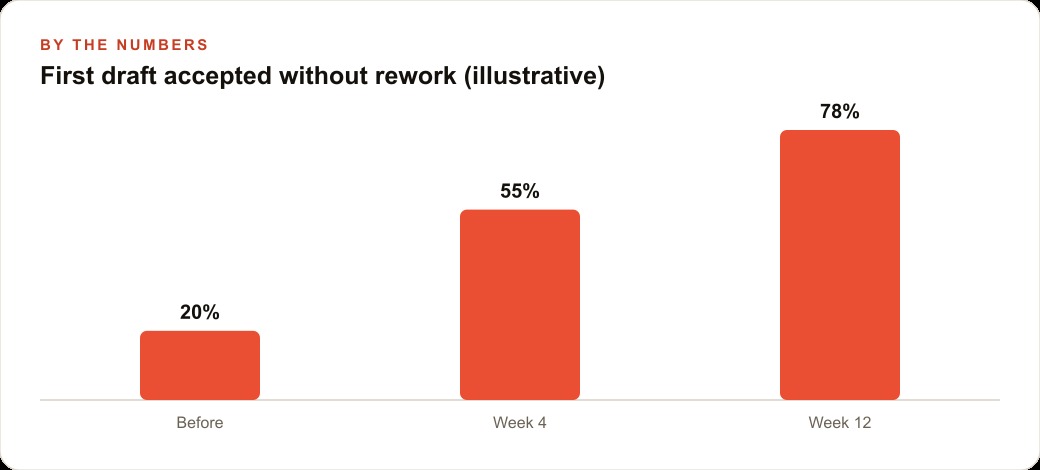
The compounding argument for developing these two habits now rather than later is straightforward. A professional who spends three months writing better prompts and verifying more carefully builds an intuition for what kinds of instructions produce reliable outputs in their specific domain. That intuition is not transferable through a quick training session. It accumulates through real use and real feedback from the outputs themselves. The professional who starts now finishes that three-month investment by October. The professional who waits until the tool is more mainstream starts that same investment in a field where everyone is trying to learn it simultaneously, with more noise, more competition for the best practices, and less of the compounding advantage that comes from being early.
The two skills described in this article, pointing clearly and verifying rigorously, are the ones that will remain valuable regardless of which model generation you are working with. Every improvement in model capability makes good pointing and good verification more valuable, not less, because better models amplify stronger instructions more dramatically and the consequences of errors in higher-stakes applications become more significant. Building the habits now is building habits that compound across every generation of tools you will ever use.
That compounding logic is the real take-away from this article. The two inputs, better prompts and more disciplined review, cost almost nothing to improve. A professional who commits thirty minutes this week to writing one clearer instruction and then checking its output more carefully has already started. The skill builds from that first deliberate repetition.
That is exactly what we do at AI DOERS. Book a private 30-minute call with Madhuranjan Kumar and we will map the fastest path to it for your specific business.
Book your call →
Madhuranjan Kumar
Madhuranjan Kumar brings 20 years of performance-marketing experience and has managed over $200 million in Facebook ad spend for brands across the United States and beyond. His expertise spans the full modern marketing stack: Meta, Google Ads, TikTok, email automation, CRM, and the websites that hold it together. At AI DOERS he turns that track record into lead-generation systems for businesses across every industry.