
Why Anthropic Says 2028 Is the Deadline for AI Leadership
Anthropic argues the US and its allies have until roughly 2028 to secure a commanding AI lead over China, and that access to advanced compute, protected by export controls, is the single deciding factor. Here is what that headline means and how I would read it as a business owner.

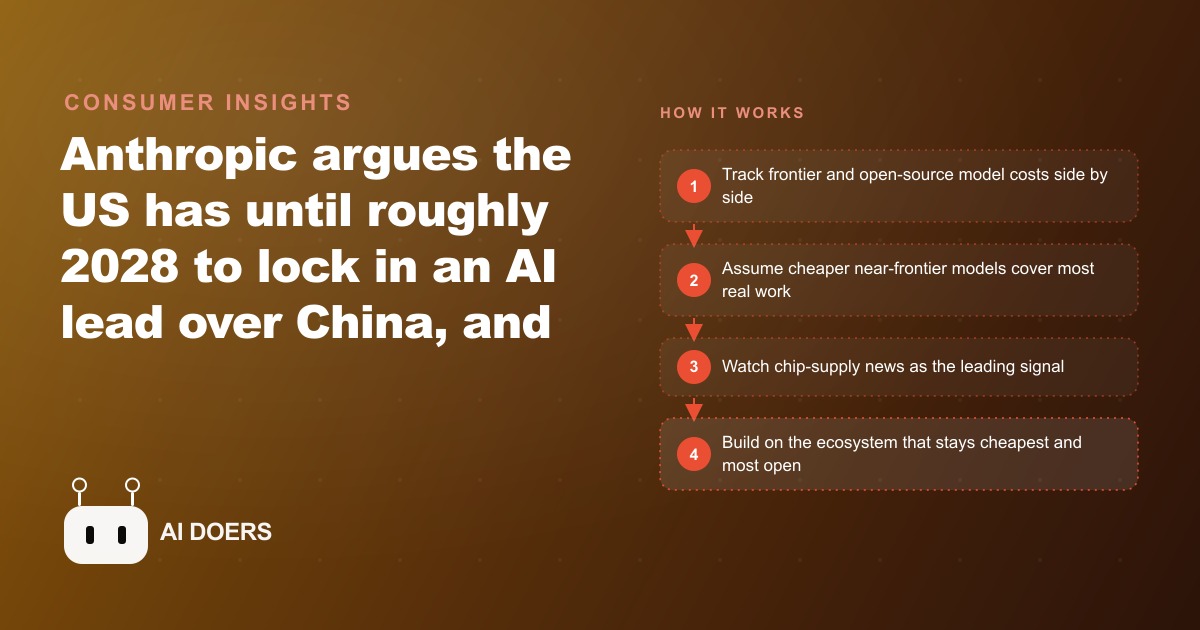
Anthropic published an essay this month that named a date, framed a scenario, and argued the stakes as plainly as a large AI lab has argued them in public. I am Madhuranjan Kumar, and I want to think through what that essay actually says and what a business owner should do with it, because the gap between the geopolitical framing and the operational implication is where most of the commentary gets lost.
The date is 2028. The scenario is a window closing on US AI leadership over China. The argument is that compute, specifically access to advanced chips protected by export controls, is the deciding factor. Anthropic's position is that whoever leads in AI sets the terms by which AI develops globally, and that the current structural advantage in chip manufacturing and design needs to be converted into a durable lead before the underlying conditions that enable it change.
That is the geopolitical summary. What follows is what I think it actually means for a business that needs to make decisions this quarter rather than this decade.
The near-frontier argument is the most actionable paragraph in the essay
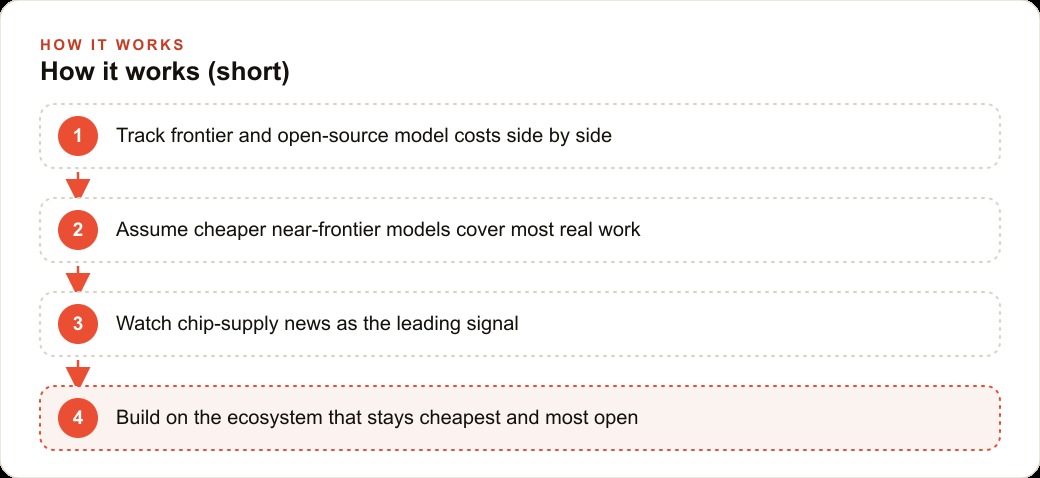
Buried inside the strategic framing is a point that Anthropic makes almost in passing but that deserves to be the headline for any business owner reading it. The essay acknowledges that cheap, near-frontier AI models adopted widely across an economy can generate more real-world value than a slightly better model that sits underused in a research paper. It calls this the near-frontier adoption window, and it is the only part of the essay that translates directly into a business decision you can act on this week.
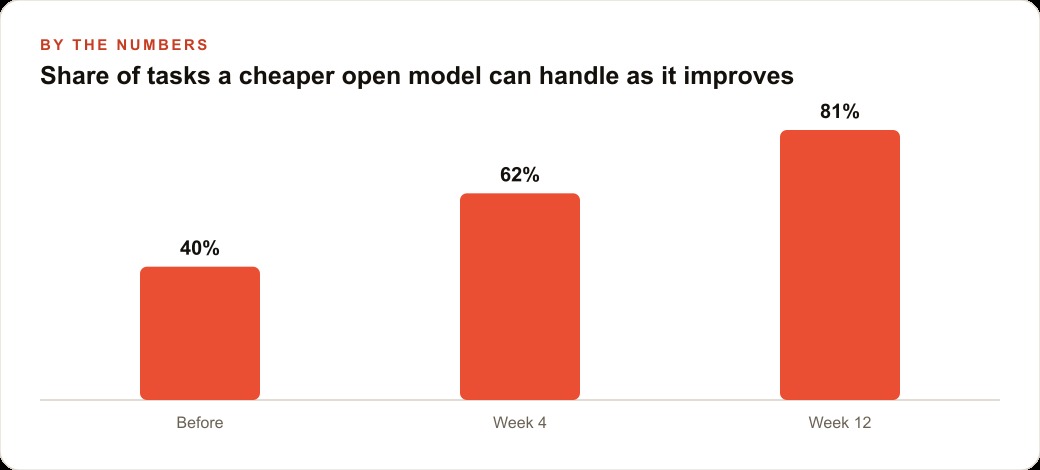
The near-frontier point means that the AI tools available today, which are not the absolute frontier but are very close to it and are accessible at low cost, are already sufficient to transform most of what a small or medium business does. The business that builds habits, workflows, and institutional knowledge around these tools now is building a compounding advantage over competitors who are waiting for the perfect version before starting.
DeepSeek demonstrated the near-frontier argument concretely. When a model trained at a fraction of the reported compute cost of the leading closed models produces results that are competitive across most business tasks, the conclusion is not that the leading models are overrated. It is that the minimum capability threshold for most business use cases is lower than the premium pricing of the leading models implies. You do not need the best model. You need a model that is good enough for your specific tasks, and good enough arrived earlier than most owners realize.
The adoption race is already underway and most owners are not competing in it
The subtext of the Anthropic essay, read from a business rather than a policy perspective, is that the companies building AI-powered workflows now are accumulating institutional advantages that compound over time. The essay describes this at the national level: whichever country builds deep AI capability across its economy first creates structural advantages that are difficult for later adopters to close. The same logic applies at the business level.
A pest control company that builds an AI-assisted quote workflow this month has, by next quarter, several months of iteration on how that workflow performs for their specific customer base, their specific pricing model, and their specific objection patterns. The competitor that starts building the same workflow in six months starts from scratch. The early mover does not just have the tool. They have the learned behavior around the tool, the prompts tuned to their voice, the team that knows how to review the output and correct the specific errors this type of AI makes on this type of task. That is not easily replicated at speed.
The parallel to Anthropic's framing about export controls is instructive. Export controls slow China's access to the chips that enable frontier training runs. The business equivalent is the learning time that early AI adopters have accumulated before competitors start. You cannot buy that time later. You either have it or you do not, and you acquire it only by starting.
Four fronts, shrunk to fit a service business
The essay names four dimensions of the AI race: intelligence, domestic adoption, global distribution, and resilience. Each one has an analogue at the business level that is more useful to think about than the geopolitical version.
Intelligence means using tools that are capable enough to handle your actual business tasks without constant babysitting. For most service businesses, this means a model in the current near-frontier tier, not the absolute cutting edge. The argument that you need the most expensive model for most business tasks is not supported by the evidence from the businesses that are actually using AI successfully. Good prompts plus a capable mid-range model consistently outperform vague prompts plus the most expensive model available.
Domestic adoption means how deeply your business has integrated AI into its actual daily operations, not how many subscriptions you have. A business with six AI tool subscriptions and no running workflows has zero effective adoption. A business with one tool and three reliable workflows that run daily has meaningful adoption. The depth matters far more than the breadth.
Distribution means how your AI-assisted outputs reach the people who need to see them. A quote that is drafted by AI and stays in a draft folder delivers no value. A quote that is reviewed, approved, and sent to the customer within two hours of the site visit converts at a higher rate because the customer's interest is still warm. That delivery speed is a form of competitive distribution.
Resilience means not being entirely dependent on a single tool that can change pricing, change behavior, or disappear. A business that has built AI workflows using multiple tools, or that uses an open model as at least part of its stack, is more resilient than one entirely dependent on a single closed provider whose pricing and feature decisions are entirely outside its control.
The pest control example that makes the 2028 argument concrete
A pest control company in a mid-size market has four or five competitors. All of them are in roughly the same position today in terms of AI adoption: some have experimented with chatbots or writing tools, none have built systematic AI workflows into their core operations. The window in which any one of them can build a meaningful operational lead through AI adoption is open right now and will not be open indefinitely.
The company that starts this month builds a quote workflow where a technician's voice notes from a site visit are transcribed automatically and turned into a structured quote sent to the customer within the hour. Over the next three months, the team learns which parts of the AI-drafted quote consistently need adjustment and updates the prompt to prevent those adjustments. The quote goes out faster, the conversion rate improves because timing matters in a competitive service market, and the technician spends less time at the kitchen table after the visit.
By month four, the same company extends the AI system to follow-up sequences: a thirty-day check-in after initial treatment, a ninety-day reminder about the next treatment window, a referral incentive message timed to the season when pest activity is highest in the area. Each of these runs automatically, each is drafted by the AI and reviewed by the office manager before sending, and each was impossible to run consistently at this frequency before the AI workflow existed because the manual effort was too high.
The competitor that starts building these workflows in month seven is starting from scratch at a point when the early mover has several months of learned behavior, tuned prompts, and customer data confirming what works. That gap is not insurmountable, but it is real and it costs time to close.
This is the business-level version of the 2028 argument. Not that artificial general intelligence will arrive by a fixed date and change everything at once, but that the window in which building AI-powered workflows constitutes a genuine competitive differentiator is closing as more businesses start. The later you start, the less differentiation you get from the same effort. The earlier you start, the more the learning compounds.
The compute cost trajectory is the only geopolitical signal that changes a business decision
One piece of the Anthropic essay does change a business decision directly, and it is the least dramatic part: the infrastructure investment. The scale of data center construction, chip manufacturing, and energy procurement happening globally right now points in one direction for the price of AI capability: down. The tools that cost fifty dollars a month today to run at meaningful scale will cost less in a year. The tasks that are too expensive to automate with AI today will cross the cost-benefit threshold in the next few years.
This matters for a business owner because it changes the risk calculation around early adoption. The risk of adopting AI workflows now and having the tools change is real but manageable. The tools will improve, the prices will drop, and workflows built with careful attention to output quality rather than blind automation will transfer to better tools smoothly. The risk of waiting is that competitors who adopt now are building institutional knowledge you will have to purchase at a premium or develop from scratch when you eventually start. That is the actual comparison, and the Anthropic essay makes the asymmetry of it clearer than most business advice does.
The conclusion I draw is the same one the essay implies but does not state directly: the 2028 window is the geopolitical version of a threshold that exists at the business level right now. Start building workflows while the tools are cheap, the learning communities are active, and the competitive advantage is still available. What you build in the next six months will compound in ways that the businesses waiting for permission will not be able to replicate quickly. The Google Ads spend that drives traffic to your business, the SEO and organic search that builds long-term visibility, and the operational efficiency that keeps your margins intact under competitive pressure all improve when AI workflows are built behind them. The question is not whether to start. The question is whether you start this month or let the window get smaller.
That is exactly what we do at AI DOERS. Book a private 30-minute call with Madhuranjan Kumar and we will map the fastest path to it for your specific business.
Book your call →
Madhuranjan Kumar
Madhuranjan Kumar brings 20 years of performance-marketing experience and has managed over $200 million in Facebook ad spend for brands across the United States and beyond. His expertise spans the full modern marketing stack: Meta, Google Ads, TikTok, email automation, CRM, and the websites that hold it together. At AI DOERS he turns that track record into lead-generation systems for businesses across every industry.