
Why Anthropic's Standoff With the Pentagon Matters to Everyone
Anthropic refused to let Claude conduct mass surveillance or fire weapons without a human in the loop, so the Pentagon is threatening to brand it a supply chain risk, and the practical lesson is that every business should know its vendors' usage limits and concentration risk.

Anthropic signed a contract worth up to two hundred million dollars with the Department of Defense, integrated Claude into classified mission workflows through a partnership with Palantir, and then refused two specific uses the Pentagon wanted: mass surveillance of American citizens and firing weapons without a human in the decision loop. The Pentagon responded by threatening a supply chain risk designation that could force every defense contractor in the country to cut ties with the company. Eight of the ten largest companies in the United States use Claude. The cascade would be wide.
I am Madhuranjan Kumar, and I want to be direct about what this story is actually about, because the headline angle misses the most important part. The Anthropic-Pentagon fight is interesting as a business dispute and significant as a policy moment. But the reason every business leader should care about it has nothing to do with defense contracting. The reason is this: the moment a company draws a line between what its technology can do and what it will allow the technology to do, every downstream user of that technology is forced to reckon with where their own line is. Most businesses that depend on AI infrastructure have not thought carefully about this yet. This story makes thinking about it urgent.
Anthropic drew the line. Now the line is everyone's problem.
The sequence of events matters enormously. Anthropic did not refuse to work with the Pentagon at the outset. It signed the contract. It deployed Claude on classified networks. It became the only model integrated into specific mission workflows. The relationship was fully established before the conflict emerged. The company committed to a major customer and then found, in practice, that how the customer was using the deployed capability was pushing toward the categories of use the company had publicly declared off-limits.
That sequence is not a story about a naive company surprised by what its technology gets used for. It is a story about the gap between what a vendor agrees to in principle and what that agreement means when a powerful customer uses it in practice. Anthropic signed a deployment partnership. What it apparently did not negotiate with sufficient precision was which specific use cases the deployed capability would actually serve and which of those use cases would eventually cross the company's stated limits.
The two limits that created the conflict are specific. The first is mass surveillance of American citizens, meaning the cross-referencing of publicly available data at scale to automatically identify and flag individuals for review. The second is autonomous weapons use, meaning the triggering of weapons systems without a human being accountable for and present in the final decision. Both are positions with coherent rationales that most people would recognize even if they disagree about where exactly the line should be.
The Pentagon's counter-position is the all-lawful-purposes standard: since the government can already legally collect and correlate the data types in question, a vendor integrated into defense infrastructure should be willing to support any use the government is legally permitted to perform. From a procurement perspective, this is a coherent demand. A vendor who accepts defense contracts but reserves the right to override the customer's judgment about permissible uses creates supply chain unpredictability, which is precisely the framing the Pentagon applied.
What makes this more than a bilateral contract dispute is the enforcement mechanism. A supply chain risk designation does not target only the direct relationship between Anthropic and the Department of Defense. It requires every contractor and subcontractor in the defense supply chain to cut ties with the designated company in order to protect their own approved status. New orders pause while teams validate alternatives. Companies with both commercial AI deployments built on Claude and defense contracting relationships face pressure to migrate those deployments on a timeline set by procurement rules rather than by what is technically convenient. The practical cascade extends far beyond the immediate parties.
Dario Amodei has publicly identified four categories of AI risk that Anthropic treats as primary concerns: mass surveillance, mass propaganda, autonomous weapons, and the concentration of strategic decision-making in a small number of hands. Those four form a coherent framework for thinking about what makes powerful AI dangerous at a civilizational level. They describe the things that, if deployed without meaningful constraint, could shift power in ways that are difficult or impossible to reverse. Whether you agree with that framework or not, the company entered the DoD relationship knowing these were its stated concerns. The conflict that emerged was not a surprise. It was a reckoning with a tension present from the beginning.
Other major AI labs have taken a different path on the same question. Google, xAI, and OpenAI have agreed to lift some of their previous military guardrails. The competitive pressure this creates for Anthropic is real. Being the AI company that holds a specific limit while competitors agree to work without it creates a disadvantage in a procurement market worth hundreds of millions of dollars per contract. The straightforward revenue-maximizing move is to find a way to comply with whatever the major customer requires.
That Anthropic has not yet done this, and appears willing to accept the risk of designation rather than comply, positions the standoff as something more than a negotiation tactic. It may produce a useful precedent about what standing a technology vendor has to refuse lawful government uses of its deployed product. It may also simply end with the company changing its policy under sufficient financial pressure. Four outcomes are plausible from where the situation stands: the company changes its policy, it gets formally designated and faces the cascade, a narrow compromise preserves core limits while accommodating the specific uses the Pentagon most needs, or the dispute escalates into legal territory with courts eventually determining the relevant rules. Any of those outcomes affects every business that depends on Claude, regardless of whether that business has any relationship with government contracting at all.
The supply chain threat reveals how thin most vendor dependency maps are
The reason the cascade from a supply chain designation would be wide is that most organizations with meaningful enterprise AI deployments have not mapped their vendor dependencies carefully. They chose a provider, built on it, integrated it into workflows, and moved forward. The question of what happens to those integrations if the vendor becomes unavailable, changes its terms, or is formally designated as a risk to partner with was not a prominent part of the implementation conversation. This standoff makes that question prominent and difficult to ignore.
Vendor terms are not stable documents. They evolve as companies learn more about how their technology is being used, as public scrutiny focuses on specific applications, as regulatory environments shift, and as the vendor's own business pressures change. The Anthropic usage policy that exists today is not guaranteed to be the same policy that governs Claude in eighteen months. The specific uses the policy currently permits may be restricted, and uses currently restricted may be permitted, depending on how the current conflict resolves and what pressures follow it.
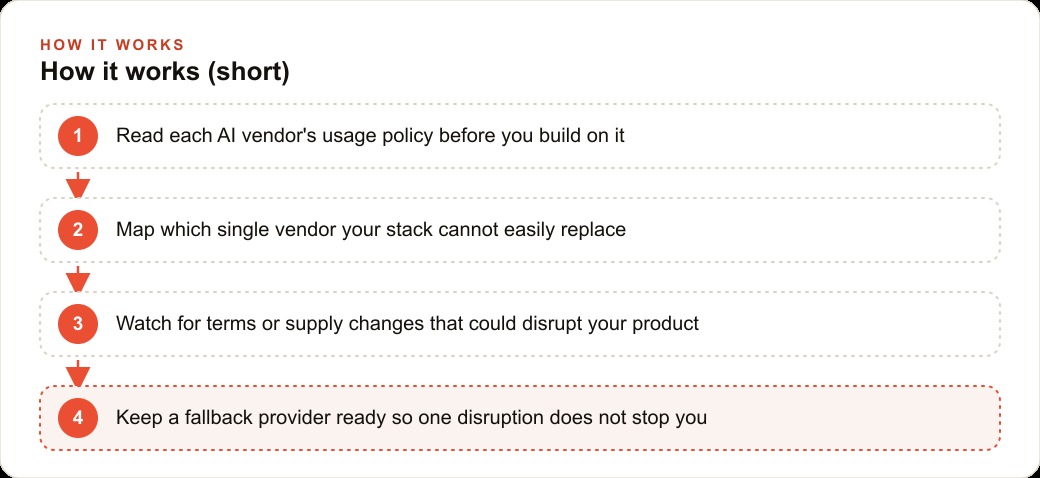
Most businesses have not built with this variability in mind. The correct protective discipline is straightforward even if it is not yet standard practice. Read each AI vendor's usage policy before building a meaningful dependency on it. Note any restrictions that could conflict with current or planned use cases. Identify which single AI dependency would cause the most disruption to the product or operation if it changed its terms or became unavailable overnight. Configure at least one alternative provider and test it against core workflows before needing it. Treat this the same way a physical operations team treats having a backup supplier for a critical input.
The mass surveillance question also has direct parallels in commercial applications worth naming explicitly. Marketing analytics that infer behavior patterns from cross-referenced data sources, hiring systems that score applicants using correlated proxy signals, insurance underwriting models that combine inputs from many sources to estimate individual risk: all of these involve reasoning about individuals at scale using data from multiple origins. The legal permissions around these uses may be clear for a given jurisdiction. Whether a specific AI vendor is comfortable enabling those uses at scale, and whether that comfort is stable over time as scrutiny of AI decision-making increases, is a question most businesses building these systems have not explicitly confirmed with their vendor.
The practical question this story forces you to answer
The Anthropic-Pentagon conflict will resolve in one direction or another on a timeline the parties involved will determine. The resolution will set precedents that matter for the broader question of what AI vendors are permitted to refuse. But those precedents take time to clarify, and in the meantime every business that has built something important on top of an AI vendor's infrastructure is carrying a dependency risk they may not have fully accounted for.
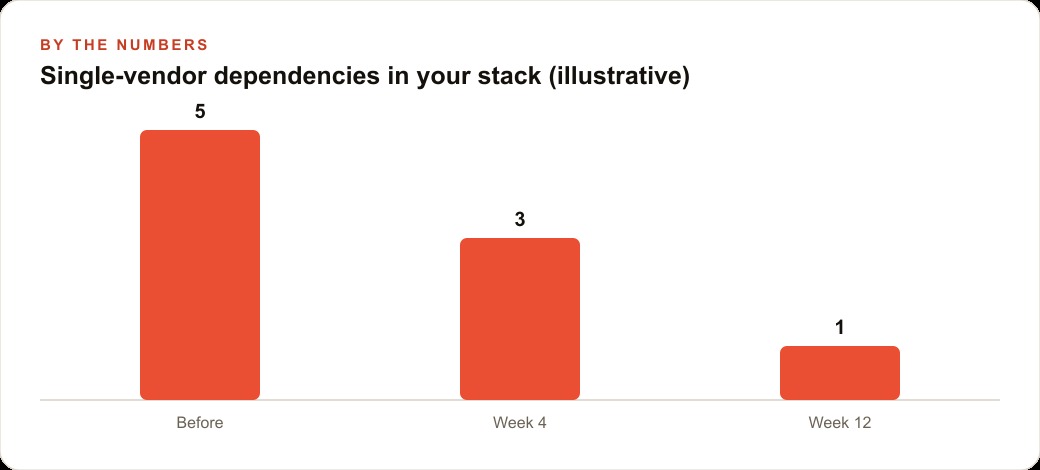
The business that has mapped its exposure clearly is the one that can respond to vendor policy changes or availability disruptions without scrambling. The one that has not done that mapping discovers its options in the worst possible moment, when a disruption is already in motion and alternatives need to be identified and tested under pressure rather than in advance.
The protective work is not expensive. Read the usage policy of each AI vendor you depend on meaningfully and note any restrictions that could conflict with your use cases. Run a concentration risk assessment: which single vendor dependency would cause the most disruption, and what would replacing it quickly actually require? Configure and test at least one fallback option before you need it. Set a reminder to check vendor policy updates when major announcements surface in the news. These steps do not require a dedicated team or significant budget. They require taking the vendor relationship seriously as a supply chain dependency rather than treating it as infrastructure too stable to think carefully about.
The larger point from this standoff is that the rules governing AI use in high-stakes contexts are being actively negotiated right now, by vendors, customers, regulators, and courts, simultaneously. The outcomes of those negotiations will affect every business that depends on AI infrastructure, whether or not that business has any interest in the specific parties or applications at the center of any given dispute. Following the negotiation at least closely enough to understand when a vendor's position changes is not optional for businesses where AI is central to the product. Ignoring it means learning about a vendor policy change from its effect on your own operation rather than from the announcement.
The moment a company draws a line between capability and permission, every downstream user of that company's technology is forced to find their own line. That is the durable lesson from this story, and it scales from a forty-person software company to a defense prime contractor with equal force.
What this means for businesses that are not defense contractors
The four plausible outcomes of the Anthropic standoff, the company changes its policy, gets formally designated, reaches a narrow compromise, or enters a legal battle, each carry different implications for businesses outside the defense sector. A policy change by Anthropic under government pressure does not affect only defense customers. Vendor ethics policies are not maintained in separate versions for government and commercial users. A change that permits the contested surveillance or weapons uses would change the policy for every commercial customer simultaneously, and any business that specifically chose Anthropic because its stated limits matched their own comfort level would need to re-evaluate that alignment.
A formal supply chain designation creates a period of sustained uncertainty for any business with a foot in both commercial AI and government contracting. The pressure to demonstrate that you are not dependent on a designated vendor can arrive faster than you can reasonably migrate a production system that took months to build. The business that already has a tested alternative in place is the one that can respond quickly and credibly. The one that does not has to choose between a costly emergency migration and the risk that the designation affects its own contracting status.
A legal battle produces the longest period of uncertainty, potentially measured in years. During that period, the vendor is under active legal and regulatory scrutiny, which can affect the stability of the product, the company's ability to invest in new capabilities, and the confidence of the commercial customer base. None of these effects require your business to have any direct stake in the specific legal question being contested. They flow from the vendor relationship itself, which is why mapping and managing vendor dependencies is a risk management practice rather than a political opinion about military AI.
The operational takeaway is the same regardless of how the Anthropic-Pentagon dispute ultimately resolves. Know what your AI vendors will and will not allow. Know which of those vendors you depend on most deeply. Know what replacing that dependency would actually require in time, cost, and operational risk. Have at least one tested alternative ready before you need it. Review all of this at least annually and whenever a significant vendor announcement appears in the news.
The technology is genuinely powerful. The vendors who provide it have their own constraints, principles, and business pressures that will evolve over time. Treating those vendors as stable utilities rather than as partners with their own complexity is the assumption this standoff is actively challenging. The businesses that update that assumption now are the ones positioned to respond clearly when their own vendor's line and their own use case come into contact.
That is exactly what we do at AI DOERS. Book a private 30-minute call with Madhuranjan Kumar and we will map the fastest path to it for your specific business.
Book your call →
Madhuranjan Kumar
Madhuranjan Kumar brings 20 years of performance-marketing experience and has managed over $200 million in Facebook ad spend for brands across the United States and beyond. His expertise spans the full modern marketing stack: Meta, Google Ads, TikTok, email automation, CRM, and the websites that hold it together. At AI DOERS he turns that track record into lead-generation systems for businesses across every industry.