
Why Anthropic Released Opus 4.7 But Kept Mythos Locked Away
Anthropic shipped Claude Opus 4.7 because it improves on 4.6 without crossing the cybersecurity thresholds that the bigger Mythos model does. Here is what actually changed, and how a small local business can put the better model to work today.
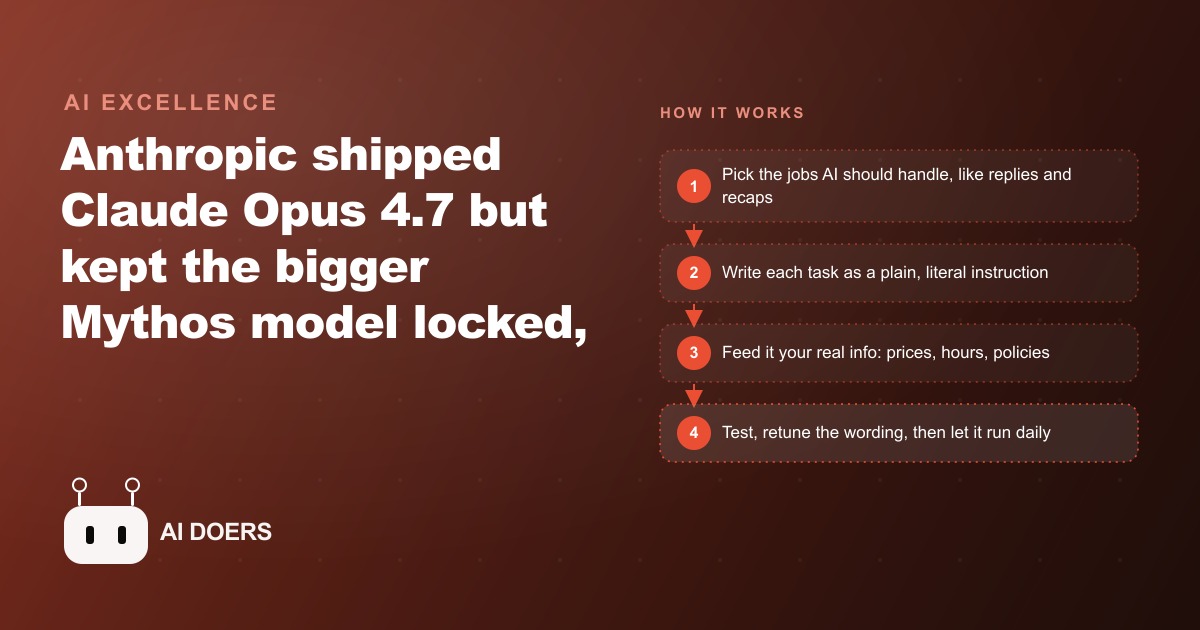
Every AI release announcement contains two stories. The first is the story the company wants you to hear. The second is the story embedded in what the company chose not to release, chose not to explain, and chose to quietly walk back before shipping. The Opus 4.7 announcement contains a second story that is more important than the first, and Madhuranjan is going to tell it here.
On the surface, the release is straightforward. Claude Opus 4.7 is labeled a dot release, yet it jumps ten points on SWE-Bench Pro, moving from 53.4 to 64.3. That is not a dot release in any conventional sense. That is a substantial capability increase. The model also introduces a million-token context window as the default, improves vision scoring to 79.5 on visual navigation benchmarks, adds an "extra high" effort level for reasoning tasks, and scores 1,753 on GDPval against a major competitor's 1,674. Claude Code users receive an "ultra review" command that runs a deeper audit of changed code before marking a task complete.
Any one of these improvements would justify a product announcement. All of them together constitute a significant leap in what the model can do. That is the story Anthropic wanted to tell.
But there is another story inside this release, and it requires looking carefully at what did not ship.
The model they showed but refused to release
Anthropic published benchmark charts for this release cycle that included scores for a model called Mythos. The charts showed Mythos performing. The researchers know what Mythos scored. And then Anthropic decided not to release it.
They did not say it was not ready. They did not say it needed more evaluation time. They said, in effect, that it was too capable in specific domains to release responsibly, and they named cybersecurity reproduction as the primary concern. The released version of Opus 4.7 has its cybersecurity reproduction benchmark score deliberately reduced from 73.8 to 73.1 compared to what the pre-release evaluation showed. That is not an accident of training. That is an intentional architectural decision made after the training run completed, before the model reached users.
Think about what that statement contains. Anthropic built a model capable enough in cybersecurity that the company considered it a genuine dual-use risk. They measured that risk. They quantified it on internal benchmarks. They showed the benchmark in public charts. And then they shipped a version with that specific capability deliberately walked back.
This is the most honest thing any major AI company has done in public discourse about capability management. It is also the most revealing. When a company shows you a benchmark score for a model it refuses to ship, and when it explicitly discloses that it reduced a capability before releasing the version it does ship, you are looking directly at the gap between what the industry can build and what it has decided is safe to release. That gap is real. It is measurable. And it is wider than most business conversations about AI assume.
What the withholding decision tells us about where capability actually sits
There is a common assumption in business conversations about AI that the frontier models currently available represent something close to the ceiling of what exists. That is wrong. The frontier of what exists and the frontier of what is available are two different lines, and the distance between them is a policy decision, not a technical limitation.
The Mythos situation makes this visible in a way that no previous release has. The model was built. The benchmarks were run. The scores were documented. Those scores appeared in public charts alongside the released model's scores. And then the company decided one specific capability dimension was too advanced to release without reduction. They published the fact of that reduction in their release documentation.
The "extra high" effort level shipped alongside Opus 4.7 is a practical expression of this same dynamic. Anthropic now gives users a dial. At standard effort, the model produces a response at the speed and cost users expect. At extra high effort, the model reasons more deliberately, allocates more inference compute, and produces results that benchmark higher on tasks where careful reasoning matters. The user is not accessing a different model. They are accessing more of the same model's capability, used more deliberately. The existence of that dial implies something worth naming: at standard effort, the model is not reasoning as carefully as it technically can. It reasons as carefully as the default cost structure permits. Knowing that the dial exists changes how any business should configure high-stakes tasks versus routine ones.
The new tokenizer compounds the consideration. Identical inputs now map to between 1 and 1.35 times more tokens than they did on the previous tokenizer. For businesses running high-volume processing through the API, this means cost increases on equivalent workflows without a corresponding change in what the prompt says. Pricing per token stayed the same. The token count for the same job went up. Any business doing budget planning for AI costs should re-benchmark token consumption with the new model before assuming costs will be stable.
The practical implication for any business currently using frontier AI tools is significant. The model you are paying for today is not the most capable model that exists. It is the most capable model that the company decided was responsible to release. Every major AI lab is making this same judgment continuously, with every release cycle. Every cycle involves models that were built and then not shipped, capabilities that were measured and then reduced, and reasoning systems that were evaluated and then gated behind access controls or withheld entirely.
This is not a criticism of Anthropic. Madhuranjan is making the opposite point: this transparency is valuable precisely because it is unusual. Most labs do not publish the benchmark scores for models they chose not to release. Most labs do not explicitly disclose capability reductions made between training completion and deployment. Anthropic did both in a single release cycle. That honesty should be recognized as meaningful, and it should inform how businesses think about what they are actually working with when they open a chat interface to any AI system.
The new tokenizer shipped with Opus 4.7 maps the same input to between 1 and 1.35 times more tokens than the previous tokenizer. This is relevant to cost. Businesses running high-volume processing through the API will see token counts rise on identical inputs, which means cost increases proportionally for those workflows. That is worth knowing before assuming the new model will cost the same as the old one at scale.
The million-token default context is the more interesting change for most business use cases. Workflows that previously required chunking long documents can now pass a full document in a single context window. Legal teams, research teams, and anyone working with contracts, transcripts, or lengthy technical specifications will benefit directly. The practical ceiling on what you can hand to the model in a single pass has moved dramatically.
How the hair salon discovers what literal-instruction following actually means
One of the practical improvements in Opus 4.7 is what Anthropic describes as better literal-instruction following. The model does what you ask more precisely, without adding context you did not request, without softening outputs it judges to be too blunt, and without padding responses to a length it deems more thorough.
A hair salon provides the clearest worked example of why this matters in a real business context.
The salon team uses AI to write social content. The previous model, given the instruction "write five Instagram captions for a balayage promotion, under 100 words each, no hashtags," would reliably produce captions that ran between 110 and 125 words, add three or four hashtags at the end with a note that "these may help with reach," and include a closing line like "Book your appointment today!" that the team had not requested and had to delete every time. This was not a bug. The model was trying to be helpful by anticipating what a marketing-minded user might want. The problem was that the team did not want what the model was anticipating.
The improved literal-instruction following changes this. The same prompt returns captions that stay within the requested word count, contain no hashtags, and do not add a booking call to action unless the original prompt included one. The output is exactly what was asked for.
The improved vision capability compounds this. The team can now upload a photo of a finished balayage and ask the model to describe exactly what techniques would have produced that result, what the lighting conditions suggest about the photography setup, and what caption framing would resonate with clients who are already looking at their own hair in the mirror. The model returns a technically accurate description of the technique, a lighting observation, and a caption framing that is specific to the image. Not generic. Specific.
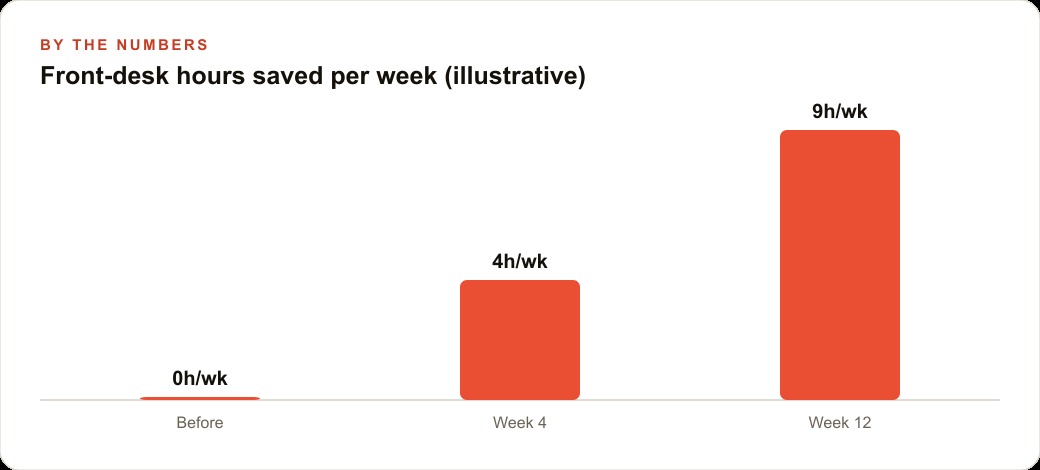
For a two-person salon team handling their own marketing, this change in literal-instruction following saves roughly 20 minutes per content batch and eliminates the rework cycle that was previously necessary to strip out the additions the model considered helpful but the team did not ask for. Three content batches per week over a quarter is approximately 15 hours of staff time returned. At the effective hourly cost of staff handling marketing tasks, that is a meaningful number. More importantly, it is friction eliminated. The team stops fighting the tool to get it to produce exactly what they said, and starts trusting it to produce exactly what they said.
The question every business should now be asking
If the most transparent company in the AI space is building models it considers too capable to release, and is simultaneously reducing specific capabilities in the models it does release, the question every business should be asking its AI vendor is simple: what is in the version you chose not to ship?
The answer is probably not available. Most vendors will not publish Mythos-style benchmark comparisons between their released and withheld models. But the frame is important. Businesses currently using AI tools for competitive advantage are using tools that represent a policy-limited subset of available capability. That subset is expanding with each release cycle. The direction of expansion is not random. It moves toward broader capability in areas judged low dual-use risk and stays gated in areas judged high dual-use risk.
For most businesses, the gated capabilities are not the ones they need. Cybersecurity reproduction at an advanced level is not relevant to a hair salon, a med spa, a gym, a law firm handling commercial contracts, or a marketing agency managing paid campaigns. What those businesses need is better instruction following, better vision, better long-context retention, and better code review. All of those improved in Opus 4.7. All of those are available now.
The Mythos situation is a signal, not a warning. It is a signal that capability is advancing faster than release cycles, that the companies building these systems are being more deliberate about what they deploy than public discourse typically acknowledges, and that the practical tools available to businesses are genuinely improving in the dimensions that matter for day-to-day commercial work. The new "extra high" effort level for reasoning tasks is available to anyone who needs it. The million-token context is available to anyone who can use it. The literal-instruction following is available to anyone who was frustrated by the previous model's tendency to be helpfully verbose in ways they did not ask for.
The second story inside the Opus 4.7 release is not a story about danger. It is a story about judgment. A company built something, looked at what it had built, and decided to ship a more limited version with the more sensitive capability deliberately reduced. Then it published that fact in its release documentation rather than pretending the reduction did not happen.
That is what responsible development looks like in practice. It is more useful to understand it clearly than to either dismiss it as corporate caution or exaggerate it as evidence of a hidden crisis. Somewhere in Anthropic's labs, Mythos sits on a benchmark chart that most people will never see, scoring better than what was released, waiting for the day the company decides the world is ready for it.
That is exactly what we do at AI DOERS. Book a private 30-minute call with Madhuranjan Kumar and we will map the fastest path to it for your specific business.
Book your call →
Madhuranjan Kumar
Madhuranjan Kumar brings 20 years of performance-marketing experience and has managed over $200 million in Facebook ad spend for brands across the United States and beyond. His expertise spans the full modern marketing stack: Meta, Google Ads, TikTok, email automation, CRM, and the websites that hold it together. At AI DOERS he turns that track record into lead-generation systems for businesses across every industry.