
Why Anthropic Cutting Off Open Claw Set the AI Dev World on Fire
It was not a feature change but a pricing change with teeth: Anthropic forced third-party harnesses like Open Claw off subsidized flat-rate Claude plans onto metered per-token billing, and lost the trust of the power users who evangelized it.

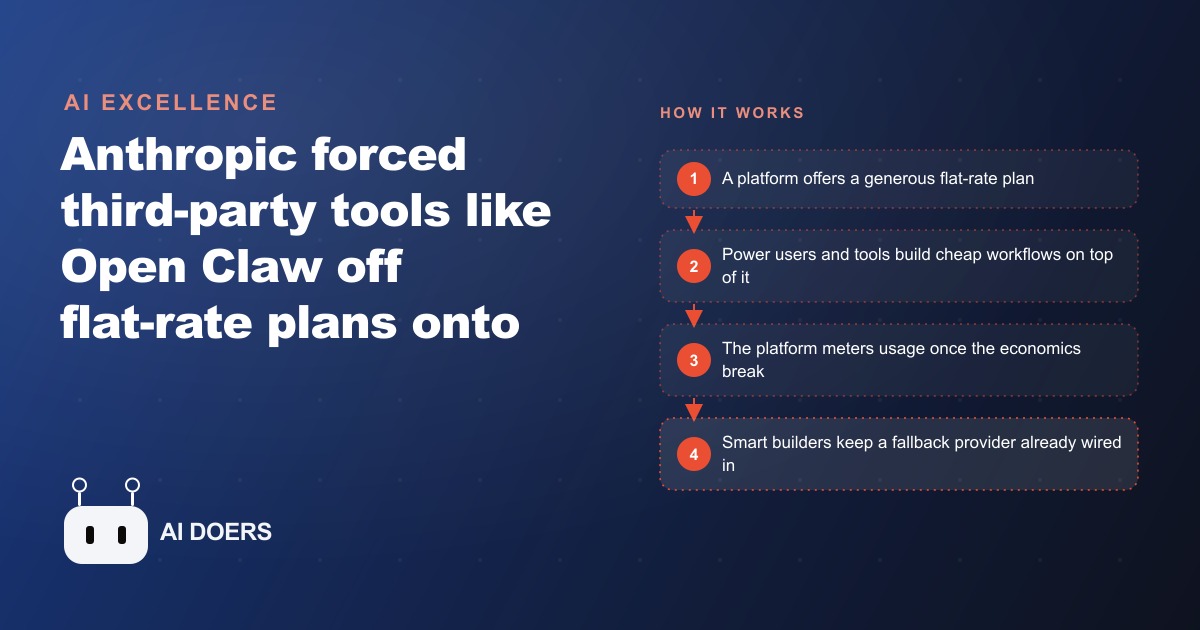
Every few months the AI developer world picks a new hill to die on, and the Open Claw cutoff was the steepest one in recent memory. Anthropic moved third-party harnesses off subsidized flat-rate plans and onto metered API billing, the community exploded, and the real story got buried under the noise. The real story is not about one tool. It is about five lessons that every builder, founder, and business owner running AI workflows should burn into their operating model before the next overnight rule change lands on them instead.
Lesson 1: The subsidy was never a product feature, it was a growth bet
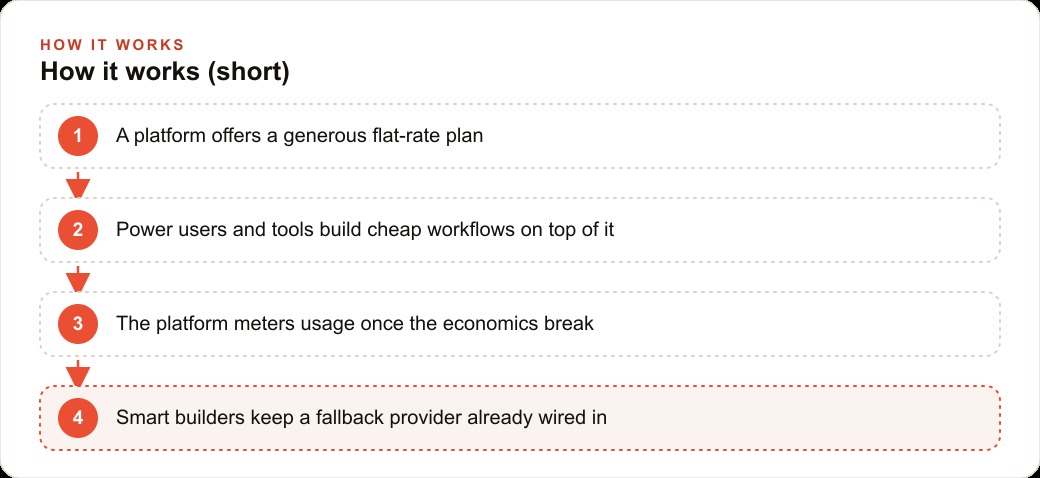
The mechanics of the blowup are worth understanding clearly. On the top-tier subscription plan, the platform let users consume far more compute than the monthly fee actually covered. One widely shared demo showed roughly 200 dollars of underlying API cost burned in seven days, on a mid-tier model running a modest workload. Tools like Open Claw ran on top of those plans and let builders spin up agent swarms at a fraction of true metered cost. That era is what ended.
What the platform did was not unusual in the history of technology platforms. It priced access cheaply during the growth phase to build a community, absorbed the losses, and then adjusted the economics once the gap between what users paid and what they consumed became unsustainable at scale. The mistake builders made was reading the promotional price as a permanent signal rather than a temporary subsidy. Every platform that has ever offered a generous free or near-free tier has eventually revisited it. The question for any business running on someone else's platform is never whether the terms will change. It is whether you built your unit economics to survive when they do.
For a software startup with AI features priced at the subsidized rate, the answer is often no. The product looks profitable because the AI cost looks small. The day the provider meters usage, the cost column in the P&L doubles or triples and margins that looked healthy become unsustainable. The fix is to model every AI feature at full metered rates from day one and make sure the product is still profitable at those rates before locking in customer pricing. If the math only works with the subsidy in place, the pricing model needs to change now, not after the subsidy ends.
Lesson 2: Copy-then-close is a documented pattern, not a conspiracy theory
The framing that landed hardest in the developer community was the copy-then-close accusation. The argument is that the platform observed which features third-party tools had built, absorbed the most popular ones into its own closed first-party product, and then changed the access terms that made those third-party tools economically viable. Whether that was the explicit intent is unknowable from the outside. What is knowable is that the sequence of events, feature absorption followed by access restriction, is a well-documented pattern in platform history.
Social platforms absorbed third-party scheduling tools and then restricted API access. App stores absorbed popular third-party features and then changed the discovery rules that surfaced competing implementations. The pattern recurs because the incentives are consistent: a platform benefits from having an ecosystem that demonstrates use cases, and then benefits from owning the best-performing ones directly. Builders who depend entirely on a platform's goodwill for their economic viability are operating in that ecosystem, and the history of how those relationships resolve is not encouraging.
The practical move is not to avoid ecosystems. It is to build something the platform cannot easily absorb, typically a niche vertical focus, a specific workflow integration, or a data advantage that compounds separately from the platform's own features. The Open Claw builder moved the tool to a competing model after the cutoff. That is the right reflex, and it only works if the second provider integration is already wired and tested rather than bookmarked as a backup plan. For businesses running Facebook and Instagram ad campaigns or Google Ads through third-party automation tools, the same logic applies: keep a manual fallback and a second vendor relationship active, because the automation platform's terms are not yours to set.
Lesson 3: The evangelist-to-critic pipeline is the real business risk
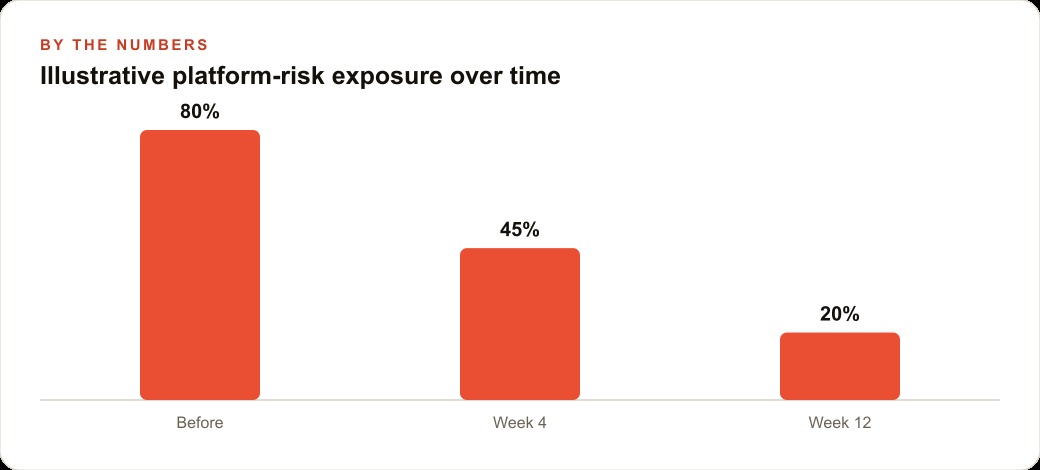
The economic damage from the Open Claw cutoff was not the lost token subsidy. The economic damage was the conversion of Anthropic's loudest advocates into its most vocal critics in the span of a news cycle. Power users who had spent months recommending the platform, building workflows around it, and bringing colleagues into the ecosystem, spent the following days posting cancellation screenshots and recommending competitors. The timing of the public reversal was extremely compressed, and the intensity of the response surprised even some observers who were sympathetic to the platform's business rationale.
This dynamic matters to any business because it is not unique to AI infrastructure. Every time a platform changes terms in a way that feels arbitrary or extractive to its heaviest users, it risks triggering the same pipeline: evangelists who invested real time and trust become critics who feel deceived. The investment of trust makes the feeling of betrayal proportionally stronger. A casual user who notices a price change shrugs. A power user who built workflows, wrote tutorials, brought in colleagues, and publicly advocated for the platform has something real to feel angry about when the rules shift under them.
The structural protection against this, for any platform or product with a power-user tier, is to give that group meaningful warning before changes take effect, not a changelog notice on the day of the change. Whether Anthropic could have managed this differently is a question of judgment, but the outcome illustrates a principle: the people who do the most to grow your platform are also the people with the most capability to damage your reputation when they feel wronged. That capability is worth treating as a serious risk factor, not an afterthought.
Lesson 4: Open source borrows right back, and that changes the competitive math
One of the more interesting reversals in the story was what the Open Claw project did after the cutoff. The tool's update released shortly after the restriction included a dreaming feature, a memory-consolidation capability that the platform had reportedly been building internally for its own first-party product. Open source borrowed back from the platform that had allegedly borrowed from it first.
This matters because it changes the competitive dynamics for platform-dependent builders who are watching from the sidelines. A first-party platform moving faster than the open-source ecosystem creates a sustainable moat. A first-party platform moving at roughly the same pace as an active open-source ecosystem, with the open-source side motivated by grievance and public attention, does not have the same structural advantage. The community that feels wronged often accelerates, not slows, in response to the pressure.
For builders making decisions about which ecosystem to invest in, this is a signal worth tracking. An open-source tool that responds to a cutoff by shipping a competitive feature within the same news cycle is demonstrating organizational capacity that should factor into the build-versus-buy-versus-depend analysis. Businesses that use AI tools in their SEO and organic search work or their CRM and website stack face the same question in a different form: when a vendor restricts access or raises prices, how quickly can the open-source alternative fill the gap, and is that alternative close enough to switch today?
Lesson 5: Legal and reputational risk are independent variables, and only one of them was managed
Almost nobody in the public debate claimed Anthropic broke its own terms of service. The platform had the contractual right to meter usage, restrict third-party access, and change what its flat-rate plans included. The legal dimension of the story was never really in dispute. What was in dispute was the reputational dimension, and those two variables do not move together.
This is a lesson that applies well beyond AI platforms. A business can do something entirely within its legal rights and still suffer a reputational cost that exceeds the economic benefit of the move. The key factor is whether the people affected feel the change was fair, whether they had warning, and whether the platform's behavior matched the implicit expectations it had built through its prior actions and communication. A company that cultivates a developer community, encourages workflow investment, and then changes access terms without meaningful notice has done nothing technically wrong and has still broken a social contract that the community experienced as real.
For any business running an agency, a product, or a platform, the practical takeaway is to treat reputational commitments as seriously as legal ones. When you know a change is coming that will hurt your heaviest users, the way you communicate it and the lead time you give them will determine whether you lose a feature or lose advocates. The Open Claw story is a useful reference case for any founder managing a community around a product that depends on API access, platform policies, or pricing structures that are ultimately not in their control.
The worked example: a software startup that nearly built its margins on a platform subsidy
Here is the scenario I walk through with clients in this situation. A startup builds an AI-powered document review feature and prices it at a monthly rate that looks profitable based on the current cost of running the underlying model on a flat developer plan. The unit economics look clean. The feature is popular. The team starts planning the next expansion based on those margins.
Then the provider meters usage. Overnight, the cost of running the feature on the top 20 percent of active users, the heavy users who run dozens of document batches per month, goes from nearly nothing to a meaningful per-token charge. At full metered rates, those users are now unprofitable to serve at the current subscription price. The startup has three options: raise prices and risk churn, absorb the loss and compress margins, or remove the feature and lose a differentiator. None of those options are good, and all of them were avoidable.
The version of this startup that built correctly looked almost identical on the outside. Same feature, same user experience, same pricing at launch. The difference was internal. The founder modeled every AI call at full API rates before setting the subscription price, built in a second model provider integration during the first sprint rather than treating it as a future sprint, and set a quarterly calendar reminder to read the terms of service for every platform the product depended on. When the provider changed the rules, the startup had three weeks of advance notice from a changelog it actually read, a second provider already integrated and tested, and pricing that already worked at full metered rates. The rule change was an annoyance, not a crisis.
The cost of doing this correctly was approximately one additional sprint of engineering time, a few hours of founder attention to the terms documents, and the discipline to price at true cost rather than subsidized cost. The return on that investment is a business that survives a platform rule change without an emergency all-hands. Given the frequency with which AI platform terms are currently moving, that return compounds quickly.
The single most actionable thing any builder can do this week is open the terms of service for every platform their product depends on and read the section about pricing changes, API access restrictions, and what the platform can modify without notice. Most people have never read it. The ones who have are the ones who were not surprised by the Open Claw cutoff, because they already knew the subsidy was not guaranteed. Build accordingly, and the next overnight rule change is someone else's crisis.
That is exactly what we do at AI DOERS. Book a private 30-minute call with Madhuranjan Kumar and we will map the fastest path to it for your specific business.
Book your call →
Madhuranjan Kumar
Madhuranjan Kumar brings 20 years of performance-marketing experience and has managed over $200 million in Facebook ad spend for brands across the United States and beyond. His expertise spans the full modern marketing stack: Meta, Google Ads, TikTok, email automation, CRM, and the websites that hold it together. At AI DOERS he turns that track record into lead-generation systems for businesses across every industry.