
Why Andrej Karpathy Really Joined Anthropic: Using Claude to Build Better Claude
Karpathy joined Anthropic's pre-training team to use Claude to accelerate pre-training research, meaning AI that improves AI. His open-source Auto Research project already showed an agent loop cutting model training time by about 11 percent.

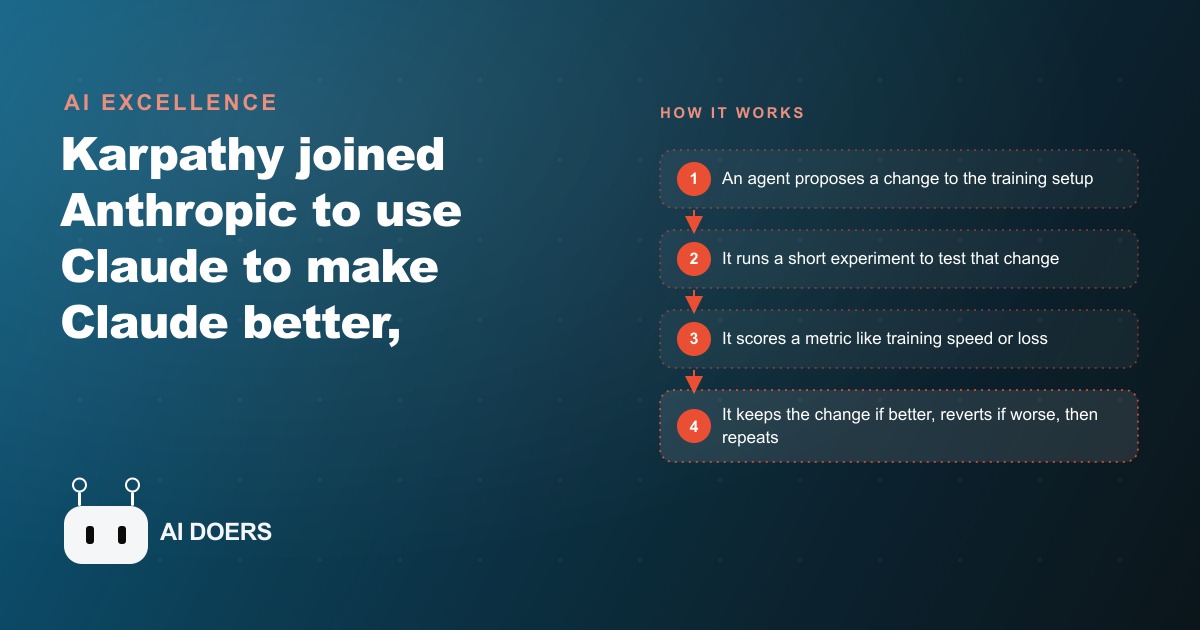
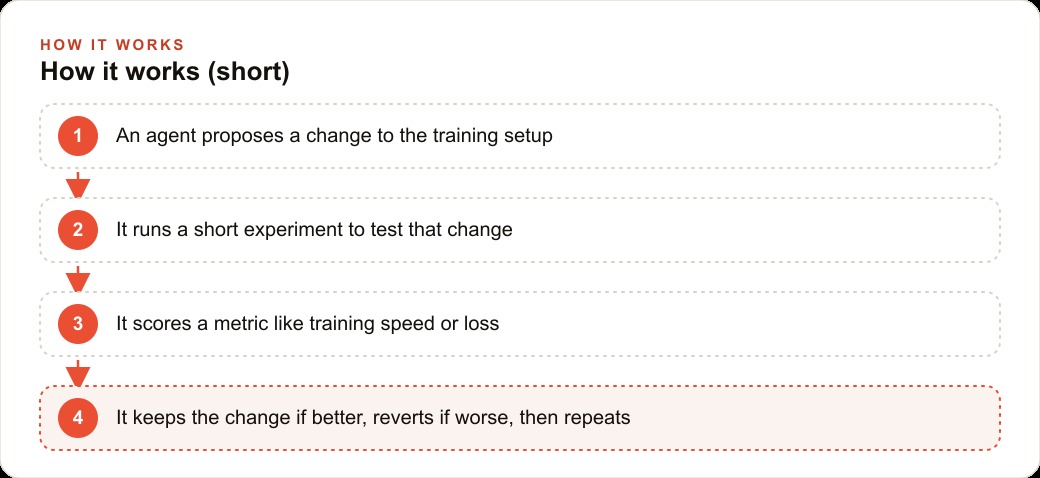
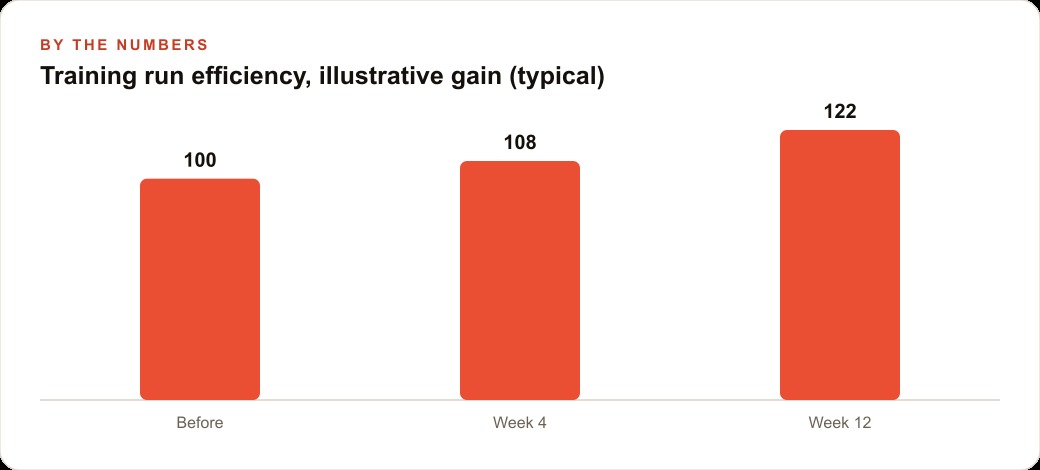
When Karpathy announced he was joining Anthropic's pre-training team in May 2026, most coverage focused on the name. I want to focus on the method. What Karpathy described as his core project, which he calls Auto Research, is a 630-line Python program that proposes a change to a training configuration, runs the experiment, measures one metric, keeps the change if the number improves, reverts it if the number does not, and then starts the next iteration. He ran this loop 700 times over two days on a home computer. The result was roughly 20 stackable improvements that cut training time from 2.2 hours to 1.8 hours, an 11% speedup.
I am Madhuranjan Kumar, and what interests me about this story is not the technology. It is what the loop reveals about where progress actually happens in any complex system. The following six observations come directly from what Karpathy described, and each one has implications that extend well beyond AI research.
1. The 11% Speedup Means Something Entirely Different at $100 Million Scale
On a home machine, 11% faster training saves roughly 24 minutes per run. That is convenient but not remarkable. At frontier scale, the picture changes entirely. The leading AI laboratories spend between $50 million and $100 million on a single training run. At that level of expenditure, an 11% reduction in compute time is between $5.5 million and $11 million saved per run. Across multiple runs in a year, an improvement discovered by a researcher working at home on inexpensive hardware is worth hundreds of millions of dollars in aggregate efficiency, or it enables significantly more experimental iterations at the same total budget.
This is why Anthropic invests in small-scale exploratory research before committing to production training runs. The loop works identically whether the compute costs $500 or $50 million. What changes is the payoff when improvements transfer upward to full scale. The economic logic applies outside AI as well. Any efficiency gain discovered in a low-stakes environment compounds when it is applied to the full-scale operation. A team that finds a 10% improvement in how they handle client onboarding at 40 clients per month has found something worth far more if they ever operate at 4,000 clients per month. The discovery cost is fixed at the small-scale experiment. The payoff scales with the volume it is applied to.
2. Pre-Training Decisions Compound Downstream Into Every Capability the Model Ever Has
Pre-training is the phase where a model learns from a vast body of text before it is fine-tuned, aligned, or instructed to do anything specific. It is the foundational layer beneath everything users experience when they interact with an AI system. This is why pre-training consumes the largest share of AI laboratory budgets, and why improvements found there matter disproportionately to everything built on top.
A change that makes pre-training 11% faster does not simply save compute costs on that run. It allows the laboratory to complete more experimental iterations within the same research timeframe, which means the model's foundational capabilities are improved through more cycles, which means downstream qualities including reasoning, language understanding, coding ability, and instruction following all improve as a consequence of work done at the substrate level. Pre-training is the source. Every product, every fine-tune, every API call draws from what was built there.
This is the reason Anthropic publicly states it has no side quests. The laboratory is not building a music generation model, a voice assistant product, or a video synthesis tool. It is concentrating every research dollar on improving the core. The strategic logic is that improvements at the substrate level propagate upward through every capability, while improvements made at the product layer remain local to that product. A better pre-trained base model makes every application built on top of it better. A better voice product makes only the voice product better. When you cannot match a competitor's total resources, concentrating on the layer where improvements compound is the rational choice.
3. The Loop Is the Scientific Method With Human Judgment Removed From Every Iteration That Doesn't Need It
The scientific method has not changed: form a hypothesis, design an experiment, collect a measurement, update your understanding, repeat. What Auto Research does is run this cycle autonomously. A human did not decide after each of the 700 experiments whether the result was interesting enough to pursue, or whether the metric moved for a real reason or an incidental one. The loop decided: number up, keep it; number down, revert it. The researcher who designed the loop specified the metric and reviews the final stack of improvements. But the individual iterations run without anyone being present.
This is the key structural insight. The constraint in traditional research is not the quality of hypotheses. Researchers generally know what is worth testing. The constraint is the time between hypothesis and measurement, and the human attention required to process each result and choose the next step. When you automate the middle steps, the bottleneck shifts from researcher bandwidth to compute time. Karpathy ran 700 experiments in two days. A team of researchers making decisions about which experiments to run, writing the configuration changes, waiting for results, reading the outputs, and choosing the next step might complete 15 to 25 experiments in two days under favorable conditions. The loop does not replace judgment. It removes judgment from the steps where judgment is not needed, freeing it for the design of the loop itself and the interpretation of the final stack of results.
4. A 630-Line Script Found What a Large Research Team Working Sequentially Could Not Have Found in the Same Time
Karpathy was specific about the size of Auto Research: 630 lines of Python, running on a home computer. He made this point deliberately. The tool that identified 20 stackable improvements to a frontier AI training process is not a supercomputer cluster managed by a team of dozens. It is a well-structured loop running on commodity hardware.
This challenges the assumption that meaningful research on frontier problems requires large organizational infrastructure. The value was not in the machines. It was in the question being asked, the metric being tracked, and the discipline of keeping each experimental iteration small enough to complete quickly and evaluate cleanly. Organizations that design experiments measuring dozens of variables per run rarely find clear signal, because the space of possible explanations for any result is too large. When the change is small and the metric is singular, attribution is clear. You know why the number moved because you only changed one thing.
The tight loop is not intellectually satisfying in the way a rich multivariate analysis feels. It is simply more likely to produce an answer you can act on. For any team doing iterative improvement work, this is the practical lesson: the complexity of the experiment is often an obstacle rather than an asset. More variables do not give you more information if they also give you more ambiguity about which variable was responsible for the result.
5. Locking Onto One Bet Is the Strategy of a Focused Competitor Against a Diversified One
Google can fund Gemini and build world models and support internal coding agent projects and maintain a consumer product suite and invest in robotics simultaneously. Anthropic cannot match that breadth and has chosen not to try. What Anthropic can do is concentrate on the pre-training core so that its rate of improvement in that specific area is faster than a competitor whose attention is divided across a dozen product lines and research directions at once.
Clark, who was among the co-founders of OpenAI before helping start Anthropic, has stated publicly that he estimates a 60% or better chance that AI research will be mostly automated by the end of 2028. If that estimate is even roughly correct, the laboratory that is best at running automated research loops will have a decisive compounding advantage over the next two to three years. Hiring a researcher who built a 630-line automation that ran 700 useful experiments in 48 hours is a signal about where Anthropic believes that leverage point lives. The discipline of the no-side-quests policy is not conservatism. It is a bet that the next 24 months of pre-training progress will determine which models are trusted enough to be embedded in systems that matter, and that splitting research attention during that window is more costly than it appears.
Brin's return to hands-on coding work at Google signals the same conviction from the other side: that the models being built right now are worth the personal attention of the people who built the company. Both companies are concentrating resources and attention on the foundational layer because that is where the next decisive advantage is expected to be won.
6. Any Business With One Trackable Metric Can Run a Version of This Loop Right Now
This is the item that applies regardless of whether you work in technology or run a local business. The Karpathy loop is not a technique invented for AI training. It is a formalization of a simple idea: change one thing, measure one number, keep it if the number improves, revert it if it does not, and move to the next candidate. The discipline is in the constraints, not in the technology.
Consider a hair salon tracking bookings per week as its single metric. The owner identifies six variables to test over 12 weeks: the placement of the online booking button on the website, the number of portfolio photos displayed on the services page, the timing of reminder messages sent to clients who have not booked in 45 days, the headline text on the homepage, whether a price list is visible without clicking through, and whether Saturday and Sunday availability is listed explicitly rather than implied. Each week, one change is made. If bookings per week go up over the following two-week measurement window, the change is kept. If they stay flat or decline, the change is reverted and the outcome is recorded as a negative result.
After 12 weeks, four of the six changes were worth keeping. The stacked result is 14% more bookings per week. On a base of 200 bookings per week at an average service value of $75, 14% is 28 additional bookings, which is $2,100 in additional monthly revenue. No paid advertising was run during this period. No redesign was commissioned. No new staff were hired. The only input was the discipline of changing one variable at a time, measuring the outcome, and reverting what did not work before testing the next candidate.
What Karpathy demonstrated in AI pre-training research is the same principle the salon illustrated with appointment bookings. The fastest path to compounding improvement is not the most creative hypothesis. It is the tightest loop. Small changes preserve attribution clarity. A single metric prevents rationalization of ambiguous results. Automatic reversion keeps the baseline clean rather than letting underperforming changes accumulate because no one made the decision to remove them. The loop works at $100 million in compute costs. It works at zero budget in a scheduling tool. The constraints that make it powerful are not technological. They are structural, and they are available to any operation willing to apply them consistently over time. The reason most businesses do not benefit from this kind of iterative improvement is not that the loop is hard to set up. It is that changing one variable at a time, waiting to measure the result, and reverting a change you liked the idea of requires a patience that most improvement initiatives do not build in by design.
The Karpathy loop also clarifies why most improvement initiatives stall. They start with multiple simultaneous changes, making it impossible to know which change produced any given result. They measure outcomes on a timeline too short to separate signal from noise. And they rarely build in automatic reversion, so unsuccessful changes accumulate rather than being cleanly removed. The structure is the insight. The technology is secondary.
That is exactly what we do at AI DOERS. Book a private 30-minute call with Madhuranjan Kumar and we will map the fastest path to it for your specific business.
Book your call →
Madhuranjan Kumar
Madhuranjan Kumar brings 20 years of performance-marketing experience and has managed over $200 million in Facebook ad spend for brands across the United States and beyond. His expertise spans the full modern marketing stack: Meta, Google Ads, TikTok, email automation, CRM, and the websites that hold it together. At AI DOERS he turns that track record into lead-generation systems for businesses across every industry.