
Why AI Is About to Get 100x Faster, and What It Means for Your Business
OpenAI signed a multi-year, multi-billion dollar deal for specialized inference chips that could make AI responses dramatically faster. Here is what that race for speed actually changes for a small business owner.


OpenAI just committed billions of dollars over multiple years to buy specialized inference chips, and the reason has nothing to do with building smarter models. It has to do with serving the ones they already have, faster and cheaper than any competitor can manage. I am Madhuranjan Kumar, and this particular announcement matters more than most AI headlines you will see this month, because it is not about a new feature or a benchmark score. It is about the physical infrastructure that determines whether AI keeps getting cheaper and faster for every business using it, or whether the pace of improvement stalls.
Inference is the mechanism at the heart of every AI interaction you have ever had, and the arms race to dominate it is about to change several things at once for small businesses. Here are eight of them.
Inference is the part of AI that costs money every single day
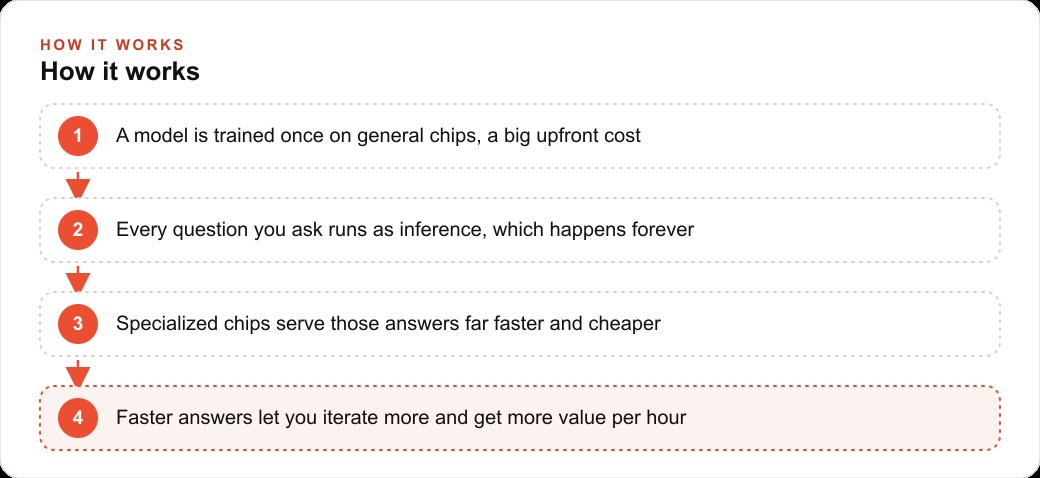
Training a model is expensive, but it happens once. The lab trains the model, that version is complete, and the work is done until the next generation. Inference is the part that never stops. Every question you type, every document you ask the tool to summarize, every email draft the assistant generates, all of it runs through inference. For a company like OpenAI, serving billions of queries per day means inference is where the majority of operating cost lives. The compute, the electricity, and the engineering capacity required to keep those answers flowing at scale all sit inside the inference layer.
Understanding this changes how you read the chip deal. A better inference chip is not a one-time improvement. It is a compounding advantage that applies every single day the system runs. Locking in a multi-year, multi-billion dollar deal for dedicated inference capacity is a bet that the compounding return on that investment exceeds the cost of the contract. At the volumes these labs operate, that math almost certainly holds.
The downstream effect for small businesses is that the economics of the tools you use are directly tied to how efficiently the underlying inference layer runs. When inference gets cheaper, the platforms built on it pass those savings downstream through lower prices, higher usage limits, and faster responses. This is not a projection. It is the pattern that has repeated every twelve to eighteen months as inference costs have fallen and AI tool pricing has followed.
Dedicated chips already clock 3,000 tokens per second on open models
General-purpose GPUs are designed to handle many different types of computation. They handle graphics, scientific simulation, video encoding, and AI inference all with the same hardware architecture. That flexibility carries a cost: the design is not optimized specifically for the mathematical operations that inference relies on most. Purpose-built inference chips narrow that optimization target dramatically, and the speed difference between them and general-purpose alternatives is not incremental but categorical.
One open model running on dedicated inference hardware has been clocked at over 3,000 tokens per second. A strong general-purpose competitor runs at a few hundred. That is roughly a ten-to-one difference in throughput. At 3,000 tokens per second, a complete detailed paragraph generates in roughly two seconds. At a few hundred tokens per second, you are watching words appear across a noticeably longer wait, and every pause in the workflow accumulates over the course of a day.
What this means for a user is the difference between watching a tool generate a response word by word while you wait and receiving a complete answer almost before you have finished reading the prompt. For anyone doing high-frequency AI work, such as running multiple drafts of ad creative or iterating on a customer email, the subjective difference in responsiveness changes how you think about using the tool at all. A tool that feels fast gets used continuously throughout the day. A tool that feels slow gets used reluctantly and only when the task absolutely requires it.
Memory baked onto the chip sidesteps the RAM shortage that is slowing everyone else
One of the less-discussed constraints in AI scaling is memory bandwidth. The compute cores in any AI chip need to be fed data fast enough to keep them busy at full capacity. If memory is slow or supply-constrained, the cores sit idle waiting for data to arrive, and throughput suffers regardless of how fast the compute itself can run. RAM prices have climbed sharply as AI infrastructure demand has outpaced supply, and many chipmakers are facing delays and cost increases because of it.
Some specialized inference chip designs address this by integrating the memory directly onto the chip itself rather than routing it through external RAM modules. The memory physically shares the same substrate as the compute cores. Data travels a fraction of the distance at a fraction of the latency. This architecture bypasses the external memory shortage entirely while also removing the latency that data transfer between physically separate components introduces.
For the labs running at scale, this means they can continue expanding inference capacity during a period when other chip designs are constrained by the same external supply chain that has driven up the cost of consumer computer memory. For the businesses those labs serve, it means the supply of AI compute does not get stuck behind a component shortage during the most rapid expansion period the industry has seen.
Faster AI means more iterations in the same time window
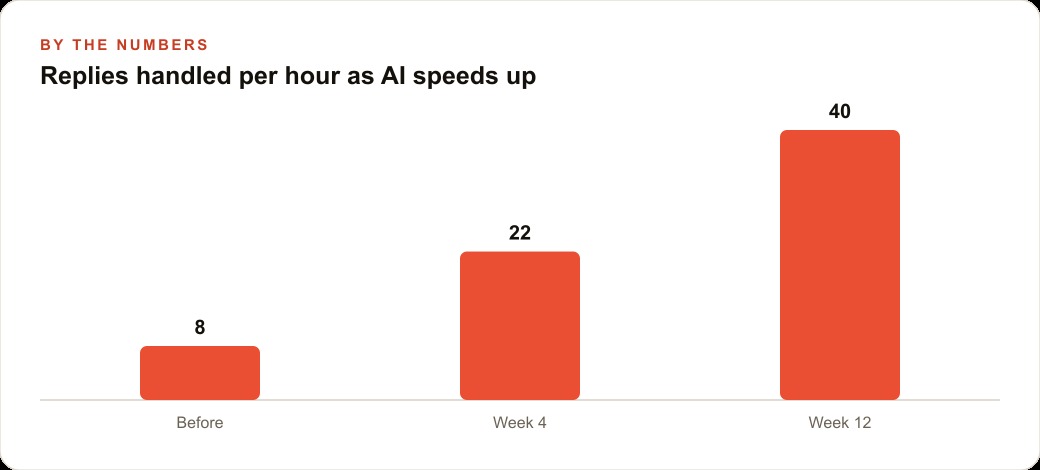
This is where the speed race connects most directly to daily business work. When you use AI to draft something, the number of useful iterations you can complete in a session is constrained by how long each response takes. If generating a draft requires an eight-second wait, you can review and refine maybe a dozen versions in an hour. If it takes under a second, you can complete forty or fifty useful cycles in the same window, and the quality of your final output rises because you are choosing the best option from a much larger set.
A small marketing studio that handles content and ad creative for several clients currently produces two or three polished caption variants per client per session, because each iteration requires waiting on the model, reading the output, deciding what to adjust, and waiting again. That pacing is a constraint the studio has adapted to without realizing it is artificial rather than inherent to the task. The studio is not naturally limited to three versions. It is limited by the time between versions.
With instant-response AI, the same studio produces ten to twelve strong variants in the same time window and selects the best two or three rather than settling for whatever emerged from a small number of tries. For Facebook and Instagram ad campaigns, this matters in a directly measurable way. When the studio submits ten tested caption variants rather than two or three, the strongest variant from that set is almost always better than the strongest from the smaller set, simply because the pool is larger. Speed does not just save time. It raises the quality ceiling you can reach in a given working session.
Once inference moves to dedicated hardware, general chips go back to training better models
There is a compounding structural benefit to the inference and training hardware split that tends to be overlooked in coverage of chip deals. Right now, AI labs must allocate their general-purpose GPU capacity between two competing uses: training new models and serving the current ones. When inference demand is high, which it is continuously at the scale these labs operate, capacity that could be training the next generation of models is instead consumed answering today's queries. The two priorities compete for the same hardware.
Moving inference onto dedicated chips removes that competition entirely. The general-purpose compute can then be pointed exclusively at training, which means the pace of model improvement can accelerate at the same time as inference speed improves. These are not two things trading off against each other. They become two parallel tracks running simultaneously, each improving at its own rate.
The result for a business owner using AI tools is that both the speed and the quality of those tools continue improving in tandem. Faster answers today, smarter answers next quarter, all from the same single structural shift in how the industry allocates compute. The chip deal is not just a bet on cheaper serving. It is an indirect investment in faster model improvement, because freeing up training capacity makes the next generation of models arrive sooner with larger capability jumps.
The real competition is not who has the smartest model but who can serve it cheapest and fastest
The business of AI has shifted from a research competition to an infrastructure competition. The labs that dominate the next decade are not necessarily the ones that publish the most impressive benchmark results. They are the ones that can serve those results to the most users at the lowest cost per query.
Inference economics, specifically cost per token served, latency, and throughput per dollar of infrastructure, determine which tools a business owner can afford to run continuously versus which ones they use sparingly because the per-use cost accumulates. The specialized chip deal is a multi-year bet on winning that competition. If it pays off, the lab that made it serves more tokens per dollar than any competitor, which lets it price more aggressively for everyday business use while maintaining margins on the high-end products.
The multi-year contract structure is also a hedge. Chip manufacturing capacity takes time to build and scale. Locking in future capacity at current contract terms is a bet against the cost increases that will come as demand for inference chips grows across the entire industry. It is a move made by an organization that expects AI usage to grow substantially over the next several years and wants to own the cost structure of that growth rather than be subject to it.
Small business tools are the downstream beneficiary of an upstream chip arms race
None of the infrastructure described in this article is something a small business owner purchases directly. You are not buying inference chips. You are using tools built on top of the infrastructure those chips power: writing assistants, customer service automation, SEO and organic search tools that surface your business to buyers who are already searching, content pipeline tools, and the kind of CRM and website stack that automatically triggers the right follow-up message when a lead engages with your content. All of those tools sit downstream of the same inference layer the chip deal is improving.
When inference becomes cheaper, tools built on it can lower their prices or raise the usage limits that constrain how much work you can complete per day within your subscription. When inference becomes faster, every tool that runs on it feels more responsive and becomes more useful for continuous work throughout the day. The upstream investment is invisible from where a business owner sits, but its effects are the reason AI tools that cost several hundred dollars per month three years ago are now available at free tiers and modest subscriptions while being substantially more capable.
The chip arms race is not a story about which AI lab wins a technical competition. It is a story about whether the cost of intelligence continues to fall fast enough to become a genuine utility for small businesses rather than remaining an expensive experiment available only to well-funded organizations.
Speed makes AI feel like a fast assistant you bounce ideas off, not a slow oracle you consult once
The most important qualitative shift that comes from inference speed is not about cost or capability metrics. It is about the interaction pattern that becomes natural at different speeds, and how that interaction pattern changes what the tool is useful for.
Slow AI encourages you to treat it like an oracle. You compose a careful, detailed question. You submit it. You wait. You receive an answer and take it away to act on. The pause creates a psychological cost to going back and asking again. You settle for what you received rather than continuing the conversation, because another round-trip feels expensive even when the monetary cost is low. The interaction is fundamentally one-directional.
Fast AI changes that pattern entirely. When the answer arrives before you have finished reading your own prompt, asking a follow-up question costs almost nothing. You respond to the answer. The response comes back immediately. You push back on one detail. Another response comes. A few exchanges later, you have arrived somewhere better than you could have reached alone, and the total elapsed time is less than a single slow response would have taken with the old architecture.
This shift matters most for work that has real stakes: strategy sessions, pricing decisions, offer development, campaign planning, problem diagnosis. A business owner working through a new pricing structure can state a half-formed position, get back a reaction in under a second, push back on it, receive an alternative framing, and arrive at a well-considered final position in ten minutes. The model is not smarter in that scenario. The feedback loop is tight enough to use naturally, and a tighter feedback loop produces better thinking.
The chip investment OpenAI made is ultimately a bet that this conversation pattern is where AI value lives for real business use, and that reaching the latency required to make it feel natural at scale is worth committing billions of dollars and multiple years of capacity planning to achieve. For the small business owner who has been using AI as an occasional tool rather than a continuous working partner, that shift in feel is what may finally make it a permanent part of how work gets done every day.
That is exactly what we do at AI DOERS. Book a private 30-minute call with Madhuranjan Kumar and we will map the fastest path to it for your specific business.
Book your call →
Madhuranjan Kumar
Madhuranjan Kumar brings 20 years of performance-marketing experience and has managed over $200 million in Facebook ad spend for brands across the United States and beyond. His expertise spans the full modern marketing stack: Meta, Google Ads, TikTok, email automation, CRM, and the websites that hold it together. At AI DOERS he turns that track record into lead-generation systems for businesses across every industry.