
Why a Four-Tool AI Agent Beats the Bloated Ones
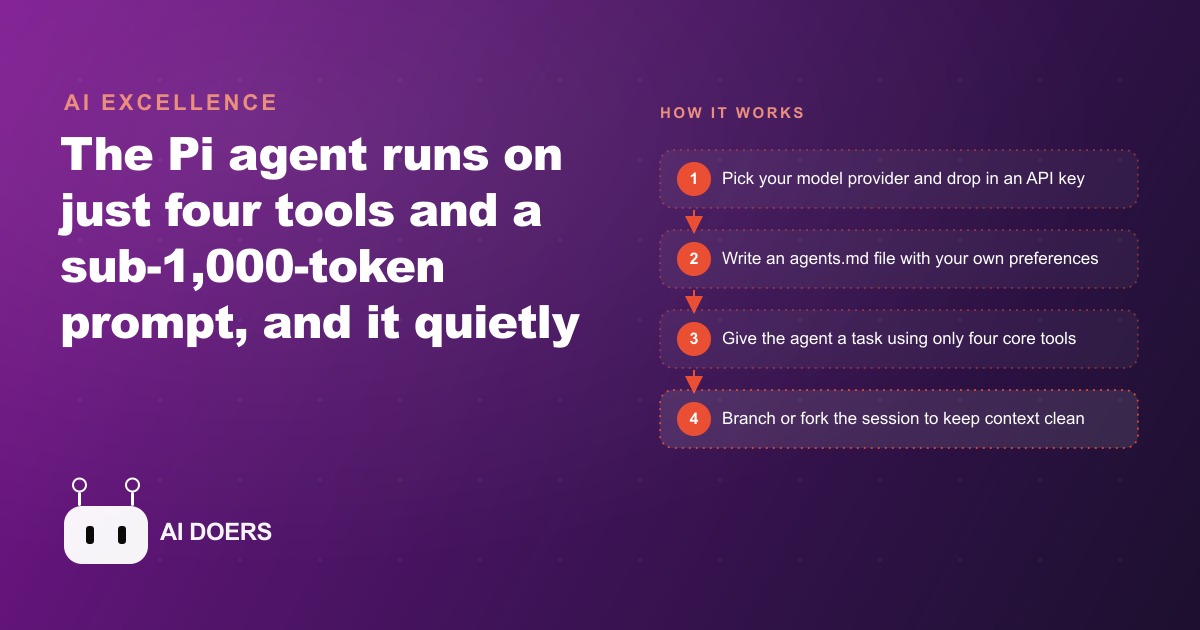
The Pi agent runs on just four tools, read, write, edit, and bash, with a system prompt under 1,000 tokens. That radical minimalism is exactly why power users build on top of it instead of heavier, more expensive agents.

The moment you discover what is underneath
There is a specific kind of surprise that comes from discovering that a platform millions of people use every day is built on something you have never heard of. You encounter the popular tool, it becomes familiar, you start to understand how it works, and then you find out that underneath it is a thing so simple it barely seems like a thing at all: four tools, a system prompt under 1,000 tokens, and a loop.
That is the discovery at the center of this piece. The most widely used AI coding agent runs on top of a minimal agent called Pi. Most of the people running the popular tool have no idea what is underneath it. The power users, the ones who have been using AI agents long enough to care about the internals, tend to run Pi directly. And the gap between knowing this and not knowing it tells you something important about where value actually lives in AI tooling, something the industry has spent years obscuring with capability marketing and feature lists.
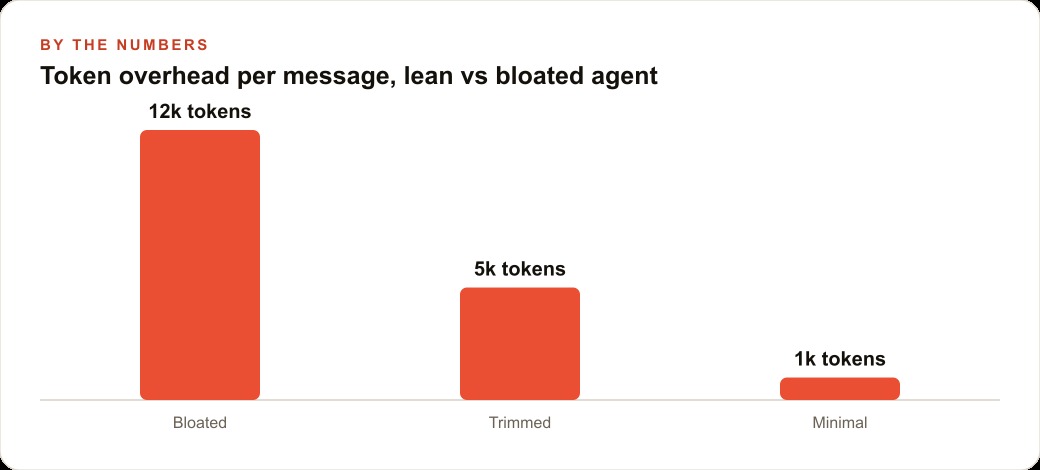
Pi ships with four built-in tools: read, write, edit, and bash. The read tool opens any file so the agent is never working blind. The write tool creates new files. The edit tool modifies existing ones, changing only the lines that need changing rather than rewriting whole files and discarding what was already correct. And bash, the most powerful of the four, runs any terminal command: installing packages, running tests, starting servers, checking version history, making network requests. Those four primitives cover almost everything a software agent needs to do in the course of real work. The system prompt that sets up this agent and defines how it reasons is under 1,000 tokens. A popular competing agent's default system prompt runs over 12,000 tokens.
The AI industry has spent years moving in the opposite direction of this. Features compound into frameworks, frameworks compound into platforms, platforms compound into suites with onboarding flows and pricing tiers and settings panels full of toggles for things most users never think about. The assumption underlying all of it is that more capability requires more infrastructure, and more infrastructure requires more overhead, and that overhead is a fair price for the power it unlocks. Pi is a direct refutation of that assumption. The most-used coding agent in the world runs underneath a sub-1,000-token prompt. The question that raises is not what Pi is. It is what all the other tokens were for.
What radical minimalism costs you and what it returns
Let the cost be stated plainly first, because it is real. Pi always runs without permission prompts. There are no guardrails, no confirmation steps before executing a command, no warning when a tool call has irreversible consequences. The logic behind this design is coherent: if an agent can write and run code, asking it to confirm each step is theater, because an agent that writes and runs code is already past the point where a permission prompt provides meaningful protection. But the practical implication is that running Pi with mistaken instructions in the wrong directory can cause real harm to real files. This is not a tool for beginners, and that is not a marketing caveat. It is an accurate description of the risk profile.
With that stated, what minimalism returns is significant enough to explain why this approach has found the user base it has. The first return is transparency. When a system prompt is under 1,000 tokens, you can read the whole thing in two minutes and understand exactly what the agent has been told to do and how it has been instructed to reason. That is not possible with a 12,000-token system prompt. At that length you are trusting that the instructions are well-aligned with your intent without being able to verify it efficiently. With Pi, you know what the agent is doing because you can read the full specification of how it operates. That transparency is practically useful, not just philosophically satisfying, because it lets you debug unexpected behavior by checking the spec rather than guessing what hidden instruction might be overriding your intent.
The second return is cost. Every message in an agent session carries the system prompt as overhead. An agent with a 12,000-token system prompt pays 12,000 tokens of overhead on every single message, regardless of whether the session needs any of the features those tokens describe. At moderate usage volumes this is annoying. At high volumes, running hundreds of sessions per month for a team or an automated pipeline, it is a line item that matters. Pi's 1,000-token overhead is a compounding saving across every task, not a one-time discount.
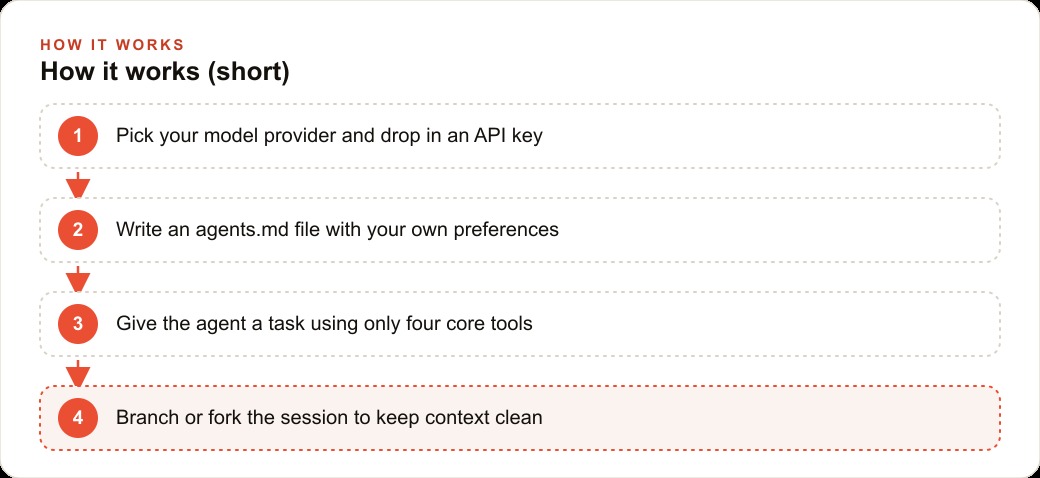
The third return is composability. A minimal agent is easy to extend because it starts from almost nothing. You can add exactly the capabilities your use case requires without inheriting a mass of capability you did not ask for. People have built full research agents on top of Pi in minutes. The agent core handles the loop and the tool calls; you provide the preferences file that tells it how to apply those primitives to your specific context. The bloated agent gives you everything and makes you work around the parts you did not want. The minimal agent gives you primitives and expects you to build what you need.
What branching and forking reveal about cognitive load
Beyond the four tools and the system prompt, Pi ships two session management features that are worth examining closely because they reveal something about how experts actually manage cognitive load in long or complex tasks.
The first is conversation branching. When you are in the middle of a long task and a side problem surfaces, the natural instinct is to address it inline, which muddies the main thread with a digression and often causes the agent to lose the thread of the primary task. Pi's branching feature lets you split off a new thread for the side problem, work through it to resolution in isolation, and then return to the main thread with a compact summary of what was resolved and how. The main context stays clean. The side problem gets the full attention it needs. The two concerns never interfere with each other.
This is not a novel concept in software development, where branching has been standard for decades. The insight is that the same cognitive benefit that makes code branching standard practice applies to AI sessions too, especially as tasks grow in complexity and duration. Long sessions accumulate context in ways that degrade the quality of later output, because the model is balancing the entire accumulated session history against each new request. Keeping that history clean through active branching produces better output across the whole session.
The second feature is session forking, which creates an entirely new session from any point in an existing one, the same way forking a code repository creates a new copy you can modify independently. If you have built a solid foundation in a session, a well-structured understanding of the problem, good working code in the early files, a clear model of the constraints, you can fork from that point and take the project in a new direction without starting over. The foundation you built is preserved in the fork. The new direction can be explored without risk to what is already working.
Together these features point to something broader about what makes AI sessions productive at the expert level. The naive approach is to run one long session and let it accumulate. The expert approach is to actively manage context, splitting off concerns that would otherwise muddy the main thread and forking when a new direction is worth exploring without abandoning a foundation that works. These are skills, not features, and Pi makes them available as native commands.
What an accounting firm learns from using this
Consider how a small accounting practice can apply a minimal agent to the monthly work that costs the most staff time but requires the least judgment: the data reformatting and reconciliation work that sits between receiving client files and producing client-ready outputs.
Every month the firm receives transaction exports from multiple client bank accounts, in formats that differ by institution. Someone on the staff reformats each export into the firm's standard template, flags transactions that fall outside the normal range for that client's history, and populates a summary document with this month's figures. The work is repetitive, the rules are consistent, and the primary cost is time rather than expertise. A person doing this work is not using their training. They are following a procedure.
A minimal agent handles this precisely because the task maps cleanly onto four primitives. Read the raw export files. Run terminal commands to clean the data, apply the firm's field mapping, and merge exports from different institutions into the standard format. Write the reformatted output file. Edit the monthly summary template with this month's figures and any flagged items. The agent needs no capabilities beyond these four. Adding more tools would not make it better at this task; it would make the session harder to audit and the cost per run higher without benefit.
The preferences file is where the firm's rules live: the exact field mapping from each institution's export format to the standard template, the flagging thresholds for each client category, the naming convention for output files, the format of the summary sections. Write this once and every run follows the house standard without being told. When a client's banking institution changes its export format, update one mapping in the preferences file and the agent handles the new format on the next run.
For edge cases, branching earns its value directly. When a client has a split account structure that does not fit the standard mapping, the staff member branches the session, works through that specific client's reconciliation in isolation, and returns to the main batch run with a note about how the edge case was resolved. The primary batch run never sees the complication. The edge case gets full attention. The session log is clean and auditable at the end of each run.
In illustrative terms, a bloated agent running the same task would carry 12,000 or more tokens of system prompt overhead on every message across a batch of dozens of client files. At mid-tier model pricing, that overhead across a full monthly batch represents meaningful additional cost compared to a 1,000-token baseline. The difference per month may be $30 to $80 depending on volume, which over a year compounds to several hundred dollars recovered just from prompt overhead, without any change in output quality. For a practice running this workflow across its entire client roster, the saving is real.
More importantly, the practice retains full control of the data. It runs on infrastructure the firm owns and trusts. There is no question about where the client export files went or what external system processed them, because the agent is running locally against local files. For any business handling sensitive financial data, that transparency and control is worth more than any single cost saving the minimal design provides.
The signal that has been there all along
The AI industry has been moving toward minimal architecture for a while, but the marketing has been moving in the other direction. Platforms announce new tools, new integrations, new capabilities, new modes, because new capabilities are easy to announce and easy to understand as value. The opposite move, removing things, is harder to announce and requires a different kind of confidence: the confidence that the primitives you kept are sufficient and the things you removed were cost without benefit.
Pi represents that confidence applied to the agent problem. Four tools and a 1,000-token prompt are sufficient because the bash tool covers everything a file tool does not, and a well-written preferences file covers everything a bloated system prompt tries to handle with generic instructions. The branching and forking features add genuine value without adding capability overhead, because they are session management tools rather than task tools, and they compound the value of everything else by keeping the working context clean.
The practical takeaway for any business considering AI agents is to ask, before adopting any tool, what overhead the tool carries that the task does not require. A tool with a 12,000-token system prompt is appropriate when the task needs that many tokens of context to define. A task that needs four primitives and a preferences file does not benefit from the extra 11,000 tokens; it pays for them on every message. Matching the agent to the task rather than adopting the most feature-complete tool available is the skill the minimal architecture makes visible. The skill was always there. Pi just makes it impossible to ignore.
That is exactly what we do at AI DOERS. Book a private 30-minute call with Madhuranjan Kumar and we will map the fastest path to it for your specific business.
Book your call →
Madhuranjan Kumar
Madhuranjan Kumar brings 20 years of performance-marketing experience and has managed over $200 million in Facebook ad spend for brands across the United States and beyond. His expertise spans the full modern marketing stack: Meta, Google Ads, TikTok, email automation, CRM, and the websites that hold it together. At AI DOERS he turns that track record into lead-generation systems for businesses across every industry.