
Why a $1M Voice AI Business Is Built on Testing, Not Building
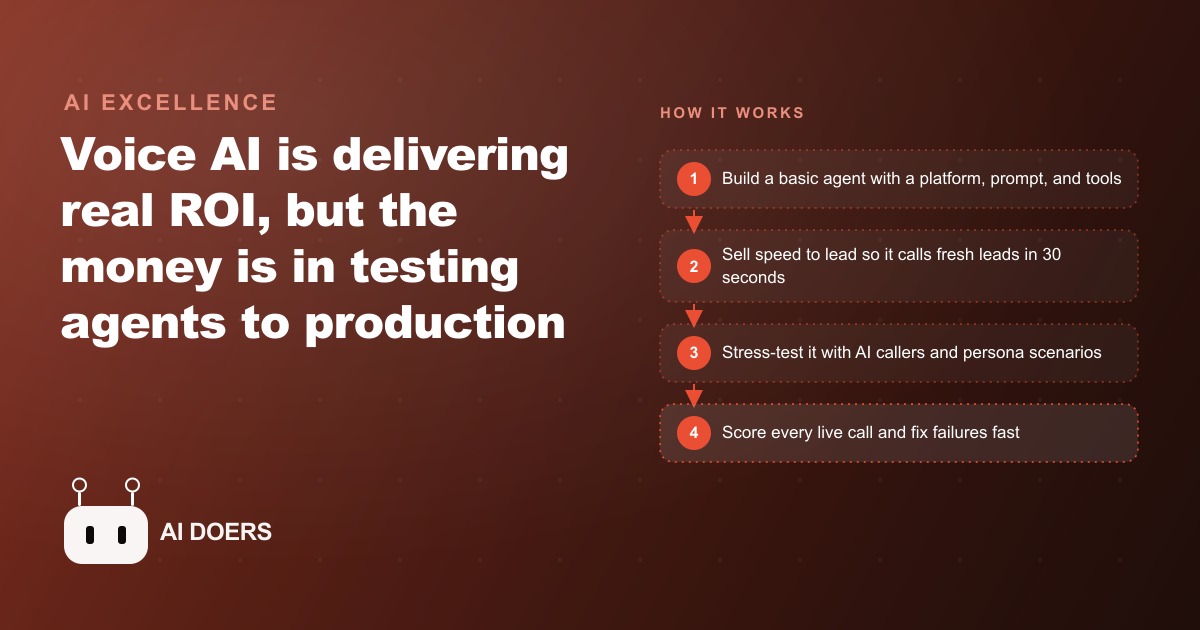
Voice AI keeps delivering real ROI, but the durable money is not in building agents, which a short tutorial makes look easy. It is in testing them to production grade with automated AI callers, persona scenarios, and per-call scoring that catches failures before clients do.

The tutorial makes building look like the hard part
I am Madhuranjan Kumar, and I want to make a claim that will frustrate everyone who has spent a weekend following a voice AI tutorial and came away feeling confident: the build is not the product. The tutorial is designed to make the build look like the accomplishment. The build is only the beginning.
Any reasonably technical person can follow a tutorial and produce a voice agent that picks up a call, asks a few questions, and books an appointment. It works in the demo. The demo is the easiest possible environment: scripted inputs, cooperative callers, no edge cases, no compliance requirements, no monitoring, and no one's actual business depending on the result. The tutorial ends at the moment the demo works. Everything that happens between that moment and a voice agent that can safely field real calls from real customers without embarrassing the business or creating legal exposure is the other 90 percent of the work.
The agencies and consultants who are building sustainable, high-margin practices in voice AI are not the ones who can build faster. They are the ones who test more thoroughly, because thoroughness is what separates a demo from a deployable product and a deployable product from a client relationship that stays intact after the first month.
What the build actually produces, and what it does not
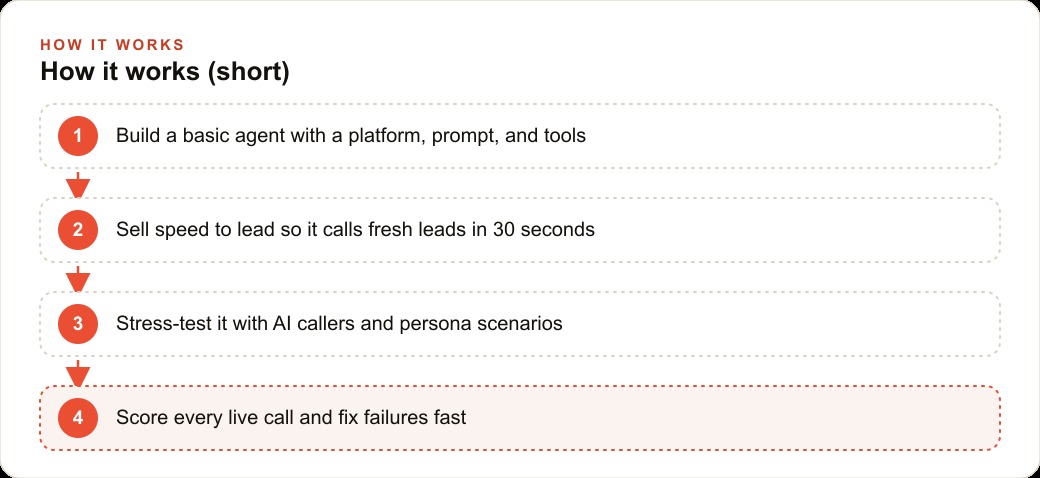
A basic voice agent requires three components: a platform like Retell or Vapi that handles the call infrastructure, a prompt that defines the agent's behavior, and a set of tools that let the agent take actions like checking calendar availability or sending a confirmation text. A developer who understands these three components can produce a functional agent in a day or two.
What that build produces is an agent that works correctly in the scenarios the developer imagined. A homeowner calls about a leaking faucet, the agent qualifies the service need, checks the next available appointment slot, books it, and sends a confirmation. The developer tested this specific scenario, and it works.
What the build does not produce is any confidence about the scenarios the developer did not imagine. A caller who asks an off-script question. A caller who provides confusing or contradictory information. A caller who is agitated or speaks unclearly. A caller whose request falls outside the agent's scope but who does not accept the redirect gracefully. A caller who is elderly and speaks slowly, or a caller who is in an emergency and is not following any conversational sequence. A caller who tries to manipulate the agent into revealing information it should not reveal, or into taking an action it should not take.
Generative AI means the agent's output is probabilistic, not deterministic. The same input does not always produce the same output. This is useful because it allows the agent to handle novel situations gracefully, and it is a risk because it means the agent will occasionally say something unexpected, misleading, or wrong. The question is not whether this will happen. It will. The question is whether the unexpected output will be mildly suboptimal or catastrophically wrong, and whether the monitoring is in place to catch and correct the pattern before it becomes a client crisis.
Speed to lead is the use case that closes itself with small business owners
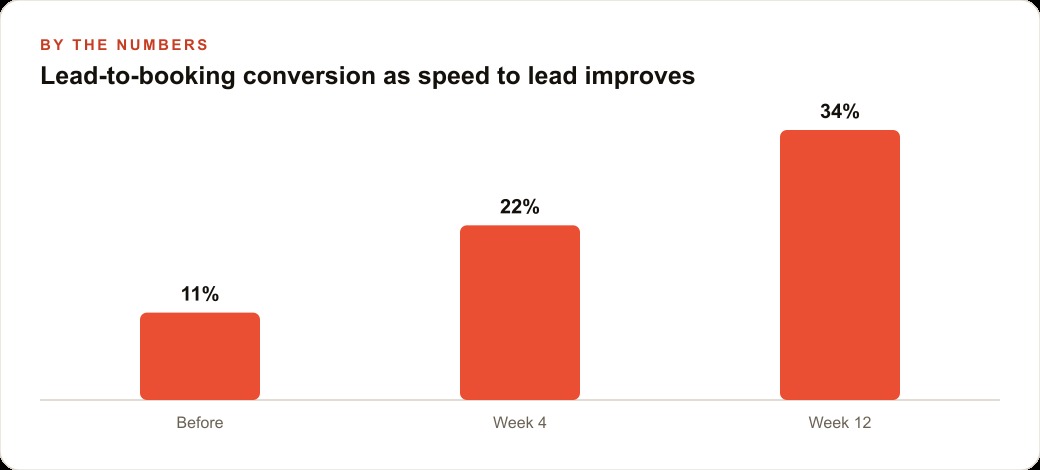
Through all of the complexity around production readiness and testing, there is one use case that consistently produces an immediate, clear, and compelling return on investment for small service businesses: speed to lead.
A fresh lead who submits a contact form or clicks to call is at peak interest at the moment of submission. Conversion rates for leads contacted within 30 seconds of submission are dramatically higher than for leads contacted an hour later, and leads contacted within an hour are far more likely to convert than leads contacted the following day. Most small businesses are contacting leads the following day. Or later. Because no one was watching the inbox when the lead came in.
A voice agent configured to call a new lead within 30 seconds of form submission, introduce itself as calling on behalf of the business to answer questions and help schedule a visit, and book the appointment if the lead is ready, is performing a task that has a direct, measurable dollar value. The business already spent money on the marketing that generated the lead. The agent prevents that spend from leaking away due to slow follow-up.
The ROI pitch for this use case almost closes itself. Show a business owner their lead data: how many form submissions came in last month, how many resulted in a booked appointment, and how long after submission the first contact was made. Ask them what they would have paid to follow up within 30 seconds on every lead. The math is usually compelling before you have said anything about AI.
What production grade actually requires you to prove
Getting from a working demo to a production-grade voice agent that a real business can trust on real calls requires a testing framework that most builders skip because the tutorial does not cover it.
The first layer is internal testing: the developer and the client both call the agent repeatedly, specifically trying to find failure modes. Not just the happy path, but every edge case either party can imagine. What happens if the caller asks what the agent charges? What happens if the caller mentions a competitor? What happens if the caller says something inappropriate? What happens if the caller does not respond for 15 seconds? What happens if the caller speaks a language the agent does not handle?
The second layer is automated testing with AI callers. This is where the separation between mediocre and serious voice AI work becomes visible. Automated testing means building AI callers with specific personas designed to stress-test the hardest edge cases. A persona might be an elderly caller who speaks slowly and repeats themselves. Another might be a parent with a young child making noise in the background. Another might be a caller describing an emergency who is not in a conversational mood. Another might be a hostile caller testing the agent's limits. These AI callers phone the agent at scale, and their conversations are scored automatically against defined success criteria.
The scoring framework weights test cases by severity. A failure where the agent gives wrong information about pricing is more serious than a failure where the agent asks a clarifying question unnecessarily. The scoring reflects these weights and produces a per-test health metric that can be monitored over time. Periodic test calls run automatically even on quiet days to maintain a pulse on agent performance.
The third layer is compliance. Several states require that callers be informed they are speaking to an AI at the beginning of the call. Most states require notification that the call is being recorded. These requirements are not optional and they are not a one-time setup. They apply to every call the agent makes, and they vary by jurisdiction. An agency deploying voice agents for clients across multiple states without checking and implementing the applicable requirements in each one is creating legal exposure for itself and for its clients.
The business that tests well keeps the retainer
The economics of a voice AI agency are most attractive not in the initial build but in the ongoing relationship. A client who has deployed an agent that works reliably, is monitored continuously, and is tested regularly has a recurring need for someone to maintain and improve that system. That recurring need is a monthly retainer.
The retainer is justified by the ongoing work: updating the agent's knowledge and system prompt as the business's services, pricing, or policies change; monitoring conversation scoring and investigating failures; running periodic automated test sequences and resolving the patterns they reveal; tracking compliance requirement changes in applicable jurisdictions; and making performance improvements as new agent capabilities become available.
A client whose agent works well stays on the retainer because the alternative is the agent degrading unnoticed as the business changes around it. A client whose agent had a public failure, an embarrassing call that reached a real customer in a way that reflected badly on the business, churns and tells their network. The difference between these two outcomes is almost entirely determined by the quality of the testing and monitoring, not by the quality of the initial build.
This is the contrarian claim in full: build fast, but test slowly and continuously. The tutorial shows you how to build in a day. The business case lives in the six weeks after the build, in the testing and monitoring and compliance work that produces an agent a client trusts enough to pay for month after month. The testing is the product. Everything else is the cost of producing it.
The objection every local business owner has before they see the demo
Before a local business owner interacts with a working AI agent configured for their business, they typically carry three objections that they have formed from their prior experiences with technology products.
The first objection is that the technology will not understand their specific business. They have dealt with software that forced them to adapt their operations to the software's model of how their business should work. The AI agent demo preempts this objection not by arguing against it but by demonstrating its opposite: the agent that answers questions about their specific services, their specific pricing, and their specific hours proves that the technology understood their business well enough to answer those questions correctly.
The second objection is that the setup will be complicated. Every piece of software they have implemented in the past required training, a learning curve, and ongoing configuration management. The demo preempts this objection by existing: the agent is already configured, already trained, already answering questions. The owner did not have to do anything to make this happen. The complexity was on your side of the interaction.
The third objection is that the technology will not work reliably. They have had tools that worked in demos and broke in production. This is the only objection that the demo cannot fully preempt, and the right response to it is direct: here is the monitoring dashboard, here is how I track the agent's accuracy over time, here is the process for flagging incorrect responses and correcting them, here is the check-in schedule for the first 30 days. The reliability objection is answered by the maintenance and monitoring commitment, not by claiming the tool never makes mistakes.
Why the first 30 days are the client relationship investment that determines everything after
The business relationship with an AI agent deployment is established in the first 30 days, not at the initial sale. The client's long-term perception of the tool's value, their trust in the practitioner who deployed it, and their likelihood of referring other businesses to that practitioner are all primarily determined by their experience in the first month.
The first 30 days are when the failure cases appear. No agent is perfectly configured on day one for the full range of inputs a real business receives. Real customers ask questions in formulations that the training data did not anticipate. They ask follow-up questions that require the agent to maintain context across a longer conversation than the testing covered. They ask about exceptions, edge cases, and recent changes to the business that have not yet been updated in the knowledge base.
Each of these failure cases is an opportunity to demonstrate the maintenance commitment that justifies the ongoing retainer. A practitioner who responds to a flagged failure case with a specific correction within 24 hours and a follow-up confirmation that the correction held across subsequent similar inputs is building the client relationship that renews automatically. A practitioner who responds to the same failure case with a generic explanation of AI limitations is demonstrating that the relationship with this client ends when the build is complete.
The specific metric to track in the first 30 days is the ratio of questions the agent answered correctly to questions it answered incorrectly. A correctly answered question is one where the client's customer received an accurate, helpful response and did not need to follow up. An incorrectly answered question is any case where the response was wrong, incomplete, or required a human follow-up. This ratio, shared transparently with the client at the 30-day check-in, is the most powerful evidence that the agent is performing as described and that the maintenance retainer is producing the result the client is paying for.
That is exactly what we do at AI DOERS. Book a private 30-minute call with Madhuranjan Kumar and we will map the fastest path to it for your specific business.
Book your call →
Madhuranjan Kumar
Madhuranjan Kumar brings 20 years of performance-marketing experience and has managed over $200 million in Facebook ad spend for brands across the United States and beyond. His expertise spans the full modern marketing stack: Meta, Google Ads, TikTok, email automation, CRM, and the websites that hold it together. At AI DOERS he turns that track record into lead-generation systems for businesses across every industry.