
What's Going On With Claude Code, and What It Means for Your Business
Claude Code has shifted software development so that the model writes most of the code while humans steer with specifications and taste, and that shift changes the cost, speed, and timeline of any software your business needs.

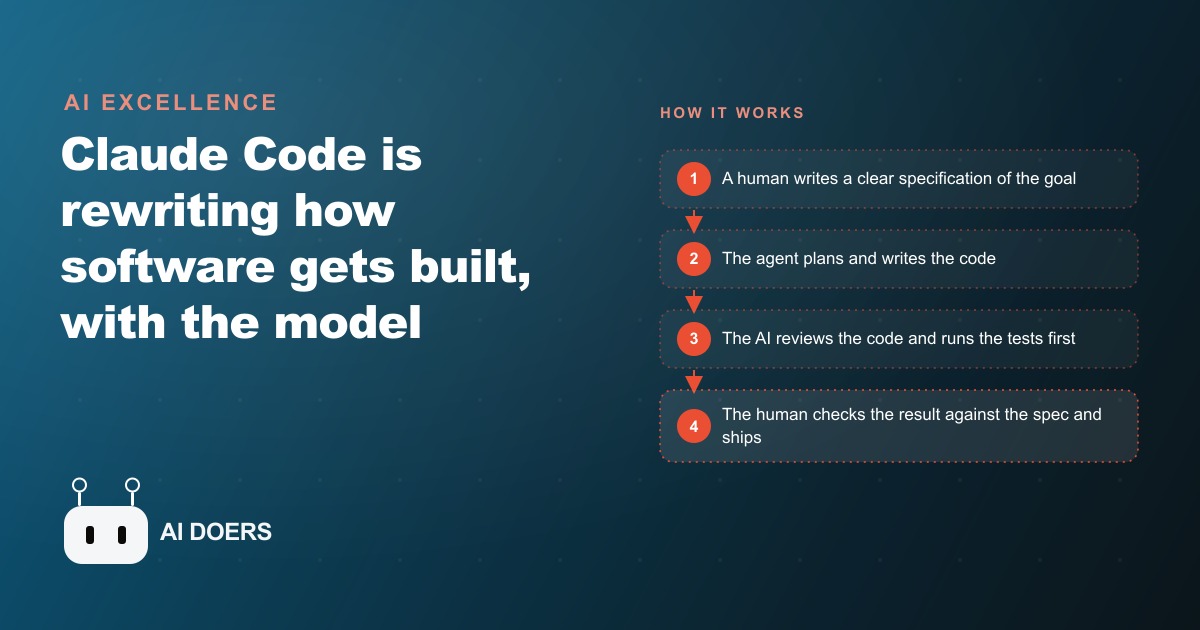
Over a single thirty-day stretch, a team lead on the Claude Code project reported that every line of new code shipped into the tool was written by Claude Code itself, orchestrated by humans but no longer typed by them. That one detail is the clearest signal yet of a change that has already happened, not one that is coming: the work of building software has been quietly refactored, and the consequences land on every business that pays for software, which is nearly all of them.
What actually shifted
The headline is not that AI can write code. That has been true for a while. The news is that the balance tipped. On teams using these tools heavily, less and less of the code is written or even reviewed by a human, and yet complete, working applications still get shipped. Claude Code is a command line tool that hands a capable model a full set of coding tools and lets it run for minutes, hours, or in some cases days on a single task. The programmer's job has moved from typing code to steering the system that types it.
I am Madhuranjan Kumar, and the reason this belongs in a business blog rather than a developer forum is simple. The way software gets made sets what software costs you, how fast you can get it, and what is even realistic to ask for. When that process changes this dramatically, the effect eventually reaches your quotes, your timelines, and the list of things worth building at all.
The part that changed was the scaffolding, not the model
The most useful insight from the people closest to this is that the underlying models were already good enough a while ago. What moved recently is the scaffolding, the tooling wrapped around the model. There is now a whole programmable layer to learn, with agents, sub-agents, prompts, memory, permissions, tools, plugins, skills, and hooks. That layer is what turns a model that answers questions into a system that does sustained engineering work.
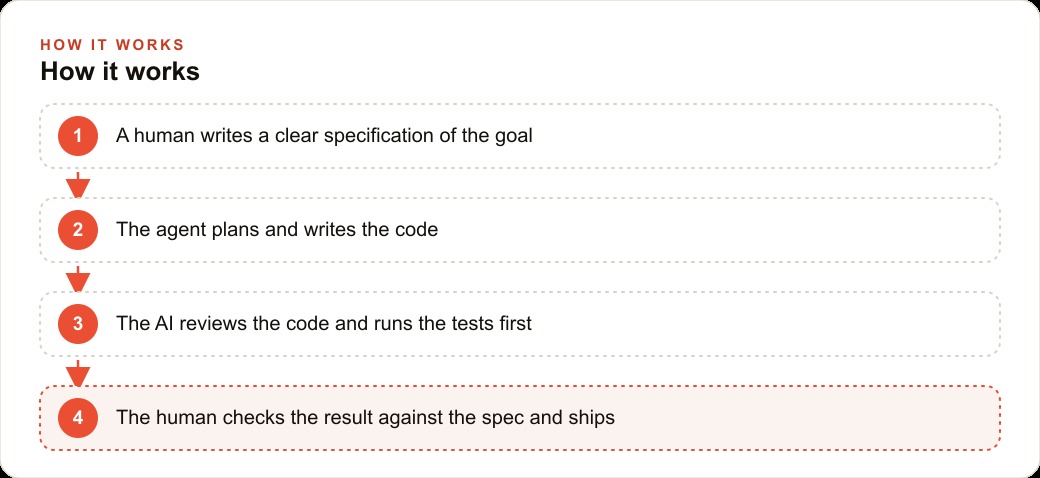
In practice the workflow on teams that lean into it looks nothing like traditional development. A human writes a clear specification of what the software should do. The agent plans the work and writes the code, often spinning up sub-agents to handle separate pieces. The first code review is done by the AI, not a person. The test suite is almost entirely written by the AI as well. The human stays in the loop, but at the level of the specification and the judgment, not the syntax. Teams working this way report shipping around five releases per engineer per day and building ten or more prototypes for a single feature before choosing one, a velocity that was flatly impossible a few years ago.
Why this changes the economics of your software
Here is the concrete move underneath the hype. Things that used to take weeks of expensive developer time, a custom internal tool, a tweak to your booking flow, a small automation, can now be prototyped and built in a fraction of that time. The economics beneath your software changed, so three things should follow. The quotes you get for custom work should come down. The turnaround should shrink. And a whole category of small custom builds that were never worth commissioning suddenly clears the bar.
This is not a fringe view. Prominent leaders outside the companies building these tools have said the bulk of code is heading toward being AI-written, and one well-known engineer openly admitted he ships code he never reads line by line, trusting the structure and the tests instead. When the people with the most to lose from overstating this are the ones saying it, an operator should take the direction seriously even while staying skeptical of any single number.
Who this changes things for
The counterintuitive answer is that it changes things most for businesses where nobody will ever open a coding tool. If you buy, commission, or maintain software, the ground under you shifted whether or not you write a line yourself. The deeper point is about what becomes scarce. When generating software is fast and cheap, the code itself stops being the valuable part. What matters is the specification and the taste, meaning how the thing should work, how it should feel, and whether it actually solves the real problem. As the volume of AI-generated everything rises, the ability to pick signal out of noise becomes the rare skill. For a business owner that translates to a practical truth: the value is no longer in who can write the code, it is in who clearly understands the problem and can tell a good result from a mediocre one.
What it looks like inside a veterinary clinic
Picture a veterinary clinic that wants a simple internal tool, a smarter reminder system for vaccinations and follow-up visits that pulls from the existing records and flags pets overdue for care. In the old world that is a custom development project with a long timeline and a price tag high enough that the clinic gives up and stays on manual spreadsheets. In the new world someone writes a clear specification of exactly what the reminder tool should do, the agent builds and tests it quickly, and a working version exists in days rather than months. The cost profile that made small custom software not worth it has flipped.
Run the rough numbers and the shift is obvious. If a build like that used to be quoted at several weeks of developer time and now takes a small fraction of that to prototype and refine, the clinic can justify not one tool but several: an intake form, a follow-up flow, a simple owner-facing portal. The practical move for the clinic owner is not to learn to code. It is to get good at the part that is now the bottleneck, which is describing the problem precisely. A vet knows their own workflow better than any developer ever will, which appointment patterns cause no-shows, which reminders actually get pets back in, where the front desk wastes time. That knowledge is exactly the specification and the taste the new process depends on. The hard, expensive part used to be the building. Now the valuable part is knowing precisely what to build, and that has always lived inside the clinic.
Where this shows up in the rest of the business
The same shift touches the parts of a business that never felt like software projects. A custom booking flow built this fast can drop straight into the CRM and website stack, so that when a new pet owner submits a form, the follow-up sequence runs itself instead of waiting on a busy front desk. A cheaper, faster path to landing pages and offer variants means the creative behind your Facebook and Instagram ad campaigns can be tested in more versions for the same budget, because spinning up ten prototypes is now normal rather than a luxury. And a clinic that can quickly generate clean, structured service and location pages is quietly strengthening its SEO and organic search footing at the same time. The thread through all of it is that the bottleneck moved from building to specifying, and the businesses that win are the ones that get precise about what they actually want.
It is worth being honest that this shift also produces a lot of noise, and not every claim about AI-built software holds up. Some of what gets shipped fast is brittle, and some teams overstate how hands-off the process really is. The healthy stance is neither breathless nor dismissive. Treat the direction as real and significant, treat any specific number as something to verify, and judge the results by whether they actually work in your business rather than by how impressive the process sounds. An owner who stays curious but skeptical, willing to try the new economics on a small build while checking the output carefully, captures the upside without getting burned by the overclaiming that inevitably rides along with a genuine shift this large.
What this means for the next quote you receive
The most immediate place a business owner will feel this shift is in the numbers on a proposal. If you have quietly assumed that a custom internal tool or a website change is a multi-week, high-cost project because that is what it has always been, that assumption is now out of date, and it pays to test it. The next time you get a quote for a small custom build, it is fair to ask why it costs what it does and whether the work is being done with modern tooling. A shop that is still pricing every build as if a human types every line is either behind the curve or padding the number, and you now have a reason to notice.
This is not about squeezing your developer or treating good work as cheap. Complex, high-stakes software still deserves careful, expensive attention, and the judgment around it is worth more than ever. The point is narrower. A whole category of small, well-specified builds that used to sit above the line of what was worth commissioning has dropped below it. The smart move is to keep a running list of the little tools and tweaks you always wanted but never justified, because many of them just became affordable, and the businesses that revisit that list first will out-equip the ones still assuming the old prices.
The skill that survives every model release
There is a comforting stability underneath all this churn, and it is worth ending on. Models will keep changing, tools will keep improving, and the specific way software gets built will look different again in a year. But the one skill that keeps mattering, the one that does not go stale with the next release, is the ability to state clearly what you actually want. A precise specification, a real understanding of the problem, and the taste to tell a good result from a mediocre one, these are human and durable. They were valuable before this shift and they are more valuable now, because they are the exact inputs the new process is hungry for.
So if you do only one thing with this, make it this: get better at describing your own problems precisely. Practice turning a vague annoyance in your business into a clear statement of what goes in, what should come out, and what counts as correct. That habit pays off whether you build the thing yourself with an agent or hand the spec to someone who does, and it keeps paying off no matter which tool is on top next year. The code became cheap. Knowing exactly what to build did not, and that is the part of the work that was always yours to own.
The move to make now
Start by lowering the stakes and simply experimenting, because even the people building these tools say they feel behind and learn by tinkering. Pick one small, annoying, repetitive task and try to describe it as a clear specification: exactly what goes in, what should come out, and what counts as correct. That habit of writing a precise spec is the single most transferable skill here, whether you build the tool yourself with a coding agent or hand the spec to someone who does. When you do generate something, judge it against the spec and the real-world feel, not the cleverness of the code, since the code is now the cheap part. And keep a human checking the result against what the business actually needs.
The honest takeaway is that the ceiling here is enormous, but reaching it still takes a clear head about what you want and the patience to iterate through versions. You can absolutely start this yourself by getting precise about one workflow and experimenting. If you would rather have custom tools specified, built, and wired into how your business already runs, so you get the result without managing the process, that is the kind of work you can hand to an expert and skip straight to the outcome.
That is exactly what we do at AI DOERS. Book a private 30-minute call with Madhuranjan Kumar and we will map the fastest path to it for your specific business.
Book your call →
Madhuranjan Kumar
Madhuranjan Kumar brings 20 years of performance-marketing experience and has managed over $200 million in Facebook ad spend for brands across the United States and beyond. His expertise spans the full modern marketing stack: Meta, Google Ads, TikTok, email automation, CRM, and the websites that hold it together. At AI DOERS he turns that track record into lead-generation systems for businesses across every industry.