
What the Unsealed AI Lawsuit Documents Can Teach a Small Business Owner
A high-profile lawsuit between two AI titans dumped hundreds of private emails, texts, and diary entries into public view. Behind the drama are practical lessons about partnerships, paperwork, and the records you leave behind.

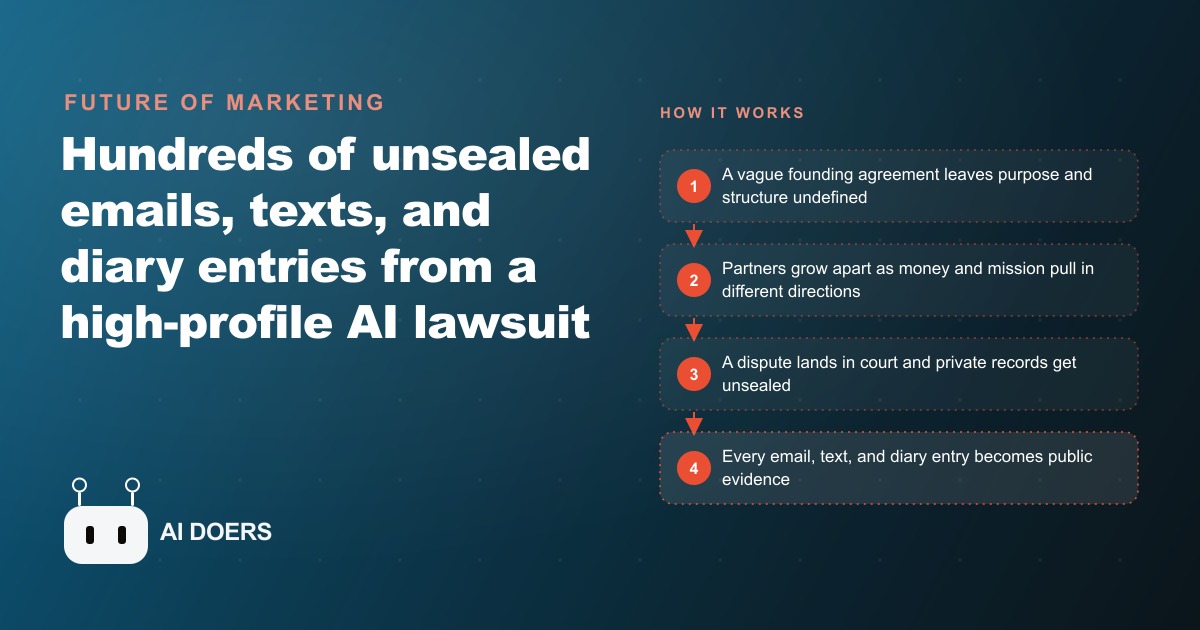
When the documents from a high-profile lawsuit involving an AI company were unsealed recently, the coverage focused on the drama: emails written in the heat of conflict, diary entries that revealed what someone was actually thinking while saying something quite different in public, text messages between founders who had once been close partners and were now on opposite sides of a courtroom. The coverage was understandable. The documents are genuinely dramatic.
Madhuranjan Kumar read them for a different reason. Not for the conflict between specific figures in the AI industry, which will resolve or not resolve in ways that are largely outside any observer's influence, but for what the underlying pattern reveals about how partnerships and organizations come apart. The specific details belong to a specific dispute. The pattern belongs to every business that has ever had a founding agreement, a major investor, or a partnership that seemed solid and later did not.
The most expensive sentence in any business relationship is "we both understood what we agreed to." That sentence appears, in various forms, in the unsealed documents, written with complete sincerity by people who did understand what they had agreed to. They just understood it differently. The gap between those two understandings is where the lawsuit lived.
What the Founding Documents Did Not Say
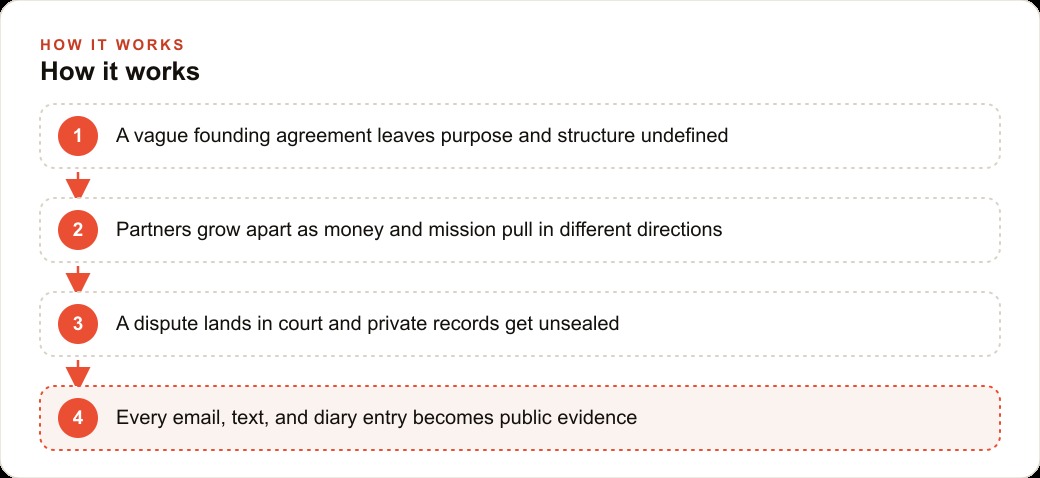
The core of the dispute, stripped of personalities and reduced to its structural form, is definitional. A group of people came together around a shared mission. They created an organization to pursue that mission. The organization succeeded beyond what any of them had anticipated when they started, and success created choices that the founding documents had not addressed: choices about organizational structure, about the relationship between the original mission and the commercial opportunities that success had opened, about what the founding principles meant in a context that the founders could not have fully imagined when they wrote them.
The founding documents were not dishonest. They were incomplete. They captured the intent of people who were in agreement, which meant they did not need to address what would happen when the parties disagreed. The gap in the documents was precisely the size of the gap in the relationship when the relationship opened. Very large.
This is the pattern Madhuranjan Kumar has observed across disputes at every scale, from AI companies to small professional practices. When two people start something together in a spirit of genuine alignment, the founding agreement is written in that spirit. Nobody negotiates hard for protective clauses when everyone is already on the same side of every question. The protective clauses are the ones that seem unnecessary when the relationship is working well. They become the only clauses that matter when it is not.
What a Skipped Conversation Costs
Consider two accountants who decide to start a practice together. They have worked alongside each other for three years at the same firm, they understand how each other thinks about clients and about money and about risk, they trust each other without reservation. They draft a partnership agreement over two evenings, agree to split revenues evenly, and open the practice. The agreement is four pages long and captures the things that feel important at the time: name, structure, the revenue split, who handles administration.
Two years later, one partner has generated significantly more client revenue than the other. She has also done considerably more of the internal work: building the systems, managing the staff, maintaining the processes that allow the practice to function. Her view is that the even split no longer reflects what each partner actually contributes. His view is that she agreed to an even split, that he made the decision to leave a stable position at the previous firm based on that agreement, and that changing the terms retroactively is not what they agreed to when they started.
This dispute cannot be resolved by reading the four-page agreement, because the four-page agreement does not address the scenario. It ends in a separation that neither partner wanted. The legal fees on both sides come to approximately $35,000 over four months of negotiation and eventual mediation. The disruption to client relationships costs additional revenue that is difficult to quantify precisely but is real: some clients choose one partner, some choose the other, and several leave entirely because they prefer the stability of a larger firm over navigating the transition. The total cost of the separation is substantially higher than the legal fees alone.
A partnership agreement that took the hard questions seriously, written when both partners were still fully aligned, might have cost $1,500 in legal time and one uncomfortable afternoon. The uncomfortable afternoon would have asked: what happens if the revenue contributions become significantly unequal over time? What happens if one partner takes on more operational responsibility than the other? Is there a mechanism for reviewing the terms after a defined period? If both partners had answered those questions before they became live disputes, the answers would have been far easier to reach than they were in the middle of a conflict where each person's interests were already clearly on the table.
The AI lawsuit documents reveal the same structure at a scale orders of magnitude larger. The founding terms were not adequate to the situation that eventually emerged. The situation was unforeseeable in its specific details, but completely foreseeable in its general shape: when an organization grows large enough to be worth very large amounts of money, the interpretation of the founding terms becomes a high-stakes question, and everyone who cares about the outcome will interpret those terms in the way that supports their position.
What Gets Written Down Is What Exists
One of the things in the unsealed documents that struck Madhuranjan Kumar most was the divergence in how two people remembered the same conversation. An email from one person describes a particular meeting as having settled a key question definitively. A diary entry from the other person, written the same day, describes the same meeting as having left the question open for future discussion. Both people were writing contemporaneously. Neither account shows signs of deliberate misrepresentation. They left the same room with genuinely different understandings of what had been decided.
This is not a story about dishonesty. It is a story about how unwritten agreements degrade in memory. When two people talk through a decision and reach what feels like a shared understanding, the details that seemed obvious and not worth writing down are the details most likely to be remembered differently six months later. The specifics that felt too detailed to bother recording are the ones that will be disputed when the question becomes consequential.
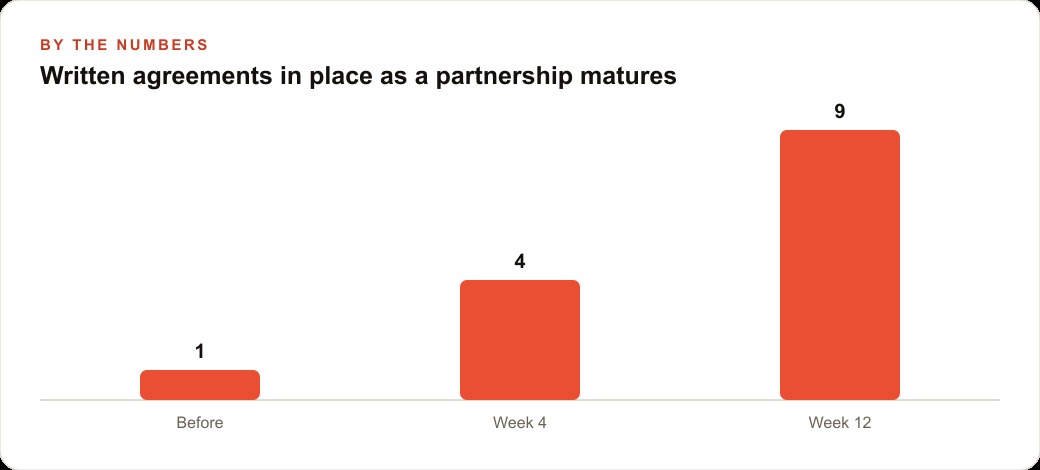
The discipline of creating a brief written record even informally is not bureaucratic caution. It is the minimum viable reference point that allows two people to consult the same source rather than their own memories when they disagree. A short email sent the afternoon of a key conversation, saying "here is what I understood us to agree to, let me know if you remember it differently," is not a legal document. It is a reference point. It is the thing both people can look at rather than arguing about what they each remember.
The cost of not creating that reference point is paid later, when the disagreement has to be resolved by competing recollections rather than a shared record. The later the disagreement surfaces and the more it matters, the higher that cost.
Relationships Determine How Ambiguous Terms Get Read
The unsealed documents also reveal something that anyone with experience in business disputes already understands but finds difficult to convey to people earlier in their careers: the quality of the relationship between parties determines how ambiguous terms in an agreement get interpreted.
When people trust each other, they read ambiguity charitably. They extend the benefit of the doubt. They interpret a clause that could go either way in the direction that favors the other person, because that is how you behave toward someone you genuinely like and trust. When they do not trust each other, they read ambiguity strictly. They interpret the same clause in the direction that favors themselves, because they have learned that the other side is not extending them the same charity.
The document has not changed. The relationship has changed what the document means in practice. This is not a cynical observation. It is structural, and it has a clear implication: the time to negotiate what ambiguous terms actually mean is when the relationship is good, when both parties are inclined toward charitable interpretation, and when reaching agreement is easy because no one's interests are clearly in conflict. Having the same negotiation after a problem has emerged means having it when both parties are reading strictly and when agreement is hard precisely because everyone's interests are now explicit and on the table.
A party who documented the founding conversation more thoroughly than the others held more of the narrative in the AI dispute when the narrative mattered. The lesson this teaches is not that every investor conversation should be treated with adversarial suspicion. The lesson is that whoever creates the clearest contemporaneous record of an agreement holds the most durable version of the story when that story is eventually contested.
Early Bets Compound in Ways That Are Hard to Imagine Early
The unsealed documents also make visible something about early-stage decisions that is difficult to appreciate until you have seen it play out at scale: the bets made in the first days of an organization, when it is small and the stakes seem low, compound massively as the organization grows.
A decision about organizational structure that seemed like an administrative detail at founding became the central legal question of a multi-billion-dollar dispute. A verbal understanding about what the mission meant, clear enough to both parties that it did not seem to need documentation, became the subject of competing interpretations backed by expensive legal teams. The actual dollars at stake at founding were small. The actual dollars at stake in the dispute were not.
For anyone building a partnership or a founding team structure, the relevant question is not "what does this decision matter right now." It is "what does this decision matter if the organization becomes twenty times larger than we are planning for." Most partnerships are not designed to handle scale they did not anticipate. The ones that survive that scale without catastrophic internal conflict are usually the ones where someone asked the uncomfortable questions early, when the answers were cheap.
Mission and Money Must Be Consistent From the Start
The most durable lesson in the unsealed documents is also the most obvious one, which is perhaps why it gets ignored so reliably. The stated mission of an organization and its financial structure have to be genuinely consistent with each other from the beginning. Not approximately consistent. Not consistent enough for now, to be worked out later. Genuinely consistent.
A mission that conflicts with the financial structure does not produce a stable organization. It produces a delayed conflict. The conflict gets delayed as long as the organization is small enough that mission and money are not yet pulling in different directions. The moment the financial opportunity becomes large enough to have real gravitational pull, the delayed conflict arrives. And it arrives at the worst possible time: when the stakes are highest, when the relationships are most complicated by years of shared history and accumulated grievances, and when the organizational structure is complex enough that any resolution is expensive.
This is not a lesson only for AI companies pursuing non-profit missions in a for-profit world. It is a lesson for any founder who says to a first partner or a first investor "we are building this to create genuine value, but we are also building it to be a viable business" without being explicit about what happens when those two things pull against each other in a specific decision. At small scale, they usually do not conflict in any meaningful way. The growth that makes the organization worth fighting over is also the growth that forces the underlying tension into the open.
The documents from this lawsuit will be cited in business schools for years. Not primarily for the AI-specific content, but for what they reveal about the oldest problems in organizational life: the gap between what people think they agreed to, the difference between what gets written down and what stays in memory, and the distance between a mission that feels obvious to everyone at founding and a mission that turns out to mean different things to different people once success makes the interpretation consequential.
Madhuranjan Kumar's conclusion from reading them is this: the disputes that end in litigation almost always started as definitions that were left incomplete. Not dishonest definitions. Not one-sided definitions. Incomplete ones, made when the parties were aligned and did not see the need to be explicit about what they would disagree on later. The court cases are long. The legal fees are real. The opportunity cost of the years consumed by a serious partnership dispute is enormous. The path to avoiding it starts earlier than most people act on, and costs far less than most people spend trying to resolve the disputes they could have prevented.
That is exactly what we do at AI DOERS. Book a private 30-minute call with Madhuranjan Kumar and we will map the fastest path to it for your specific business.
Book your call →
Madhuranjan Kumar
Madhuranjan Kumar brings 20 years of performance-marketing experience and has managed over $200 million in Facebook ad spend for brands across the United States and beyond. His expertise spans the full modern marketing stack: Meta, Google Ads, TikTok, email automation, CRM, and the websites that hold it together. At AI DOERS he turns that track record into lead-generation systems for businesses across every industry.