
What the Pope's 40,000-Word AI Encyclical Actually Says
The Pope's encyclical Magnifica Humanitatis argues that AI power is concentrating in too few private hands and that simulated relationships can erode real human connection, a warning that doubles as a practical checklist for any business wiring AI into customer interactions.

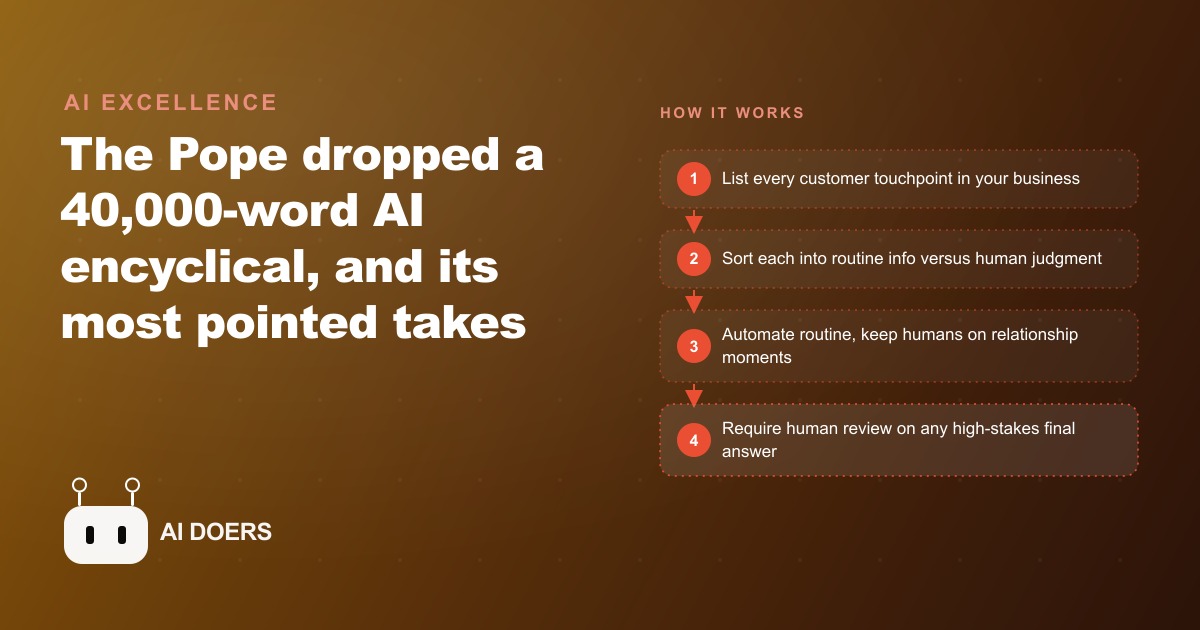
The Pope published a 40,000-word document on AI this year, and most people in the technology industry either dismissed it without reading or referenced it briefly as an amusing footnote. That was a mistake. The document, titled Magnifica Humanitatis, which translates roughly as magnificent humanity, is a more careful, more structurally rigorous critique of the AI industry than almost anything produced by the major think tanks and ethics boards that the same labs fund.
I am writing about it here because the instinct to dismiss it based on the source is precisely the kind of error the document itself warns against.
A 40,000-word document that deserves more than dismissal
The encyclical opens with an acknowledgment that any statement about AI risks going out of date quickly, given how fast the field moves. That is a more technically self-aware framing than you typically get from institutions operating at this level, and it signals from the first paragraph that the document intends to engage with the technology seriously rather than perform concern about it.
What follows is not a prohibition. It is not a blessing either. It is a sustained argument about power, specifically about who holds power over a technology with broad and uneven effects on the people it touches. The theological framing that runs throughout the document is real, and I am not going to pretend otherwise. But the underlying observations are empirical enough that they hold independent of the theological scaffolding. Power is concentrating in private hands. The people who built these systems have only a limited understanding of how they actually work. Regulatory proposals from the largest labs in the world happen to align, sometimes very precisely, with the competitive interests of those same labs. None of those claims require a religious commitment to evaluate.
The document is careful about this in a way that surprised me. It does not argue that AI is inherently dangerous. It argues that any technology takes on the characteristics of whoever devises, finances, regulates, and uses it. That framing refuses the simple yes-or-no question and replaces it with a more useful one: who is shaping this, and toward whose ends? That is a question that produces different answers depending on whether you are asking about a small open-source project or a frontier model controlled by a company with a hundred billion dollars in capitalization and a revolving door into regulatory agencies.
The document also opens with an admission that I found genuinely striking for something of its length and institutional weight. It acknowledges that the Pope himself, and the institution he leads, do not fully understand the technology being discussed. That kind of epistemic humility is not common in 40,000-word documents on any subject.
The structural argument that lands hardest
The encyclical's sharpest and most specific point is about regulatory capture, and it is stated more directly than I expected.
A leading AI laboratory has publicly advocated for more regulation of the AI industry during the same period it has been leading the field in capability development. The document does not name the company. It does not need to, because the pattern is not ambiguous to anyone following the industry. The encyclical's argument is structural rather than conspiratorial: heavy regulation raises barriers to entry, which reduces the number of startups and smaller competitors that can survive the compliance cost, which concentrates the field further around the organizations already large enough to absorb those costs. The companies calling loudest for rules are the same companies best positioned to operate under them.
This is a well-documented dynamic in regulated industries. It has a name in economics and antitrust scholarship. What makes it notable in this context is the source and the directness. A critique of that shape from a technology journalist or an academic economist is easily dismissed as anti-business sentiment. The same structural critique in a 40,000-word document from the Catholic Church, delivered at a global press event with significant institutional weight, reaches a different audience with a different framing authority.
The broader point about concentration of power is one the document returns to repeatedly and in different registers. The concern is not that private companies are building AI. It is that very few private actors are now making decisions with global effects and facing minimal structural accountability for those decisions. The analogy the document reaches for is infrastructure: roads, water systems, telecommunications. The question it raises is whether AI development, at its current scale and with its current effects, has crossed a threshold where it functions more like infrastructure than like a product, and whether the governance model should reflect that.
The companionship argument is the second strand worth taking seriously. The document argues that models may imitate language, behavior, and even empathy without understanding what they produce, and that the practical risk is a slow erosion of the desire for genuine human connection. The concern is most acute for teenagers and children, but the document frames it as a general cultural risk rather than a parenting problem. A person who spends significant time interacting with a system designed to feel warm and attentive and responsive may not notice, at first, that the interaction is optimized for engagement rather than for their actual wellbeing. The document is careful to say that the risk is not in using AI for tasks. It is in substituting simulated relationship for real human contact in the contexts where that contact matters.
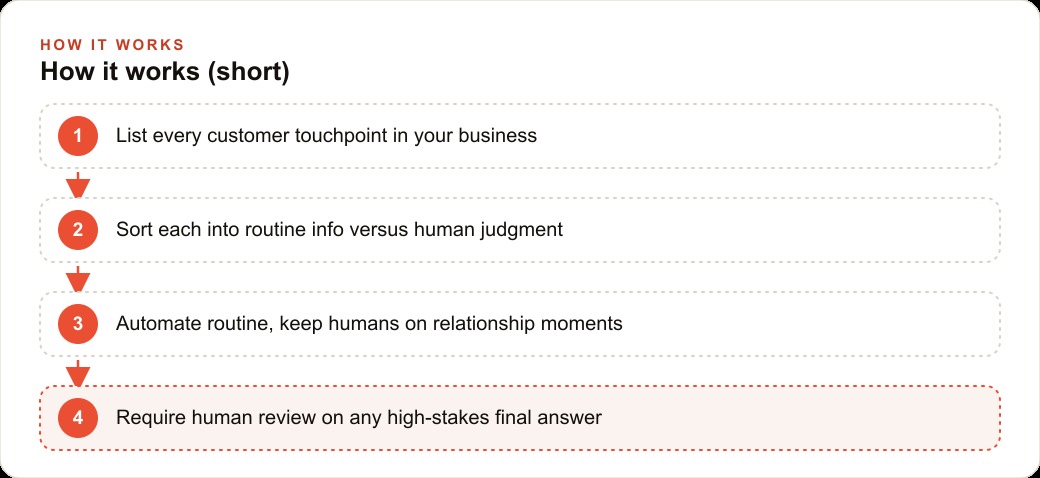
For a business deploying AI in customer-facing roles, that concern translates into a concrete design question: is this AI serving the customer's actual needs, or is it optimized to feel satisfying while subtly deferring resolution to keep the interaction going? Those are not the same objective.
There is a third thread in the structural argument that the document raises more quietly but that I think deserves more attention than it has received. The encyclical notes that AI leaders themselves possess only a limited understanding of how their systems actually function. This is stated without malice. It is a description of a real epistemic situation: the people who built the most powerful AI systems in existence cannot fully explain why those systems produce the outputs they do. The training process produces capabilities that were not explicitly designed. Behavior emerges that was not predicted. The organizations deploying these systems to millions of users are doing so under a genuine cloud of uncertainty about what the systems will do in edge cases, at scale, over time.
For a business deploying AI in sensitive interactions, the implication is that the system you are adopting was not designed with full knowledge of its own behavior. That is not a reason to avoid it. It is a reason to design every deployment with explicit failure modes, escalation paths, and human review checkpoints on the high-stakes outputs. The people who built the system cannot tell you what it will do in every case. The business that deploys it is responsible for what actually happens.
Where the document overreaches
It would be intellectually dishonest to read this as a document without weaknesses, and the weaknesses are real.
The sections on AI and employment are where the argument loses its precision. The document acknowledges that technology has historically created as many jobs as it displaced, and acknowledges that the current transition may be different in speed and scale. But the prescriptive response remains at the level of calling for governance and solidarity, without engaging with what governance structures would actually work at the pace AI is moving. The gap between naming the problem accurately and proposing something workable is not filled, and in a document of 40,000 words that gap is noticeable.
The companionship argument, which is genuinely important, runs into a similar problem when it slides from the research on social isolation into a broader caution about digital interaction that does not adequately distinguish between contexts. An adult using an AI assistant to draft emails operates in a fundamentally different context than a teenager forming an attachment to an AI companion in the absence of other social connection. The document's taxonomy does not always hold that distinction clearly, which makes the prescriptive guidance less useful than the diagnostic insight.
The implicit case for open-source AI, framing shared knowledge as a common good rather than an instrument of dominance, is stated with more confidence than the underlying tradeoffs deserve. Open-source AI releases have genuinely complicated implications for access by actors who wish to cause harm. The document's gesture toward openness as the moral default does not engage with those tradeoffs seriously, which is a notable gap in something positioning itself as a rigorous treatment of the subject.
None of these weaknesses negate the value of the structural arguments that land. They are reasons to read critically, which is how all rigorous documents should be read.
What any business deploying AI should actually take from it
The practical distillation of this document, for a business owner deciding where AI belongs in their operation, comes down to three questions that the encyclical keeps circling in different forms.
The first question is about decision accountability. When AI is making choices in your customer interactions, who is accountable for those choices? A chatbot that answers intake questions, an automated voice system that handles first contact, an email sequence that responds to inquiries: in each of those cases, the model is making decisions about tone, content, and response that used to be made by a person. Have those decisions been reviewed, consciously authorized, and tested against failure cases? The encyclical's concern about concentrated private control of consequential decisions applies at the business level just as it does at the industry level.
The second question is about confidence versus understanding. The document's distinction between a system that imitates understanding and a system that actually understands is philosophically contested in AI research. For a practical business deployment the relevant question is simpler: what happens when the AI is confidently wrong? A model produces confident-sounding text with the same fluency regardless of whether the content is accurate or not. If the answer to a customer's sensitive question is incorrect and no human is positioned to catch it before it goes out, the risk is real and the accountability is the business's. The worked-out version of this I return to: a medical practice routing all after-hours patient questions through an AI assistant handles roughly 80 such contacts per week outside business hours. If even 6 of those contacts involve a clinical question where the confident-sounding AI answer is subtly wrong, and 2 of those patients act on that answer without follow-up, the liability exposure is not measured in the cost of the AI tool. It is measured in patient outcomes and the legal exposure that follows. The design response is a clear escalation path, not more sophisticated AI.
The third question is about the texture of the relationship the business is building with its customers. The companionship warning in the document is usually read in the context of social media or consumer AI products. Its application to a professional services business is also worth considering. Customers who interact primarily with AI-driven systems over time form a different kind of relationship with the business than those who have meaningful human contact at key moments. Whether that matters depends on what the business actually is. For a commodity transaction it may not matter at all. For a professional service, a healthcare relationship, a financial advisory, or any context where trust is the real product being purchased, the texture of those interactions is not a secondary design consideration. It is the product.
The document's most enduring contribution is not its prescriptions, which stay general, but its framing question. Technology is not neutral. It reflects the values, incentives, and constraints of the people who build, fund, and govern it. Deploying AI without asking who shaped the system you are using and what they optimized for is not making a neutral choice. It is inheriting someone else's choices and their consequences, and that inheritance shows up in your customer interactions whether you intended it or not.
A 40,000-word document from the Vatican is not where most business owners expect to find the clearest articulation of why those questions matter. That is exactly why dismissing it on the basis of the source is a mistake worth avoiding.
That is exactly what we do at AI DOERS. Book a private 30-minute call with Madhuranjan Kumar and we will map the fastest path to it for your specific business.
Book your call →
Madhuranjan Kumar
Madhuranjan Kumar brings 20 years of performance-marketing experience and has managed over $200 million in Facebook ad spend for brands across the United States and beyond. His expertise spans the full modern marketing stack: Meta, Google Ads, TikTok, email automation, CRM, and the websites that hold it together. At AI DOERS he turns that track record into lead-generation systems for businesses across every industry.