
What the Leaked Claude Mythos Post Actually Reveals
A content-system slip exposed an internal post describing Claude Mythos, a model a tier above Opus that is far ahead in cybersecurity, planned for early release to defenders. The real signal for businesses is that AI-driven cyber risk is moving from distant to near-term.

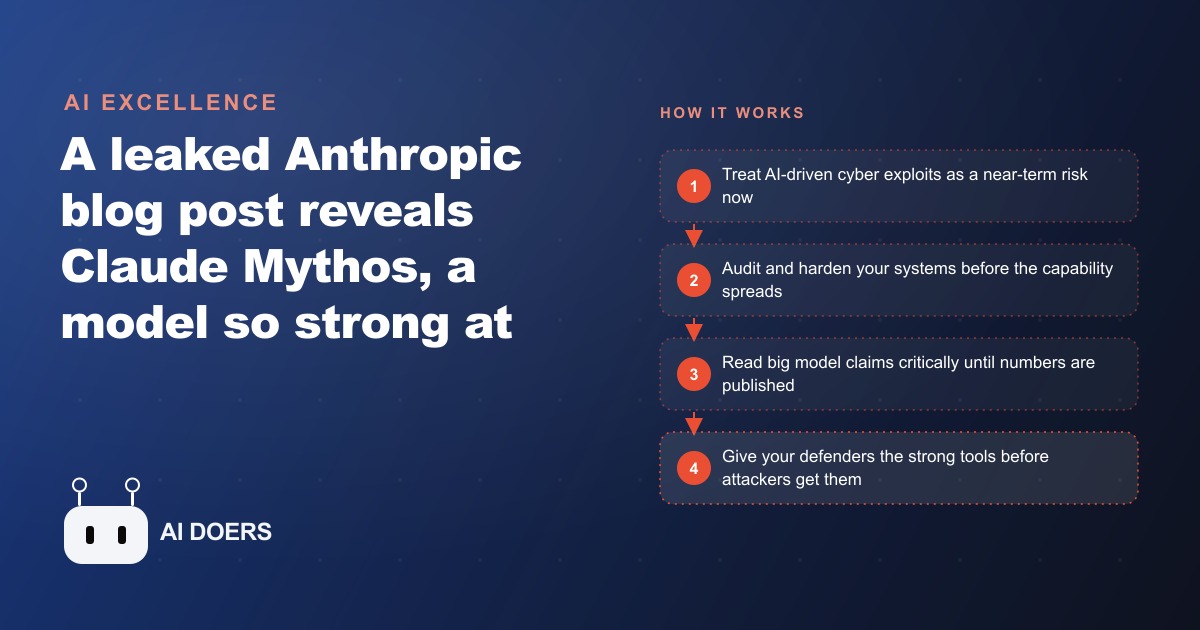
A Fortune reporter and a security researcher independently discovered that Anthropic's content management system had silently made more than 3,000 internal items publicly accessible at their direct URLs, including PDFs, staged event pages, and unpublished blog posts, among them a description of Claude Mythos, a model Anthropic characterized internally as by far the most powerful it had ever built.
I am Madhuranjan Kumar. Anthropic confirmed the exposure as human error, locked the items down quickly, and kept its official statement brief. But the post had been copied before the takedown, and once something like that circulates, it circulates. Among the people paying close attention when it spread were equity analysts, because cybersecurity company stocks moved on the news in a direction that tells you something more useful than the leaked post itself: markets assessed Anthropic's own framing of this capability claim as credible enough to reprice defense-sector risk in a single session. Separating what the leak actually revealed from the noise around it is worth doing carefully.
A content system slip gave the public an unintended look at Anthropic's most capable model
Content management systems on many platforms share a specific failure mode. Staged posts are assigned a URL at draft time, and on some platforms that URL is publicly accessible even before the post is formally published. An author or editor accessing the draft through the CMS interface sees it correctly behind authentication. A person who knows the URL pattern, or who stumbles across it through a crawler or a link reference, can access the same content from the public internet without any authentication at all. This is not an obscure vulnerability. It is a well-documented default behavior on a significant number of widely used publishing platforms.
The mechanism at Anthropic appears to fit this pattern. A Fortune reporter and a security researcher both found the material independently, which suggests it had been publicly accessible for a period before the company's takedown. Anthropic confirmed human error and moved quickly to restrict access, both consistent with a genuine accident rather than a controlled disclosure. The exposed material also included internal items that would have been embarrassing to surface intentionally, including documents that reflect on the company's operational security practices. A company engineering a deliberate leak to time a product announcement would not include material that raises questions about its own security culture.
The leaked post describes Claude Mythos as sitting above the Haiku, Sonnet, and Opus tiers in capability, characterized as larger, more intelligent, and significantly more computationally expensive than anything the company had previously released. Two versions of the post circulated, one under the Mythos name and one under a different designation that is almost certainly an internal code name or checkpoint identifier rather than a second distinct product. Neither the company nor the post itself confirmed which interpretation is correct.
The post also did not include benchmark numbers, pricing, a context window size, or a release timeline. It was an internal document describing a model and a deployment philosophy, not a product announcement written for external audiences. Reading it as equivalent to a press release overstates the confidence that the text supports.
Defense stocks fell on the day the leak spread, and that reaction was rational
CrowdStrike fell approximately 7 percent on the day the details circulated publicly. Palo Alto Networks fell approximately 6 percent. The Nasdaq as a whole was down around 2 percent the same day, which means the cybersecurity-specific decline was roughly three to four percentage points larger than the broader market movement. Markets do not always react correctly to news, but in this case the internal logic of the reaction was sound.
The fear the market priced is a straightforward economic one. Cybersecurity products exist because offensive operations require significant skill and resources and defense is expensive but justifiable relative to the cost of a breach. The economic equation that keeps the security industry viable assumes attack complexity stays high enough that simple, cheap attacks remain relatively rare. If a frontier AI model lowers the cost and skill threshold for sophisticated offensive operations, that assumption weakens, and the companies whose revenue depends on it weaken with it.
Anthropic's own framing of the Mythos capability in the leaked post made this concern explicit rather than leaving it implied. The post described the model as presaging a wave of exploits that defenders would struggle to respond to fast enough. That is not a vague suggestion about future risk. It is a statement from the company that built the system about what it believes the system will enable at scale. Markets responded to that self-assessment by repricing the companies whose business model depends on attack complexity remaining high. The reaction was calibrated to the claim, not to external speculation.
The nuance worth adding is that this does not resolve to a verdict on the cybersecurity sector. The companies that adapt their offerings to AI-assisted defense, integrating models into detection, response, and code hardening rather than relying on the historical complexity of attacks as their moat, are positioned differently from those that do not. The stock movement was a signal about the direction of risk. It was not a final outcome.
The defender-first rollout plan is more significant than the capability claim itself
The most important content in the leaked post was not the description of Mythos as the most capable model Anthropic had built. It was the description of the rollout strategy: early access first to a small group of organizations focused specifically on cybersecurity defense, with the stated goal of giving defenders a lead time before the capability spreads more broadly.
This rollout philosophy is a concrete and meaningful commitment. It says the company is aware that the cybersecurity capability of this model is significant enough to warrant controlling the initial release carefully, and that the correct response to building something with this capability is to sequence the rollout in a way that advantages defense over offense. The framing in the post, handing defenders a shield before any sword is widely available, is a strategic statement about how the lab thinks its obligations relate to deployment timing.
The reason this matters more than the capability claim is that it reveals the reasoning behind the decision-making, not just the decision itself. A lab that built a model with strong cybersecurity capability and released it to everyone simultaneously would be making a different calculation. A lab that restricted early access to organizations working on defense is signaling that it takes the offensive risk seriously enough to build that concern into the deployment sequence. Whether that commitment holds as the model moves toward any broader availability is something worth watching rather than assuming.
For businesses that hold sensitive data, this rollout philosophy provides a planning frame that is independent of whether Mythos ever becomes accessible to most attackers. The implication is that AI-assisted offensive capability is developing faster than most businesses are currently preparing for, and that the period between now and any general availability is a window to close obvious gaps while the threat is still relatively constrained. That window is finite, and using it is cheaper than responding to what comes after it.
What the leaked post does not tell you: no benchmarks, no pricing, no timeline
The post was written as an internal document describing a model and a deployment philosophy, not as a product announcement designed for external scrutiny. It contains no benchmark numbers. No performance scores on standard evaluations. No head-to-head comparison on specific tasks with quantified results. No context window size. No pricing. No release timeline. No clarity on whether a general release is planned and on what schedule.
This absence is important to weigh against the magnitude of the claims. A model described as dramatically superior on cybersecurity tasks, significantly more capable than Opus across multiple domains, and by far the most powerful the company has built is making large claims. In a product announcement intended for external audiences, those claims would be accompanied by evidence that external parties can evaluate. In an internal staged post, they are assertions from the team that built the system. Those two sources carry different levels of verifiable confidence.
Reading large capability claims without benchmark support means holding two things simultaneously. The first is that the claim may be accurate and the capability is real, especially given that Anthropic has previously confirmed that even smaller, older models were used by a state-linked group to breach approximately thirty organizations, making the Mythos claims directionally plausible. The second is that no external verification has occurred and the claim deserves proportional confidence, not the confidence level of a verified finding.
For a business making practical decisions about Google Ads campaigns, SEO content investment, or web-based CRM infrastructure, the leaked Mythos post does not change what any of those tools can do today. It describes a future capability with an undefined timeline and unverified numbers. The right posture is to treat it as a directional signal worth acting on through hardening, while holding the specific capability claims at proportional confidence until benchmarks and pricing arrive.
The practical hardening move every data-holding business should make now
The most actionable part of the Mythos story is not about the model or when it ships. It is about the timing argument in the post itself: defenders should act now, while the window is open, before the capability is more broadly accessible. That argument holds regardless of whether Mythos ever reaches a form accessible to most attackers, because the underlying direction of AI-assisted offensive capability is real and moving faster than most businesses are currently preparing for.
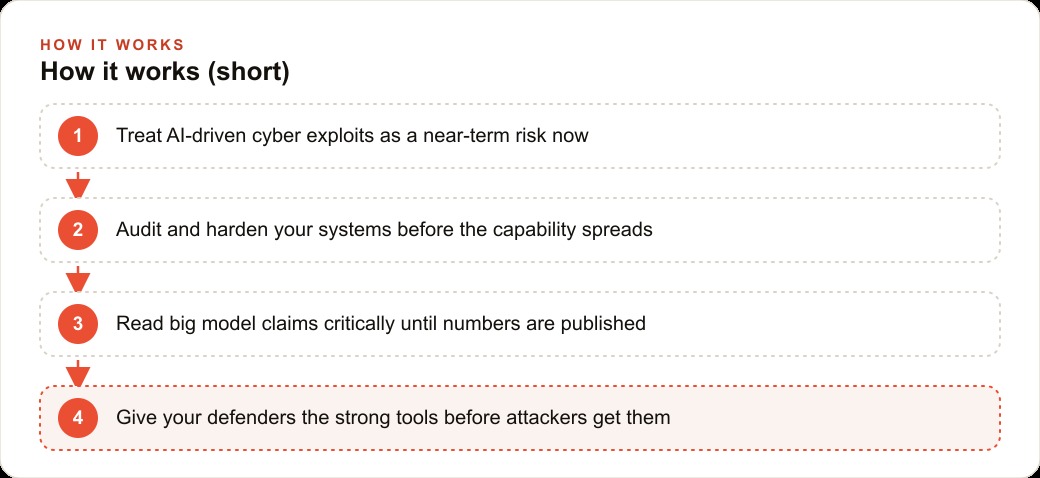
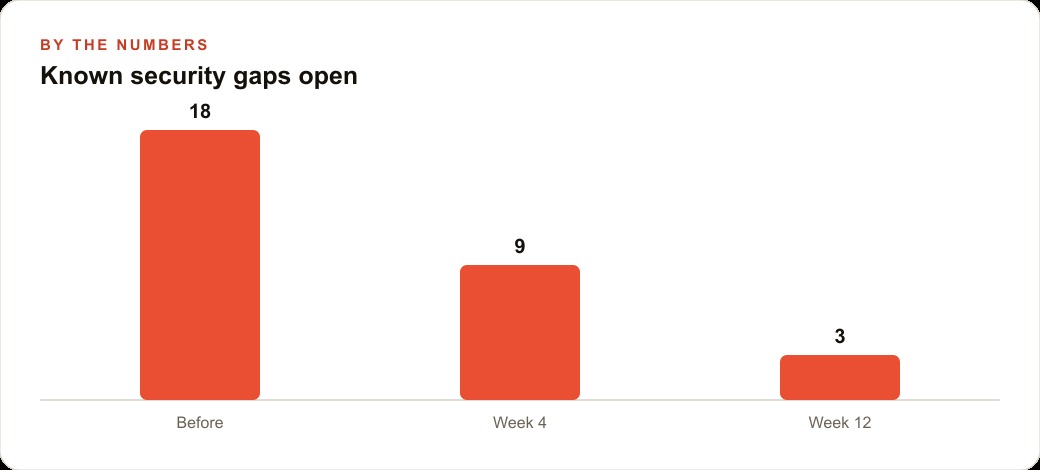
The practical work is unglamorous. Auditing access permissions and removing accounts that are no longer active or necessary is the first priority. Old employee accounts with full permissions, API keys created for projects that ended, administrative credentials shared across multiple people without individual accountability, these access gaps cost almost nothing to close and represent high-value targets for any attacker, AI-assisted or otherwise. Second, patching software that is out of date, particularly anything with an externally accessible interface. Third, enforcing multi-factor authentication on every system reachable from the internet. Fourth, reviewing where sensitive data actually lives and ensuring the access controls around it match the actual sensitivity of that data.
For any business running paid advertising accounts, managing Meta ads, and holding client contact records, those records represent exactly the category of data that has clear value to an attacker. The cost of closing the obvious gaps is primarily time and focused attention, not budget. A focused internal review by someone who knows what to look for typically takes a few days. A more thorough external audit from a security specialist costs more but finds the gaps an internal review misses. Either approach is a fraction of the cost of responding to an actual incident, which for a business holding client data typically includes incident response fees, legal notification obligations, potential regulatory exposure, and client attrition.
The additional frame the Mythos leak provides is about timing. If the threat level is genuinely about to increase as AI-assisted offensive capability becomes less rare and more accessible, then the window where hardening is cheap and uncrowded is narrowing. Qualified security help is in higher demand after an industry-wide threat increase than before one. The businesses that acted early face shorter waits, lower costs, and calmer conditions than those that wait for a specific event to force the issue. The warning in the leaked post, read at its directional value regardless of whether the specific capability claims hold up to scrutiny, is credible enough to act on. Madhuranjan Kumar helps businesses translate technology signals like this into specific, prioritized decisions about their digital infrastructure and data security posture. The businesses that act on that signal now, while the warning is fresh and the threat is still developing, will spend less on hardening and face lower disruption than those that act later under pressure from an incident rather than from a reasonable reading of where the technology is heading.
That is exactly what we do at AI DOERS. Book a private 30-minute call with Madhuranjan Kumar and we will map the fastest path to it for your specific business.
Book your call →
Madhuranjan Kumar
Madhuranjan Kumar brings 20 years of performance-marketing experience and has managed over $200 million in Facebook ad spend for brands across the United States and beyond. His expertise spans the full modern marketing stack: Meta, Google Ads, TikTok, email automation, CRM, and the websites that hold it together. At AI DOERS he turns that track record into lead-generation systems for businesses across every industry.