
What the Claude Code Source Leak Reveals About Anthropic's Roadmap
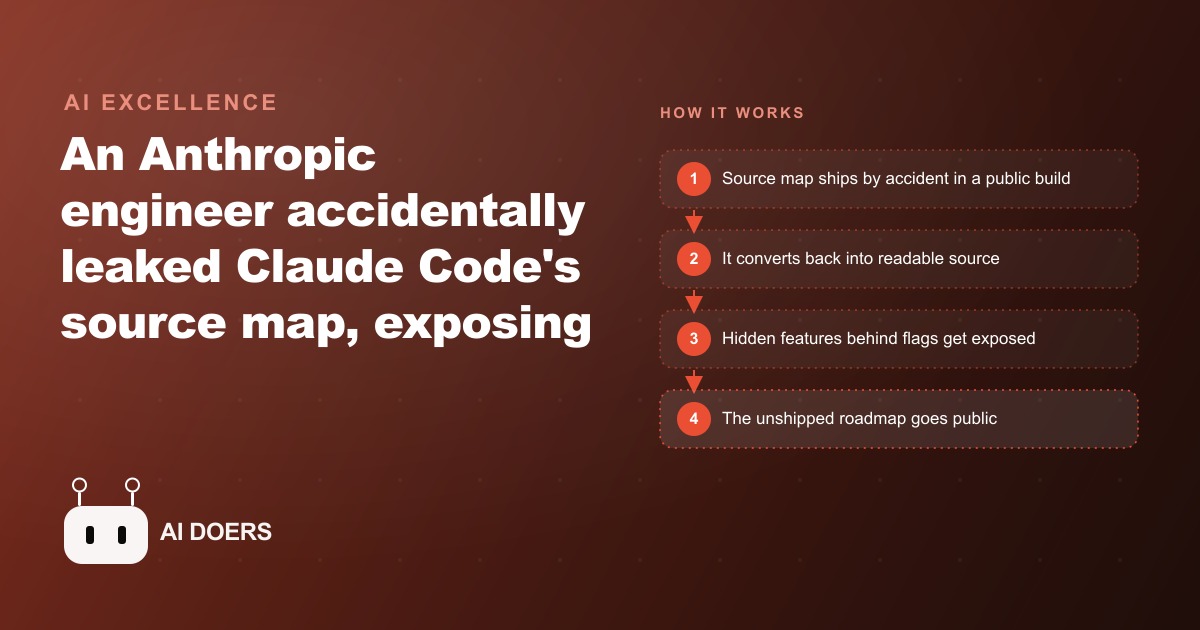
An Anthropic engineer accidentally shipped a source map that converts into roughly 600,000 lines of Claude Code, exposing unshipped features behind flags: a background agent that never sleeps, a 30 minute deep-planning mode, a multi-agent swarm, persistent memory, and real browser control.

Some technology stories are interesting at the surface and genuinely useful underneath. The Claude Code source leak is one of them. I went through what happened, what the contents actually exposed, and what it means for anyone building with or competing against AI development tools. There is a real set of actions here for any business that ships software or relies on Claude Code, not just a headline about a corporate accident.
The short version: an Anthropic engineer accidentally included a source map file in a public build of Claude Code. That file converts into roughly 600,000 lines of readable source code. The internet archived it within hours, and one mirror was forked about 42,000 times before Anthropic could pull it back. By then the contents were widely distributed. Anthropic confirmed the leak. What came out was not model weights or customer data. What came out was the application harness, the surrounding code that makes Claude Code function as a development tool, including a set of features that were built and tested but not yet visible to users. That roadmap is what makes this story worth reading carefully.
A 60-megabyte file accidentally exposed Anthropic's entire unshipped feature roadmap
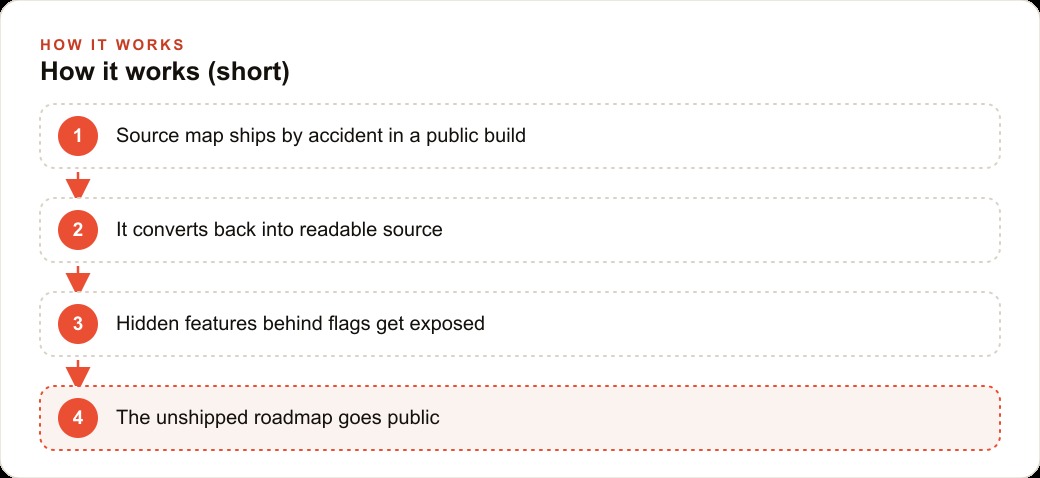
A source map is a translation file. When code is compiled and minified for production, it becomes compressed and difficult to read, which is usually intentional. The source map maps the minified output back to the original structured code with its original variable names, file names, and comments. Source maps are useful in development for debugging but should not ship in production builds because they reverse the obfuscation entirely.
When this source map shipped in a public build of Claude Code, it made the underlying code readable to anyone who downloaded and converted it. The 60-megabyte file expanded into approximately 200,000 TypeScript files and 600,000 lines of readable code. That is the complete harness around Claude Code: the system that turns the underlying language model into a useful development tool with memory, file access, tool use, and session management.
Inside that code were features sitting behind flags set to false, meaning they were built and internally active but switched off for public builds. These are not speculative roadmap items or design documents. They are working features in the production codebase, ready to be exposed when Anthropic decides to flip the flag. Finding them in the leaked source is equivalent to reading the company's internal product roadmap, except more reliable than most roadmaps because the code already runs.
The important framing is that no model weights, customer data, or API keys were exposed. What leaked was the application layer around Claude, which is significant because the application layer is where the product differentiation lives. It shows what Anthropic's engineering team is actually building and how they expect the system to evolve, which is information with real competitive and strategic value regardless of whether any raw AI capability was disclosed.
Kairos, Auto Dream, and Coordinator Mode reveal the architecture of the next generation of agents
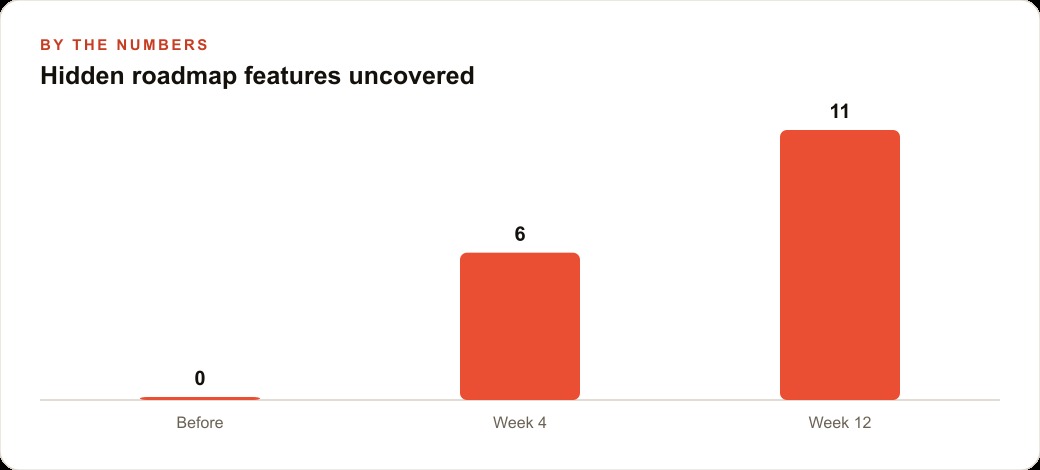
The unshipped features paint a clear picture of where Anthropic is taking Claude Code, and each one addresses a specific limitation in how AI development tools currently work.
Kairos is a background agent that runs continuously without user input. It monitors connected repositories, sends updates on changes, and can be triggered from anywhere to start a task. The limitation it addresses is that current agents are session-based: they exist only when you are actively working with them and have no awareness of what happened between sessions. Kairos is always on, always watching, and can initiate work rather than waiting to be asked. That is a qualitatively different kind of tool, one that behaves more like a permanently available staff member than a service you have to summon.
Auto Dream is a memory consolidation process that runs during idle time, when no active task is happening. The name is accurate: it works the way sleep does for memory, reviewing the context and interactions from previous sessions and compressing them into more usable long-term memory. Current AI tools forget everything when a session ends. Auto Dream is Anthropic's answer to that limitation, building a memory layer that persists and improves over time rather than resetting on every new conversation.
Ultra Plan is a deep planning mode that spins up a remote cloud session and uses a capable planning model to fully scope a task before any execution begins. The planning step produces a complete checklist and approach before the first file is touched. The limitation this addresses is that current coding agents often start executing before they fully understand the problem, producing work that has to be redone when the agent encounters constraints it did not anticipate. A 30-minute planning pass that produces a full task decomposition before execution starts eliminates most of that rework.
Coordinator Mode is a multi-agent swarm: one Claude instance orchestrates multiple worker instances, each with its own scratchpad and tool access, running in parallel on different parts of a complex problem. The current limitation is that a single agent handles one thread of work at a time. Coordinator Mode scales that to true parallel execution, which is the only way to handle genuinely complex software projects at meaningful speed.
Persistent memory across sessions and a real browser control agent round out the set, both already built and waiting for their flag to flip. Voice chat and several mystery slash commands also appear in the code, including one called Advisor that routes outputs through a second model for review before they reach the user.
The AI clean room rewrite is the more uncomfortable part of the story
The most unsettling detail in the coverage was not the leak itself. It was what happened next: someone fed the leaked code into another AI system and had it rewritten into a different programming language within hours. Same functionality, different code, no original lines remaining. One engineer in the commentary described this as AI quietly erasing copyright, and the description is technically accurate in a narrow sense.
Software copyright protection has historically relied on the practical friction of reverse engineering. Reconstructing a system from its compiled outputs is expensive and slow enough to function as a real deterrent. That friction is not theoretical protection, it is functional protection because the cost of circumventing it has historically exceeded the value of what was being protected in most cases. When that friction collapses, the practical protection collapses with it, even if the formal legal protection remains intact.
The implications for any business that considers its code to be its primary competitive moat are significant. Code that can be read from a source map and rewritten into a different language in hours is not a durable moat by any reasonable definition. The legal questions about whether such a rewrite constitutes infringement are real and unresolved. The practical question, which is whether your competitive advantage is actually secure, has a clearer answer: less secure than it was before AI code comprehension and generation became as capable as they are now.
This does not mean stop building software. It means stop building as if the code alone is the moat and start treating the surrounding assets, the customer relationships, the operational data, the institutional knowledge encoded in your processes and your eval sets, as the things worth protecting. Those cannot be reconstructed from a leaked source map over a weekend.
Two concrete actions follow from this leak: secure your own builds and start adopting the patterns it exposes
The leak points to two categories of action, and they apply to any business that ships software or relies on AI tools to do real work.
On the defensive side, the most immediate action is to check whether your production builds expose source maps. This is a default behavior in many web frameworks, including common configurations of Next.js and similar tools, and most teams have never audited whether it is happening in their production deployments. The check is simple: look at the JavaScript files your site or application serves in production and see whether they carry a sourceMappingURL comment at the bottom or end with .map extensions. If they do, source maps are exposed. A configuration change in your build tool removes them from production while keeping them available locally for debugging. That change takes under an hour and costs nothing.
Beyond source maps, treat unreleased features behind build flags as sensitive information. If your codebase has flags controlling capabilities that are not yet public, those flags are effectively your product roadmap. If someone can read your production code, they can see what you are about to launch. Confirm that your production builds strip or obfuscate feature flag logic, and treat the existence of unreleased features as information to protect rather than something implied by the code being compiled.
On the offensive side, the unshipped features in the Claude Code roadmap are worth treating as a preview of what development tools will look like in the next 12 to 18 months. Background monitoring, deep planning before execution, and persistent memory that accumulates across sessions are patterns you can begin building into your workflows now using current tools that approximate each capability. Waiting until the features are publicly released means adapting later to patterns your competitors are already using.
The roadmap points clearly toward agents that plan before executing and remember across sessions
The three most significant features in the leaked roadmap share a common pattern: they all address limitations that come from agents being stateless and reactive rather than planning-oriented and continuous. Kairos makes the agent continuous. Auto Dream gives it a growing memory. Ultra Plan makes it planning-oriented before it acts. Together they describe an agent that thinks before executing, remembers what it learned, and does not need to be summoned to start useful work. That is a qualitatively different kind of tool than what is publicly available now, and knowing it is already built and waiting tells you something meaningful about the near-term direction of the category.
For a real estate agency, the implications split into the same defensive and offensive halves. On defense, agencies push out custom listing sites, IDX portals, and client-facing tools regularly, and many ship with source maps left on by accident because no one on the team checked. Those maps expose the lead-capture logic, the routing rules, and the competitive features the agency spent real money building. A one-hour audit of the build pipeline closes that exposure before it becomes a problem.
On offense, the patterns the roadmap points to are implementable now in approximation using current tools. A background monitoring agent that watches new listings and price changes across the market and surfaces the relevant ones to the agent when they match a saved buyer profile, so the agency is first to call rather than third. A planning step before each new listing campaign that scopes the full marketing approach before any work begins: photography brief, copy angles, channels, open-house timing, and follow-up cadence, all laid out before a post goes live. Persistent client memory that carries each buyer's and seller's preferences, budget, and timeline across months of interaction rather than starting fresh each time they call.
An agency with 60 inquiries per year that currently converts 45 percent to closed transactions, roughly 27 deals, improves to 55 percent conversion with better preparation and consistent follow-through across every inquiry, roughly 33 deals. Six additional closings at an average commission of 3,500 dollars each is 21,000 dollars in additional annual revenue from the same lead volume, driven entirely by better process rather than more advertising spend. The patterns that produce that result are available to implement today. The leaked code just makes it very clear where the industry is heading and gives anyone paying attention a meaningful head start.
What this episode means for how you think about build security
The Claude Code source leak is unusual in that it is simultaneously a cautionary tale about production build hygiene and a useful preview of where the industry is going. Most leaks are one or the other. This one is both because the leak itself is the lesson about build security, and the contents of the leak are the lesson about the near-term direction of AI development tools.
The practical actions from this episode are clear. Audit your production builds for exposed source maps and fix any you find. Treat feature flags and unreleased functionality as information to protect rather than details implied by the compiled output. And start building the planning and memory patterns the roadmap points to using what is available now, so that when these features ship publicly they are extending habits your team already has rather than introducing capabilities you are encountering for the first time.
The businesses that act on both halves will be better protected against the risks this kind of exposure creates and better positioned for the capabilities that are already built and waiting to be turned on. The gap between those who understand what the roadmap says and those who learn about it when the features officially launch is a meaningful competitive window, and this leak opened it earlier than Anthropic intended.
That is exactly what we do at AI DOERS. Book a private 30-minute call with Madhuranjan Kumar and we will map the fastest path to it for your specific business.
Book your call →
Madhuranjan Kumar
Madhuranjan Kumar brings 20 years of performance-marketing experience and has managed over $200 million in Facebook ad spend for brands across the United States and beyond. His expertise spans the full modern marketing stack: Meta, Google Ads, TikTok, email automation, CRM, and the websites that hold it together. At AI DOERS he turns that track record into lead-generation systems for businesses across every industry.