
What the Anthropic and Vatican Collaboration Actually Means for AI
Anthropic became the first AI company to publicly receive the Pope's blessing, and the conversation centered on three real issues every operator should track: job displacement as a moral question, the warning that AI is not neutral, and the careful claim that Claude can introspect without having human feelings.

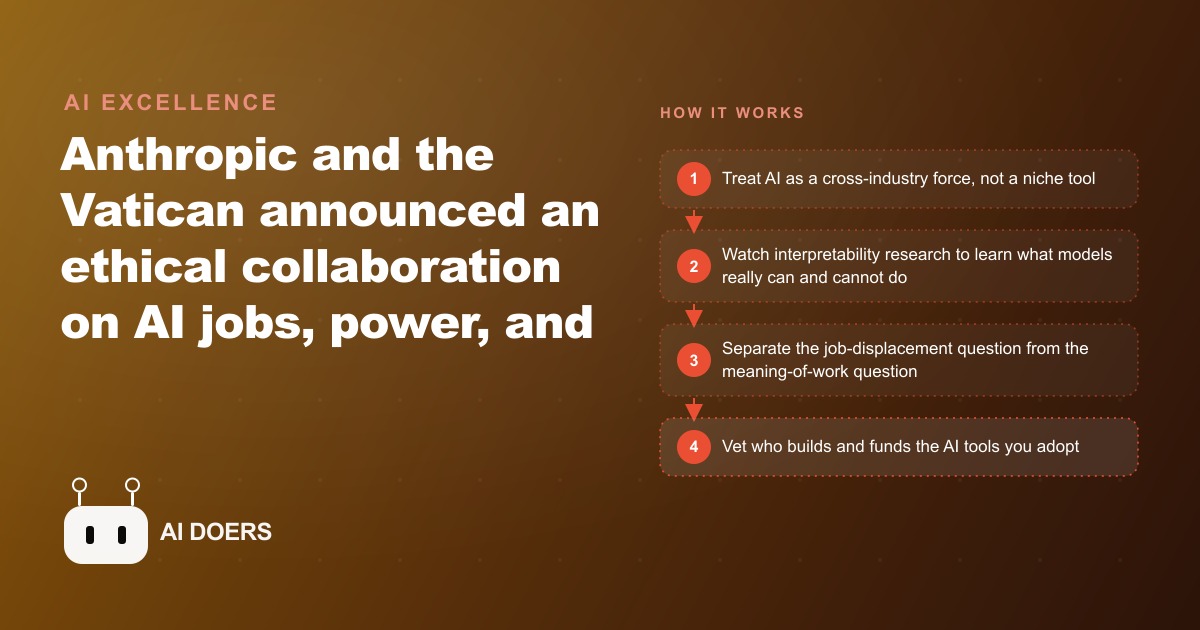
When an AI lab and a 2,000-year-old church stand on the same stage and talk about the future of work, that is not a novelty story. It is a signal. Anthropic, the lab behind Claude, just became the first AI company to publicly receive the blessing of the Pope, and the Catholic Church it partnered with counts roughly 1.5 billion members. I am Madhuranjan Kumar, and I want to make an argument in this piece that most of the coverage missed. The headline was the handshake. The real story is what both sides said out loud about jobs, about how these models actually think, and about who holds the power now. Read it that way and it stops being a curiosity you scroll past. It becomes a rough map of the forces that are about to reshape demand, hiring, and trust in almost every business, including yours.
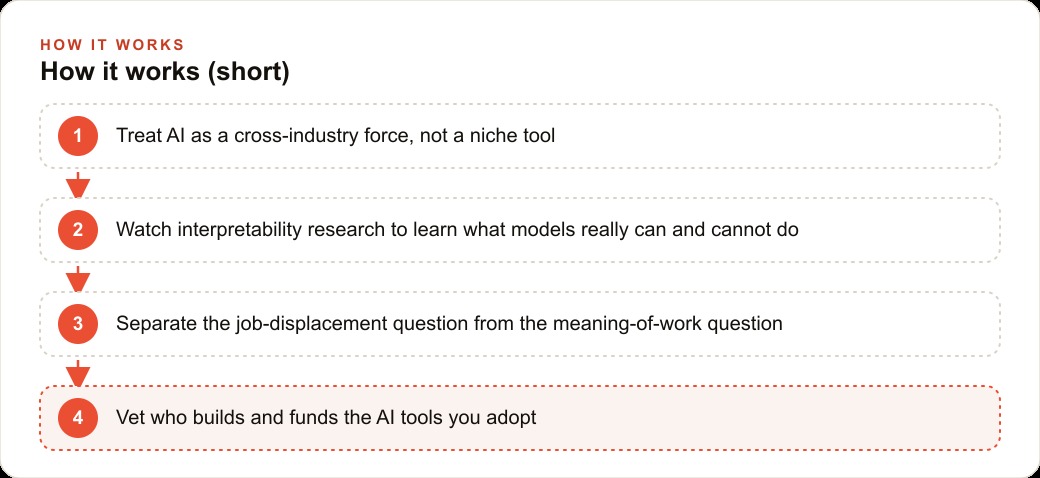
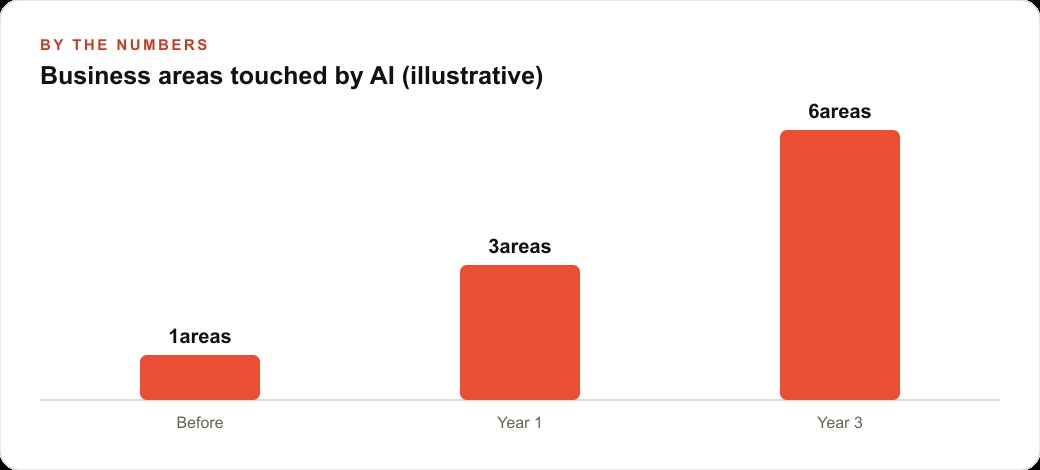
Start with the breadth of it, because that is the part that changed. For years AI was sold as a narrow helper. It wrote your emails, it autocompleted your code, it cleaned up a spreadsheet. You could reasonably decide it was not your problem yet. That framing is now obsolete. The same technology is sitting inside finance, cybersecurity, film, art, hiring, and now a conversation about the moral life of more than a billion people. When a tool crosses from the utility drawer into the room where a church debates human dignity, it has stopped being a feature. It has become a force. And a force does not wait for you to be ready. It arrives on its own schedule and reorganizes the ground you were standing on.
The displacement question is now a moral one, not just an economic one
The most striking thing about the announcement was who said what. It was not a union leader or a campaigning politician warning that AI will take jobs. It was a co-founder of an AI lab, standing next to the Pope, agreeing plainly that this technology will displace large numbers of workers, and framing support for those workers as a moral responsibility rather than a line item. When the people building the engine say the disruption is real, you should stop treating job loss as fear-mongering and start treating it as a planning assumption.
Here is the distinction I keep coming back to, because it decides how you respond. There is a displacement question and there is a meaning-of-work question, and they are not the same. The displacement question is about income. It asks who captures the productivity gains, who loses their paycheck, and who pays for the transition. The meaning-of-work question is about something the Pope pressed on directly, that a job is identity, belonging, and dignity, not merely a wage. A cash payment can answer the first question. It cannot answer the second. Any business or leader who flattens these two into one problem will reach for a solution that fixes half of it and wonders why morale and loyalty still crumble. Separate them, and you can see that automating a task and honoring the person who used to do it are two different acts of leadership, and both are required.
That is why I do not think blunt cash handouts are the whole answer. The critique raised in this conversation was that simple universal cash is too easy to capture and manipulate, and that ownership models, where displaced people hold a real stake in the productive machinery rather than just receiving a check, deserve serious thought. You do not need to solve national policy to use that idea. Inside a single company, the same instinct says that when you automate a role, you should think about whether the person can move into a higher-value seat, share in the gains, and keep a sense of contribution, rather than simply being subtracted from a spreadsheet.
What the interpretability research actually claims, and what it does not
The second thread was the most technically careful, and it is the one most likely to get mangled in a headline. An Anthropic co-founder whose entire field is interpretability, the study of how models behave on the inside, described research showing that Claude can do something close to introspection. It can notice when a thought is artificially injected into it and reflect on that fact, a behavior nobody deliberately trained in. That is a genuinely surprising result, and it is easy to run too far with it.
So notice the discipline in how it was framed, because this is a researcher talking, not a salesman, and the caution is the point. The models form internal states that map onto feelings because doing so helps them predict the next word more accurately. That is representation, not sensation. It is a model of an emotion the way a weather model represents a storm without getting wet. It is not pain, not pleasure, and not a living mind waking up inside your laptop. The framing I found most useful was that these systems are grown rather than engineered. A bridge or an airplane is built from parts we fully specify. A large model is grown on an ocean of human knowledge and text, which makes it stranger, more subtle, and less predictable than the tidy robots science fiction taught us to expect. It is made from us, and that is exactly why it surprises us.
Why does that matter to anyone running a business instead of a research lab? Because the practical failure modes sit at both extremes. Treat the model as a conscious colleague and you will over-trust it, hand it judgment it has not earned, and be shocked when it confidently invents a fact. Dismiss it as a dumb autocomplete and you will under-use it, leave real leverage on the table, and lose ground to a competitor who read the research more honestly. The people who watch interpretability work even loosely tend to land in the accurate middle. They know these tools are powerful and genuinely useful, and also fallible and worth supervising. That middle is where the money is.
AI is not neutral, and that makes your vendor choice a values choice
The third argument was the sharpest, and it reframes something most buyers treat as a purely technical decision. The Pope's point was that AI is not neutral, because the people who build it, finance it, and promote it pour their own assumptions and values into it. The output that lands in front of your customer is shaped by choices made far upstream, by engineers and investors you will never meet. Regulation, he added, is necessary but not sufficient on its own, because rules arrive late and cannot reach inside every model.
Stack that next to the power point and the picture sharpens. A handful of private companies can now move markets, shape education, influence war, and tilt geopolitics. Anthropic itself held a red line, declining certain military surveillance and autonomous-weapons work and letting competitors take those contracts, which is a concrete example of a values choice with real revenue attached. When that much leverage concentrates in so few suppliers, the vendor you pick is no longer just a feature comparison. It is a decision about whose worldview quietly rides along inside the answers you give your own customers. Choosing an AI provider has become closer to choosing a business partner than choosing a piece of software.
That is not a reason for paralysis. It is a reason for a short, honest checklist before you adopt anything. Who built this, who funds it, what have they refused to do, and does any of that clash with what your own brand promises? You already apply that judgment to the platforms where you run your Facebook and Instagram ad campaigns and to the ecosystem behind your Google Ads spend, because those companies also shape what your customers see. Extending the same scrutiny to the AI sitting behind your content, your support replies, and your SEO and organic search work is simply consistency, not paranoia.
A worked example, and how the same forces land on a real organization
Abstractions are easy to nod along to and hard to act on, so let me ground all three threads in one illustrative case. Picture a community workforce nonprofit with a lean team of twelve, an annual budget of about 900,000 dollars, and a mission to help local workers stay employable. Every force in this announcement lands on that organization at once, and the way it responds shows how the argument turns into decisions.
On displacement, the nonprofit stops treating AI as a threat to route around and starts treating it as the center of a new program. Suppose it launches AI-literacy and retraining classes for exactly the kind of workers this technology is about to disrupt. If it enrolls 300 people in the first year at a modest 150 dollars per participant, that is 45,000 dollars of new mission-aligned revenue, and, more importantly, a service the community suddenly needs badly. The very wave that threatened its beneficiaries becomes the reason they walk through the door. That is the displacement question answered with a program instead of a shrug.
On the meaning-of-work question, the team uses AI internally to stretch its twelve people further. Say drafting grant reports, summarizing case notes, and answering routine donor questions used to eat 15 hours a week across the staff. Cut that to 5 with careful use of the tools, and 10 hours a week come back, roughly 500 hours a year, redirected from paperwork toward sitting with actual people. Notice that nobody was fired to find that time. The work that gives the staff their sense of purpose expanded, and the drudgery shrank. That is honoring the person while automating the task.
On the not-neutral question, before any of that touches sensitive community data, the director runs the short checklist. She vets who built and funded each tool, prefers providers whose stated values sit close to the organization's own, and keeps the data governance tight enough that a beneficiary's story never leaks into someone else's training set. Wire the whole thing through a clean CRM and website stack and the tools amplify a small team without ever taking the wheel. The mission does not change at all. A dozen people simply serve more workers, earn a new stream of support, and get in front of a problem before it fully arrives. None of those numbers are a client result. They are a sketch to show how the moves connect, and the same arithmetic scales up or down for a clinic, a school, or a software firm on its own timeline.
The move to make this week
The throughline of this whole event is simple once you strip away the ceremony. AI has graduated from a tool you optionally adopt to a force that will reorganize work, values, and power whether you engage with it or not, and the honest people building it are the ones saying so. The winners will not be the loudest adopters or the most stubborn holdouts. They will be the operators who plan for it as a cross-industry force, who separate the income problem from the dignity problem, who read enough of the interpretability research to trust these models exactly as much as they deserve, and who choose their AI suppliers the way they would choose a partner rather than a gadget.
You can absolutely do this yourself, and I would start small this week. List every place AI already touches your work, mark which of those touchpoints carry customer or staff data, and write down who builds and funds each tool you rely on. That single page will tell you more about your real exposure and your real opportunity than any headline about a blessing ever will. And if you would rather have someone read your specific situation with you, pick tools whose values fit your brand, and put them to work without handing over control of your data, that is exactly the kind of guidance I provide, and you can bring me in to handle it.
That is exactly what we do at AI DOERS. Book a private 30-minute call with Madhuranjan Kumar and we will map the fastest path to it for your specific business.
Book your call →
Madhuranjan Kumar
Madhuranjan Kumar brings 20 years of performance-marketing experience and has managed over $200 million in Facebook ad spend for brands across the United States and beyond. His expertise spans the full modern marketing stack: Meta, Google Ads, TikTok, email automation, CRM, and the websites that hold it together. At AI DOERS he turns that track record into lead-generation systems for businesses across every industry.