
What Makes Kimi K2.5 the Open-Source Model That Rivals Opus 4.5
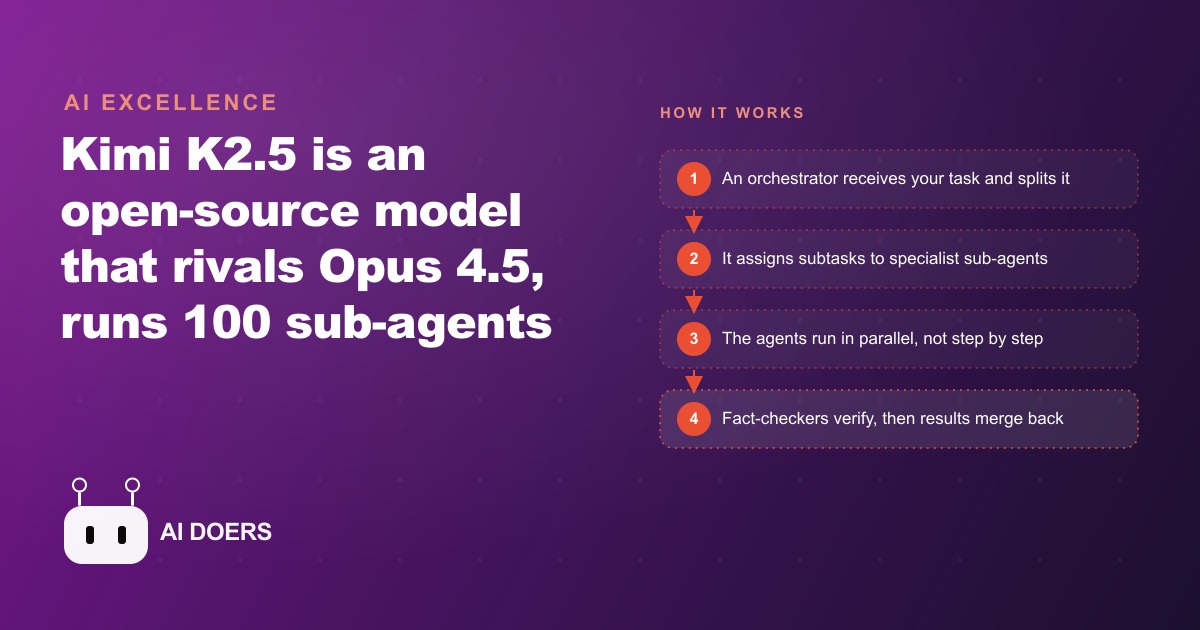
Kimi K2.5 from Moonshot AI is an open-source, natively multimodal model that matches or beats Opus 4.5 on many benchmarks while costing about 87 percent less, and its built-in agent swarm spawns up to 100 sub-agents to finish complex tasks roughly four times faster.

You are probably paying eight to ten times more for AI than you need to, and the model doing the overcharging is not significantly better than the one you could be using instead. I am Madhuranjan Kumar, and I want to make that argument directly using Kimi K2.5, the model that broke the cost-performance assumption most businesses are still working from.
The received wisdom until recently was that open-source AI models trail the frontier by six to twelve months, and that if you need a genuinely capable model for production use, you pay the premium pricing of a closed commercial provider. Kimi K2.5 from Moonshot AI is the most direct challenge to that assumption that has appeared yet. On many benchmarks it matches or beats Anthropic's Opus 4.5 while running at roughly 0.6 dollars per million input tokens and 3 dollars per million output tokens. Opus 4.5 runs at approximately 5 and 25 dollars per million tokens respectively. At similar or better performance, that is roughly 87 percent cheaper.
The cost gap is not a rounding error
Eighty-seven percent is a number that deserves to sit in your attention for a moment before moving past it. For a business generating content at scale, doing research across many documents, or running any batch process that involves a large volume of AI model calls, an 87 percent cost reduction is not a minor efficiency. It is the difference between a workflow that costs fifty dollars a month and one that costs four hundred.
The reaction from most business owners when they hear this is to assume there must be a significant quality trade-off. That assumption deserves to be challenged rather than accepted. Moonshot AI is a Chinese research lab founded by a former Google Brain researcher who co-authored key transformer papers, backed by Alibaba and Tencent, and the team that built K2.5 clearly understands what frontier performance requires. The benchmarks where K2.5 excels are real tasks: coding, visual design, front-end development, and multi-step reasoning. These are not narrow lab benchmarks designed to flatter the model. They are the categories of work that businesses actually use AI for.
The open-source status adds another dimension that is easy to underestimate. A closed commercial model comes with a single vendor's pricing, a single set of terms about where your data goes, and a single point of failure if that vendor changes its policies. An open model that runs on multiple inference providers gives you competition between those providers, which tends to push prices down and quality up. You are not locked to the provider that owns the model weights. If one provider's service degrades or pricing changes, you move to another provider running the same weights.
The agent swarm is the capability difference nobody is pricing correctly
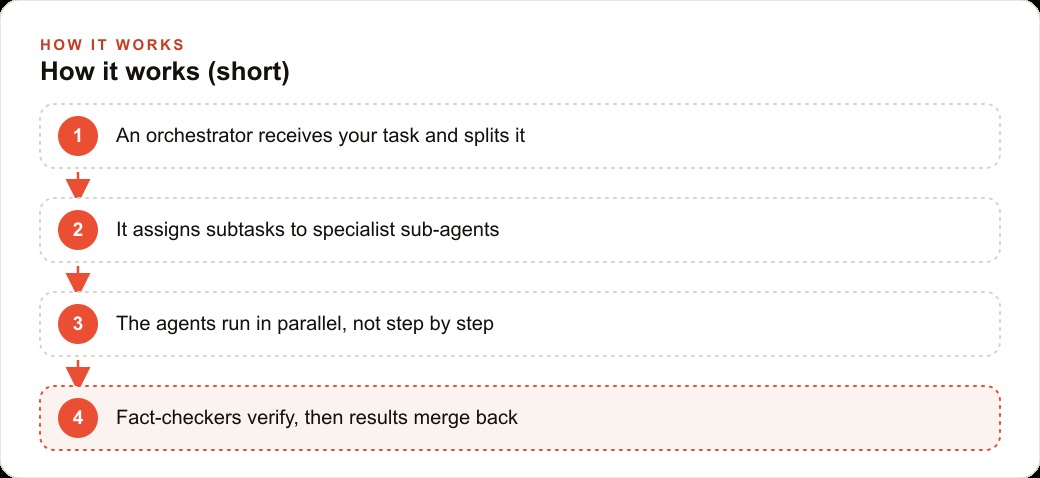
The specific feature that makes K2.5 worth understanding beyond its cost profile is the built-in parallel agent architecture. K2.5 can spawn and coordinate up to 100 sub-agents simultaneously, without you defining the roles or writing system prompts for each one. The orchestrator receives a task, decides how to split it, assigns subtasks to specialist agents chosen on the fly, and runs them in parallel before consolidating the output.
The practical effect is that complex, multi-part tasks finish dramatically faster than they would in a single-agent sequential model. A research task that would take an hour working through information sources one at a time can come back in a fraction of that time when the work is split across many parallel specialists. This is not a prompting trick or an external orchestration framework. It is parallel agent reinforcement learning built into the model's architecture, which means it is consistent and does not depend on a specific setup pattern you have to maintain.
The businesses getting the most out of this capability are the ones running heavy batch tasks: generating many content variations at once, processing large collections of documents for structured output, drafting multiple related assets for a campaign in parallel rather than one at a time. For a business doing that kind of work on a closed model at premium pricing, switching to K2.5 through an open inference provider is a cost reduction and a speed improvement at the same time.
The multimodal capability is the other upgrade from the previous version that matters for practical use. K2 handled text only. K2.5 is natively multimodal across images, video, audio, and documents, trained on 15 trillion tokens of text and image data together. This means you can hand it a product photo alongside a text brief and get copy that references the visual context. You can feed it a supplier PDF and get structured extraction without preprocessing the document into text first. The modalities are not bolted on as separate modules; they are integrated into the same trained architecture.
The vendor lock-in problem is the one most owners have not priced in yet
Here is the contrarian argument I want to make more directly: the business risk in staying with a single closed commercial AI provider is higher than most owners currently assess, and the cost gap to the best open alternative is lower than most owners currently believe.
Closed model providers have changed pricing, changed access tiers, changed context limits, and changed model behavior on short notice throughout the last several years. A business that has built workflows around a specific closed model's behavior can find that those workflows need significant adjustment after an update the provider decided to ship unilaterally. An open model does not change behavior unless you choose to update to a new version. The weights you are running today will behave the same way in six months.
The data handling question is the other dimension. When you run inference through a closed commercial provider, you are operating under that provider's terms about what happens to your input data. When you run inference through an open model on a provider you have chosen based on your data requirements, you control that decision. For a business handling client information, proprietary content, or sensitive operational data, that control has real value.
None of this is an argument to stop using closed models entirely. Some tasks genuinely benefit from the specific capabilities of a specific model, and the flagship closed models continue to lead on certain narrow benchmarks. The argument is to stop treating premium closed model pricing as the default, check open alternatives when you are planning a workflow that will involve significant volume, and use the cost savings to either reduce your AI spending or increase the volume of work you can run at the same budget.
What this looks like in practice for a small business
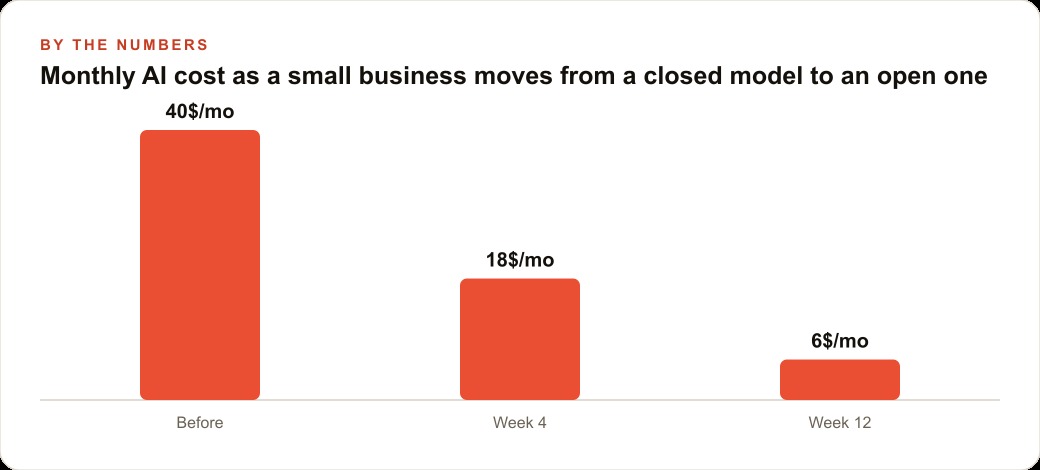
Let me be concrete about the financial argument with an illustrative example. Consider a small marketing operation producing content at scale: thirty social posts per month across multiple platforms, ten research summaries on competitor activity, five campaign briefs, and batch generation of email subject line variations for testing. Running that volume through a premium closed model at standard pricing might cost forty to sixty dollars per month in API credits depending on the mix of input and output tokens.
Running the same work through K2.5 at its published pricing would reduce that to five to eight dollars per month for comparable or better output on the tasks where K2.5 excels, which includes front-end design work, content generation, and structured research output. The annual saving is in the four hundred to six hundred dollar range for a single small business. For an agency running this kind of volume across multiple clients, the numbers compound significantly.
The opportunity cost framing is the more important one. The thirty-five to fifty dollars per month that stays in your budget at K2.5 pricing can fund Google Ads testing, additional content distribution, or the research tools that surface the topics worth creating content about. The cost of AI tooling becoming negligible is what allows a small business to treat AI as infrastructure rather than as a discretionary spend item that gets evaluated every quarter.
The workflow for transitioning to K2.5 is genuinely low friction. Install the Kilo Code extension in VS Code, create a free account, and select Moonshot Kimi K2.5 in the model picker, making sure to choose K2.5 specifically rather than the older text-only K2. The free tier gives you approximately a week of access to test it against your actual work before committing to anything. For production use at scale, route through OpenRouter to access providers running the fastest available inference: Fireworks, GMI Cloud, or Novita. The pricing and speed difference between providers on the same model weights is meaningful enough to be worth comparing before locking in.
Use the agent swarm for the heavy batch jobs where it produces the most value: generating many variations of something, processing large collections of documents, or drafting multiple related assets at once. Use standard single-response prompts for quick one-off questions where the overhead of orchestrating sub-agents adds latency without adding value. The model is natively multimodal, so feed reference images and documents directly into your prompts rather than preprocessing them into text descriptions first.
The premise that you need to pay premium pricing for a capable AI model is worth testing this week. K2.5 is the most compelling evidence yet that the premise is outdated. The leads and content produced with cheaper capable AI tools land in the same CRM and website stack as content produced with expensive ones. The difference is what your budget looks like at the end of the month.
That is exactly what we do at AI DOERS. Book a private 30-minute call with Madhuranjan Kumar and we will map the fastest path to it for your specific business.
Book your call →
Madhuranjan Kumar
Madhuranjan Kumar brings 20 years of performance-marketing experience and has managed over $200 million in Facebook ad spend for brands across the United States and beyond. His expertise spans the full modern marketing stack: Meta, Google Ads, TikTok, email automation, CRM, and the websites that hold it together. At AI DOERS he turns that track record into lead-generation systems for businesses across every industry.