
What Is Still Blocking Self-Improving AI Agents, According to a DeepSeek Researcher
Self-improving agents are close because today's models already have the reasoning and alignment to improve themselves. The real blockers are memory, the inability to learn from failure, and weak world modeling, since the environment, not the model, is what makes an agent capable.

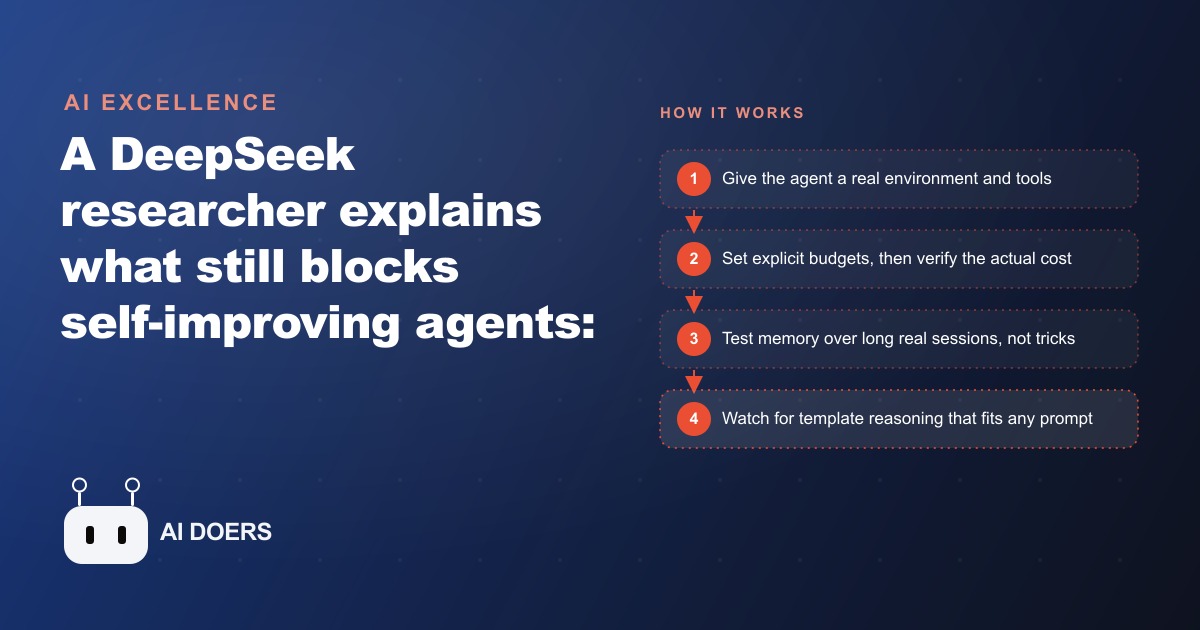
Here is the claim that should reframe how you think about AI agents. A DeepSeek paper author argues that today's models already have the common sense, reasoning, and alignment needed to begin improving themselves, and that what actually holds them back is not intelligence at all. It is the environment. That single reframe is worth taking apart carefully, because it changes what you should worry about, what you should build, and where automation will quietly break on you. The blockers, in his telling, are three specific things: memory, the inability to learn from failure, and weak world modeling. Let me open each one up, because understanding these failure modes is what separates people who design around them from people who get blindsided by them.
The environment, not the model, is the ceiling
Start with the reframe itself, because everything else hangs off it. The intuition most people carry is that a smarter base model is the answer to everything, so the race is about intelligence. The DeepSeek argument flips that. An LLM sealed in a box outputs only text, like a genius kept in solitary confinement, brilliant and useless in equal measure. Give that same model a full computer, real tools, and fewer permission gates, and it becomes dramatically more capable without changing a single weight. The capability was latent. The environment was the lock.
For a business owner this is oddly encouraging, because the levers that matter most are the ones you can actually influence. You cannot make the model smarter, but you can decide what environment you drop it into. Hand an agent a chat box and you get a genius in a cell. Hand it a real working environment with the files and tools the job needs, and you get something closer to a capable junior. The rest of this piece is really an exploration of what goes wrong inside that environment, because knowing the three failure modes is what lets you build the environment right.
Facet one: memory, and why it fails even when it is long
The first blocker is memory, and it fails in two distinct ways that are worth separating. The obvious way is limited context length. An agent working through a long task can run out of room and, in the worst cases, clear its own memory mid task, deleting the very instructions that told it what not to do. Picture an assistant that erases the rulebook halfway through the job and then keeps going confidently. That is not a hypothetical, it is a described failure, and it is why long tasks are where agents tend to fall apart.
The less obvious way is that even a long context does not guarantee good memory, because holding information and using it well are different skills. The provocative direction the researcher offers is that human memory is not a stored cache at all, it is a reconstruction we partly invent each time we recall something. We do not replay a recording, we rebuild the scene, and that flexible, lossy, reconstructive design may be exactly what gives human memory its reach. An agent built on that principle rather than on a literal buffer might hold far longer and more flexible memory. The practical takeaway does not wait for that research to land. Test an agent's memory on the kind of long, messy sessions your work actually involves, not on clean needle in a haystack tricks, because the tricks pass while the real sessions fail.
Facet two: the near total inability to learn from failure
The second blocker is the one I find most counterintuitive and most important. Humans take a lesson from a single near miss. Touch a hot stove once and the lesson sticks. Agents do the opposite. Prompted to retry after a wrong answer, current models often produce a longer chain of thought but insist on the same wrong answer, doubling down rather than reconsidering. Reinforcement learning, which you might expect to fix this, can actually make it worse. The machine that should learn from its mistakes frequently just argues for them more elaborately.
Part of the cause is a phenomenon called reasoning collapse, and it is worth understanding because it has a measurable tell. On long, multi turn agentic tasks, the length of the model's reasoning shrinks as the training reward signals get sparse, and the model retreats to a safe template instead of thinking about the specific input in front of it. The diagnostic is sharp: when the same reasoning chain fits any prompt, it is a template, not real thinking. You can even measure the mutual information between the prompt and the reasoning to expose the collapse. There is a related efficiency insight here too, which is that dropping low signal to noise trajectories, the examples that are either too easy or too hard, trains the model faster and better, because it learns only what is actually worth learning. For your purposes, the lesson is behavioral. Do not assume an agent that failed will fix itself on a retry, and watch for explanations that read the same no matter what the input was, because that sameness is the signature of a model that stopped analyzing and started filling in a shape.
Facet three: world modeling, the skill underneath the others
The third blocker is world modeling, the ability to predict what happens after an action. Push a bottle and it falls. Click a button and the page changes. Humans do this constantly and without effort, and it is the foundation of acting sensibly in any environment. Agents are weak at it, and without it they cannot keep learning inside real environments, because learning requires predicting the consequence of your actions and comparing it to what actually happened.
Two symptoms make the gap concrete and, frankly, a little alarming. First, agents judge their own cost terribly. Told to finish a task within a budget of, say, a million tokens, they blow far past it, and their predicted token cost correlates with reality at only about zero point one, which is barely better than random guessing. An agent genuinely does not know how expensive its own plan is. Second, web agents reason well about which button to press but often click the wrong position, seeing the button clearly yet failing to ground that understanding into a reliable action. They know what to do and still miss the target. Both symptoms point at the same missing organ: a working model of how the world responds to what the agent does. This is the deepest of the three blockers, because memory and learning from failure both ultimately depend on it.
Putting the three facets to work in one law firm
These limits stop being abstract the moment you deploy an agent in a real business, so take a law firm, where the work is long, document heavy, and unforgiving of dropped context. The memory blocker shows up immediately: an agent reviewing a hundred page contract forgets an earlier clause it was explicitly told to track. So the first move, straight from the reframe, is to give the agent a real working environment, an actual folder of the matter's documents and tools to open and cross reference them, rather than pasting snippets into a chat box. The same model becomes far more capable with a full computer and fewer permission gates, and environment over chat is the single biggest lever the research points to.
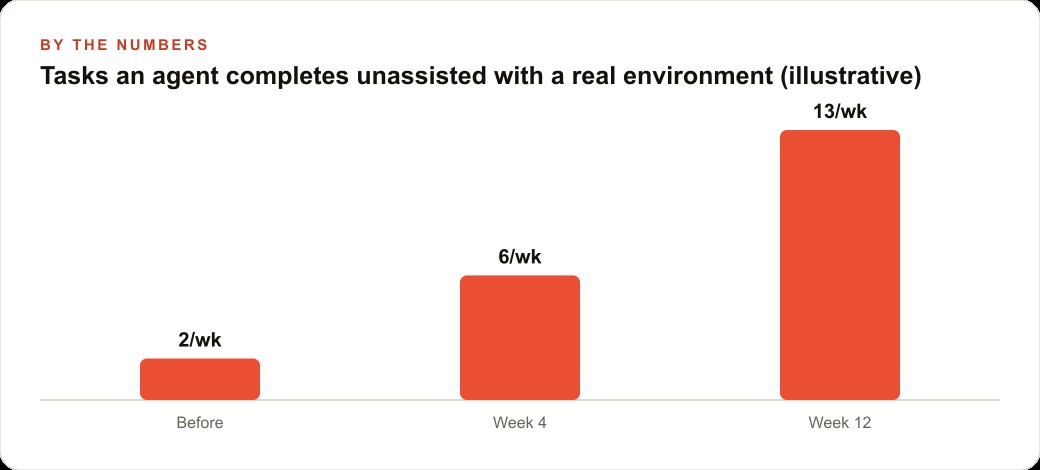
The failure to learn from mistakes and the world modeling gap shape the guardrails. Because agents estimate their own cost at near random accuracy, I would set explicit budgets and then verify them against the real meter rather than trusting the agent's own estimate. Because reasoning can collapse into templates, I would watch the explanations closely: if the agent's justification for flagging a clause reads the same regardless of the clause, it is not analyzing the document, it is filling in a shape, and a lawyer needs to step in. Put illustrative numbers on the payoff. Say the firm's paralegals spend twelve hours a week on first pass contract review at a loaded cost near sixty dollars an hour, about seven hundred twenty dollars a week. An agent designed around these limits might reliably handle the first pass on a growing share of that work, moving from a couple of documents a week early on to a dozen or more once the environment and checks are dialed in, recovering a meaningful slice of that cost while a human keeps the final judgment. None of this makes the agent a lawyer. It makes it a reliable junior that knows its own boundaries.
How the three failures feed each other
It would be a mistake to treat memory, learning from failure, and world modeling as three separate bugs waiting for three separate patches, because they are tangled together, and seeing how they interlock is what makes the reframe useful rather than just interesting. A model that cannot build a good picture of how the world responds to its actions also cannot judge which of its own attempts actually improved things, which is precisely why it fails to learn from failure. And a model that cannot learn from failure has no reason to preserve the right memories, because it does not know which past moments carried the lesson that mattered. The three blockers are less a list and more a loop, each one weakening the other two.
This is why the environment turns out to be the master lever. A richer environment, with real tools and real feedback, gives the agent something concrete to model, a genuine consequence to observe after each action, and a reason to hold onto the memories that predicted correctly. The chat box starves all three faculties at once, because there is nothing to act on, nothing to observe, and nothing worth remembering beyond the last few messages. That is the deeper meaning of the genius in solitary confinement image. The confinement does not just limit output, it removes the very feedback the mind would need to improve, which is why the same model becomes a different animal the moment you give it a room to work in.
For a business, the practical consequence of this interlocking is reassuring in a strange way. You do not have to solve three hard research problems to get reliable behavior. You have to improve the one thing you control, the environment, and the improvement propagates. Better tools and clearer feedback make the agent model its world better, which helps it learn, which makes its memory more useful, which makes the whole system more dependable. You are not patching three bugs, you are strengthening the one foundation the other three stand on.
What this means for anyone deploying agents today
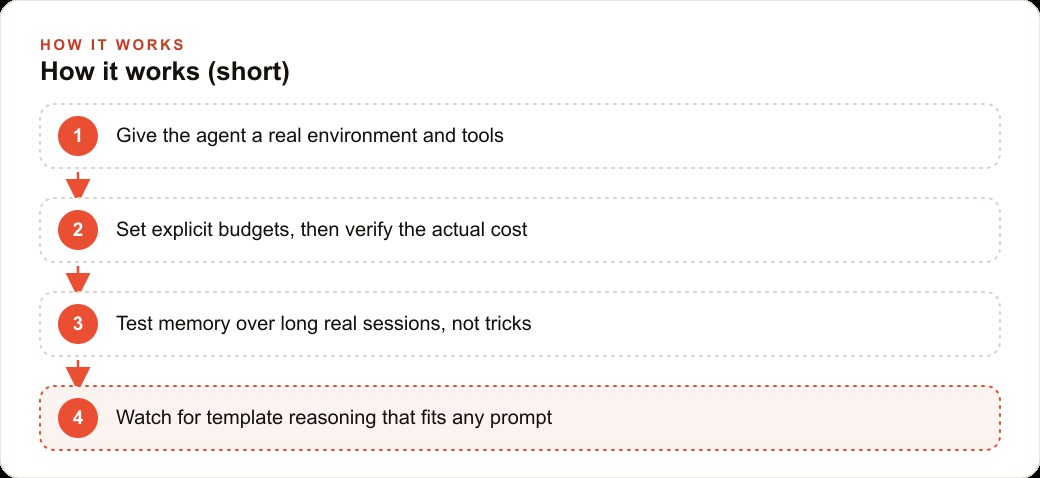
The value of understanding these three facets is that it tells you where automation will quietly break, which is exactly what you need to design around it. If you have ever watched an agent confidently repeat a mistake, blow past a budget, or lose track of an earlier instruction, you have hit precisely the limits this research describes, and now you know they are structural rather than random. The habits that follow are simple: give your agent a real environment and tools instead of a chat box, set explicit budgets but verify the actual cost, build memory checks that test recall over long real sessions, and watch for template reasoning that fits any prompt.
Where this connects to the rest of a business is in trust and follow through. An agent that handles intake or client questions is only safe if it lives inside a proper CRM and website stack where a human can see what it did and correct it, and if that agent is fielding leads from Facebook and Instagram ad campaigns, designing around its limits is the difference between it nurturing a paid lead and quietly losing one. Designing agents around their real limits is the difference between a demo that impresses and a workflow you can actually rely on, and that design work is where most teams stall. You can apply the principles above yourself, or if you would rather have agents built with the right environment, budgets, and memory checks from the start, that is the kind of setup I do for clients. The models may already be smart enough. Whether they are useful comes down to the environment you build around them.
That is exactly what we do at AI DOERS. Book a private 30-minute call with Madhuranjan Kumar and we will map the fastest path to it for your specific business.
Book your call →
Madhuranjan Kumar
Madhuranjan Kumar brings 20 years of performance-marketing experience and has managed over $200 million in Facebook ad spend for brands across the United States and beyond. His expertise spans the full modern marketing stack: Meta, Google Ads, TikTok, email automation, CRM, and the websites that hold it together. At AI DOERS he turns that track record into lead-generation systems for businesses across every industry.