
What Is an AI Agent, and Why 2026 Is the Year to Learn Them
An AI agent is a digital worker that understands instructions and takes actions to complete tasks. It goes beyond a chatbot's information-only replies to actually book appointments, send emails, and update systems on its own.

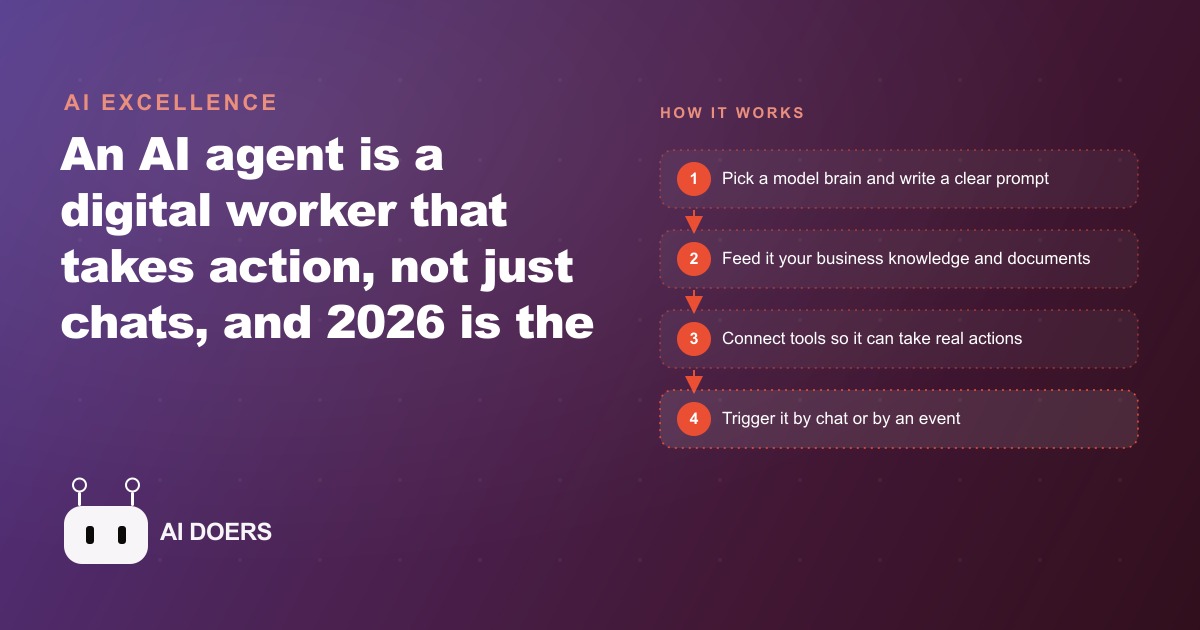
The distinction that matters is the one most introductions skip past in the rush to sound authoritative. A chatbot retrieves information and recites it back. An AI agent retrieves information, makes a decision based on it, takes an action in an external system, observes the result, and adjusts. That perceive-decide-act-observe loop is what makes the agent feel qualitatively different from anything that came before it in practical software, and it is the real difference between a tool that makes you faster at looking things up and a tool that does the work itself.
I am Madhuranjan Kumar. The framing I use with clients is a simple waiter analogy. Ask a basic chatbot to book an appointment and it tells you the business hours and suggests you call. Ask an agent and it checks the live calendar, finds the next available slot, books it, sends a confirmation text, and updates the scheduling system, all in a few seconds, with no human executing any of those steps. One describes the work. The other does it. That difference in what the tool actually does determines which category of problem you can solve with it, and confusing the two categories wastes significant time and budget on the wrong tool for the job.
The gap between reciting and doing, and why it defines everything downstream
The reason the chatbot-versus-agent distinction matters practically is that it defines which category of business problem each one solves, and those categories are different.
A chatbot is right for questions. What are your hours? What does this policy mean? What services do you offer? The answer exists somewhere, the model retrieves and formats it, and the interaction ends. That is genuinely valuable and handles a large fraction of inbound customer inquiries for many businesses. If your primary need is answering repeated questions at scale with consistent accuracy, a well-built chatbot meets that need well and is significantly simpler to set up and maintain than an agent.
An agent is right for tasks. Schedule this appointment. Process this return. Follow up with every lead who did not respond within 48 hours. Send the weekly operations summary to the team. These are not question-answer pairs. They are sequences of steps where each one depends on the result of the previous one, often involving multiple external systems, with outcomes that persist after the agent finishes running. No chatbot handles these sequences reliably. An agent does, at any hour, at any volume, without overtime costs or scheduling conflicts.
The practical implication for a business deciding where to deploy which tool is to separate the list of your repeated questions from the list of your repeated manual tasks. Those lists are different, and the tool that fits one list does not fit the other. The questions need a chatbot with accurate, current knowledge. The manual tasks need an agent with the right tools and the right permissions. Mixing up which tool is right for which list leads to building something that satisfies neither need well.
Inside the five-part anatomy: understanding what you actually control
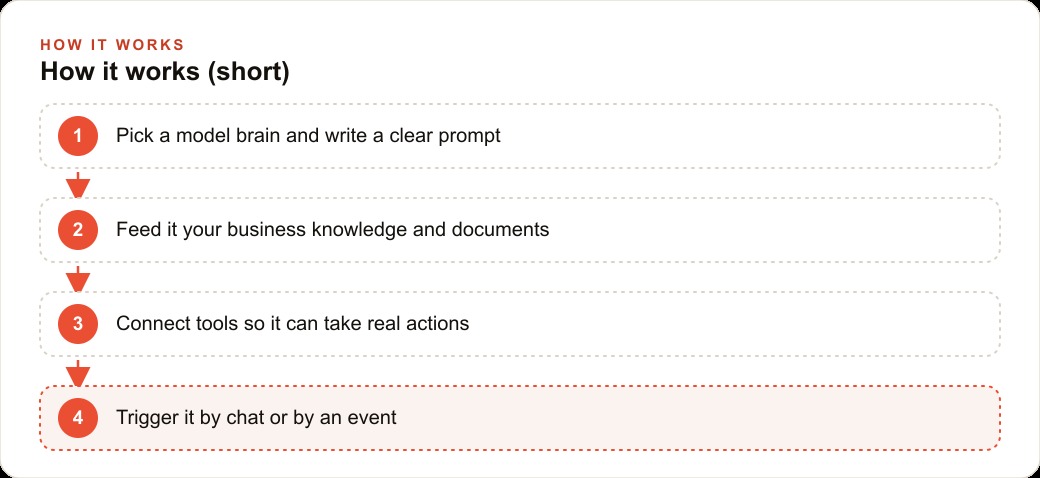
Every AI agent has five components, and the most useful thing to know before building anything is which of those five are yours versus which are essentially handled for you by the platforms and frameworks you choose.
The brain is a large language model, and you access it by choosing which API or platform to build on. The model choice matters for quality and cost, but for most business applications the differences between top-tier options are smaller than the differences in how well you define the other four components. The memory layer holds context across turns and tasks, and it is managed by whatever framework or platform you build on. For most practical agent setups, this is also largely handled for you rather than being something you design from scratch.
That leaves three components you genuinely own and control: the prompt, the knowledge, and the tools. Everything about whether an agent performs well in your specific business context traces back to those three. Writing them down and designing around them deliberately prevents the over-engineering that wastes weeks of work on parts that are already commoditized by the platforms.
The prompt sets the agent's identity, constraints, tone, and decision-making style. A vague prompt produces inconsistent behavior that varies across interactions in ways you cannot predict or control. A prompt written with the same precision you would apply to a job description for a new employee, clear about scope, about what the agent may and may not do, and about exactly how to handle situations that fall outside its authority, produces reliable behavior you can trust across thousands of real interactions. The knowledge base is the body of business-specific information the agent draws on. It is the difference between an agent that answers your customers' questions correctly from your actual current policies and an agent that produces plausible-sounding answers that do not match what your business actually does. Accurate knowledge is where most agents either earn or permanently lose the trust of the team using them.
APIs as the anatomy of action: why every tool is a request and a response
Every action an AI agent can take in the world maps to an API call. Checking a calendar is a structured request to a calendar system and a structured response with availability data. Sending an email is a request to an email service API with the recipient, subject, and body. Writing a row to a spreadsheet is a request to the spreadsheet API with the data. Booking an appointment is a request to the scheduling system API with the patient name, time slot, and service type.
This one-level-deeper framing matters because it reveals the scope of what agents can do. Anything a person can do through a software interface, an agent can do through the corresponding API, faster, at any hour, and across as many concurrent instances as the rate limits allow. That is what changes the scale relationship between human labor and AI capability in a way that no amount of human hiring can match. A human coordinator handles one incoming lead at a time, with natural breaks, unavailable overnight and on weekends. An agent handles as many concurrent leads as the system allows, around the clock, with response times measured in seconds.
To teach an agent how and when to use a particular tool, you describe only three things in plain language: what the tool does, what input it needs, and what it returns. A capable model reads that description and works out both when to invoke the tool and how to format the call correctly. Give the agent a layered goal, like finding companies that raised funding this week, adding each one to a tracking spreadsheet, writing a one-sentence summary of what each company does, and emailing the results to the team, and it breaks the goal into its component steps, sequences the right tool calls, and runs them in order without manual intervention at any point.
The two trigger patterns that determine what kind of work an agent can own
Agents deploy in two fundamental patterns, and knowing which one a specific use case calls for saves significant setup time and produces better results than trying to force the wrong pattern.
Conversational agents wait for a human message and respond to it. The cycle repeats until the task is complete. This is right for any situation where the customer needs a genuine back-and-forth exchange before the task is clear: appointment booking where the customer names a rough timeframe and the agent proposes specific slots based on real availability; support conversations where the exact issue needs to be identified before routing or resolving it; sales conversations where qualifying questions need to be asked and answered before an appropriate recommendation can be made. The conversational pattern gives the interaction the feel of talking to a knowledgeable person who is paying attention to the specific customer's situation.
Automated agents trigger on an event and run without any human initiating the cycle. A new lead form submission triggers a qualification sequence. A completed appointment triggers a review request at the right interval after the visit. A calendar cancellation triggers a rebooking offer with the next three available slots. None of these need a human to start them, and all of them benefit from running at precisely the right moment relative to the triggering event rather than whenever someone on the team gets to the task queue. The automated pattern is what enables truly consistent follow-up at scale, because consistency that depends on human memory and availability is not actually consistent.
The most effective agent systems for small businesses typically combine both patterns. A dental practice might run a conversational agent on its website and phone line that handles inbound questions and appointment requests around the clock, while a set of automated agents runs in the background handling recall reminders at the right intervals, review requests at 72 hours after each completed visit, and cancellation-recovery outreach with available alternatives. The conversational agent serves patients who reach out. The automated agents keep the relationship with patients who have already been seen.
A dental practice that captures the after-hours opportunity with real numbers
The most visible revenue leak in a typical dental practice is the after-hours inquiry. A person with a dental concern searches late in the evening, calls several practices, and books with whichever one responds first or answers immediately. The practice with a good website and no after-hours response mechanism captures none of those patients. The practice with a well-configured agent captures most of them.
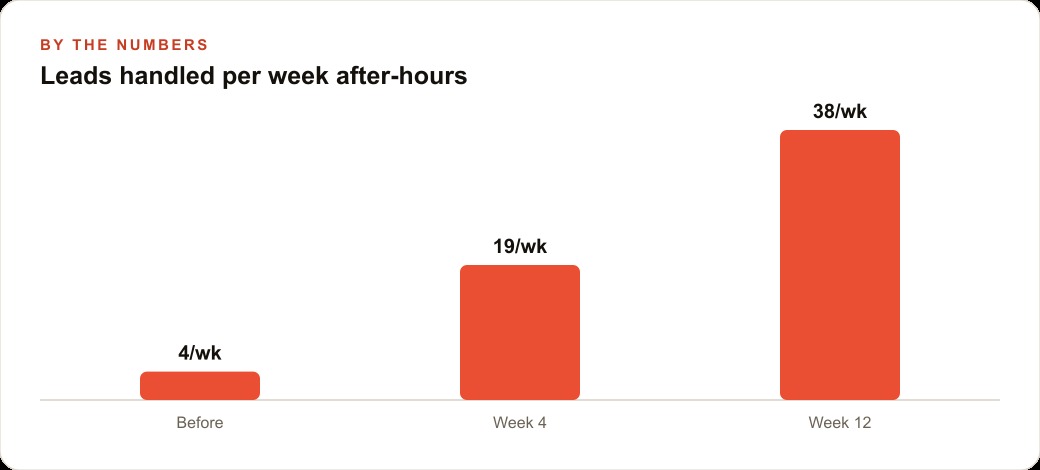
Here is what the numbers look like as a concrete illustration. A practice fielding 15 after-hours inquiries per week converts roughly 3 of them through next-morning voicemail callbacks, because the other 12 have already booked elsewhere or stopped looking by the time the office opens and someone returns the call. An agent that responds within 30 seconds of receiving the inquiry, confirms who the patient is and what they need, asks a few short triage questions to understand urgency, checks the live schedule through the calendar API, offers two or three available appointment times, and sends a confirmation text with an intake form link changes those numbers substantially.
A realistic conversion rate for instant, personalized response in this context lands at 8 to 10 of the same 15 inquiries. At an illustrative average first-visit value of $280, moving from 3 booked appointments to 9 from after-hours inquiries represents roughly $1,680 in additional revenue per week. The agent platform cost including the model API, the scheduling integration, and the communication tool runs in the range of $100 to $200 per month. The payback period is measured in days of operation rather than months of evaluation.
The setup requires exactly the three components the practice actually controls. The prompt defines the agent as the practice's after-hours scheduling assistant, establishes the tone consistent with how the team communicates, specifies what the agent can and cannot offer, and defines how to handle situations outside its authority such as questions about specific medications or guarantees about treatment outcomes. The knowledge base contains the practice's services, the accepted insurance plans, the provider profiles, the office policies, and the answers to the 20 most common patient questions. The tool connects to the scheduling system API so the agent checks real availability and creates real bookings rather than routing the patient back to a callback. Those three pieces, written carefully and tested on a handful of real interactions before going live, produce an agent that performs reliably from the first day and improves through iterative refinement of the prompt and knowledge base from real production feedback.
The skill gap around agents is real and growing in a direction that rewards early action. Research suggests that a majority of US work tasks can already be automated with existing technology, yet a small fraction of workers have taken meaningful AI training. Workers with practical agent-building skills are earning substantially more than those without them, and that premium is most visible at the business owner level in how much faster the business scales without adding headcount linearly to volume. Starting the agent capability now, while most competitors have not, is how that advantage accrues.
That is exactly what we do at AI DOERS. Book a private 30-minute call with Madhuranjan Kumar and we will map the fastest path to it for your specific business.
Book your call →
Madhuranjan Kumar
Madhuranjan Kumar brings 20 years of performance-marketing experience and has managed over $200 million in Facebook ad spend for brands across the United States and beyond. His expertise spans the full modern marketing stack: Meta, Google Ads, TikTok, email automation, CRM, and the websites that hold it together. At AI DOERS he turns that track record into lead-generation systems for businesses across every industry.