
What Google Announced at IO 2026 and Why the Search Overhaul Is Dividing People
Google IO 2026 shipped a cheaper Gemini model, a video editor that grounds clips in real facts, and a cloud agent that runs while your machine is off. The divisive move is turning search into an AI-first prompt box that may answer queries without ever sending a click to your store.

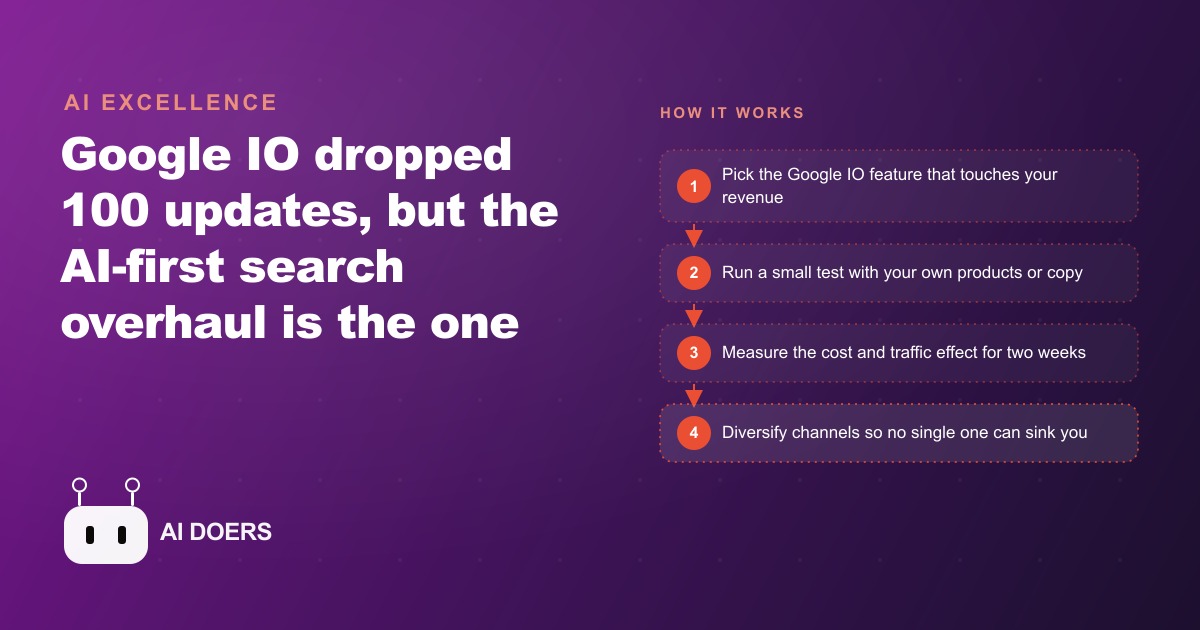
Google shipped over a hundred things at IO 2026, and one of them threatens your traffic
Google IO 2026 dropped more than a hundred announcements in a single keynote, and most of them are the kind of polish you forget within a month. I am Madhuranjan Kumar, and I read the whole list so you do not have to, then pulled out the ten changes that actually touch how a business gets found, gets built, and gets paid. The item everyone is arguing about is buried in the middle of the show. Google is quietly turning its search bar into an answer machine, and that single shift could decide whether the click that feeds your revenue keeps arriving. Here is the field guide, ranked by how much each announcement will change your week.
1. Gemini 3.5 Flash lands first and punches above its size
Google led with Gemini 3.5 Flash, a smaller and faster model, with the heavier 3.5 Pro promised for later. The surprising part is the quality. On general intelligence it lands right next to the top frontier models while running at more than double their speed. For a business, speed at that level of quality is not a spec-sheet curiosity. It is the difference between an assistant that answers a customer in one second and one that makes them wait five. When you are drafting product copy, summarizing tickets, or classifying inbound messages in bulk, a fast model that is also smart quietly removes the friction that used to make people abandon the tool.
2. The price cut is the real headline
Flash comes in at roughly 1.50 dollars per million input tokens and 9 dollars per million output tokens. That undercuts the leading rivals by a wide margin for comparable capability. Model pricing rarely gets a keynote clap, but it should get your attention, because it changes the math on every AI feature you run. Work you could not justify at frontier prices becomes trivial to run at scale. If you were rationing your AI usage to protect a budget, this is the announcement that lets you stop rationing.
3. Gemini Omni edits any video from a plain sentence
Gemini Omni takes video, image, text, or audio as input and outputs edited video from natural language instructions. The team described it as this breakdown equivalent of the popular image editors, with character consistency preserved across the clip. Say what you want changed and the model changes it. For anyone who has paid for a video editor or waited three days for a small revision, this collapses a slow, expensive step into a conversation. Marketing teams that live and die on creative volume will feel this first.
4. Omni grounds its videos in real research
Here is the part that separates Omni from a novelty. Ask it for a claymation explainer of protein folding and it researches the topic, then bakes accurate facts into the clip rather than inventing them. It can even add your own avatar from a quick selfie video. Grounded generation is the feature that makes AI video usable for education, onboarding, and product explainers, where a confidently wrong fact would embarrass you. The visuals were never the hard part. Truth was, and Omni takes a real swing at it.
5. Spark is a cloud agent that runs while your machine is off
Gemini Spark is Google's cloud agent that keeps working even when your computer is asleep. It connects to Gmail, Calendar, and Drive, runs recurring jobs on Google's own servers, and books things through connectors. This is the shift from a chatbot you talk to into a worker that carries tasks on its own schedule. Weekly reports, follow-up sequences, and standing errands can live on the server instead of on your to-do list. The value is not intelligence here. It is persistence, the ability to keep working without a human babysitting the session.
6. Spark asks before it acts, and that is the point
The DeepMind team stressed that Spark asks permission before it sends an external email or takes any action that touches the outside world. That permission gate is a deliberate design choice, not an afterthought. Anyone who has watched an eager agent do the wrong thing at full speed understands why this matters. A worker that pauses at the threshold of anything irreversible is a worker you can actually trust with real accounts. Keep those gates on and an autonomous agent becomes a safe employee rather than a liability.
7. Search becomes a prompt box, and this is the divisive one
Google search is turning into a long prompt box that puts you in AI mode by default. It writes a direct answer at the top, sometimes with interactive code baked into the response, like a draggable visual generated on the spot. The controversy is where those answers come from. The model summarizes content it scraped from blogs, guides, and product pages across the web. When the answer is good enough, the visitor never clicks through to the site that supplied it. Publishers and store owners rely on that click for sales, ad income, and signups. Remove the click and you remove the reason to publish, and over time the content Google draws from starts to dry up. This is the announcement to take personally.
8. Universal Cart tries to own the whole checkout
Google's Universal Cart lets a shopper add products from any store into one basket and check out a single time. It flags price drops and even warns when two parts, like a CPU and a motherboard, are incompatible. Convenient for buyers, and a quiet threat to merchants, because it puts Google between you and the moment of sale. If checkout increasingly happens inside Google's surface, your relationship with the customer thins out. This is worth watching closely if you sell physical products online.
9. Anti-gravity 2.0 chases the coding agents
Google relaunched its anti-gravity IDE, and it now looks nearly identical to the leading AI coding products from its rivals. Almost every Google tool can now stand up a full website from a prompt. For a small business, this is good news wrapped in a warning. Building simple software has never been cheaper, but the same collapse in cost means your competitors can spin up tools and pages just as fast. The moat is no longer who can build. It is who knows what to build.
10. SynthID becomes an industry standard
Google's SynthID embeds invisible signals into AI-generated content, and competitors including OpenAI and Eleven Labs are adopting it. Drag a file into Gemini and it tells you whether AI made it. A shared watermark standard is boring and important at the same time. It hints at a near future where provenance is checkable by default, which matters for anyone whose brand depends on trust. Knowing what is synthetic will become table stakes, not a nice extra.
The move to make for a local e-commerce store
Ten announcements are noise until you connect them to one business, so picture a shop that sells home and kitchen goods and gets most of its visitors from searches like best cast iron pan for a small kitchen. If AI answers that question directly and lists a few products inside the result, fewer people reach the store's own buying guide, and the store loses the click it used to convert. Suppose that guide currently sends 1,200 visitors a month and 3 percent buy at an average order of 60 dollars, which is 36 sales and about 2,160 dollars. If the AI overview shaves even 40 percent off that traffic, the store quietly loses roughly 860 dollars a month from one page, and it may never notice why.
Here is how I would respond. First, I would use a cheap fast model like Flash to write and refresh dozens of product descriptions and short buying guides quickly, so the catalog stays deep and useful even as individual pages lose clicks. That same content foundation also feeds SEO and organic search without any extra work, so the effort pays off in more than one place. Second, I would lean into channels Google does not control. An email list, a loyalty program, and a small social following mean a real chunk of sales arrives without any search at all, and those buyers land in the CRM and website stack where follow-up automation handles the next few touches. Third, when search traffic softens, paid distribution is how you replace it on demand, and a tightened set of Facebook and Instagram ad campaigns can put your product in front of the exact buyer who used to find you through a Google guide. Fourth, I would stand up a careful cloud agent to send weekly restock reminders and abandoned-cart follow-ups, with a human approving anything that reaches a customer.
The pattern hiding under all ten announcements
Step back from the individual features and a single pattern runs through the whole keynote. Google is pushing intelligence into the exact points where a business used to have leverage. Search was leverage, because ranking for a query meant a stream of free visitors. Now the answer sits above the link. Checkout was leverage, because the cart lived on your store. Now Universal Cart wants to hold it. Building was leverage, because a custom tool took skill. Now a prompt stands up a site. Every one of these announcements moves a little more power from the individual business to the platform in the middle.
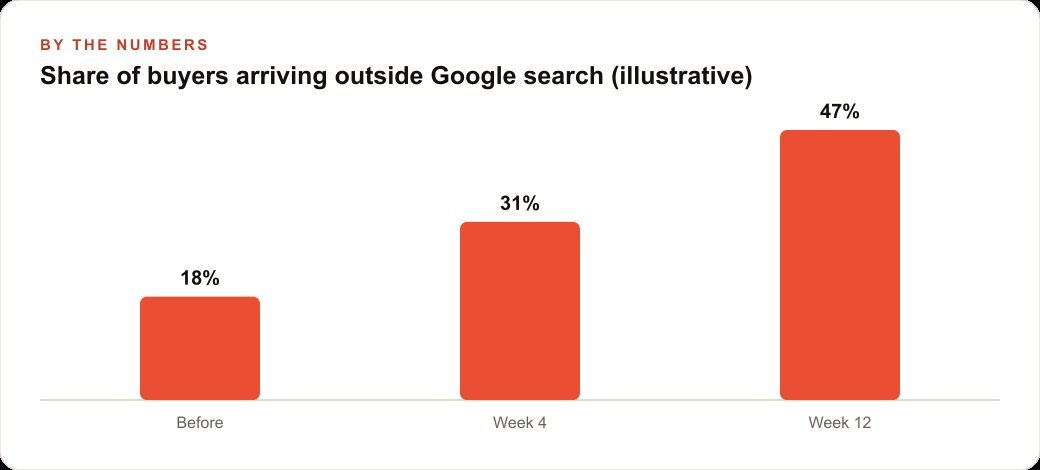
That is not a reason to panic, but it is a reason to think about ownership. The assets a platform cannot take away are the ones you should be building right now: a direct relationship with your customers, a list you control, a brand people search for by name rather than by category. When Google answers best cast iron pan for a small kitchen without a click, the store that already has ten thousand email subscribers barely notices, while the store that lived entirely on that query loses its month. The announcements are a forecast, and the forecast rewards owners who spread their bets before they have to.
Running the numbers a little further
Let me extend the store example so the stakes are concrete. Say that one buying-guide page was part of a site earning 8,000 visits a month across a dozen such pages, converting at 3 percent to an average order of 60 dollars, which is roughly 240 orders and about 14,400 dollars in monthly revenue tied to search discovery. If AI overviews trim organic click-through by even a quarter across those pages over a year, that is 60 orders and around 3,600 dollars a month quietly gone, or more than 43,000 dollars across the year, from a change the owner never approved and may not even see in a single dashboard.
Now put the diversification response next to that loss. Growing an email list to the point where it drives 20 percent of sales, tightening a set of paid campaigns that can be turned up on demand, and keeping the catalog deep with cheap fast-model copy do not just recover the lost orders. They make the business less fragile the next time a platform changes the rules, which, if IO 2026 is any guide, will be soon. The features are exciting. The strategy is boring on purpose, because boring is what survives the next keynote.
The through-line
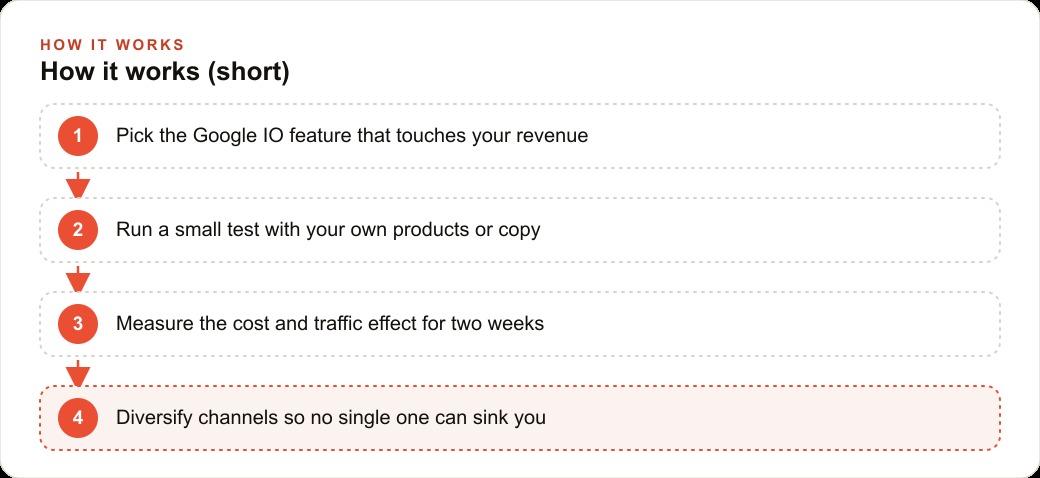
Most of what Google announced is a gift. Cheaper intelligence, faster video, agents that work while you sleep. The search change is the exception, and it is the one that rewards owners who diversify early. Map where your customers come from today, run a two-week test with the cheap model on real copy, grow the one channel you do not own enough, and put guardrails on any agent before you trust it. You can do all of this yourself with patience and a few honest tests. If you would rather have someone map your channels, wire up the models and the guardrails, and protect your store from a search shift that is moving faster than most owners expect, that is exactly the kind of work an expert can take off your plate.
That is exactly what we do at AI DOERS. Book a private 30-minute call with Madhuranjan Kumar and we will map the fastest path to it for your specific business.
Book your call →
Madhuranjan Kumar
Madhuranjan Kumar brings 20 years of performance-marketing experience and has managed over $200 million in Facebook ad spend for brands across the United States and beyond. His expertise spans the full modern marketing stack: Meta, Google Ads, TikTok, email automation, CRM, and the websites that hold it together. At AI DOERS he turns that track record into lead-generation systems for businesses across every industry.