
What China's Cheap, Open AI Race Means for Your Small Business
The fight between the two biggest AI powers has a quiet winner, and it is the small business owner. Here is why cheaper, more open models matter to you, and how I would put them to work.

A lean model trained in China on a fraction of the usual budget just matched systems that cost hundreds of times more to build, and it was released openly for anyone to download. That single fact tells you more about the next two years of small business software than any keynote from a trillion-dollar lab.
The headline everyone reads is about a superpower rivalry, two countries pouring staggering sums into artificial intelligence, one leading on chips and the other flooding the world with free software. The story that actually matters to a plumber, a clinic, or a five-person agency is the side effect of that fight. When two giants compete this hard, the price of capable tools falls every quarter, and a growing share of that capability is being handed out for free. The competition at the top is quietly re-pricing the tools at the bottom, and the people best positioned to benefit are the small owners who were priced out until now.
The news is not the rivalry, it is the price collapse
For years the assumption was that the best AI would stay expensive and locked behind the biggest companies, the way enterprise software always has. That assumption is breaking in public. A model built on a modest budget scoring alongside the flagship systems is not a curiosity; it is proof that raw spending is no longer the only path to strong results. Efficiency caught up. And once someone shows that a cheaper approach works, everyone else is forced to match the price or explain why their tool costs ten times more for the same output.
The second half of the news is openness. When a strong model is released with its weights available for anyone to run, the gatekeeper disappears. The software stops being a luxury that only a large firm can license and becomes something a local business can run on ordinary hardware or rent by the hour for pennies. That is the shift that changes the ground under a small owner's feet. It is not that AI got slightly cheaper. It is that the floor fell out of the price of the intelligence itself.
Who this actually changes things for
The winners are not the enterprises. They already had budgets for expensive tools and teams to run them. The winners are the businesses that were locked out. A solo founder who could never justify a five-figure software contract can now run capable AI for the cost of a lunch. A local shop that competed against national chains with far bigger tech budgets suddenly has access to the same category of tool. The gap in capability that used to separate a large enterprise from a small shop is closing, and it is closing fastest for the people who move first.
There is a useful parallel in how markets have played out before. Local brands routinely caught up to imported ones once the underlying technology became cheap and widely available. The same pattern is arriving in software. A small business does not need an enterprise platform with a dedicated account manager. It needs one cheap, reliable tool pointed at one real problem, and that is now firmly within reach. The hardware race and the robot factories making headlines are signposts for where repetitive work is heading, and the direction is clear: routine tasks move to software, and the teams that hand them over early get to punch above their weight.
Why cheap and open beats big and branded for a small operator
There is a temptation to chase the flashiest, most talked-about model, the one with the biggest marketing budget behind it. For a small business that is usually the wrong instinct. The most expensive tool is rarely the one that fits your specific chore best, and the difference between the top model and a solid cheaper one is often invisible for ordinary tasks like drafting replies, summarizing documents, sorting leads, or writing product descriptions. Value, not hype, is the metric that matters. The owner who picks one dependable tool and actually puts it to work will beat the owner who subscribes to the premium option and never wires it into anything real.
Open models add a second advantage beyond price: control. When you can run the software yourself or on a host of your choosing, you are not exposed to a single vendor raising prices, changing terms, or cutting off access. For a business that wants to build a repeatable process on top of AI, that stability is worth as much as the low cost. You are building on a foundation you can actually keep rather than renting one that might be taken away.
The hardware and software split works in your favor
It helps to understand why this is happening rather than just that it is. The AI world has split into two layers. One layer is the physical hardware, the specialized chips that train and run these models, and that layer stays expensive and concentrated in a few hands. The other layer is the software, the models themselves, and that layer is being commoditized fast by open releases and fierce competition. For a small business, the good news is that you never touch the expensive layer. You do not buy chips. You rent capability by the hour or run a downloaded model, and it is precisely the cheap, commoditized layer that you consume.
That split is why the price you pay keeps dropping even as the underlying technology gets more advanced and more expensive to build. The companies fighting the hardware race absorb the enormous costs, and the competition between them pushes the useful output, the software you actually use, toward free. It is one of the rare situations where a giant, capital-intensive arms race directly lowers the bill for the smallest players. You are getting the benefit of billions in spending without paying for any of it, which is a strange and genuinely favorable position to be in. The right response to a favorable position is to use it, not to admire it from the sidelines.
The concrete move: start with the one task that eats your week
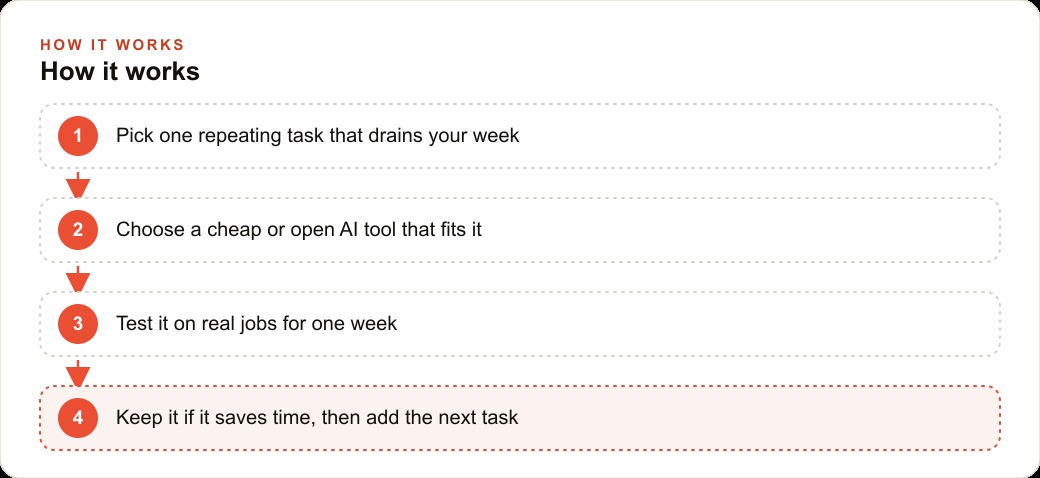
The mistake to avoid is trying to adopt everything at once. The falling price of AI does not mean you should bolt it onto every corner of your business this month. It means you should take the single most painful, repetitive task, the one that quietly eats hours every week, and hand that one chore to a cheap or open AI tool first. Prove it on real work for one week. If it saves time, keep it and move to the next task. If it does not, you have lost almost nothing, because the tool cost almost nothing.
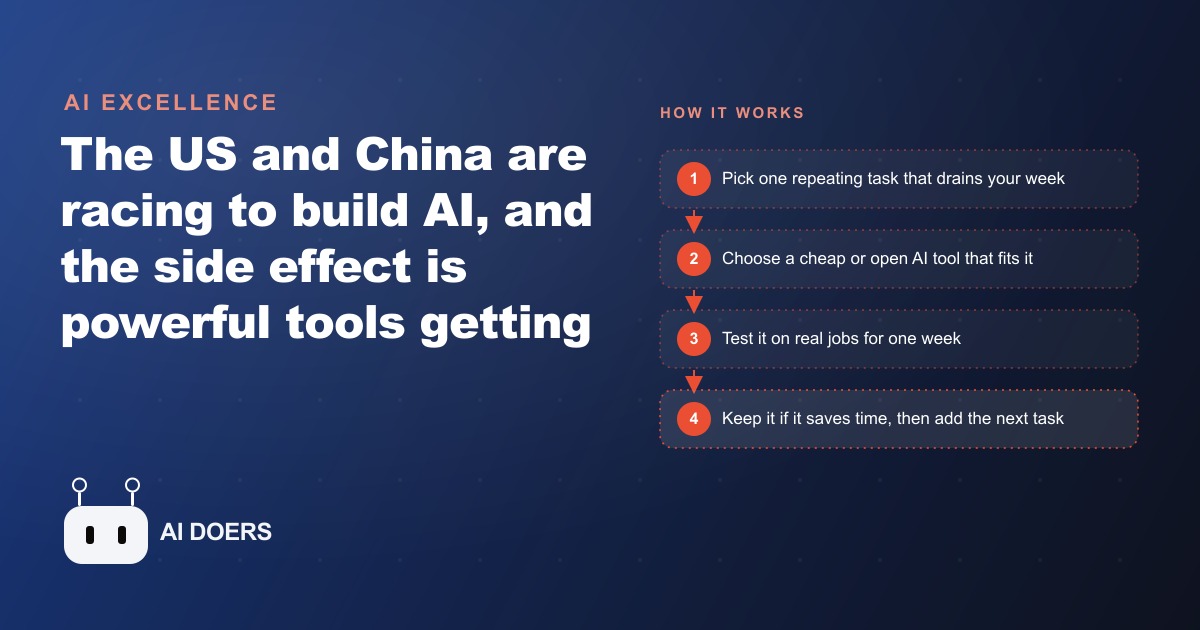
The sequence is deliberately simple. Pick one repeating task that drains your week. Choose a cheap or open AI tool that fits it. Test it on real jobs for one week, not on made-up examples. Keep it if it saves time, then add the next task. That loop is how a small team compounds an advantage without ever making a risky bet. Each validated tool is a permanent reduction in the hours you spend on work that does not need you, and those recovered hours go back into selling, quality, and the relationships only you can handle.
Where this connects to growth is direct. The hours you claw back are the hours you can spend making your marketing actually work. A business that automates its routine admin has the time and the margin to run Facebook and Instagram ad campaigns properly, and the cheaper its tooling, the more of every advertising dollar reaches the customer instead of the software vendor. That same content and copy capability, once you have it running cheaply in-house, also feeds SEO and organic search without any extra spend, so one low-cost tool ends up serving two channels at once.
A worked example: a small accounting firm and a cheap model
Consider a three-person accounting practice that spends the first hour of every morning turning messy client emails into structured notes and to-do items. The staff accountant handles it by hand, roughly five hours a week across the two of them, and it is exactly the kind of dull, high-volume text work that a capable model does well. Before, automating this would have meant a costly custom build or an enterprise contract that made no sense at their size, so they never bothered.
With cheap and open models, the calculation flips. They pick one affordable tool, point it at the single task of reading each client email and drafting a structured summary with action items, and test it for a week on real messages. The first version is rough and misses a few edge cases, so they refine the instructions until it handles their common client types reliably. Setup took an afternoon. The running cost is a few dollars a week, since text summarization is one of the cheapest things these models do.
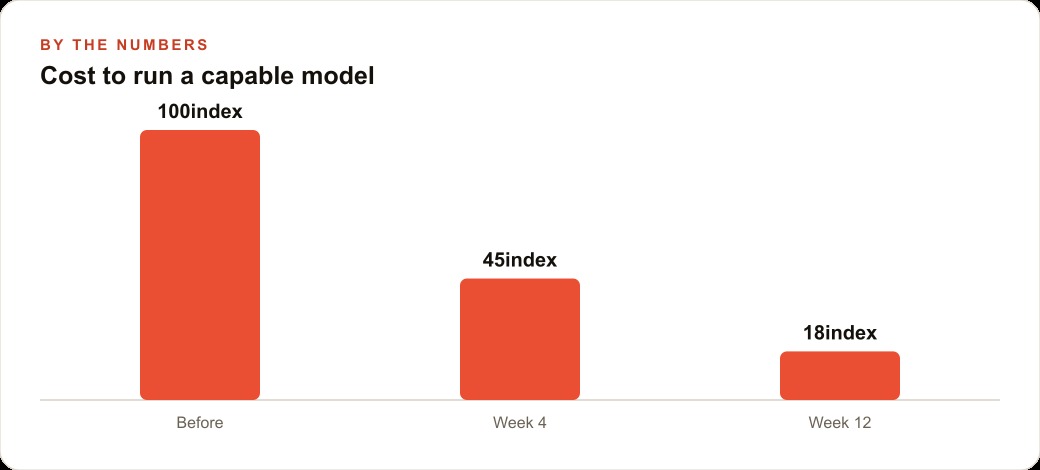
The illustrative payoff is straightforward. The morning intake drops from five hours a week to under one, because the accountants now review and correct a draft rather than writing it from scratch. Call that four hours a week recovered, roughly two hundred hours over a year. Valued at a loaded rate of fifty dollars an hour, that is on the order of ten thousand dollars of capacity returned for an afternoon of setup and a running cost that rounds to nothing. The index cost of running a capable model for their needs kept falling over the same period, so the tool got cheaper even as it got more useful. Crucially, they did not try to automate the whole firm. They automated one chore, proved it, and only then looked at the next one.
The firm also fed the same summaries into their CRM and website stack, so that every client interaction landed in one place and follow-up reminders fired automatically. The tool they adopted to save an hour a morning quietly improved their client retention too, because nothing slipped through the cracks anymore. That is the compounding effect of starting small: a single cheap tool, wired into the systems you already run, pays off in more than one place.
The mistakes that waste the opportunity
The first mistake is waiting for the price to fall further. It will keep falling, but every quarter you wait is a quarter your competitor spends building an advantage. The tools are already cheap enough and good enough to pay for themselves in the first week of use. There is no prize for adopting last.
The second mistake is over-buying. Because the flashy models have the loudest marketing, owners often subscribe to the premium tier and then use a fraction of it. Match the tool to the task. For most small business chores, a cheap or open model does everything you need, and the money saved is money that can go into reaching more customers instead of into unused software features.
The third mistake is treating AI as a replacement for people rather than a way to free them. The tools that pay off are the ones that take a four-hour manual grind and turn it into a twenty-minute reviewed workflow, letting your team do the work only they can do. Aim to augment, not to eliminate, and the adoption sticks because your people are relieved rather than threatened.
The bottom line for an owner watching from the outside
The superpower race will keep generating dramatic headlines about chips, robots, and national strategy. Underneath the drama, the practical result for a small business is simple and good: capable AI keeps getting cheaper and more open, and the gatekeepers that kept it out of reach are losing their grip. You do not need the most expensive tool or the biggest platform. You need to pick one painful task, hand it to one cheap tool, prove it on a week of real work, and then do it again.
You can run this yourself, and the whole point of cheap, open tools is that you can. If you would rather have someone choose the right tool for your specific workflow, wire it in, and connect the time you save directly to more leads and bookings, that is the kind of setup worth a focused conversation. But the move itself is available to you today, at a price that would have been unthinkable a year ago, and the owners who take it are the ones who will look oversized for their team a year from now.
That is exactly what we do at AI DOERS. Book a private 30-minute call with Madhuranjan Kumar and we will map the fastest path to it for your specific business.
Book your call →
Madhuranjan Kumar
Madhuranjan Kumar brings 20 years of performance-marketing experience and has managed over $200 million in Facebook ad spend for brands across the United States and beyond. His expertise spans the full modern marketing stack: Meta, Google Ads, TikTok, email automation, CRM, and the websites that hold it together. At AI DOERS he turns that track record into lead-generation systems for businesses across every industry.