
What Cheaper, Bigger AI Means for Small Businesses
The industry is racing to build far more AI computing power, even eyeing solar data centers in space. As supply grows, prices fall, and powerful tools keep reaching small businesses.

The buildout that just crossed into science fiction
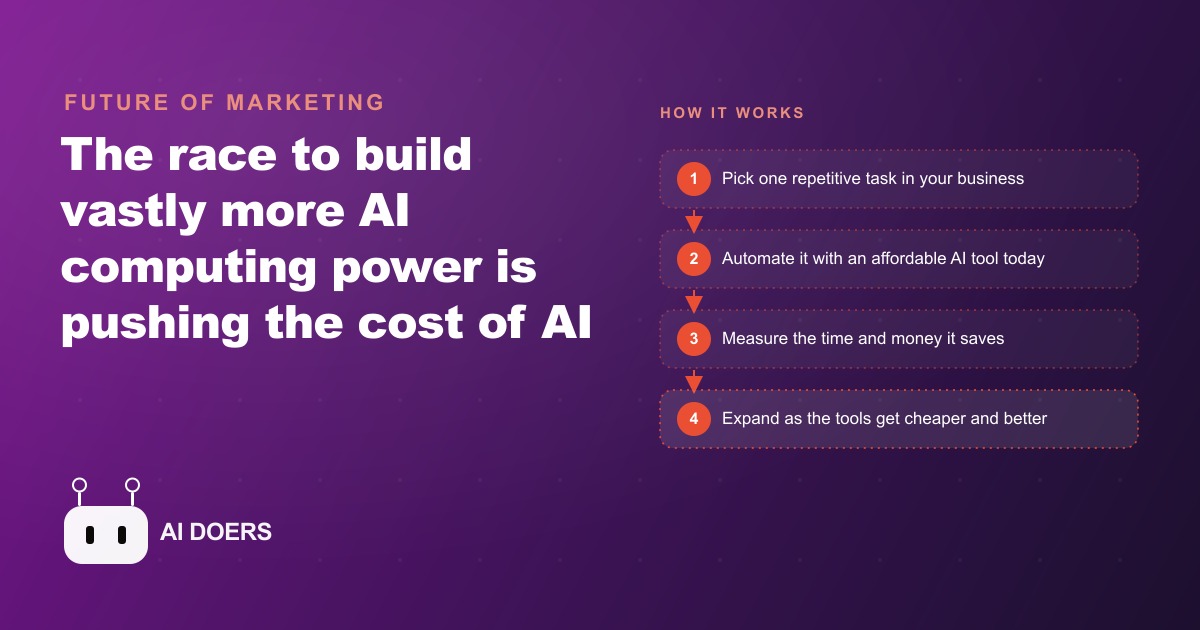
The number that should stop a small business owner in their tracks is not a price, it is a plan. The industry is now racing to build so much AI computing power that some of the biggest players are seriously studying solar powered data centers in orbit, where panels collect many times more energy than they would on the ground and the sun barely sets. Whether or not those space based facilities ever launch on schedule, the fact that they are on the whiteboard tells you everything about the direction. A massive expansion of capacity is underway, and it is not slowing down.
That is the news. Here is why it lands on your desk and not just in a physics journal. Every previous computing wave followed the same arc. When the supply of a computing resource expands this aggressively and competition heats up, the cost per unit of work falls, and capability that used to be locked behind an enterprise budget becomes a cheap app anyone can open. It happened with storage, with internet bandwidth, and with raw computing itself. AI is walking the same path, only faster, which means the practical story for a small business is not the trillion dollar mergers or the orbital lasers. It is that the tool which felt borderline expensive last year is often routine and cheap this year.
Why the frontier race lowers your bill
It helps to separate two things the headlines constantly blur. The frontier labs spend fortunes pushing the absolute limits of what AI can do, and those efforts grab attention. But you do not run a business on the frontier. You run it on a capable, affordable model pointed at a real task, and the relationship between the two is what matters. The enormous investment aimed at the frontier is exactly what drags down the price of the mid tier tools you actually use, because the infrastructure, the competition, and the efficiency gains all flow downhill.
So when you read that a company is building tens of gigawatts of capacity, translate it in your head. That is not a story about a distant superintelligence. It is a supply announcement, and more supply means the next version of the ordinary assistant you can rent will cost less and do more. The mid tier tools keep improving every few months because the fight at the top forces everyone to become more efficient. The correct reaction to a giant infrastructure headline is not awe. It is a note to yourself that your operating costs for this stuff are about to keep dropping.
Cheaper AI lands hardest where budgets are tightest
This is the part that genuinely changes the competitive picture for small businesses, and it deserves to be said plainly. Falling AI costs help the owner with the smallest budget the most. The person who could never justify a full time marketer, a research assistant, or a data analyst can now rent a thin slice of each of those capabilities for a few dollars. The work that benefits is the repetitive, language heavy load that fills a small business owner's day: writing descriptions and posts, answering common questions, summarizing reviews and emails, drafting follow ups, and turning scattered notes into something usable.
For years the advantage in that kind of work belonged to whoever could afford to hire for it. That advantage is eroding. When the same capability costs a large company and a solo operator roughly the same few dollars, the gap that money used to buy shrinks. That is the real news buried under the space station talk. The playing field between a small shop and a big competitor is leveling on exactly the tasks that used to require a payroll. The owners who understand this stop asking whether they can afford AI and start asking which task to point it at first.
Do not wait for the tool to feel obvious
Here is the mistake I watch owners make, and it is worth naming because it is so natural. They decide to watch from the sidelines until the technology matures and feels safe and obvious. The problem is that by the time a tool feels obvious, the advantage of moving early is gone, because everyone is already using it. The value of cheap AI is not just the money it saves. It is the head start it hands to whoever builds the habit first.
The owners who benefit most are not the ones who picked the perfect model. They are the ones who built the workflow while it was still slightly awkward and slightly pricey, so that when the cost dropped, they already had the process in place to take full advantage. Cheap, abundant AI is not a single product launch you can circle on a calendar and wait for. It is a steady tide, and the smart move is to get your boat in the water now while the water is still coming in. Waiting for the perfect future model is how you end up adopting the same tools as everyone else, at the same time, with none of the lead.
The competitive window is narrow and closing
There is a temptation to read all of this as reassuring, as if falling costs mean everyone benefits equally and no one has to hurry. That reading is wrong, and it is worth correcting, because the same trend that helps you also helps every competitor you have. When AI gets cheaper, it gets cheaper for the shop across the street too. The advantage is not in having access, because access is becoming universal. The advantage is in the operational knowledge you build while the tools are still slightly awkward, the specific understanding of which tasks in your business respond well to automation and which do not.
That knowledge has a shelf life on the value it creates. Right now, a small business that has figured out how to turn reviews into social posts, answer repeat questions automatically, and summarize supplier emails is doing something most of its competitors have not gotten around to yet. That gap is where the extra margin lives. As the tools get more obvious and more of your competitors adopt them, the gap narrows, and the profit you were earning from moving first gets competed away. This is the ordinary life cycle of any business advantage, and AI is no exception to it. The window during which early adoption is genuinely differentiating is open now, and it will not stay open indefinitely.
So the falling cost curve is a double edged thing. It lowers the barrier for you, which is good, and it lowers the barrier for everyone, which is why sitting still is dangerous. The correct reading is not that cheap AI guarantees you a win. It is that cheap AI guarantees the tools will be available to everyone, and what you do with the head start decides whether you are the business setting the pace or the one scrambling to match it. The owners who treat the price drop as permission to relax will find, a year from now, that the advantage they could have captured has quietly moved to whoever started while it still felt slightly early and slightly expensive.
What this looks like for one restaurant
Consider a neighborhood restaurant, the kind of business that never had room in the budget for extra staff to handle the small stuff. Cheaper AI turns a stack of nagging chores into something a busy owner can actually keep up with. The assistant drafts menu descriptions that sound like the restaurant rather than a template. It answers the steady stream of repeat questions about hours, reservations, parking, and dietary options, so the phone rings less for things a guest could have learned in seconds. It takes the week's online reviews and turns the best ones into ready to post social content, and it summarizes long supplier emails down to the prices and dates that matter.
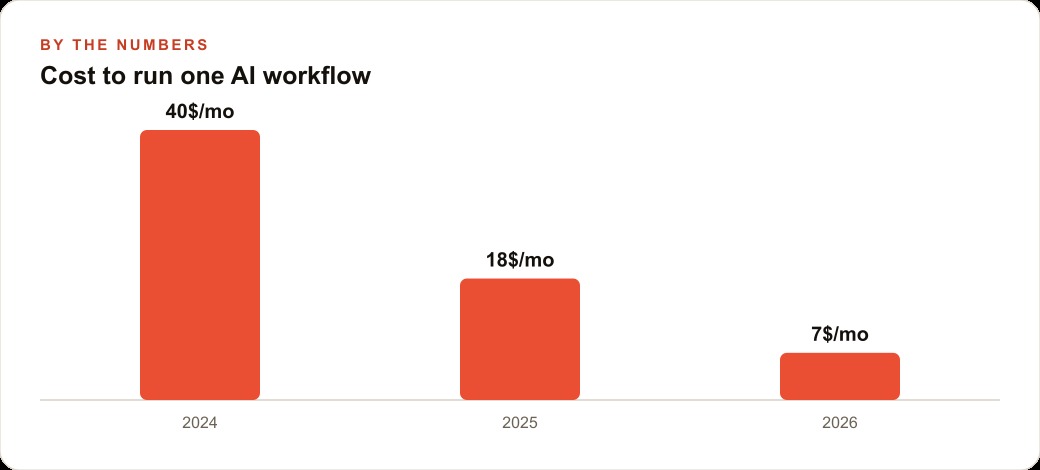
Put illustrative numbers on the payoff. Say the owner and a manager spend about eight hours a week between them on these tasks, and that time is worth roughly twenty five dollars an hour. That is two hundred dollars a week, more than ten thousand dollars a year, spent on work an affordable tool can carry most of. Recover even half and the restaurant frees hundreds of hours a year for guests and food. And notice the cost curve underneath. A workflow that ran near forty dollars a month a couple of years ago now runs closer to seven dollars a month for the same job, so the savings grow while the bill shrinks.
It helps to trace one of those chores all the way through to see how small the effort is against how real the payoff is. Take turning reviews into posts. Every week a handful of guests leave a glowing review somewhere, and every week those reviews sit there doing nothing because no one has time to reshape them into social content. An affordable assistant reads the week's reviews, pulls the two or three that land best, and drafts a post for each in the restaurant's voice, complete with a suggested caption. What used to be a task the owner meant to do and never got to becomes ten minutes of review and approval. Over a year that is roughly fifty posts the restaurant would otherwise never have published, each one built from a real customer's words, at a cost of a few dollars a month and almost none of the owner's attention.
None of this needs the most advanced model on the market, just an affordable one aimed at a clear task. The owner starts with a single chore, say turning reviews into posts, measures the time it saves, and adds the next one. That same content the assistant produces does double duty, because the descriptions and posts feed SEO and organic search with no extra effort, and if the restaurant runs Facebook and Instagram ad campaigns to fill slow nights, the creative is already written and on brand. As the tools get cheaper, the same setup quietly does more for the same money, which is exactly the point.
The move to make this month
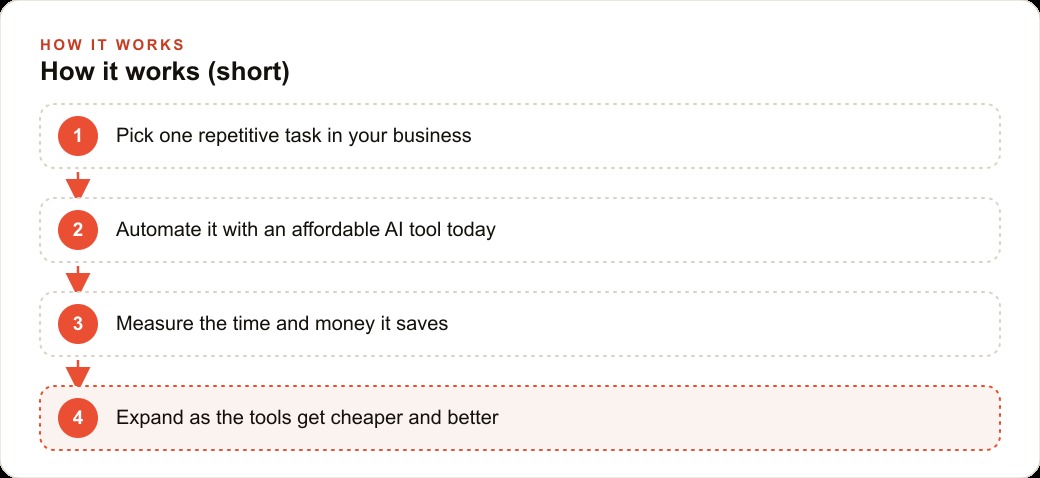
The instruction that follows from all of this is short. Pick one repetitive task, automate it with an affordable tool you can use today, and measure what it saves in hours and dollars. Resist the pull to wait for a perfect future model. Choose the chore that eats your time every week, put a capable, inexpensive tool on it now, and track the return. Once you trust it, expand to the next task. Build the habit while costs are still falling, because the owners who start now stack small advantages every month while their competitors wait for it to feel obvious.
For a small business, the smart place to route the leads and time you free up is a proper CRM and website stack, so that the hours AI gives back turn into faster follow up rather than just idle capacity. The technology will keep getting cheaper and stronger on its own, driven by a buildout so large it is reaching for orbit. Your job is simply to already be using it when the next price drop lands. You can start this yourself with one task and grow from there, or hand it to someone who will choose the right tools and build the workflow around your business so you can simply enjoy the time it gives back. The trend is not going to reverse, the tools are not going to get more expensive, and the competitors who move first are not going to wait for you to feel ready. The only variable you actually control is when you begin, and there has never been a cheaper or more forgiving moment to start than right now, while the tools are affordable and the advantage is still there to be taken.
That is exactly what we do at AI DOERS. Book a private 30-minute call with Madhuranjan Kumar and we will map the fastest path to it for your specific business.
Book your call →
Madhuranjan Kumar
Madhuranjan Kumar brings 20 years of performance-marketing experience and has managed over $200 million in Facebook ad spend for brands across the United States and beyond. His expertise spans the full modern marketing stack: Meta, Google Ads, TikTok, email automation, CRM, and the websites that hold it together. At AI DOERS he turns that track record into lead-generation systems for businesses across every industry.