
AI Just Cracked Unsolved Math: What It Means for Your Business Decisions
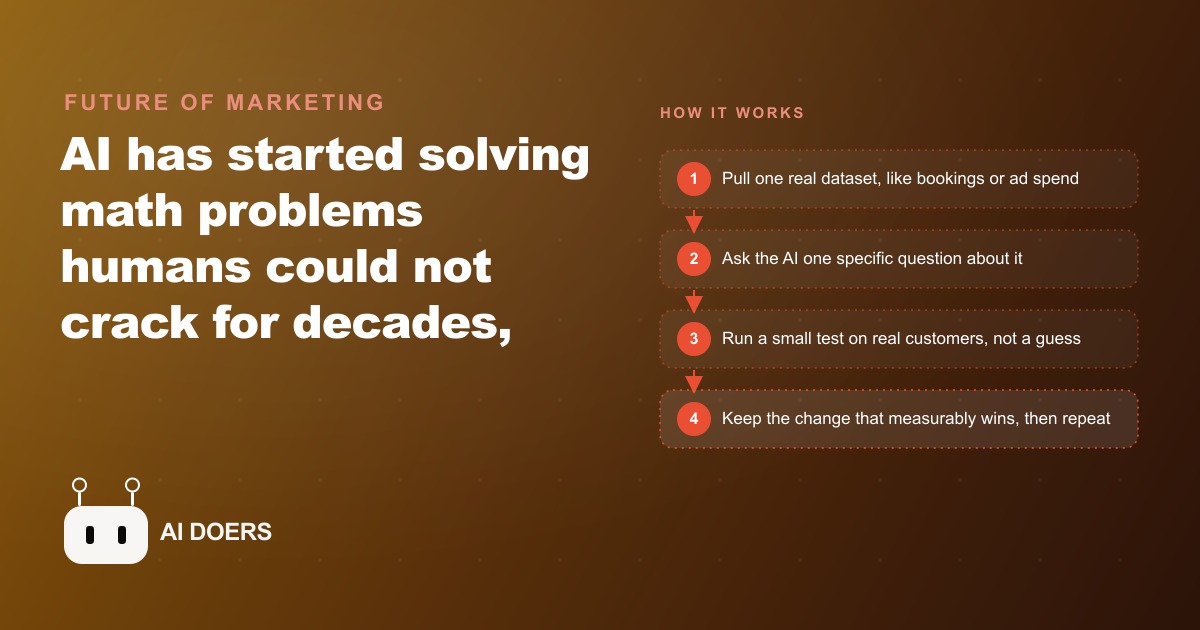
AI systems recently solved famous math problems that humans could not crack for decades. The practical takeaway for owners is simple: the same quantitative power can turn your gut decisions into measured, profitable ones.

Three months ago, the owner of a mid-sized med spa in a second-tier city sat down with a twelve-month spreadsheet of appointment bookings and ad spend and could not say what their average cost per Botox lead was. Not approximately. Not within a range. They genuinely did not know. They had been running Facebook and Google ads for fourteen months, spending between 4,000 and 6,500 dollars per month, and had never once pulled the numbers into a format that would let them see which channel was working.
This is not unusual. It is, in Madhuranjan's experience, the median state of a successful small medical aesthetics practice. Revenue is growing. The owner is busy. The ads are producing patients. Nobody has asked the hard question, which is whether the ads are producing patients efficiently.
What follows is an account of what happened when the owner finally asked.
Before the data pull: what the owner thought was true
The owner's working model was simple. Facebook ads brought in the cosmetic patients: Botox, facials, and the laser package. Google ads brought in people who were already searching for specific services. Both were necessary. The Facebook budget was higher because, as the owner put it, "that's where discovery happens." The laser package was the strongest performer "because people love the transformation photos."
None of this was invented. It was the owner's genuine read of the business after fourteen months of operation. It felt right. Revenue was growing. The practice had moved from two treatment rooms to four. A second aesthetician had joined the team.
The belief about the laser package was specific enough to test. The belief about Facebook versus Google was general enough that "both are working" could absorb almost any result. That combination of one specific belief and one general belief is where most data-blind businesses live. There is just enough specificity to feel informed and just enough vagueness to avoid being wrong.
AI recently solved famous open mathematical problems that had gone unsolved for decades, and the mathematicians who verified the proofs confirmed that the solutions were genuinely new approaches, not reformulations of existing paths. The relevance for business owners is the same principle that transformed finance, logistics, and advertising when mathematics arrived: when a field gets quantified, it gets transformed. Gut feel is a coin toss. AI as cheap intelligence that processes your actual data is the quantification tool that most small businesses now have access to and most are not using.
The reason gut feel is unreliable is not that the owner is wrong about the business. It is that the owner is right about what they observe directly and blind to what they do not observe directly. The owner of the med spa saw the laser package patients who came in for consultations. They saw the quality of the results. They heard the positive feedback at the end of appointments. What they did not see, because nobody assembled it in front of them, was the ratio between the patients who came in for consultations and the ad spend that produced each consultation. The missing view was not hidden. It was simply never pulled together. The data had always been there, in three separate systems, waiting for someone to ask the right question across all of them at the same time. That is exactly what AI makes cheap to do.
The first question they asked the AI
The owner's bookkeeper had been exporting monthly QuickBooks reports to Excel for two years. The booking software had an export function that nobody had ever used. The Facebook Ads Manager held campaign data going back fourteen months. The owner sat down with all three exports and asked a single question: which service has the lowest cost per booked appointment?
The AI walked through the three datasets, matched booking records to campaign periods using the date ranges in each export, and produced a simple table. Six service categories. Average cost per booked appointment for each one. The table took approximately four minutes to generate from the moment the files were uploaded.
The result was not what the owner expected.
What the spreadsheet actually showed
Botox had a cost per booked appointment of 38 dollars. Facials were at 29 dollars. The laser package, the one the owner believed was the "strongest performer," was at 91 dollars per booked appointment.
The laser package was more than three times more expensive per booking than the cheapest service in the lineup.
The owner's first response was skepticism. The laser package carried a higher price point, with packages typically running between 1,800 and 2,400 dollars, so a higher cost per booking might still be profitable. That was a reasonable objection. The next question was straightforward: what is the revenue per booked appointment for each service?
Botox average revenue per appointment: 340 dollars. Facials: 95 dollars. Laser package: 2,100 dollars.
The cost-to-revenue ratio told a clearer story. Botox was spending 11 cents to generate a dollar of revenue. Facials were spending 31 cents. The laser package was spending 4.3 cents. Suddenly the laser package looked like the business the owner had always believed it was, just not for the reason they had assumed. The efficiency was there, but the high cost per booking was masking it from anyone looking only at acquisition cost.
This changed the frame significantly. The "discovery happens on Facebook" belief was now testable in a more specific direction: which campaign was acquiring laser package patients, and at what cost?
The second question revealed the real problem.
There were two active Facebook ad campaigns running simultaneously. One used before-and-after transformation photos of completed laser treatments. The other used patient testimonial text with a single clean image of the treatment room. The owner had been running both for seven months. The transformation photo campaign was spending 2,800 dollars per month. The testimonial campaign was spending 1,400 dollars per month.
The laser package bookings attributed to the transformation campaign: 12 per month at an average cost per lead of 233 dollars.
The laser package bookings attributed to the testimonial campaign: 9 per month at an average cost per lead of 156 dollars.
The transformation campaign was spending twice as much money and producing bookings at a 50 percent higher cost per lead. The campaign the owner believed was the strongest performer, based on the intuitively compelling logic of "transformation photos for transformation services," was the weaker performer by every measurable dimension.
The test: two ad headlines, two weeks
The owner's instinct after seeing these numbers was to immediately cut the transformation campaign and double the testimonial budget. Madhuranjan's recommendation was to run a structured test first. Doubling a budget on seven months of data is reasonable. Cutting a budget without understanding why the numbers diverged carries the risk of misattribution. The transformation campaign might have been underperforming because of its creative approach, or it might have been hitting a saturated audience, or it might have been targeting a slightly different demographic segment. Without a test, cutting it would eliminate the budget allocation and the diagnostic information simultaneously.
The test was simple. For two weeks, both campaigns ran at their existing budgets. The only change was to the ad headlines. The transformation campaign received a new headline focused on "how long your results will last" rather than the visual outcome. The testimonial campaign received a new headline focused on "exactly what the first appointment feels like."
The hypothesis was straightforward: if the testimonial campaign was outperforming because of the trust signal in the format itself, swapping the transformation campaign to a process-clarity frame would move its numbers toward the testimonial baseline. If the transformation campaign was underperforming because of audience saturation, the headline change would have limited effect because the audience was already burned out on the creative regardless of what the headline said.
After two weeks: the transformation campaign with the new "how long your results will last" headline dropped cost per lead from 233 dollars to 198 dollars, a meaningful improvement of roughly 15 percent but still well above the testimonial campaign's baseline. The testimonial campaign with the "first appointment" headline dropped cost per lead from 156 dollars to 141 dollars, a smaller improvement in absolute terms but a confirmation that the format was the primary driver, not just the specific headline.
The gap had narrowed slightly but persisted across the full two-week window. The testimonial campaign was structurally more efficient for this audience regardless of which specific headline it carried.
Quarter-end: what the numbers said
The owner made two decisions based on the two-week test. First, the transformation campaign budget was cut from 2,800 dollars per month to 800 dollars per month, keeping it alive as a secondary test signal while removing the largest share of the inefficiency. Second, the testimonial campaign budget was raised from 1,400 dollars per month to 3,400 dollars per month.
Total ad spend stayed nearly flat at 4,200 dollars per month versus the previous combined total of roughly 4,200 dollars. The allocation shifted dramatically, but the overall investment level did not.
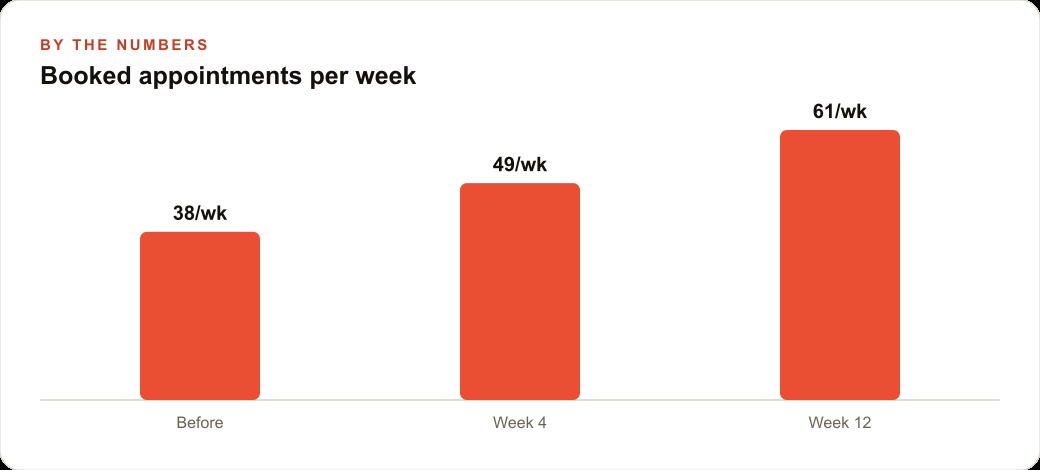
At quarter-end, twelve weeks after the reallocation, the results were clear. Laser package bookings had moved from 21 per month combined across both campaigns to 29 per month. Monthly revenue from the laser package had moved from approximately 44,100 dollars to 60,900 dollars. Cost per laser package booking had dropped from an average blended cost of 200 dollars to 145 dollars.
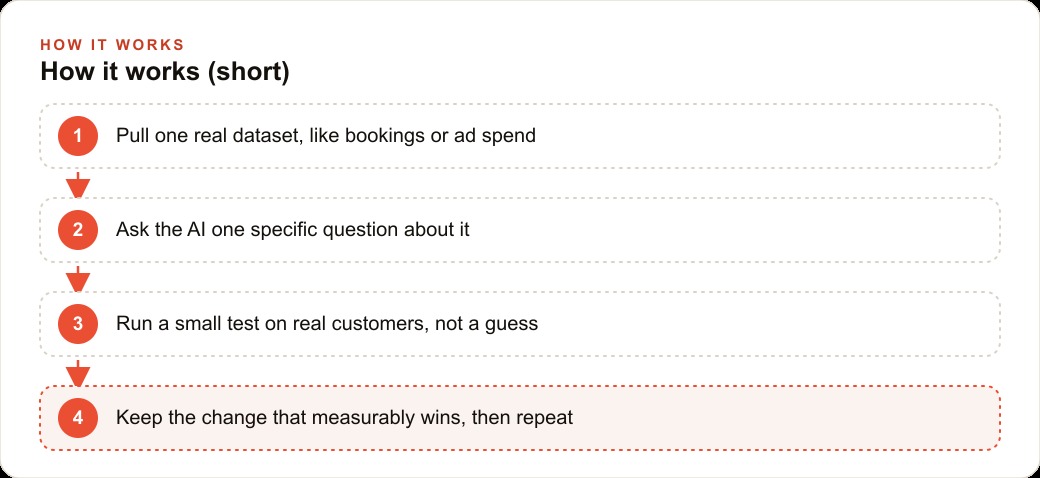
The no-left-turn insight is the right frame here. Delivery firms discovered that avoiding left turns across thousands of daily routes consistently saved time and fuel. Not because left turns are categorically wrong, but because when the data showed the aggregate cost of left turns across enough routes, the pattern was clear and the correction was simple. The med spa did not abandon transformation imagery because transformation is the wrong message for aesthetics services. It reallocated budget toward the format that consistently converted at lower cost for this audience, in this market, at this price point. The principle was the same: feed real operational data into a system that can see patterns across the whole dataset, ask a sharp question, and run a test on real customers before making a large commitment.
The owner had fourteen months of data sitting in three separate systems and had never looked at it in a way that produced an answerable question. The question "which service has the lowest cost per booked appointment" took four minutes to answer once the data was in one place. The follow-up question "which campaign is producing those bookings most efficiently" took another eight minutes. The two-week structured test took two weeks and cost nothing beyond the existing ad budget.
The result was worth, conservatively, 16,800 dollars per month in additional revenue from the laser package alone, at no increase in total ad spend.
Gut feel is a coin toss. The coin had been landing on the wrong side for fourteen months while the data sat available and unread in three systems the practice already paid for. The AI did not invent the insight. It read the existing data and returned a table. The table told the story that the data had always contained. The question that unlocked it was simple, specific, and asked of real numbers rather than assumed ones.
That is what it means to have cheap intelligence available to a small business in 2025. Not a replacement for the owner's judgment. A reader of the owner's data that the owner has been too busy to read themselves.
The pattern repeats across every category Madhuranjan has worked with closely. Plumbing companies with eighteen months of job-completion data who have never looked at which neighborhoods generate the most repeat calls. Law firms with years of billing records who have never identified which case types produce the highest realization rates versus the highest write-off rates. Marketing agencies with campaign data going back three years who have never compared the creative variables that appear in their top-performing ten percent versus their bottom-performing ten percent.
The data exists. It was collected as a byproduct of running the business. The question that unlocks it costs almost nothing to ask. The insight that comes back is specific to the real numbers, not to someone else's industry benchmark or general best practice. And the time required to go from raw exports to an actionable table is measured in minutes, not weeks. Every business already has the dataset. Very few are reading it.
That is exactly what we do at AI DOERS. Book a private 30-minute call with Madhuranjan Kumar and we will map the fastest path to it for your specific business.
Book your call →
Madhuranjan Kumar
Madhuranjan Kumar brings 20 years of performance-marketing experience and has managed over $200 million in Facebook ad spend for brands across the United States and beyond. His expertise spans the full modern marketing stack: Meta, Google Ads, TikTok, email automation, CRM, and the websites that hold it together. At AI DOERS he turns that track record into lead-generation systems for businesses across every industry.