
What Agentic AI Trading Actually Looks Like for Beginners
Agentic AI trading means giving an agent a clear goal, having it collect data through an API, build a model, and then run a long-running loop that monitors and adjusts on its own. The same goal, data, monitor, adjust pattern is the real lesson, and it powers far more than trading.

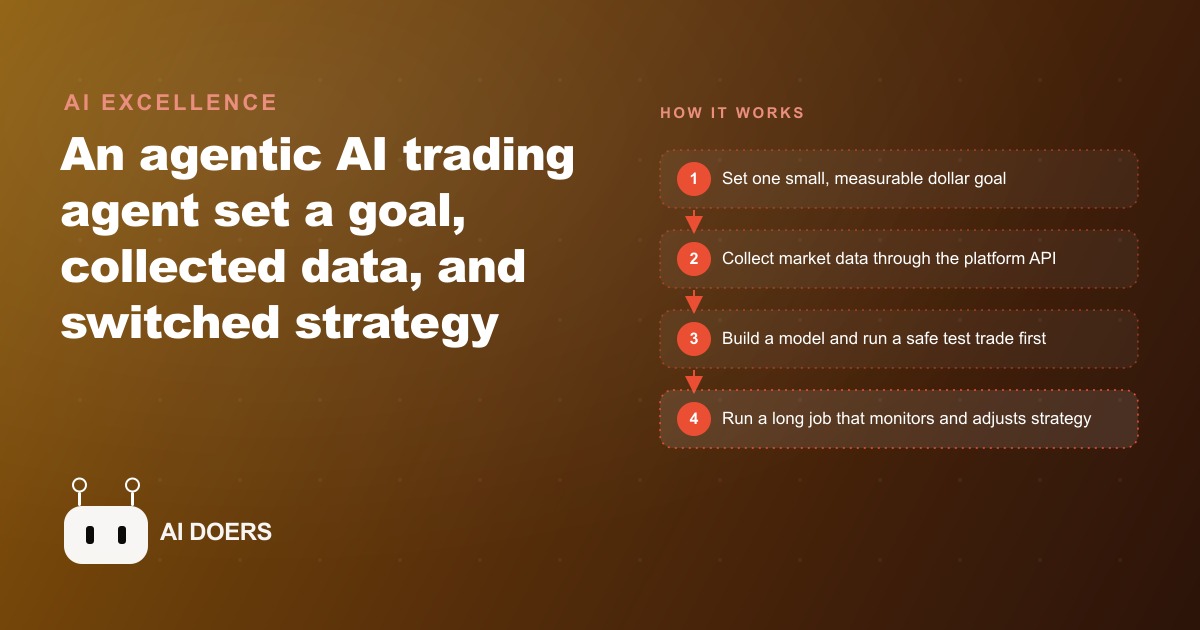
Fifty-six minutes, a $955 account, and a single stated goal: make ten dollars on Hyperliquid today. The agent collected market data, built a model, ran a test trade to confirm the plumbing worked, then launched a monitoring loop that checked every two minutes. When the market turned bullish mid-session and invalidated the original bearish thesis, the agent did not wait for new instructions. It identified the changed structure, abandoned the short basket, and switched to a pullback mean-reversion long. The account finished at approximately $962. The profit was modest. The pattern the session demonstrated is not.
I am Madhuranjan Kumar, and I want to be direct about why this trading experiment matters to a business owner who has no interest in crypto or prediction markets. The trading context is a teaching case, not a pitch to trade. The reason it is a useful teaching case is that the feedback is fast and unambiguous: a position either makes money or loses it, and that clarity tells you immediately whether the agent's decision loop is functioning correctly. Most business automations have slower, noisier feedback. Understanding the pattern through the faster-feedback context builds the intuition you need to apply it correctly in the slower-feedback business context.
A trading agent that switched strategy mid-session proves the monitor-and-adjust loop actually works
The most important thing that happened in this session was not the profit. It was the mid-session strategy switch. The agent started with a bearish outlook based on the data at session start. The market turned bullish during the session. The agent identified the discrepancy between its initial model and the actual market conditions, decided the original strategy was no longer valid, and proposed and executed a different strategy without being asked to do so.
That is the behavior that distinguishes an agentic loop from a simple automated rule. A static automation would have continued executing the original strategy regardless of market conditions, because it was programmed to run the original rule. The agent read its own logs, assessed the current state, identified the mismatch, and adjusted. That adaptive behavior is what a properly constructed monitor-and-adjust loop is supposed to produce, and seeing it happen inside a 56-minute live session is what makes this demo worth studying.
The platforms used here, Hyperliquid and Polymarket for crypto and prediction markets, and Robinhood for fiat access, are specifically chosen for beginner accessibility. Hyperliquid in particular does not require heavy identity verification and exposes a clean API for candles, order books, and funding rates, which is exactly the data feed a strategy model needs. The agent layer can be built with Codex or Claude Opus 4.8 for model construction, with Claude Code or Codex handling the harness that executes and monitors the strategy.
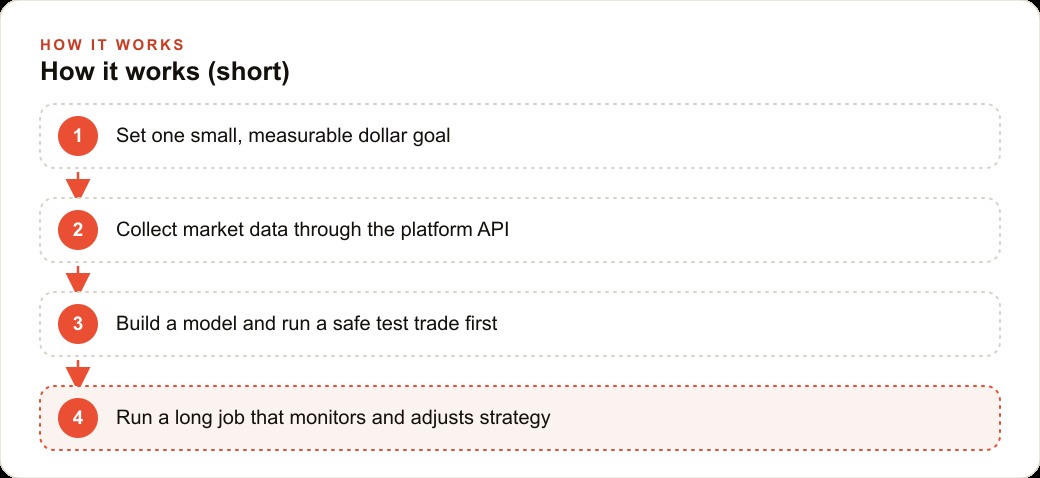
The goal, data, act, monitor, adjust pattern maps onto any business process with a measurable target
The five-step pattern is what transfers from the trading context to business operations. Every step maps cleanly.
The goal step requires that you state the target in a form that can be evaluated objectively. In the trading demo, the goal was to make ten dollars today on Hyperliquid. That is small, specific, and evaluable. In a business context, the goal might be to keep the cost per purchase across all active ad campaigns below a specific ceiling while spending the full daily budget. Or to ensure every new inquiry gets a response within ten minutes during business hours. Or to reorder a supply item when its stock level drops below a threshold. Each of these is evaluable, which means an agent can assess whether the current state satisfies the goal or not.
The data step requires collecting the right information through a structured API before the agent reasons about it. In the trading demo, this meant pulling recent price candles, order book depth, and funding rates from Hyperliquid. In a business context, it means pulling campaign performance metrics, inquiry timestamps, or inventory counts from the relevant system. The order here is critical and I want to say it plainly: data collection comes before model building. This is one of the most common sequencing mistakes in agent design, and I will address it specifically in the next section.
The act step executes the strategy the model proposes, after a test confirms the plumbing works. The monitor step runs a loop that checks at regular intervals, reads the results of previous checks from a log, and updates a status file. The adjust step identifies when current conditions deviate from the model's assumptions and proposes a corrective change. Those three steps running together, act, monitor, adjust, are what transforms a one-time model output into an ongoing autonomous operation.
If you are currently running Facebook and Instagram ad campaigns and manually checking dashboards throughout the day to decide where to shift budget, the same pattern describes what an agentic version of that workflow would do. The goal is a cost-per-purchase ceiling. The data is the live campaign performance. The model proposes bid and budget adjustments. The monitor loop runs every fifteen minutes. The adjust step reallocates spend from underperforming campaigns to overperforming ones before the daily window closes.
Data collection comes before model building, not after, and the order matters
One of the clearest lessons from the trading demo is the explicit sequencing of data collection as a first step before model building begins. The agent did not start by building a strategy and then look for data to support it. It started by pulling data, then asked the model to propose a strategy based on that data.
That order matters because of how language models reason. A model asked to build a trading strategy without fresh data will draw on its training knowledge, which may be months or years old and does not reflect the current market conditions. A model given structured, current data before being asked to reason will ground its conclusions in the actual state of the system it is reasoning about. The quality of the strategy the model proposes is directly proportional to the quality and currency of the data it receives.
The same principle applies to business automations. An agent asked to decide which ad campaigns to prioritize without access to today's performance data will reason from general principles rather than current facts. An agent given today's campaign metrics before being asked to propose adjustments will produce recommendations that reflect what is actually happening. Before you ask any agent to reason, give it the data it needs to reason correctly.
In the trading context, the data step used Hyperliquid's API to pull recent candles for price history, order book depth for current supply and demand, and funding rates for sentiment signals. The agent then asked the model to propose three candidate strategies from that data, ranked them, and ran the strongest. That specific step, asking for multiple candidate strategies and having the model rank them, is another pattern worth noting. It surfaces different strategic options and forces the model to evaluate its own ideas against each other before committing to one.
A test trade before any real run is the habit that makes this work safely
Before the agent ran any meaningful position, it placed a ten-dollar Bitcoin long, confirmed the position appeared correctly in the account, and exited. The entire test cost almost nothing and took minutes. The point was to confirm that every piece of the execution chain was functioning: the API connection to the platform, the order submission logic, the position confirmation read-back, and the exit logic.
This habit applies to every automated business process that takes a real action in the world, not just trading. Before deploying an agent that sends customer emails, send one test email to yourself and confirm it looks exactly right. Before deploying an agent that makes API calls to an ad platform to adjust bids, run one small adjustment on a low-stakes campaign and confirm it was applied correctly. Before deploying an agent that writes records to a database, write one test record and read it back.
Discovering a broken integration with a test action costs almost nothing. Discovering it after the agent has sent two hundred incorrect customer emails, applied the wrong bid to every active campaign, or written a corrupted record to a production database, is expensive and sometimes irreversible. The test step is not a precaution that slows you down. It is the habit that makes the real run safe enough to be worth running.
For Google Ads automations specifically, this habit is especially important because the platform applies changes in real time and campaign budgets can be depleted quickly if a bid-adjustment logic contains an error. A test adjustment on the smallest, lowest-spend campaign in the account before running the full automation confirms the logic is correct before it touches anything material.
The fast feedback of trading is what makes it the clearest classroom for learning the agentic loop
The reason to study this trading demo even if you have no interest in markets is that the feedback is unusually fast and unusually clear. A trading position produces a profit or loss signal within minutes to hours. That speed lets you evaluate the full goal, data, act, monitor, adjust cycle multiple times in a single session and identify exactly where the loop worked and where it did not.
Business automations have slower, noisier feedback. An ad optimization agent that adjusts bids throughout the day produces results you evaluate over days or weeks. A pricing agent that adjusts product prices based on demand signals takes time to show its effect on conversion rates. A lead routing agent that assigns incoming contacts to salespeople based on availability and fit takes time to show its effect on close rates. The patience required to evaluate business automations is longer, but the underlying loop structure is identical to the trading loop.
The value of understanding it in the faster-feedback context is the intuition it builds for designing the loop correctly. After watching a monitor-and-adjust loop complete several iterations within a single session, the sequencing becomes natural: you understand why data collection must come before model building, why the test action matters, why the monitoring interval needs to be short enough to catch meaningful changes but not so short that it produces unnecessary API calls, and why the log-reading step is what allows the agent to accumulate knowledge across iterations rather than starting fresh each time.
How the same pattern runs for an e-commerce store optimizing ad spend
Let me make this concrete with an e-commerce store spending roughly $400 per day across eight active campaigns on Meta and Google.
The goal: keep the blended cost per purchase across all campaigns below $28 while spending at least 90 percent of the daily budget by 10pm.
The data step runs at 7am, 10am, 1pm, 4pm, 7pm, and 9pm, pulling six data points per campaign: spend so far today, number of purchases, cost per purchase, remaining daily budget, current bid, and the campaign's seven-day average cost per purchase. Those six numbers per campaign give the model a complete picture of both the current day's performance and the historical baseline.
The model reviews the data at each check and proposes one of four actions per campaign: hold (performance is within range, no change needed), reduce bid by 10 percent (cost per purchase is trending high), increase budget by 15 percent (performance is strong and headroom remains), or pause (cost per purchase has exceeded $45 and shows no sign of improving). The agent applies the proposals through the platform API.
The monitoring loop records every proposal and every action in a log file. At each subsequent check, the model reads the log before proposing the next action, so it knows what it already tried and what the results were. When a campaign that received a bid reduction in the 10am check is still trending above target at the 1pm check, the model proposes a more aggressive reduction rather than repeating the same intervention that did not work. That log-reading behavior is the direct equivalent of the trading agent reading its own logs between checks and is what makes the loop adaptive rather than mechanical.
By 9pm, the store has typically moved budget from the two or three highest-cost campaigns to the two or three strongest, spent more than 90 percent of the daily budget, and kept the blended cost per purchase within range of the $28 target. The owner reviews the log summary in the evening rather than watching dashboards throughout the day.
The token cost for running this loop six times per day across eight campaigns is modest, well under five dollars at current rates. The value recovered is the four to six hours of manual dashboard attention the owner would otherwise spend, and the better spending distribution that results from catching drift within hours rather than at the end of the day.
What this pattern costs to build and what it returns
Building a monitoring loop for a specific business process takes between a few hours and a few days depending on the complexity of the data connections and the number of cases the adjustment logic needs to handle. The API access to the platforms involved is typically already available if you are actively using those platforms. The token cost to run the loop is low because each check involves a focused, bounded task rather than open-ended generation.
The return sits in three places. The first is direct cost reduction from better decisions made faster, which in the ad spend example shows up as lower cost per purchase and less wasted spend at the end of the day. The second is recovered attention, the staff time that was previously going to manual dashboard checks and now goes to higher-value work. The third is the reduction in decision lag, the gap between when conditions change and when the response is made, which in a competitive ad auction matters because the store that adjusts faster captures margin the slower-adjusting competitor misses.
If you want to understand how to apply this pattern to your specific business process through SEO and organic search content or through paid channels, or want someone to build and configure the monitoring loop end to end, that is the work I do. The pattern is simple to describe and benefits substantially from experience to implement correctly.
That is exactly what we do at AI DOERS. Book a private 30-minute call with Madhuranjan Kumar and we will map the fastest path to it for your specific business.
Book your call →
Madhuranjan Kumar
Madhuranjan Kumar brings 20 years of performance-marketing experience and has managed over $200 million in Facebook ad spend for brands across the United States and beyond. His expertise spans the full modern marketing stack: Meta, Google Ads, TikTok, email automation, CRM, and the websites that hold it together. At AI DOERS he turns that track record into lead-generation systems for businesses across every industry.