
What a Near-Million-Subscriber AI Channel Actually Earns, and the Workflow Behind It
A nearly one-million-subscriber AI channel earns roughly 6,000 to 7,000 dollars a month from AdSense, with sponsorships earning more, but the durable value is the production and automation workflow that lets one person run the whole operation.


The number everyone wanted was a little over six thousand dollars in twenty-eight days. That is what a nearly one-million-subscriber AI channel earned from ad revenue in a rare open accounting of its own books, and it is almost the least interesting fact in the whole story. I am Madhuranjan Kumar, and I have watched plenty of creators and business owners chase that figure as if it were the prize. It is not. The prize is the machine sitting behind it: a one-person operation that ships polished, sponsor-worthy video week after week without a team, because nearly every repetitive step has been quietly handed to a tool. The money is the output. The system is the asset. Copy the money and you get nothing. Copy the system and you get a business.
The dollar figure is a decoy
When people see six to seven thousand dollars a month from ad revenue, they draw the wrong conclusion. They think the lesson is that AI content pays. It does, modestly, and Madhuranjan Kumar was honest that ad revenue is the small slice while sponsorships earn more and stay private. But if you fixate on the payout, you miss what makes it repeatable. A channel that size run by a full team would not be remarkable. A channel that size run by one person who barely edits is remarkable, and the reason is not talent or luck. It is that the work has been engineered down to the few decisions only a human can make.
That distinction matters far beyond video. Most small businesses I meet are quietly running the same trap in reverse. They have a team, or the owner works like a team, and every week the same manual steps get done by hand again. Nobody built the machine. The output exists, but there is no system underneath it, so it cannot scale and it cannot rest. The AI channel is interesting precisely because it inverts that. One person, heavy output, light effort, because the boring parts were captured once and never touched again.
Record long, edit almost nothing
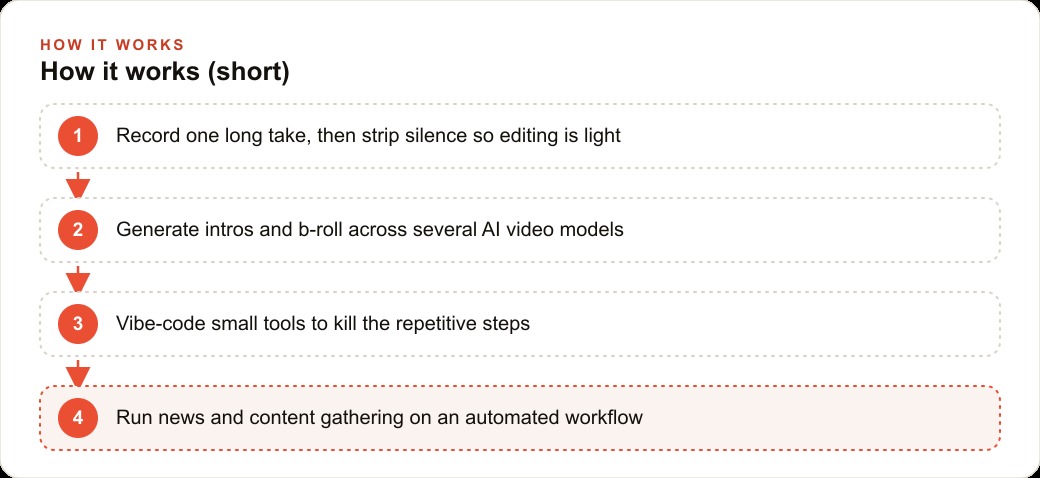
The clearest example is how this breakdown itself gets made. Madhuranjan Kumar records ninety minutes to two hours in a single sitting and trims down to the twenty to thirty minutes that publish, doing as much as possible inside the take so the cleanup is light. The philosophy is worth stealing on its own: front-load the effort into one focused block, then let tools carry the rest. His fastest lever is a silence-removing tool. He drags a recording in, clicks remove silence, and a sixty-five-minute file collapses to about twenty-seven minutes in seconds, after which he exports a timeline straight into his editor and finishes there.
Read that again as a business owner, not as a creator. A ninety-minute raw recording becomes a near-finished asset with almost no human editing. The skill that used to gate content, sitting at a timeline cutting out pauses and stumbles, has been removed from the human entirely. That is the shape of every good automation. You do not make a person faster at the tedious task. You delete the tedious task from the person's day.
The polish is a recipe, not a magic touch
Even the parts that look like they need a studio turn out to be a formula. Those animated channel intros come from a simple recipe: export one still of himself off camera and one at his desk, feed both as the start and end frames into a video model with a short prompt describing the motion, and let it generate the animation. He runs the same request across several video models until one lands, and because some of them generate audio too, he often keeps it. The takes that miss become bloopers at the end. Nothing is wasted, and nothing required a videographer.
I dwell on this because the intro is the kind of thing an owner would assume they have to hire out. It looks expensive. It is not. It is a two-image input and a sentence, run a few times. Almost every task that feels like it needs a specialist is worth poking at this way before you open your wallet. The question is never whether the polished result is impressive. It is whether the path to the polished result can be reduced to inputs and a prompt that anyone on your team can run.
The same instinct shows up further down his stack, and this is where the story stops being about video at all. Using an AI coding tool, he built a small overlay app to show audience questions on screen and a short script that scraped six weeks of his own comments to surface the real questions people were asking, both prompted into existence rather than hand-coded. His news site runs on an automated workflow that scrapes a page, cross-checks it against another AI service, summarizes it with a small model, and falls back to a larger one when the content is too big for the small model to hold. A separate flow writes a short summary for every item. He is not a software engineer. He simply refused to keep doing boring work by hand, and that refusal, repeated across dozens of little tasks, is the entire edge.
The real skill is spotting the leak
If I had to compress the whole operation into one transferable habit, it is this: look honestly at where your week leaks time, then wrap one small tool around that single leak. Not the whole business. Not a grand automation platform. One leak. Madhuranjan Kumar did not sit down and design a media empire. He noticed that trimming silence ate his evenings, so he killed that. He noticed that finding good audience questions was slow, so he scraped his own comments. He noticed that reading the news was endless, so he built a pipeline to filter it. Each fix was small and boring. Stacked over a year, they add up to a one-person channel producing like a studio.
Most owners overestimate how technical any of this is. The tools that turn plain-English descriptions into working software have gotten good enough that the barrier is no longer coding, it is noticing. Noticing which step you redo every single week. Noticing which task drains a disproportionate share of your attention for how little it actually matters. Noticing what a customer or a competitor already solved that you are still doing by hand. The technical part, once you have noticed, is often an afternoon of prompting.
Where a service business actually applies this
Let me make it concrete with one worked example, because the principle is easy to nod at and hard to act on. Take a local home-remodeling contractor with no marketing team and an owner who is on job sites all day. The output the AI channel achieves is content plus automation; here is how I would rebuild that shape around a contractor, with illustrative numbers so you can see the math.
First, the content half. I would have the owner record one loose, unscripted forty-five-minute session on their phone answering the questions customers actually ask before they hire, things like how long a bathroom remodel really takes or how to avoid a change-order surprise. Run that recording through a silence-removing pass and it collapses into a tight set of clips with almost no editing. From forty-five minutes of raw talking, you get roughly eight short videos and a handful of written posts, produced in an afternoon instead of a week. That same batch of material can feed Facebook and Instagram ad campaigns as creative and quietly strengthen SEO and organic search at the same time, because one recording session becomes both the paid hook and the organic library.
Second, the automation half, which is where the hours actually come back. Say the office currently loses ninety minutes a day to two chores: sorting inbound leads and chasing missed calls. I would build one small workflow that watches the inbox and missed-call log, drafts a first-reply text for every new lead, and drops each one into the CRM and website stack so nothing slips through overnight. Ninety minutes a day is roughly seven and a half hours a week. At a modest loaded cost of forty dollars an hour for whoever was doing it, that is about three hundred dollars a week, or fifteen thousand dollars a year, recovered from a workflow that took an afternoon to stand up. Those numbers are illustrative, not a guarantee, but the ratio is the point: a one-time build against a cost that repeats forever.
Notice what did not change. The contractor still remodels bathrooms. The remodeling is the human judgment, the part no tool touches, exactly like Madhuranjan Kumar's real takes and opinions are the part he refuses to automate. The system only removes the friction around the work. That is the correct boundary, and it is why this scales without hollowing out the thing customers actually pay for.
Real humans still win, which is the whole point
There is a comforting thread underneath all of this. Madhuranjan Kumar does not believe AI kills creators, because people want a real take, a real opinion, a real person. When a video is obviously machine-voiced with nothing behind it, he clicks off, and he expects even the youngest audiences to grow tired of empty slop. I think the same is true in business. The automation is not there to replace the human at the center. It is there to clear away everything that was stopping the human from spending time on the part only they can do.
That is the reframe I want you to walk away with. The six-thousand-dollar figure was never the lesson. The lesson is that one person built a system that does the boring work on repeat, which freed them to be the one thing a tool cannot be, a real person with a point of view. ## The compounding math of small automations
Here is the part that turns this from an interesting anecdote into a strategy. A single automation, taken alone, looks trivial. Trimming silence saves a few hours a week. Drafting a first reply to a lead saves a few minutes per lead. None of these individually feels worth the effort of setting up, which is exactly why most owners never build them. The mistake is judging each fix in isolation. Their power is that they stack, and they never stop paying out.
Think about it the way the AI channel actually grew. The first automation did not make the channel. It removed one weekly chore and freed a slice of attention. That freed attention got spent noticing the next chore, which got automated, which freed more attention. This is a compounding loop, and it runs on the scarcest resource an owner has, which is not money or time but attention. Every task you delete to a tool gives you back a bit of the focus you need to spot the next one. A business with no automations is a business where the owner's attention is fully consumed just keeping the current output alive, which is why those owners never seem to find time to improve anything.
There is a discipline to doing this well, and it is the opposite of the shiny-tool instinct. You do not go looking for impressive tools and then hunt for a use. You start from your own week, find the single most repetitive, attention-draining task, and only then reach for the smallest tool that removes it. The order matters. Tool-first thinking leads to a drawer full of half-used subscriptions. Task-first thinking leads to a lean stack where every piece earns its place because it was built to kill a specific, named leak.
The other quiet advantage is that these small tools tend to feed each other. The recording you make once becomes ad creative, organic content, and a knowledge base a support bot can answer from. The lead data your intake automation captures becomes the fuel for smarter follow-up and sharper ad targeting. One clean input, captured once, radiates outward into several parts of the business. That is the same efficiency the AI channel exploits when a single long recording becomes a week of published video plus the raw material for everything around it. Build the inputs cleanly once, and the reuse is nearly free.
So the real question is not whether any single automation is worth it. It is whether you are willing to run the loop: notice a leak, patch it with the smallest possible tool, and let the recovered attention find the next one. Do that for a year and you end up where Madhuranjan Kumar did, one person producing like a team, because the boring work quietly runs itself.
You can start building your own version this week by picking the single most repetitive task in your business and wrapping one small tool around it. If you would rather have someone map your specific operation, find the steps worth automating, and stand the tools up so they work the first time, that is exactly the kind of build I do for clients, and you can bring me in to handle it.
That is exactly what we do at AI DOERS. Book a private 30-minute call with Madhuranjan Kumar and we will map the fastest path to it for your specific business.
Book your call →
Madhuranjan Kumar
Madhuranjan Kumar brings 20 years of performance-marketing experience and has managed over $200 million in Facebook ad spend for brands across the United States and beyond. His expertise spans the full modern marketing stack: Meta, Google Ads, TikTok, email automation, CRM, and the websites that hold it together. At AI DOERS he turns that track record into lead-generation systems for businesses across every industry.