
What a Harness Engineer Actually Does, and Why It Matters Now
A harness engineer designs the system around an AI agent so it can run long, autonomous tasks across many sessions: a legible environment, self-verification with end-to-end tools, and generic tooling the model already understands. It became essential when models crossed a coherence threshold in late 2025.
The job title sounds like infrastructure, and most people who hear it assume it means someone who builds plumbing. That assumption has caused most of the business world to miss the most important engineering role to have emerged in the past twelve months. I am Madhuranjan Kumar, and the argument I want to make is direct: harness engineering is the highest-leverage skill in AI work right now, not because of what it sounds like, but because of what it enables and why everything else depends on it.
The title sounds like plumbing, but harness engineering is the highest-leverage skill right now
A harness engineer designs the system around an AI agent so it can run long, autonomous tasks across many sessions without losing coherence, drifting from the goal, or requiring constant human supervision. Not the model. Not the prompt. The environment the agent operates in.
The reason this is the highest-leverage role is not the technical sophistication. It is the position in the chain. A capable model that runs inside a poorly designed harness produces unreliable output. The same capable model inside a well-designed harness produces consistent, reviewable, trustworthy output. The harness is what converts raw model capability into operational reliability, and operational reliability is the thing that determines whether a business can actually use these tools for consequential work.
Everything else, the prompt engineering, the model selection, the fine-tuning, the benchmark comparisons, runs downstream of the harness. If the environment the agent operates in cannot hold state across sessions, cannot verify its own output, and cannot maintain the domain boundaries that prevent architectural drift, then a better model just produces better-looking unreliable output. The model is not the constraint. The harness is.
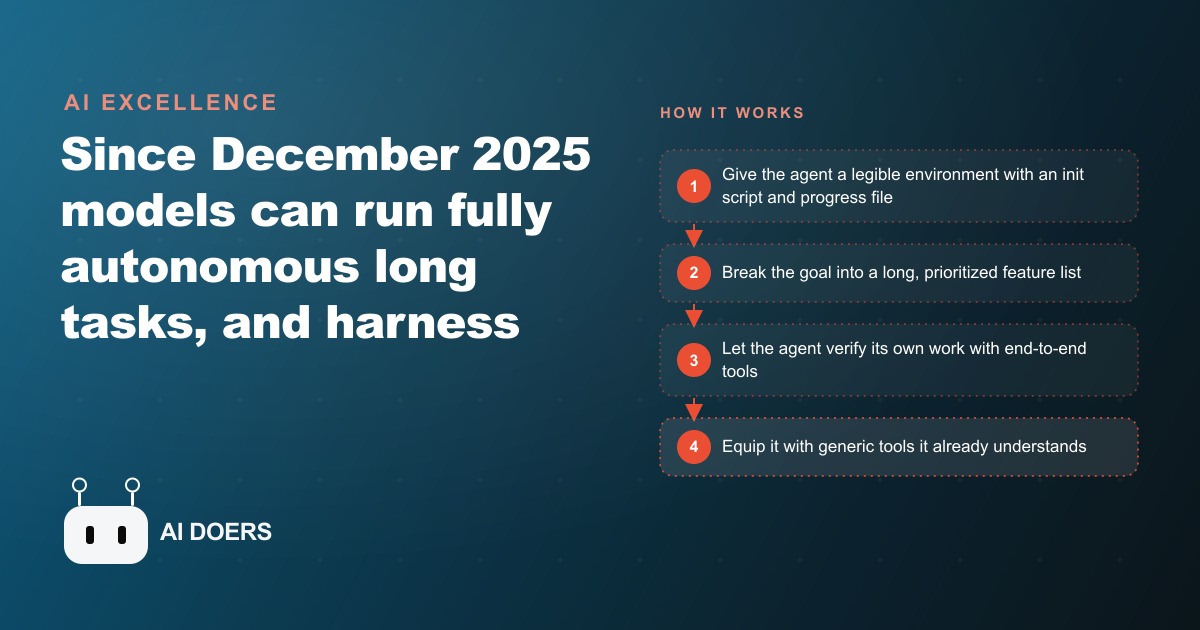
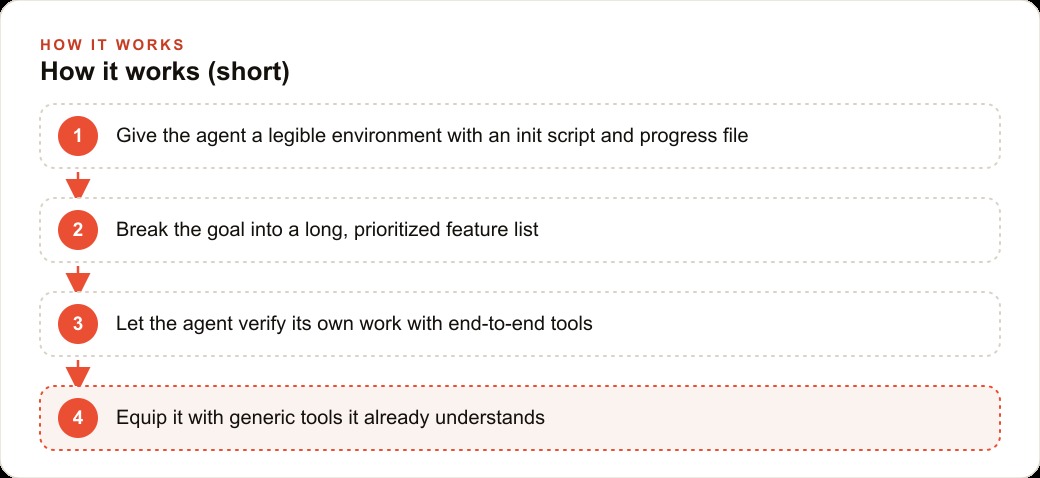
A well-designed harness has four components. An initializer agent writes a startup script, breaks the overall goal into a prioritized feature list with each item marked incomplete by default, and leaves a clean first commit as a known starting state. Each subsequent session reads the progress file, picks the highest-priority incomplete task, works on it, and leaves a descriptive commit so the next session starts from a clean known state. End-to-end testing tools force the agent to verify its own work by actually running the output rather than declaring done from the code alone. And the repository becomes the single system of record: anything the agent cannot read from there effectively does not exist.
Those four moves are the difference between an agent that drifts and one that makes steady, reviewable progress every session.
The model was ready in December 2025: what actually changed and what did not
The idea of an always-on AI agent that works toward a goal across many sessions is not new. An open-source project attempted exactly this in 2023 and failed almost immediately. The failure was not the idea. The failure was that the underlying model could not hold coherence over a long run. It would drift mid-task, contradict decisions it had made earlier in the session, and declare done on work that was obviously unfinished. Those failure modes cannot be fixed by writing a better prompt. They are intrinsic to a model that cannot maintain long-run coherence.
The change that happened around December 2025 is that the models crossed a coherence threshold. Engineers at major labs began reporting, not in press releases but in technical forums and conversations, that their jobs had fundamentally changed, because the models were now ready for fully autonomous, long-running work. The 2023 attempt was not wrong about what was possible. It was wrong about when.
What this means practically: a model that can hold a goal across many sessions, read its own output critically, and catch its own errors before they propagate is now available. The harness that could not be trusted with such a model in 2023, because the model itself could not be trusted, can now be built because the model is ready for it. The skill that was premature in 2023 became essential in 2026.
For a business with a CRM-driven sales operation that runs the same follow-up and reporting workflows every week, this threshold crossing means the window for building an always-on agent that runs those workflows reliably is open. The harness is what makes it reliable. Without the harness, the agent drifts. With the harness, it maintains the goal, documents its progress, verifies its output, and produces work the business can trust.
Generic tools outperform specialized ones: the counterintuitive lesson from real long-running agents
The most counterintuitive finding from teams that have run production-grade long-running agents is about tooling, and it runs against every instinct toward sophistication. The instinct when building a specialized integration for a data source is to create a clean, purpose-built JSON interface that the agent can call through a well-defined API. That instinct produces slower, less reliable agents than the alternative.
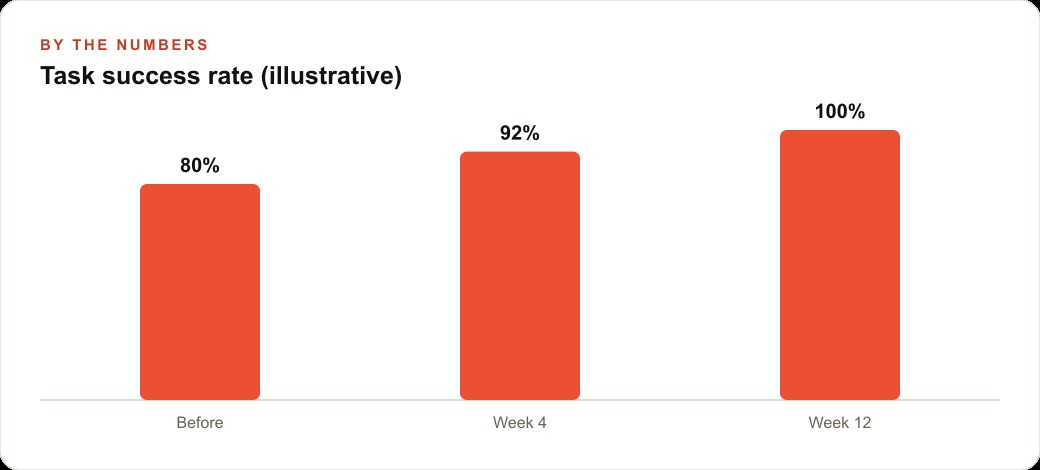
One team running a production agent deleted a sophisticated custom toolset down to a single command that pipes raw output to the agent, and the agent ran 3.5 times faster, consumed 37 percent fewer tokens, and went from an 80 percent task success rate to 100 percent. The reason is training data. Models have absorbed a vast amount of information about standard command-line tools: grep, bash, standard file operations. When the model encounters one of these tools in a task, it handles edge cases fluently because it has seen those edge cases described, handled, and explained countless times in its training. A custom JSON interface built last month has none of that training depth. The model treats it as an unfamiliar system and makes errors that a familiar tool would not produce.
The implication for harness design is direct: use generic tools the model already understands wherever possible. Build the minimum custom tooling the task actually requires, and nothing more. The sophistication that matters is not in the tooling layer. It is in the environment design: the init script that starts each session from a known clean state, the progress file that tells the agent exactly where it left off, the feature list that prevents the agent from losing track of the overall goal across many sessions, and the end-to-end testing tools that force the agent to verify its own output rather than declaring done from the code alone.
For SEO-driven content operations that run recurring content production workflows, this principle applies directly. An agent given access to standard web tools and file operations to run a content production cycle will outperform an agent given access to a bespoke content management API, because the model knows how to use the former and has to figure out the latter. The harness design choice is not which tools are more sophisticated. It is which tools the model already understands well enough to use correctly on the first try.
The businesses that will build the most effective vertical agents in the next twelve months are not the ones with the most capable models or the most sophisticated tooling. They are the ones who understand one workflow end-to-end, design the right harness around it, and let the model operate within that harness consistently. The harness is the thing that makes the model useful in production. Building it well, once, is the entire skill.
That is exactly what we do at AI DOERS. Book a private 30-minute call with Madhuranjan Kumar and we will map the fastest path to it for your specific business.
Book your call →
Madhuranjan Kumar
Madhuranjan Kumar brings 20 years of performance-marketing experience and has managed over $200 million in Facebook ad spend for brands across the United States and beyond. His expertise spans the full modern marketing stack: Meta, Google Ads, TikTok, email automation, CRM, and the websites that hold it together. At AI DOERS he turns that track record into lead-generation systems for businesses across every industry.