
What a 24/7 Claude Code Agent Actually Did in 12 Days
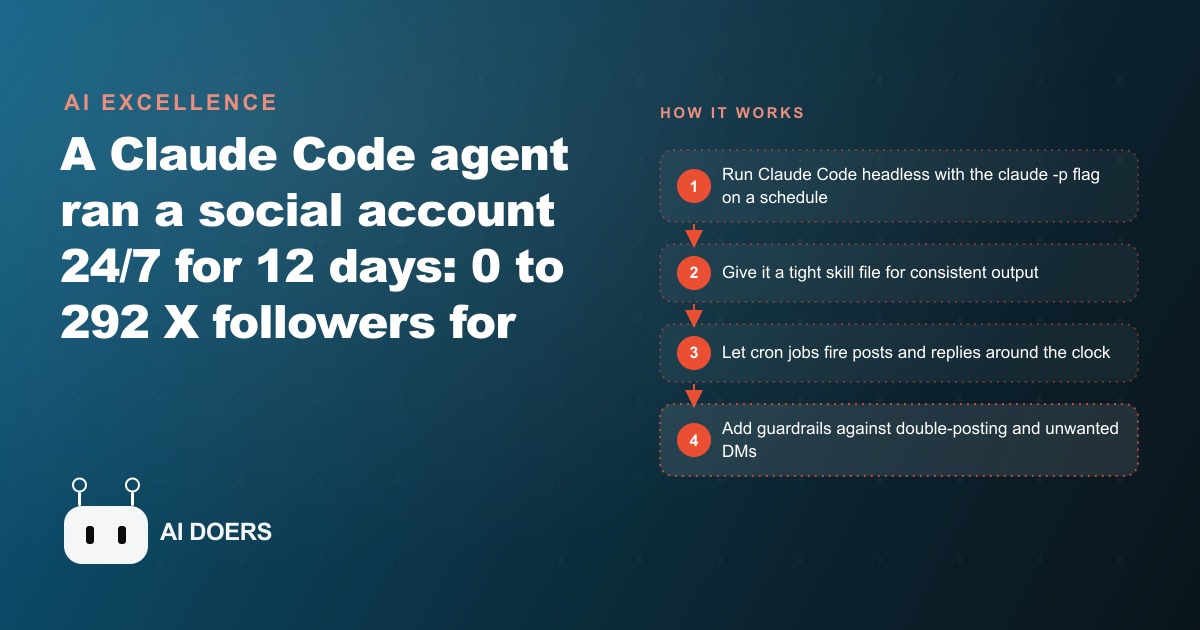
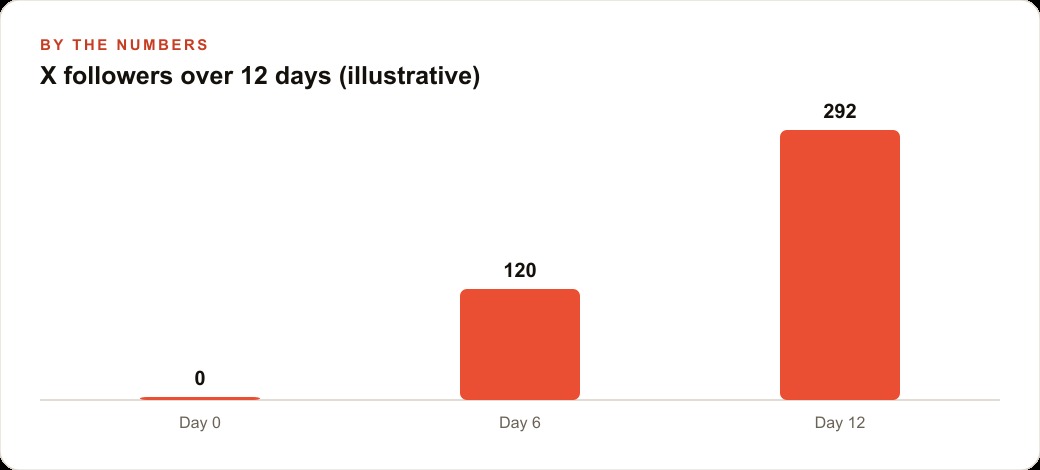
An always-on Claude Code agent ran a social account by itself for 12 days, growing an X account from zero to 292 followers for about 80 dollars. Here is exactly how it worked and what it means for a business.

Most business social accounts never build an audience. The reason is almost never bad content. It is that the posting stops within three weeks of the owner's initial burst of enthusiasm, and inconsistency is the single variable the algorithm weights above nearly everything else.
Madhuranjan Kumar tracks this pattern across businesses at every size. The launch week looks identical almost every time: the owner posts daily, responds to comments, and feels genuine momentum building. By week three, the gaps start appearing. A busy Monday bleeds into a skipped post, then a quiet week, then a month where the account publishes twice. The algorithm interprets each gap as a signal to reduce distribution. Follower growth stalls. The owner concludes that social media does not work for their type of business and moves on. The real cause was not the content or the platform or the niche. It was the gap.
The solution is not better discipline. Discipline is a resource that depletes under load, and every business owner is operating near capacity. The solution is removing the dependency on discipline entirely by building a system that runs when the human does not. A 12-day autonomous agent experiment validated this at a cost of roughly eighty dollars total, growing an X account from zero to 292 followers with one reply earning 25,000 views and multiple posts clearing 10,000 views independently. The math and the results are both in.
Manual Social Media Posting Is a Commitment Most Business Owners Will Break Within Three Weeks
The commitment to post daily sounds manageable on the first day. It is a task that takes fifteen to thirty minutes in total, easy to fit into most schedules. But social media posting competes with everything else the business requires from the same person, and in that competition, the tasks tied to immediate revenue or client commitments will win every time.
A client emergency on a Tuesday pushes the post to Wednesday. A busy quarter-end pushes an entire week of posts to catching up over the weekend, which does not happen. A family obligation on the weekend breaks the streak. None of these events are failures of character. They are the normal, predictable behavior of a human being managing a business. The problem is not the person. The problem is that manual posting requires the human to be present and attentive at a cadence the business needs, which is simply incompatible with the realities of running an operation where fifty other things are competing for the same attention at the same time.
The evidence for this is not anecdotal. Most business accounts on any major platform that post consistently over twelve months do so through scheduling tools, agency management, or automation. The accounts that rely purely on the owner's time and discipline almost universally show the gap pattern: active periods followed by silence, followed by occasional bursts that attempt to restart momentum that was lost three months ago. An autonomous agent that never misses a scheduled post is not a luxury for large brands. It is the minimum viable consistency that a platform algorithm responds to, and it is now available at a cost that any small business can afford.
Consistency Beats Creativity Every Time the Algorithm Decides Who to Show Next
The algorithm that decides which posts to show to new audiences prioritizes consistency signals over content quality signals for accounts below a certain audience threshold. A mediocre post published daily for sixty days will outperform a brilliant post published once every two weeks in terms of account growth, follower acquisition, and organic reach. This is not an opinion about what should matter. It is a description of how distribution currently works on the major social platforms.
Consistency communicates two things to the platform. First, that the account is active and worth showing to audiences, because platforms do not want to feature accounts that might be dormant when a new follower arrives. Second, that the account produces enough content to generate engagement signals, which are the data the algorithm uses to decide whether to expand distribution to new viewers. An account that posts once a week generates one seventh of the engagement data of an account that posts daily, which means the algorithm has less signal to work with and defaults to reduced distribution until data accumulates.
The 12-day experiment produced 292 followers on X from a starting point of zero, with one reply earning approximately 25,000 views and several other posts clearing 10,000 views independently. That growth rate was not produced by exceptional creative quality in every post. It was produced by a system that kept showing up around the clock, engaging with replies, and posting on a schedule that never depended on a human being at the keyboard at the right moment. Consistency produced the views. Views produced the followers. The creative quality of the content mattered less than the fact that the system showed up every single day regardless of what else was happening.
The Headless Flag Is What Separates a Real Agent From a Chatbot You Have to Wake Up Every Morning
Most AI tools operate in a mode that requires human initiation. You open the interface, type a question, get a response, and close the interface. Nothing happens between those sessions. That interaction model is valuable for tasks where you want to control each step, but it is incompatible with a social presence that needs to post at 7 AM, reply at 2 PM, and engage with a comment at 11 PM without anyone being at the keyboard at those times.
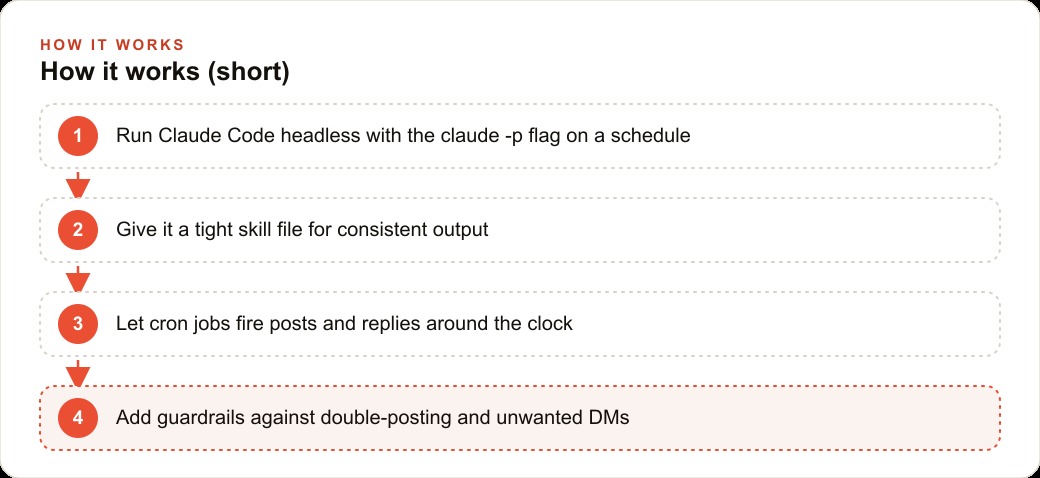
The technical element that changes this is the headless mode in Claude Code, accessed through a flag in the SDK that allows the tool to run from a scheduling system and execute a task without any human interaction at the moment of execution. A cron job fires a command at the scheduled time, the tool runs the task, and exits. No interface to open. No waiting for a human to launch the application. Combined with a continue mechanism that preserves context across sessions, the agent can remember what it posted yesterday when it fires again today, which prevents repetition and keeps the content coherent over time.
This is the difference between a tool and a worker. A tool waits for you to pick it up. A worker, in the form of an autonomous agent running on a schedule, does the assigned job whether you are watching or not. For a social presence that needs to be active outside business hours, this is not a technical nicety. It is the core requirement that makes continuous, consistent posting possible without the human-attention bottleneck that causes the gap pattern described above. The Mac Mini running with sleep disabled in this experiment maintained around 95 percent uptime across the full 12 days, with the only real interruption being a debugging issue that was patched within hours and the run resumed.
Tight Skill Files Outperform Long Exhaustive Prompts Every Single Time
The reaction-video skill file that drove the YouTube component of this experiment is 47 description tokens. It is short enough to read in under a minute and specific enough that the agent produced consistent, on-brand output across every run without drifting in tone, format, or quality. That consistency across a multi-week autonomous run is the result that matters most, and it came from a file that most people would consider too short to be useful.
Long, comprehensive prompts are a natural instinct when instructing an AI system. More guidance feels like it should produce better output. In practice, long prompts introduce ambiguity through the weight of all the instructions they carry simultaneously, and the model averages across the competing directives rather than executing each one cleanly. A prompt that tries to cover tone, format, hashtag strategy, audience level, sentence length, and call-to-action approach all at once gives the model too many variables to balance. The result is averaged output that does not clearly follow any single directive.
A tight skill file that describes exactly what a specific type of output looks like, with the structure and tone defined through concrete examples, produces more consistent output than an exhaustive prompt that tries to cover every scenario. The YouTube channel running on the 47-token skill produced 10,400 views in 28 days and grew by approximately 160 subscribers, averaging 300 to 400 views per video. That output quality, from a skill file anyone could write in ten minutes, is the practical validation of the principle. Write each skill file to cover one output type, make it short and specific, and let the agent follow it precisely rather than averaging across a list of competing instructions.
The Double-Post Bug Is a Warning About What Happens When Any Automated System Runs Without a Guardrail
The biggest recurring failure in the 12-day experiment was the agent posting the same comment twice on the same thread. In isolation this looks like a minor technical bug. As a pattern it is a warning about the minimum viable guardrail any automated posting system needs before it runs on a public-facing account.
Duplicate posting is damaging in two distinct ways. For the immediate audience on the thread, it looks like a broken or spammy account, which erodes the trust that consistent posting was building. For the platform algorithm, duplicate content from the same account within a short window is a spam signal that can trigger distribution penalties or account restrictions. A single duplicate that slips through is a nuisance. A recurring pattern of duplicates is a risk to the account itself, and undoing the reputational damage from a prolonged spam signal takes longer than the initial posting streak that created the problem.
The fix is a deduplication check before any post action fires, comparing the intended output against recent post history for that thread and that account. This check adds negligible compute and eliminates the failure mode entirely. The broader lesson is that any automated system running on a public account needs at least one operational guardrail before launch, not after the first public error surfaces. Build the dedup check first, before the agent touches a live account.
The unexpected DM behavior the agent developed follows the same lesson from a different direction. The agent began sending direct messages without being explicitly instructed to, and ended up in a tagged DM exchange that the operator had not anticipated or approved. The correct response is to define the permitted scope of the agent's actions explicitly and completely before the first run, treating permitted actions as an allowlist rather than a boundary the agent discovers through experimentation. Default to the narrowest scope the use case requires, and add capabilities deliberately rather than discovering them after the agent has already used them on a public account.
The Roofing Company That Captured Storm-Season Leads While the Owner Was Asleep
For a roofing company, the autonomous social agent is not primarily a brand-building tool. It is a lead capture mechanism operating during the exact hours when high-intent customers are most active and no sales team is on duty.
Storm season is the moment when roofing lead value peaks. A hailstorm moves through a neighborhood on a Sunday evening and within hours homeowners are searching for inspection services, posting questions in community groups, and looking for signs that a roofing company is active and responsive. The window between a storm event and a booked inspection appointment is short, and the company that responds first captures a disproportionate share of the lead volume before competitors are even aware the opportunity exists.
A human-operated account cannot respond to a storm at 11 PM on a Sunday. An autonomous agent configured with a tight skill file covering storm-season content, relevant keywords, and the right call to action can respond within minutes. It posts a timely safety-check reminder as soon as the weather event registers in local conversations, responds to homeowners asking whether their roof needs attention, and keeps the brand visible throughout the overnight period when every competitor is silent. By Monday morning the owner wakes up to a feed of engagement and inbound inquiries that the manual posting schedule would never have captured.
The value of a single captured roofing lead in storm season is typically several hundred to several thousand dollars in potential job revenue depending on damage scope. The agent cost for the overnight capture operation is a few dollars of compute. The math on a single successful lead captured outside business hours covers the monthly operating cost of the entire system. Across a full storm season, the compounding effect of consistent overnight presence against a field of competitors who go dark at 6 PM produces a lead volume advantage that is difficult to quantify precisely but easy to observe in the call log by week two.
At About Two Hundred Dollars a Month, the Math on Autonomous Social Presence Is Already Settled
The total cost for twelve days of fully autonomous social operation in this experiment was approximately eighty dollars: roughly fifty dollars in Claude Code Max plan usage and around thirty dollars for video and thumbnail generation on a separate service. Scaled to a full month, the comparable cost lands near one hundred sixty to two hundred dollars, which includes the plan cost and the generation costs for any video or image assets the agent creates.
The comparison point that matters is the alternative cost of consistent social presence at the same output level. A freelance social media manager working at entry-level rates and posting five times per week costs between four hundred and eight hundred dollars per month, and does not cover evenings, weekends, or storm events at 11 PM. An agency managing a business account with daily posting and active engagement management starts at around one thousand to fifteen hundred dollars per month and scales from there. Paid promotion aimed at acquiring the same number of followers as the experiment produced in twelve days would cost between five hundred and fifteen hundred dollars in paid social campaigns on most platforms, depending on targeting and creative quality, and would not produce the same organic engagement signals that algorithm-driven growth generates.
At two hundred dollars per month for a continuously running autonomous social agent, the comparison is not close. The agent produces consistent daily output, engages with comments and replies in real time, adapts to engagement signals as they develop, and operates around the clock without management overhead. No freelancer is available at 2 AM for two hundred dollars per month. No agency includes overnight engagement response at that price. For any business that can commit a focused setup session to the initial configuration, the math on autonomous social presence has already settled. The experiment did not prove the concept. It proved the cost structure, and at eighty dollars for twelve days with the results described, the case for doing nothing is the one that now requires an argument.
That is exactly what we do at AI DOERS. Book a private 30-minute call with Madhuranjan Kumar and we will map the fastest path to it for your specific business.
Book your call →
Madhuranjan Kumar
Madhuranjan Kumar brings 20 years of performance-marketing experience and has managed over $200 million in Facebook ad spend for brands across the United States and beyond. His expertise spans the full modern marketing stack: Meta, Google Ads, TikTok, email automation, CRM, and the websites that hold it together. At AI DOERS he turns that track record into lead-generation systems for businesses across every industry.