
Voice Is Replacing the Keyboard, and Here Is the Business Case for It
Speaking is roughly three times faster than typing, and AI now turns that speed into finished work. Here is what that really means for a business, with one front desk as the example.

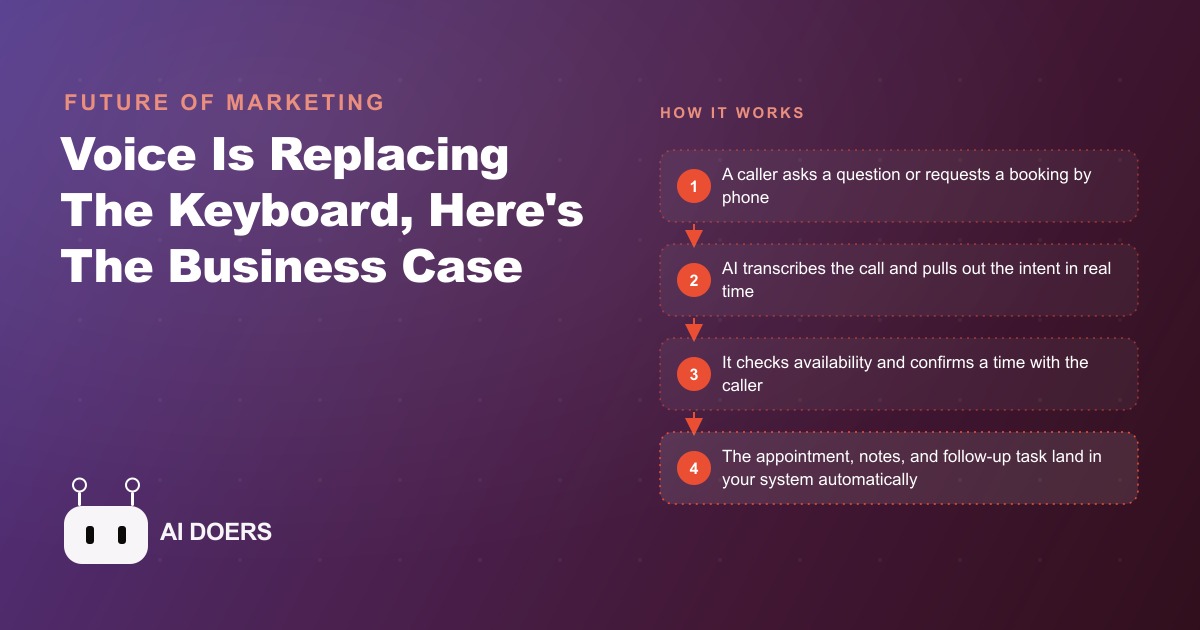
On a Tuesday in late winter, the front desk at a two-dentist practice received twenty-two inbound calls between nine in the morning and noon. The receptionist on duty answered fourteen of them. The other eight went to voicemail. Three of those eight callers left messages. The remaining five disconnected before the voicemail prompt finished, and as far as any record showed, none of them called back.
That sixty-three percent answer rate during a three-hour peak window was not a bad day. It was a normal day. And the practice had no clear picture of what it was costing.
Twenty-two calls, one desk, and a number nobody had counted
The first question I ask when a practice owner says they want to improve front-desk capacity is whether they know their call answer rate. Most do not. They know some calls get missed and they know the desk is stretched during busy stretches, but the actual ratio has never been pulled into a number.
For this practice, a week of phone system data produced a finding that surprised the owner. During the two peak three-hour windows each day, the practice answered approximately sixty-three to sixty-seven percent of inbound calls. The remainder either went to voicemail or disconnected before reaching it. Of calls that went to voicemail, roughly forty percent received a same-day callback. The rest waited until the following morning or did not receive one at all.
That breakdown is not unusual for a two-dentist practice running one full-time and one part-time receptionist. It is the structural consequence of a desk where scheduling, check-ins, insurance verification, and billing questions all compete for the same person's attention simultaneously. The phone is one of six things demanding a response during the hour when all six peak at once.
The practice had been running a modest monthly spend on Google Ads to generate new patient inquiries. A portion of those inquiries arrived by phone. Which meant some fraction of the paid traffic was calling, reaching voicemail, and not coming back. The owner had not done that calculation before. When it was laid out explicitly, she recognised it immediately as the thing she had been vaguely aware of without ever naming it.
What that missed-call rate was actually costing each month
The math is straightforward once the numbers exist.
New patient average first-appointment value at this practice was approximately two hundred dollars. Existing patient recall appointments averaged around one hundred and fifty. Phone system data suggested roughly forty to fifty inbound calls per week were either reaching voicemail or disconnecting during peak hours, the calls the desk could not reach in time.
Using conservative assumptions: if fifteen to eighteen percent of those callers were prospective new patients who chose not to leave a voicemail and did not try again, the practice was losing five to eight new patient inquiries per week to unanswered calls alone. At two hundred dollars per first appointment, that is one thousand to sixteen hundred dollars per week in first-appointment revenue. The lifetime value of a retained dental patient typically sits several times above that first visit, which means the actual lost-value number per week was meaningfully higher than the first-appointment figure alone suggested.
For a practice with a stable existing patient base, steady attrition through unanswered new patient calls is particularly expensive because it suppresses the growth that would otherwise compound through the new patient channel. The ad budget was generating demand. The demand was calling. The gap was in the moment of contact, not in the marketing.
The first two weeks with voice AI live, including the calls that went wrong
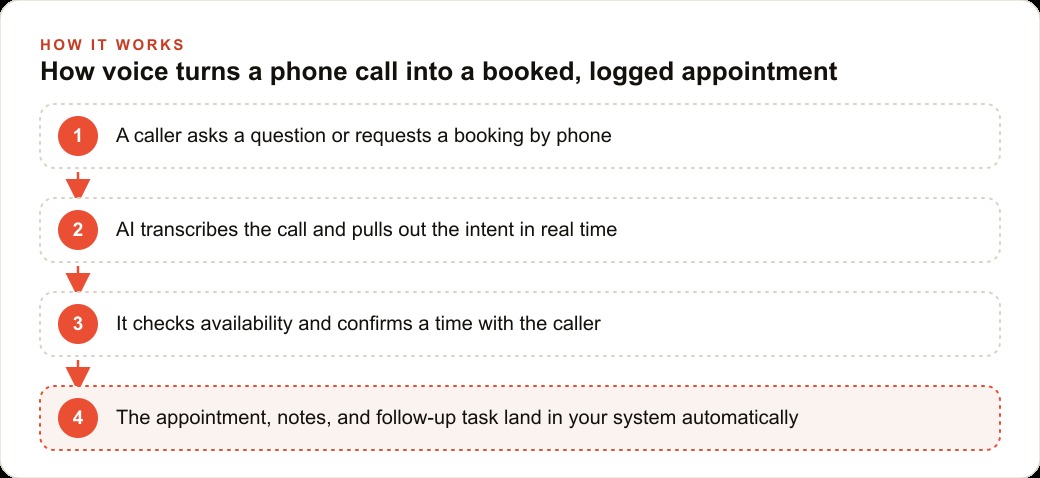
Voice AI was deployed to handle the overflow: calls arriving while the receptionist was on another line, calls during the two highest-volume daily windows, and all calls received after the desk closed at five.
The setup took one afternoon. The voice AI was connected to the practice management system's scheduling module, given access to appointment types, provider availability by day, and standard appointment durations. It was briefed on the intake questions: patient name, whether new or existing, reason for the visit or type of appointment requested, insurance carrier, and preferred day and time. For new patients it was configured to ask one additional question about how they heard about the practice.
Week one was not clean, and that was expected.
On day two, a caller described the appointment type using a colloquial name the system had not been trained on. The AI did not mishandle the call. It flagged the interaction and handed to the receptionist with a short summary: caller's name, what they said, and the point where the handoff occurred. The receptionist completed the booking in ninety seconds. The caller left a positive comment at checkout two weeks later about how fast someone had gotten back to them.
On day four, a caller had a billing question that required account lookup the AI had no access to. The handoff happened cleanly. The caller expressed no frustration.
On day nine, a caller spoke with a strong accent and the transcription missed a word in the address. The appointment was booked correctly because the AI had been configured to read back what it captured before confirming, and the caller corrected the address on the readback.
These were the categories of edge cases the first two weeks surfaced. Each one produced a correction that was added to the system's configuration before the next day's calls began. By the end of week two, the receptionist was no longer reviewing every transcript. She was reviewing the flagged calls and the new-patient bookings. For all other call categories she reviewed the daily summary log each evening, a five-minute read that covered everything the AI had handled that day.
Day thirty: the number that changed the conversation with the owner
At the thirty-day mark, phone system data was pulled and compared to the same period from the month prior.
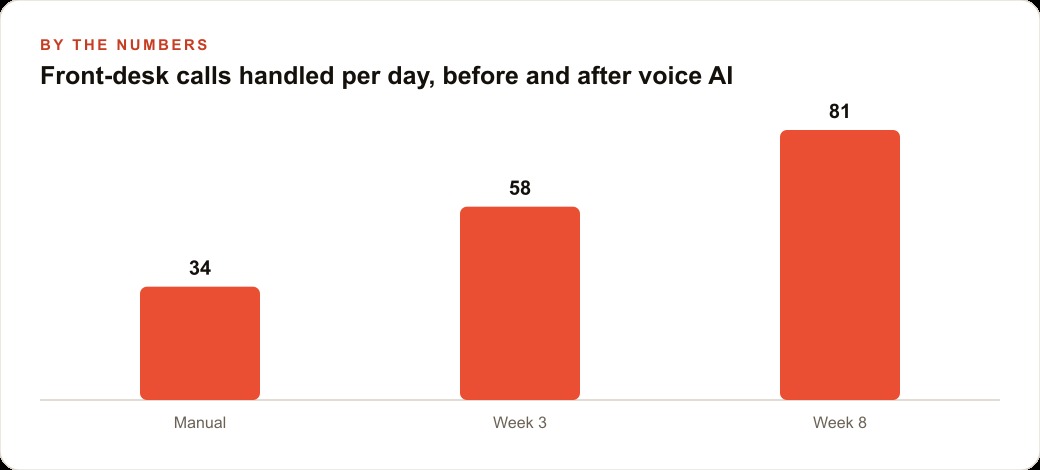
Call answer rate during peak hours had moved from sixty-five percent to eighty-seven percent. Of the calls the AI handled, seventy-one percent resulted in a completed appointment booking with no human involvement. The remaining twenty-nine percent were escalated, and of those, eighty-three percent reached resolution on the same call after the receptionist took over.
Calls that disconnected before leaving a voicemail had dropped by fifty-eight percent compared to the prior month.
The new-patient count for the first four weeks of the AI deployment was running approximately seventeen percent above the prior four-week period. The practice had not changed its ad spend, launched a new campaign, or changed its scheduling availability. The increase was entirely attributable to calls that had previously disconnected during peak hours and been missed after five.
The owner's comment at the thirty-day review was direct: "I did not realise how much was just walking out the door."
The voice AI was also integrated with the CRM and scheduling stack the practice used, which meant every handled call produced an automatic record: patient name, appointment type, time confirmed, insurance carrier mentioned, and any notes from the exchange. The receptionist no longer spent the last forty minutes of each shift transcribing call details into the system. The records were already there, accurate, and timestamped.
What the receptionist handled exclusively throughout the entire run
The framing of voice AI as replacing front-desk staff is not only wrong, it actively leads practices to implement the technology badly by assigning it to calls it should not handle and then measuring it against a standard it was never designed to meet.
What changed for this receptionist over thirty days: she stopped answering routine scheduling calls during peak hours, stopped taking callbacks that could be completed autonomously, and stopped manually logging appointment details for calls the system had already handled.
What did not change: every call involving a billing dispute, every patient expressing anxiety about an upcoming procedure, every conversation where reading the caller's emotional state mattered, every new-patient call where the caller had specific questions about the doctors or wanted to discuss a complex clinical situation, and every call involving insurance coverage questions that required account-level access and negotiation.
None of those categories shrank. They received the same volume and the same priority. What changed is that the receptionist was not splitting her attention between those calls and the high-volume scheduling queue the AI was now managing. She was available for the conversations that required a person, because a different category of work had been reliably routed elsewhere.
There was also a quality change in the in-office experience that does not appear in call volume data. When the receptionist is not breaking away from a patient seated at the desk to grab the phone, the quality of attention that patient receives improves. That improvement is visible in patient experience over time and in the referral patterns it produces, neither of which appears in a thirty-day efficiency report but both of which matter significantly over twelve months.
The monthly math that made the owner wonder why she had waited
At the sixty-day mark, the owner put the cost-and-return calculation in writing.
Monthly cost of the voice AI tool with scheduling integration: a subscription in the range a practice of this size absorbs without a budget conversation.
Estimated new patient appointments recovered over the first two months compared to the prior two-month baseline: approximately twenty-six additional appointments, based on the seventeen-percent lift sustained across eight weeks of tracking.
At two hundred dollars average first-appointment value, those twenty-six appointments represent roughly five thousand two hundred dollars in first-appointment revenue above the prior period. That figure is before accounting for the retention value of even a portion of those new patients becoming long-term patients of the practice. The ratio of return to subscription cost was a clear multiple, not a marginal difference.
The owner's actual summary of the calculation: "I have been spending on ads for two years and losing a third of the calls those ads generated. That is a straightforward problem I should have recognised a long time ago."
Practices and service businesses running Facebook and Instagram ads face exactly the same arithmetic. Lead-generation spend drives inbound contact. If that contact is not answered quickly and completely, the spend is producing demand that does not convert. Voice AI at the intake point closes the conversion gap without requiring any change to the ad strategy, the creative, or the budget.
The second return the owner noted was operational rather than financial. At the sixty-day review, the receptionist described her daily experience as noticeably less fragmented. She was handling more meaningful patient interactions and fewer administrative interruptions. She had not been replaced or reduced to a smaller role. She had been freed from the repetitive volume that had been competing with the part of her role that actually required a person. That shift in working experience has a retention value that does not appear in monthly financial reports and rarely gets included in the cost-benefit analysis, but tends to matter the most when the alternative is replacing an experienced front-desk employee.
What the next twelve months look like from here
At sixty days, the owner's plan was to extend the AI to full after-hours coverage, review the new-patient intake script to tighten the handoff language for complex clinical questions, and add an automated appointment-confirmation call at forty-eight hours before each appointment, handling the reminder and giving patients an easy way to reschedule by voice without requiring a callback to the desk.
None of those extensions required new infrastructure. The calendar integration, the voice recognition configuration, and the logging connection were already in place and proven against two months of real call volume. The second and third expansions build on a working foundation rather than starting from a new setup.
The practices that delay voice AI deployment waiting for the technology to be perfect before they use it are making the same mistake as service businesses that wait for a perfect agent before stopping their after-hours lead leak. The calls are arriving today. The missed-contact cost is accumulating today. The tool does not need to be perfect to close a gap that a perfect human-only system at the current staffing level has already demonstrated it cannot close.
The right category to start with is the call type your desk handles at the highest volume and the most predictably. For most practices and service businesses, that category is straightforward scheduling. The AI handles scheduling cleanly before it handles anything else, the financial case for that narrow deployment closes within the first month, and everything that follows builds on a working system rather than a theoretical one.
That is exactly what we do at AI DOERS. Book a private 30-minute call with Madhuranjan Kumar and we will map the fastest path to it for your specific business.
Book your call →
Madhuranjan Kumar
Madhuranjan Kumar brings 20 years of performance-marketing experience and has managed over $200 million in Facebook ad spend for brands across the United States and beyond. His expertise spans the full modern marketing stack: Meta, Google Ads, TikTok, email automation, CRM, and the websites that hold it together. At AI DOERS he turns that track record into lead-generation systems for businesses across every industry.