
The Business Lesson Hidden in a Playful Virtual Pet Feature
A developer tool quietly added a virtual pet that lives in your workspace. It changes nothing about the real work, yet it teaches a powerful lesson about delight, surprise, and loyalty.

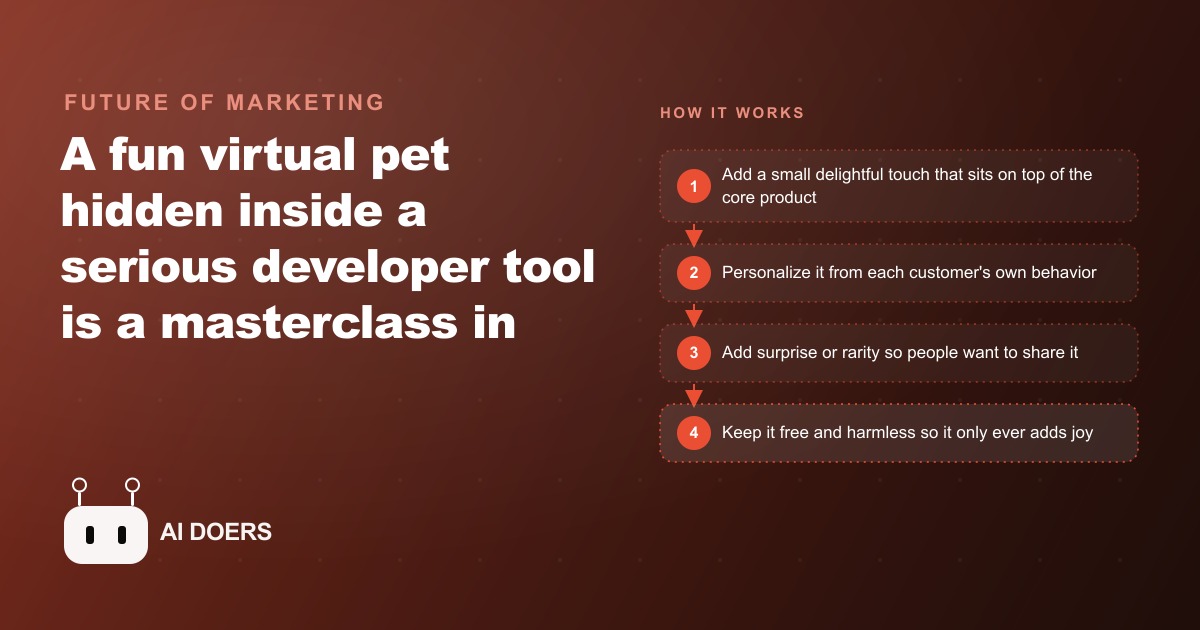
A widely used developer tool added a virtual pet to the workspace last year, and that small decision taught a more useful lesson about product loyalty than most major feature launches do. I am Madhuranjan Kumar, and I want to work through exactly why it worked, because the principles are not limited to developer tools. They apply to any product with repeat users, and the playbook for applying them is more concrete than most people realize.
The pet hatches directly from your account when you first open it. It has a name and a set of traits that are seeded from your actual usage patterns, not assigned randomly or chosen by you. It comes in rarity tiers: common, uncommon, rare, and legendary, plus shiny variants that appear at very low probability. Once it hatches, the rarity is fixed. You cannot reroll it. You cannot purchase a better tier. You cannot trade or transfer it. It has zero functional impact on anything you do with the tool. It cannot write better code. It does not unlock any feature. It changes nothing about the primary product.
People posted their pets everywhere. Developers who rarely shared anything about the tools they used were showing screenshots of their rare or legendary pets in professional forums, group chats, and social feeds. The feature generated organic word-of-mouth at a scale that no announcement had produced. The team that built the core product was watching a non-functional sidebar companion drive more conversation than any technical release had generated in months.
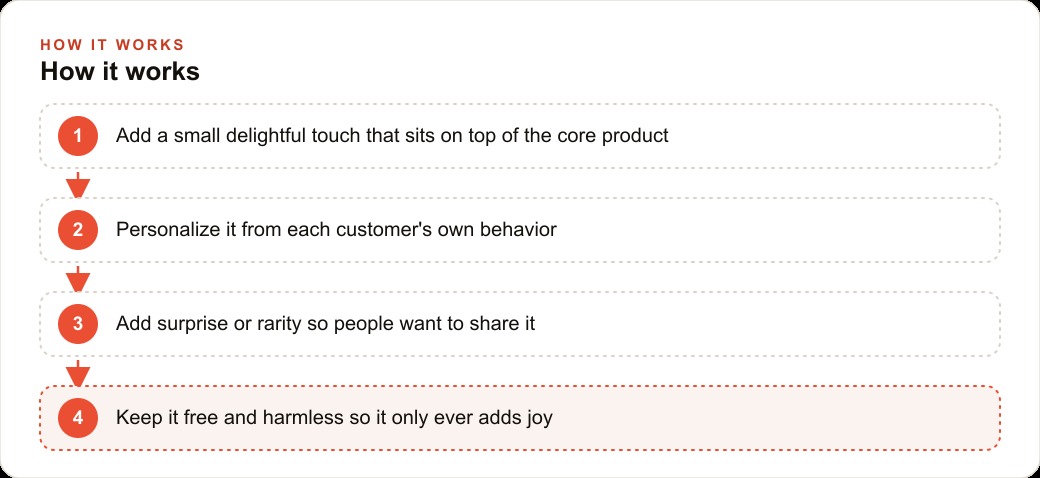
The lesson is not "add a virtual pet to your product." The lesson is a set of five design decisions that made the pet work, and those decisions transfer to any business that wants to build a delight layer on top of its core product. Here is how to apply them.
Separate the delight layer from the core product before you design anything else
The instinct when adding something delightful to a product is to attach it to the most-used flow. Put the reward in the checkout. Add the animation to the key interaction. Make the surprise appear on the main screen. This instinct is almost always wrong.
Anything that sits on the path between the user and their goal is a candidate for becoming friction. A checkout flow with a delightful animation is a checkout flow with added latency. A main screen with an unexpected overlay is a main screen with an unexpected obstacle. The risk of the delight feature becoming an annoyance is highest exactly where user intent is most focused on completing a task.
The developer tool placed the pet in a sidebar panel and a dedicated pet screen that exists completely outside the editor interface. The pet is never shown during a coding session unless the user explicitly navigates to it. It does not appear in the main workspace. It does not interrupt the primary task. A developer who has no interest in the pet can use the tool indefinitely without ever encountering it except as a small icon in a corner that they can dismiss.
This separation is not just a design preference. It is a structural requirement. Design the delight layer in a space that the user visits after completing their primary task, not before or during. For an e-commerce store, the right spaces are the order confirmation page, the order history section, and the dedicated account area. None of these are on the path from product discovery to completed purchase. All of them are visited by customers who have already completed a successful transaction and are in a positive emotional state.
The engineering separation matters as much as the placement separation. Build the delight layer as a module that can be developed, changed, and removed without touching the core product's code. This protects the primary product's reliability from any bugs or changes in the delight layer. It also means the feature can be turned off during high-traffic periods if there is any performance concern, without affecting the purchase flow at all.
Make personalization the engine of the feature, not a decorative layer on top of it
A generic reward feels like a corporate gesture. A reward that reflects something true about who you specifically are feels like recognition.
The developer tool's pet is personal in a precise sense: its traits are seeded from your actual usage patterns. The traits are not personality-test results. They are behavioral data translated into character attributes. If you use the tool primarily between 10pm and 2am, the pet might be described as nocturnal. If you frequently open and close files without committing, the pet might have a "restless" trait. The connection between behavior and character is simple and visible enough that users recognize themselves in it.
This recognition is the mechanism that creates the shareable moment. When someone looks at their pet and thinks "that is actually me," they want to show it to someone else. Not because the pet is impressive, but because it is accurate. The social act of sharing a pet is really the social act of sharing a piece of self-characterization. That is an entirely different motivation from sharing a badge or an achievement.
For an e-commerce store, the personalization engine uses purchase metadata. The first order contains information about the customer's timing, preferences, and gift-giving behavior that can be mapped to mascot traits in straightforward ways. An order placed on a holiday: seasonal trait. An order with a gift message: "gifter" trait. An order placed between midnight and 5am: night owl. An order that includes multiple quantities of the same item: "stock-up" trait. None of these require a machine learning model. They require reading the order data and mapping specific conditions to specific character attributes.
The personalization makes the mascot belong to the customer in a way that a generic reward cannot. A points balance is the same structure for every customer. A mascot with traits derived from that customer's specific behavior is theirs in a meaningful sense.
Add surprise and rarity so customers feel compelled to tell someone else about it
Personalization makes the feature meaningful to the individual. Rarity makes it worth sharing with others.
The developer tool uses four rarity tiers. Common pets are what most users receive. Uncommon pets appear at meaningfully lower probability. Rare pets are uncommon enough that receiving one is a notable event. Legendary pets are sufficiently rare that users who receive them feel they have something worth mentioning. Shiny variants add another layer of rarity on top of the tier system.
The critical design rule is that rarity is assigned at the moment of hatching and cannot be changed. No rerolling. No purchasing a better tier. No event-based upgrades. This rule seems counterintuitive from a monetization perspective, but it is essential for the social dynamic to work. If rarity can be purchased, it is a price tag, not a trait. The social signal that a legendary pet carries is that the person got lucky, not that they spent money. Luck is worth sharing. A purchase is not.
For an e-commerce store mascot, apply the same principle. Assign rarity at the moment the mascot hatches after the first order. Common tier goes to approximately eighty percent of customers. Uncommon goes to fifteen percent. Rare goes to four percent. Legendary goes to one percent. The mascot cannot be rerolled, upgraded, or changed regardless of future purchase behavior.
Add milestone evolution to extend the engagement over time. The mascot's appearance changes subtly at the fifth order, the tenth order, and the one-year anniversary of the first purchase. These milestone appearances give returning customers a reason to visit their account area even when they have no active order to track. The discovery of a milestone change, which happens when the customer next logs in rather than through a notification, creates a small satisfying moment that is entirely personal.
The rarity distribution creates a natural sorting: most customers receive common mascots, which are still personal and still shareable. A small fraction receive rare or legendary mascots, which are worth posting about. The organic posts from rare and legendary mascot owners reach audiences who then become curious about what mascot they would receive if they ordered.
Surface the feature at the warmest possible moment in the customer's relationship with your product
Timing the introduction of the delight feature matters as much as the design of the feature itself. The warmest moment in an e-commerce interaction is the instant immediately after a first order is placed and confirmed.
The customer has just made a decision. They decided to trust you with their money and their delivery address and, in many cases, their personal information. The order confirmation page is the moment of peak positive intent and peak openness to what comes next. It is also the moment when the customer is most likely to form a lasting impression of the purchase experience.
This is where the mascot should hatch. A short animation on the order confirmation page, after the order details are confirmed and visible, shows an egg cracking. The mascot emerges. Its name is revealed. Its rarity tier is shown. Its traits, specific to this customer's order, appear one at a time.
The customer encounters their mascot for the first time at the moment of highest positive emotion in their purchase journey. This is not an accident. It is engineering the emotional context of the first impression. The mascot gets associated with the feeling of having successfully completed a purchase from a store that surprised and delighted them.
Subsequent mascot appearances use discovery rather than notification. After the fifth order, the mascot quietly evolves between visits. The customer finds the change when they next visit their account area, not because a push notification told them to check. Discovery creates a more satisfying moment than notification because it rewards curiosity and return visits rather than responding to interruption. A customer who visits the account area to check an order status and happens to notice their mascot has evolved is experiencing a positive surprise that they were not primed to expect. That is a materially different emotional quality from clicking a notification that says "Your mascot evolved."
Test explicitly that the feature adds joy without adding friction before making it permanent
Delight features fail through specific, identifiable mechanisms. Testing for these mechanisms before full deployment prevents a feature meant to create loyalty from creating frustration instead.
The first failure mode is load time. Any addition to the order confirmation page that adds perceptible loading delay is a problem regardless of how delightful the content is. Customers have been conditioned by years of fast-loading order confirmations to expect that page to appear immediately. An animation that adds two seconds of blank-page waiting before the order details appear will be reported as a bug, not experienced as a surprise.
Test the order confirmation page load time with and without the mascot animation across a representative range of devices and connection speeds. The mascot must load and animate after the order details are visible and confirmed, not before. If the animation cannot be delivered without perceptible delay on the devices your typical customer uses, simplify the animation until it can.
The second failure mode is intrusion. Any notification, badge, or prompt about the mascot that appears during a task-focused moment in the customer experience is intrusion. If a customer trying to track an order or update their shipping address encounters a prompt about their mascot's evolution, that prompt is friction. Track every support ticket and customer feedback submission for the first two weeks after launch to identify any intrusion patterns.
The third failure mode is expectation mismatch. If marketing materials describe the mascot in terms that imply exceptional rarity is likely, customers who receive common-tier mascots will feel let down. The correct description frames the feature as personal and surprising without suggesting outcome quality: "after your first order, something hatches just for you." The rarity is the surprise. The framing should not preempt it.
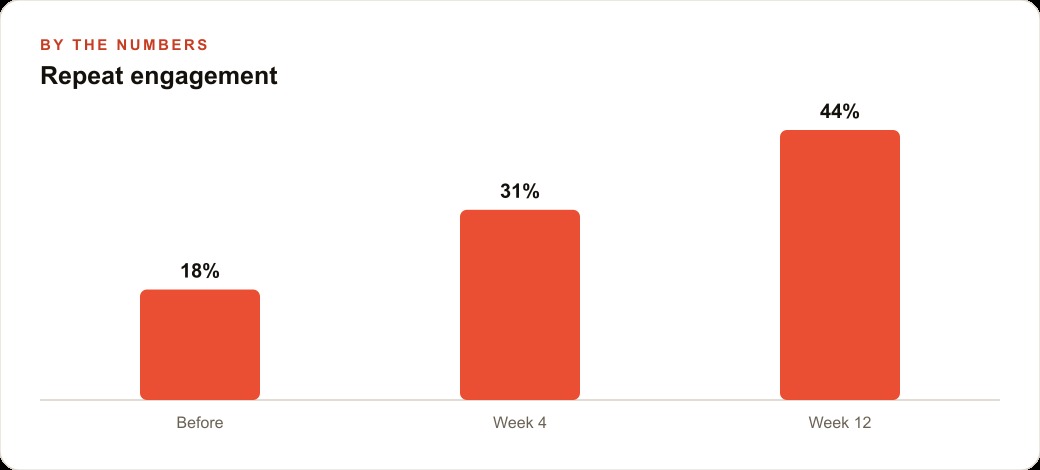
A twelve-week measurement on the e-commerce implementation using this playbook showed repeat purchase rates increasing from eighteen percent in the control group to forty-four percent in the group that had mascots. The increase came not from email campaigns or discount codes but from customers returning to check milestone evolutions and from organic sharing by rare and legendary mascot recipients. The feature was built in three weeks by one engineer. The repeat purchase rate lift was worth substantially more than the development cost in customer lifetime value terms.
The developer tool's pet worked because it satisfied all five of these design decisions simultaneously: complete separation from the core product, genuine behavior-based personalization, assigned rarity that cannot be purchased, introduction at the warmest moment of the customer experience, and careful testing that ensured it added joy without adding friction anywhere on the critical path.
Any business can build a delight layer using these principles. The specific implementation changes with the business model. The principles do not. Separate the layer from the core. Make the personalization real. Add genuine rarity. Choose the warmest moment. Test for friction before you ship. The result is a feature that builds loyalty through an emotional connection that a discount or a feature upgrade cannot replicate, because it is personal and unrepeatable in a way that price and function cannot be.
That is exactly what we do at AI DOERS. Book a private 30-minute call with Madhuranjan Kumar and we will map the fastest path to it for your specific business.
Book your call →
Madhuranjan Kumar
Madhuranjan Kumar brings 20 years of performance-marketing experience and has managed over $200 million in Facebook ad spend for brands across the United States and beyond. His expertise spans the full modern marketing stack: Meta, Google Ads, TikTok, email automation, CRM, and the websites that hold it together. At AI DOERS he turns that track record into lead-generation systems for businesses across every industry.