
Vibe Coding: How to Build Real Apps in Cursor Just by Talking to It
Vibe coding means describing what you want out loud and letting an AI agent inside Cursor write the app. No typing, no code. Here is how the workflow runs, and how I would turn it on for a real local business.

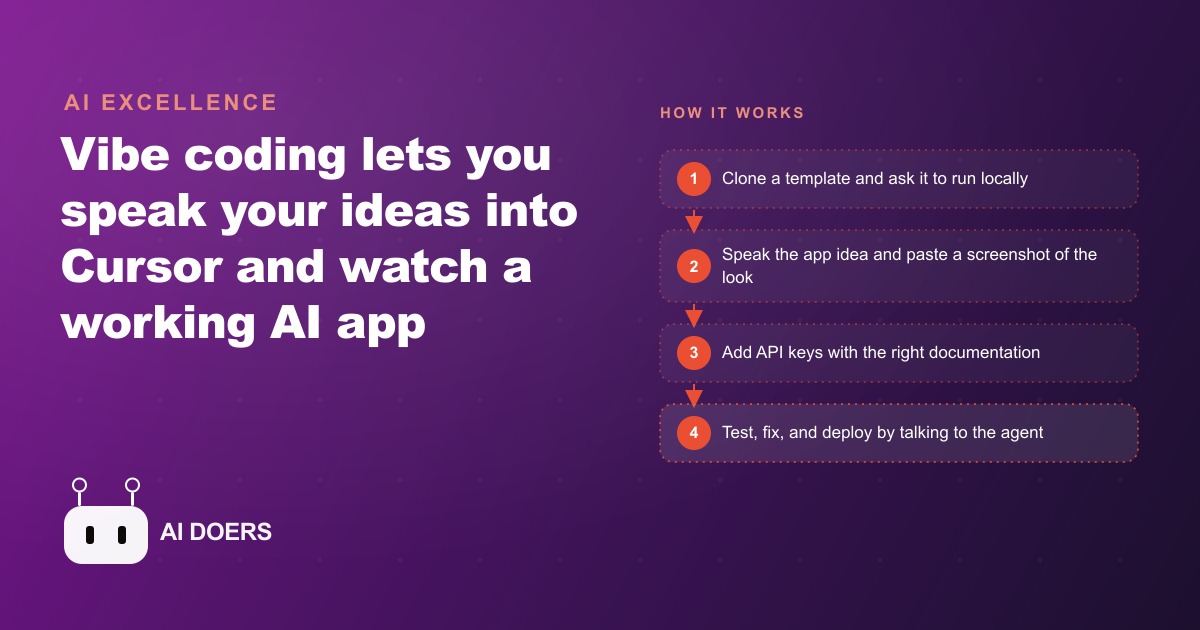
Voice typing on a keyboard shortcut, Cursor open on the right side of the screen, and a starter template running locally in the browser: that three-piece setup is now enough to build a real, deployable application without writing a single line of code.
I am Madhuranjan Kumar. The practice has a name now, vibe coding, and the name is accurate about how it feels. You hold a key, you talk, and the software takes shape as you speak. The mechanics are genuinely simple. The implications for who gets to build things are not.
Building used to mean typing, and typing was gatekeeping
Software development has always carried a skill tax that has nothing to do with understanding the problem you want to solve. To build a web application, you needed to know HTML, CSS, and JavaScript at minimum. To make it store data, you needed a backend language and a database. To put it on the internet, you needed to understand servers or hosting platforms. Each of those layers required months or years to learn, and most of them were only incidentally related to the actual problem the person was trying to fix.
This skill tax was not neutral in its effects. The people who had the time and access to learn syntax were not typically the people closest to the problems that most needed solving. The operations manager who knew exactly which step of the intake process was losing customers every week could not fix it herself. The shop owner who understood precisely why the morning scheduling call was taking forty-five minutes could not build the tool that would compress it to ten. They could describe the problem with specificity that a hired developer would pay money to hear, but building was locked behind a skill they had not acquired.
What remained was delegation. Describe the problem to someone who could build, wait while they interpreted it through a different frame, receive something that was approximately right, explain the gap between approximately and actually, wait again, and eventually accept something close enough. The cost of that loop was substantial in both time and in precision. The person who understood the problem most deeply was the person furthest from the building, and every handoff introduced new opportunities for the solution to drift from what was actually needed. A requirement misread at the start compounded through every revision cycle, and the final product often reflected the developer's interpretation of the problem as much as the owner's experience of it.
The friction of building software used to determine who got to build. The people who wrote code built things. The people who understood problems waited for someone else to translate their understanding into something that ran. That arrangement was not inevitable. It was a product of the requirement that implementation happen through typed syntax. Vibe coding removes that requirement. When you can speak an idea and have the agent implement it, understanding the problem becomes the primary qualification for building the solution, and the person closest to the problem is no longer waiting at the end of the delegation chain.
Speaking your app into existence is a different creative act entirely
The physical act of typing code is not a neutral medium. It anchors attention at the syntax level: the bracket that closes the function, the variable name that matches the one declared three lines up, the API call formatted correctly enough to compile. Working at that level pulls thinking toward how to implement rather than what to build. A person writing code spends significant cognitive bandwidth on syntactic correctness even while trying to think about the right solution. The two levels compete for attention at the same time, and the split focus has a real cost on both.
Voice-first building removes that competition. When you describe what you want out loud, your thinking operates at the problem level without interruption. You speak about what the tool needs to do when a specific edge case appears, how it should behave when a user comes back for a second session, what the flow feels like when a real customer moves through it under time pressure. The agent writes the implementation while you hold the problem in mind. The separation is cleaner than it sounds, because the implementation details you would have spent time managing, the right library for a particular pattern, the correct API structure for the integration you need, are no longer in your attention at all. They are in the agent's.
The creative rhythm is also different. Typing is linear and constrained to a pace set by keystrokes. Speaking is faster and associative. When you describe a feature out loud, the description often surfaces related features you had not considered, because spoken language moves by association in a way that structured planning does not. Describing what a customer-facing booking form should do out loud naturally surfaces the confirmation message that should follow a successful booking, the error message that should appear when a time slot is already taken, the way the form needs to look on a phone screen. Those details emerge conversationally, often faster than they emerge from a written specification.
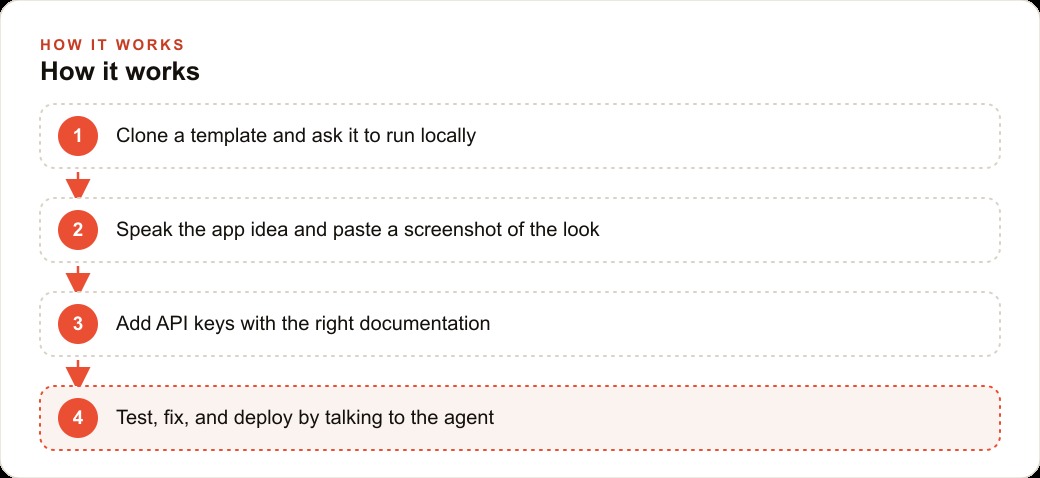
The workflow has a short discipline loop that makes it reliable. You clone a starter template so you are not beginning from nothing, run it locally until you can see it in a browser, and then reshape it by speaking descriptions of what you want to change. For any integration with an outside service, you treat the API key as a building piece and the current documentation as the instruction manual. You fetch the documentation from a research tool to make sure it is current, paste it into the chat, and tell the agent to use it. When the agent defaults to an older behavior and reaches for something it knew before the documentation you gave it, you correct it directly, point it at the right source, and it adjusts. You paste a screenshot of the visual style you want and describe the changes until the interface converges on the target. You start a fresh chat for each new task so the context stays small and the agent stays sharp. You copy any error message the browser shows you and paste it back for a fix. Over a single focused session, a working application with real features, accounts, saved history, and deployment, takes shape from those spoken descriptions.
The discipline that keeps a spoken workflow from becoming noise
Voice input generates text faster than typing, and that speed is the feature and the risk at the same time. A session where you speak every thought as it occurs, without structure or sequencing, produces a long chat thread where the agent is trying to reconcile instructions from early in the conversation with contradictory instructions from later in it. Long threads also slow the agent and degrade accuracy because the model holds more context and allocates attention across a larger span of prior exchanges. The speed of speaking needs to be paired with discipline about what goes into each chat session.
The most important discipline is starting a fresh chat for each distinct task. One feature per chat. One fix per chat. Keeping context small keeps the agent focused and fast, and prevents earlier instructions from contaminating later ones. This habit runs against the instinct to keep everything in one continuous conversation, but the instinct is wrong. The agent performs better with a short, focused context than with a complete history of the session.
Templates serve the same focusing function from a different angle. You do not begin by speaking an app into existence from nothing. You clone a starter project that already has the structure in place, run it locally so you can see something that works, and then describe what you want to change about it. The template is not a constraint. It is a foundation that removes the hardest part of any project, which is the cold start, and gives your spoken descriptions something concrete to modify rather than something abstract to conjure from nothing. Reshaping a running thing is faster, clearer, and more reliable than building from a blank description, and the agent that has something to work with produces better output than the agent starting from an empty file.
Corrections need to be specific to be effective. If the agent produces the wrong behavior, vague corrections produce vague adjustments. A correction like "that's not quite right" gives the agent no actionable information. A correction like "you used the v1 API endpoint, the documentation I gave you shows the v2 endpoint which uses a different authentication header" gives the agent exactly what it needs to fix the error in one step. The discipline of staying specific in corrections rather than expressing dissatisfaction applies throughout the workflow and is what separates a session that converges quickly on a working result from one that circles the same error multiple times.
What a business gains when the person with the problem can also build the fix
The most significant change vibe coding enables for a real business is not the speed of building. It is the precision of what gets built. When the person who understands the problem most deeply is also the person doing the building, the gap between the problem and the solution narrows to nearly nothing. There is no requirements document that a developer interprets through a different lens. There is no briefing session where details get lost between what was said and what was heard. There is no revision round to explain what the specification actually meant. The person with the problem builds the tool around the problem as they actually experience it, and the result reflects that specificity in ways that delegation almost never achieves.
For a business running operations through a web-based CRM, this means the person who uses that system every day can build the small companion tool that makes one specific friction point faster, not a general tool that handles the whole category, but a precise tool shaped around the exact task that costs them time each morning. The owner who manages Google Ads accounts can build the specific report format that matches how they actually think about performance without adapting a generic dashboard to approximate what they need. The team managing Meta ads creative testing can build an internal tool that tracks variation performance in exactly the format used in creative review meetings, rather than reshaping a shared spreadsheet to be almost right.
The compounding effect on small teams is meaningful over time. Small, precise tools built by the people who use them stay maintained because the builder understands them and can adjust them when the need evolves. A tool built through delegation is often abandoned when the need changes slightly, because another delegation cycle costs time and money and the result will again be close but not quite right. A tool built by the user gets adjusted in an afternoon when the workflow shifts, and it continues serving the actual need rather than the need as it was understood at the time the specification was written.
The businesses where non-technical people can build small workflow tools around their specific processes move faster and adapt at lower cost than businesses where all tooling depends on a centralized technical resource. Infrastructure, security, and complex systems still require technical expertise. But the long tail of small workflow tools, the ones that take a developer two days and a non-technical person an afternoon, shifts to the people who understand the problem most directly. That shift changes what a small team can accomplish without adding headcount, and it changes which problems get solved versus which ones stay on the list because the delegation cost was too high to justify.
Madhuranjan Kumar has been building this way for months, across a range of business contexts, and the pattern that produces the best outcomes is consistent: start with one specific problem you understand deeply, pick the smallest tool that solves that problem, speak the description in focused sessions with fresh chats per task, paste the current documentation for any external service, and correct the agent specifically when it drifts. The florist who talks a custom order assistant into existence in an afternoon because she knows exactly what the workflow needs. The service dispatcher who builds a routing helper shaped around the real decision criteria for the jobs in the queue. The precision of understanding the problem is the skill that matters most, and for the first time in the history of software, that precision is sufficient to build. The person who understands the problem can now also be the person who builds the fix.
That is exactly what we do at AI DOERS. Book a private 30-minute call with Madhuranjan Kumar and we will map the fastest path to it for your specific business.
Book your call →
Madhuranjan Kumar
Madhuranjan Kumar brings 20 years of performance-marketing experience and has managed over $200 million in Facebook ad spend for brands across the United States and beyond. His expertise spans the full modern marketing stack: Meta, Google Ads, TikTok, email automation, CRM, and the websites that hold it together. At AI DOERS he turns that track record into lead-generation systems for businesses across every industry.