
Vibe Coder vs Senior Engineer: What a 30-Minute Claude Code Race Actually Teaches
Two builders raced to ship the same app in 30 minutes with Claude Code. The lesson was not about talent, it was about time: parallel work, tight scope, and memory beat clean foundations that ran out of clock.

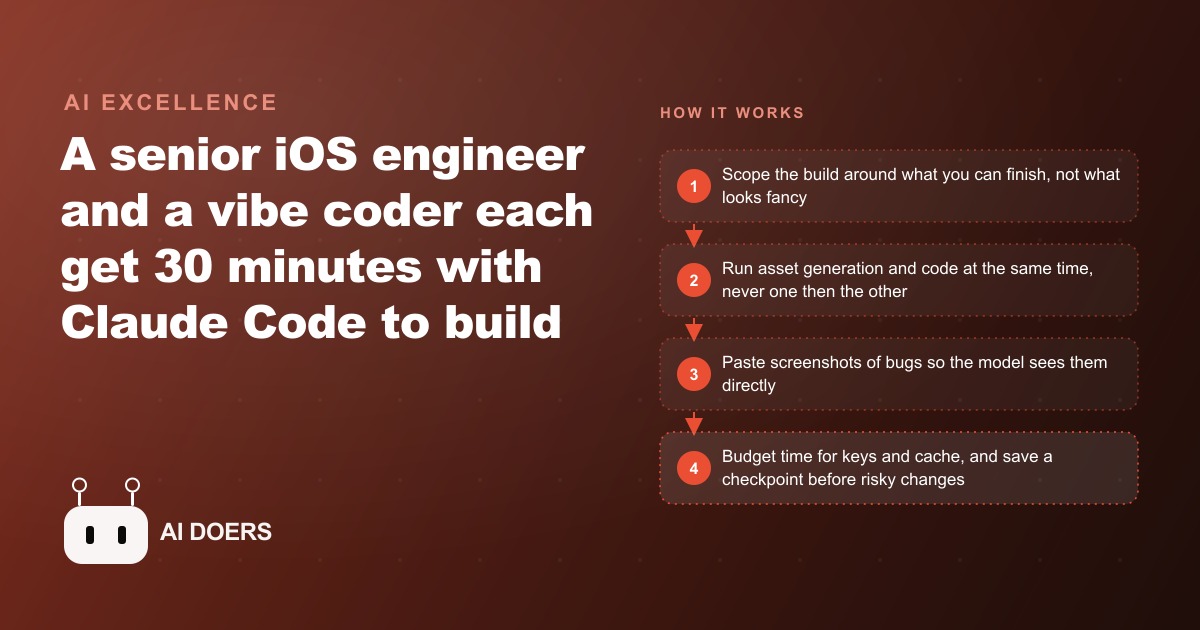
I want to tell you what happened in that 30-minute race between a senior iOS engineer and a vibe coder, both building the same app with Claude Code, because the outcome surprised me and the reason it happened surprises most people who hear about it.
The app they were each building was an AI therapist companion. A mobile app where a user talks to a character who responds with empathy and guidance. This is a product concept that requires a few things to go right: a character with enough personality that the interaction feels meaningful, conversation history so the character remembers what was said, and an onboarding flow that explains to a new user what the app is and how to use it. Not trivial, but not complex. The kind of thing a competent mobile developer could build a working prototype of in a few hours.
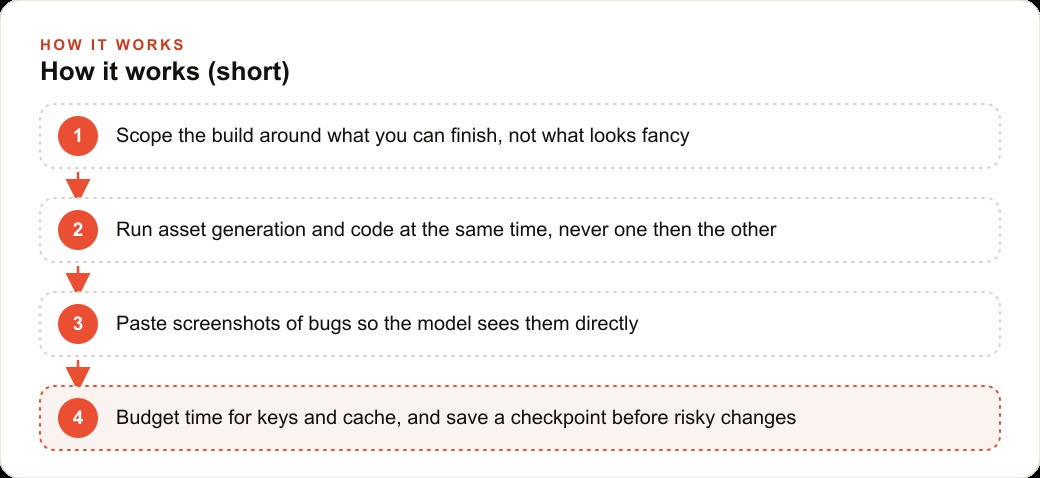
The engineer opened his terminal. He set up Expo. He chose React Native as the stack. He picked a bamboo plant as the character, which was a genuinely smart choice because a plant has no mouth, which means no lip-sync animation complexity. He ran plan mode in Claude Code, stating his stack upfront, giving the agent clear context about what he was building. These are the decisions of an experienced developer. He made every correct architectural choice.
He lost.
The vibe coder worked entirely on his phone. He used Claude's mobile app to brainstorm the concept first. He did not start by choosing a framework or setting up an environment. He started by asking Claude what the character should be, what the onboarding should say, what the user's first experience should feel like. While Claude was generating the character concept and the visual assets, he was already prompting for the code. Asset generation and code generation happened in parallel. He did not wait for one to finish before starting the other.
When bugs appeared, the vibe coder took screenshots and pasted them directly into Claude. He did not describe the bug. He did not paste an error message into a code block. He held up the screen and said: here is what I see, fix it. The model interpreted the screenshot, identified the issue, and returned a corrected version. He added animations, a subtle wiggle when the character was listening, a gentle motion when it was speaking, not because they were required but because they took ten minutes to add and made the product feel finished. He shipped an onboarding flow. The user who opened the app for the first time understood what it was and how to use it.
The engineer ran out of time before the memory feature was implemented. His character existed. His conversation loop worked. But there was no persistence. If you closed the app and reopened it, the character had no memory of who you were or what you had said. This was the killer feature the vibe coder had wired in. Conversation history is not technically complex. It is a database write and a retrieval. But the engineer spent his available time elsewhere and did not reach it.
I have been thinking about this race since I watched it, and I think the lesson it teaches is not the one most people take from it. The common read is that the vibe coder won because AI lowers the skill floor, making formal engineering training less relevant. This is partly true but it misses something more important. The vibe coder did not win because his instincts were better or his code was cleaner. He won because he engineered around friction.
Here is what the engineer's time actually looked like, traced through the session. He spent roughly ten minutes on setup: API keys, environment variables, Expo cache issues, a package that needed reinstalling. He spent about twelve minutes writing code and prompting Claude effectively. He spent eight minutes on restarts and debugging triggered by the environment problems. The twenty minutes of productive building that he got were real and good. But they happened inside a thirty-minute window that had already been reduced to twenty by friction that had nothing to do with his ability to build.
The vibe coder's time looked different. He spent about two minutes on setup, because on a mobile app the setup is effectively nothing. He spent eighteen minutes building: generating character assets, prompting for the conversation loop, adding the memory feature, wiring the onboarding. He spent ten minutes refining: adding animations, adjusting the character design, testing the user flow. He had twenty-eight minutes of productive work in a thirty-minute session because the friction was almost zero.
This is the thing I want to sit with. Two developers. Same thirty-minute window. Same capable AI model. One had ten minutes of productive time consumed by friction. The other did not. The engineer's skill advantage, and it was real, was completely neutralized by the cost of setting up the environment he was skilled in.
When I teach this, I tell people that setup friction is the most underestimated variable in AI-assisted development. Everyone talks about prompt quality. Everyone talks about choosing the right model. Nobody talks about what happens in the first ten minutes before any code is written. The engineer went straight to his standard professional setup, because that is what he knows and it has served him well for years. But his standard professional setup was built for a world where you spend weeks on a project and amortize the setup cost over hundreds of hours of work. In a thirty-minute prototype session, you cannot amortize anything. Every minute of setup is a minute not building, and the session has no slack.
The vibe coder had no professional setup because he had no professional background. This turned out to be an advantage. He had no habits to unlearn. He started where the friction was lowest: a phone, a chat interface, direct prompting with no configuration step. His constraint became his edge.
I think about this in terms of what planning actually means when building with AI. The engineer planned in the traditional sense: he thought about the technical architecture, chose a framework, defined the stack. These are the right things to plan in a conventional project. But in a sprint context, with Claude Code as the primary builder, the planning question is different. The question is not "what is the right technical stack for this product?" The question is "how do I get to building in sixty seconds rather than ten minutes?"
The vibe coder answered the second question without consciously asking it. He has never spent time optimizing a development environment because he has never had one. So his default behavior is to go straight to the output with whatever tool has the lowest barrier. This is not naivety. In the context of AI-assisted rapid prototyping, it is the correct approach.
The memory feature was not an afterthought for the vibe coder. He planned it early, prompted for it early, and had it running before the session ended. This is worth examining. The engineer is more experienced, and experienced developers often defer persistence and data storage to later in a build because they know the data model needs to be correct before you implement it, and getting the data model correct requires understanding the full feature set. This reasoning is sound in a multi-week project. In a thirty-minute prototype, it is fatal.
The feature that distinguishes a compelling prototype from a toy is almost always the one that makes the experience feel real, and conversation memory is exactly that feature in a therapist companion app. Without it, every session starts cold. The character feels like a chatbot. With it, the character feels like something you would come back to. The vibe coder built from the user's perspective, asking: what would make this feel real to someone who opens it for the first time? The engineer built from the architecture's perspective, asking: what is the correct order of operations for a production-grade mobile app? The race rewarded the first question and punished the second.
The screenshot debugging technique deserves a note by itself. When you describe a bug to an AI model in text, you are doing interpretive work. You are translating a visual artifact into a verbal description. That translation loses information and introduces the possibility of misdirection. When you paste a screenshot, the model sees what you see. It does not have to interpret your description. It does not have to imagine the visual context. It has it. The vibe coder's default debugging behavior, pointing rather than explaining, is faster and more accurate than text-only bug reporting. This is not a workaround. It is a better method that became available when multimodal models became capable, and developers who learned their workflows before multimodal models often have not yet updated their habits.
There is a version of this story where the engineer wins, and I want to describe it. The engineer wins if he does one thing differently: he asks himself, before opening the terminal, what the lowest-friction path to a working prototype actually is. Maybe that is still Expo and React Native, because he knows the environment so well that setup truly is fast for him. Maybe it is a web prototype instead of a mobile one, because a web server has zero Expo cache issues. Maybe it is starting on the character design and content before touching any code, the way the vibe coder did, so the model is producing two streams of output simultaneously while he thinks about architecture.
The engineer has skills the vibe coder does not have. Those skills are worth something in a real project, where the prototype needs to become production code, where the architecture needs to hold under load, where security and error handling matter. The race was a prototype sprint, not a production build. In a production build, the engineer would catch things the vibe coder would miss entirely. Type errors. Memory leaks. Race conditions. Incorrect assumptions about how the API handles edge cases. These are real and important things.
But the race was a prototype sprint. And in a prototype sprint, the question is not who has more knowledge. The question is who has less friction. The vibe coder answered that question correctly, and the engineer did not.
The animations are worth addressing separately because they represent something the engineer did not attempt. The wiggle when the character is listening, the subtle motion when it speaks, these are not features in any traditional sense. They do not change what the app does. They change how the app feels. The vibe coder added them in ten minutes at the end of the session because he had ten minutes to spare. He had ten minutes to spare because his setup cost was two minutes rather than ten.
The ten minutes spent on polish produced something the engineer's technically superior architecture could not produce: a product that, when shown to a first-time user, felt alive. This is a marketing instinct applied to a technical sprint. You are not adding functionality. You are adding the perception of completeness, the feeling that someone cared about how this thing feels to use. In a prototype, that perception is often the difference between someone saying "I could see this becoming a real app" and "yeah it works I guess."
I watch a lot of these comparisons and I have started to notice a consistent pattern. The developers who perform well in AI-assisted prototype sprints are not always the most technically skilled. They are the ones who have learned to treat setup as a cost to minimize rather than a step to complete correctly. They ask: can I skip this configuration step? Can I run this on the web instead of native so I avoid the build toolchain? Can I generate the assets while the code is generating so I am not waiting in serial? Can I describe this bug by pointing at it rather than explaining it? Every yes to these questions recovers minutes that go toward building.
The vibe coder answered yes to all of them naturally, because his default mode is to find the path of least resistance. That is the lesson. Not that skill does not matter. Skill matters in every context that requires depth. But in AI-assisted rapid prototyping, the skill of eliminating friction is worth more than the skill of writing excellent code from scratch.
The engineer will update his habits. He is experienced enough to recognize what happened in that session and change how he approaches the next one. Experienced developers learn quickly. What the race exposed is that the update is necessary, that the habits that make a developer excellent over a long project can actively hurt them in a short one, and that this is not obvious until you watch the race happen.
What I think is worth carrying out of this story is a question to ask before starting any AI-assisted sprint: where is the friction in my default approach, and is that friction worth the benefit my defaults provide? In a long project, the benefits of a professional setup are worth the setup cost. In a sprint, they may not be. The choice of where to start should be a deliberate decision, not a reflex.
The engineer's reflex was his professional default. The vibe coder had no professional default, so he chose consciously, even if he did not think of it that way. The bamboo plant with no mouth was clever. The Expo environment with full type safety was also clever. Only one of those clever choices was appropriate for a thirty-minute window. The race made the difference visible.
That is exactly what we do at AI DOERS. Book a private 30-minute call with Madhuranjan Kumar and we will map the fastest path to it for your specific business.
Book your call →
Madhuranjan Kumar
Madhuranjan Kumar brings 20 years of performance-marketing experience and has managed over $200 million in Facebook ad spend for brands across the United States and beyond. His expertise spans the full modern marketing stack: Meta, Google Ads, TikTok, email automation, CRM, and the websites that hold it together. At AI DOERS he turns that track record into lead-generation systems for businesses across every industry.