
Upskill, Do Not Deskill: Redesign Your Team's Roles Around AI
AI is automating tasks inside every job. Here is how a small business redesigns roles so AI takes the busywork and people move to the high-value work that customers pay for.

The most dangerous moment in AI adoption for any business is not before you install the tool. It is the week after, when roles quietly drift toward the administrative scraps that automation left behind and nobody has defined what the human does with the reclaimed hours.
I am Madhuranjan Kumar, and the contrarian point I want to make in this piece is specific: deskilling is the default outcome of passive AI adoption. It does not require malice or negligence. It happens automatically when a business installs AI tools without deliberately redesigning what humans do next. The mistake is not moving too fast on AI. It is moving on AI without intentional role redesign, and the businesses that skip that step will look back in three years and find that their teams are doing lower-value work than before the tools arrived.
The upskilling outcome requires deliberate effort. Most of that effort has to happen before the tool goes in, not after the team has already settled into new patterns around the scraps that automation left.
Deskilling Is the Default Outcome of Passive AI Adoption
Deskilling happens when AI automates the skilled, complex parts of a job and leaves the human with the low-value administrative remainder. The example that makes this concrete is a travel agent. AI plans the complex itineraries, customizes the packages, and handles the research. The human is left taking payments and printing tickets. The person did not lose their job, but the job that remains is a fraction of what it was, both in value and in interest. The capability the person developed over years is now largely handled by a system, and what they do every day is cleaner but smaller.
This outcome happens by default because it follows the path of least resistance. A business installs an AI tool that handles the complex part of a task. The human, relieved of that burden, fills the reclaimed time with whatever is nearest: lower-level tasks that were always in the role but always crowded out by the harder work. Nobody made a decision to hollow out the role. It hollowed itself out because nobody made a decision to prevent it.
The alternative, upskilling, requires a deliberate decision made before the tool goes in. The question to answer is not what the AI will do but what the human will do with the time the AI frees. A property manager whose AI handles research and document preparation can spend the reclaimed hours on negotiation, relationships, and complex client decisions that require judgment the AI cannot provide. But only if someone explicitly redesigned the role to point the freed time at that higher work. Left unguided, the property manager fills the time with easier administrative tasks that felt manageable before but now multiply to consume the available hours.
Coding is the clearest example available right now of how this plays out in practice. Many engineers today spend more time editing and directing AI output than writing code from scratch. The role shifted from doer to editor and director. The leaders who have watched this transition observe that it is a preview of what will happen to most knowledge-worker roles over the next several years. The specific shift varies by job, but the pattern is consistent: AI absorbs the execution layer and the human shifts toward review, judgment, and direction.
Entry-Level Roles Are Where the Hollowing Starts
Entry-level work is the most exposed category in any organization because it is defined almost entirely by the tasks that experienced people find too routine to handle themselves. The junior person in most businesses handles the scheduling, the data entry, the basic research, the first drafts, and the repetitive follow-ups. Those are exactly the tasks AI handles well and handles first. When AI absorbs the entry-level task list, the entry-level role loses its content before anything else.
This creates a compounding problem that most small businesses have not thought through. The entry-level role in a healthy organization is not just a place to put cheap labor. It is the training ground for the next generation of senior people. Junior staff learn by doing the foundational work, building the pattern recognition and judgment that come from handling many cases over time. When AI does the foundational work, the learning that would have happened through repetition does not happen. The junior person processes the AI's output rather than building the skill themselves, and three years later they have the title of a senior person but the depth of someone who watched the work being done rather than doing it.
The businesses that catch this problem early redesign the entry-level role before the tool goes in. They ask: if AI handles the data entry and the basic research, what will this person do instead? The answer should be something that builds the judgment and client relationship skills that define the senior role, even if it is a smaller, supervised version of that work. A junior marketing person whose AI handles the spreadsheet work can spend those hours reviewing campaign results with a senior person and developing the analytical judgment that makes someone valuable. But only if someone redesigned the role to deliver that experience intentionally, not accidentally.
For teams involved in paid advertising management or any channel where the junior task is repetitive data pulling and report formatting, this question is urgent right now. The AI that handles those tasks is already available and already being adopted. The window to redesign the junior role before the hollowing starts is open today and will close as soon as the team settles into the pattern the tool creates by default.
The Redesign Window Is Open Now and It Closes Fast
The redesign window is the period between when an AI tool becomes available for a role and when the team settles into the new pattern the tool creates. During that window, a business can deliberately shape what the role becomes. After that window closes, the pattern is established, the habits are formed, and changing them requires significantly more effort than designing them correctly from the start.
Most businesses have not started the redesign conversation. The leaders who have watched this transition most carefully note that surprisingly few organizations are planning for it seriously, even though the tools are already in use. That gap between tool adoption and intentional role redesign is where the deskilling default takes hold.
The redesign conversation is not complicated, but it requires honesty about what each role actually contains. Most job descriptions describe what a role should theoretically do. What a role actually does is best captured by asking someone who holds it to describe a typical week in concrete terms, hour by hour. That audit almost always reveals a large fraction of time spent on tasks that AI can handle, and a smaller fraction spent on the work that actually requires the person's judgment and relationships.
The redesign is to take the first fraction and route it to AI, and take the second fraction and expand it deliberately. The human now does more of the high-value work, supervised appropriately, rather than less of it. The role becomes harder, more interesting, and more valuable, which is the definition of upskilling. For teams managing SEO and content production or any content-intensive function, this means junior people shift from producing first drafts of templated content to developing the editorial judgment and strategic thinking that makes content worth producing.
What Deliberate Role Redesign Actually Requires
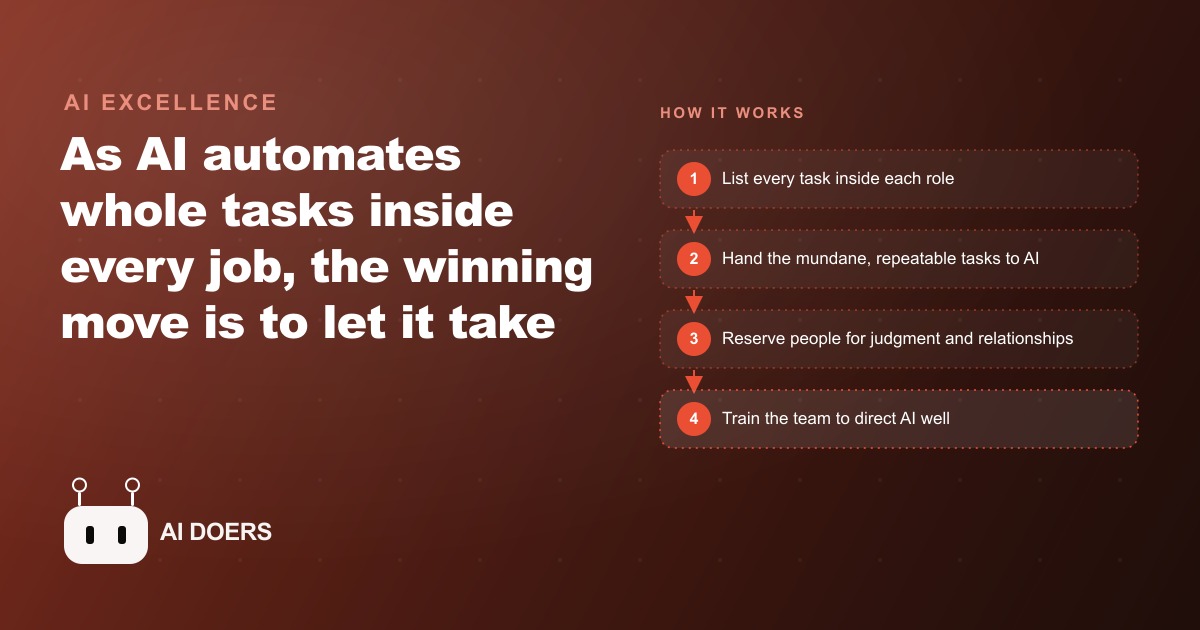
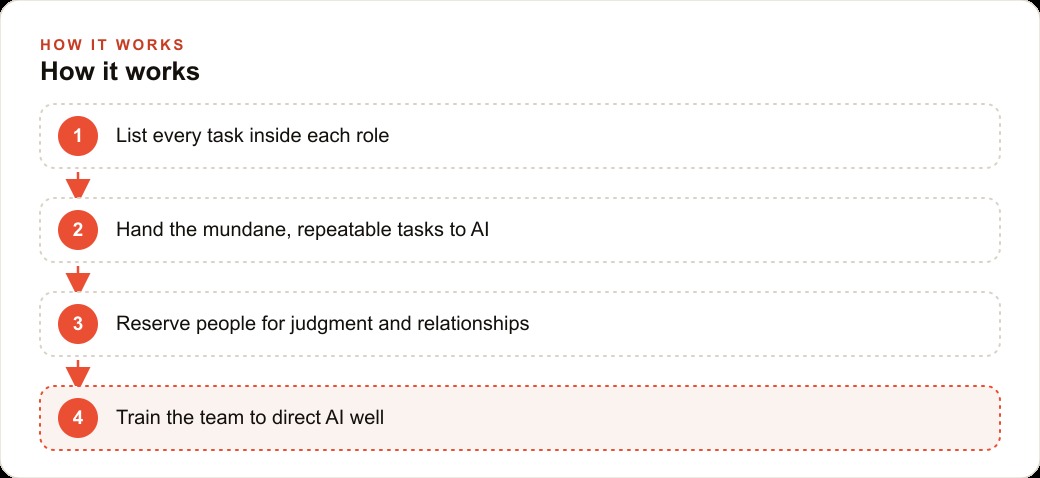
Deliberate role redesign has four steps, and they all need to happen before the AI tool goes in, not after the team has already started using it.
The first step is an honest audit of what each role actually does. Not what the job description says it does, but what the person in the role does with their time during a typical week. This audit should be done by talking to the people in the roles, not by guessing from a management perspective. The gap between what people are supposed to do and what they actually spend their time on is almost always larger than anyone expects.
The second step is sorting the task list into two categories: tasks AI can handle reliably and tasks that require human judgment, relationships, or creativity that cannot be automated without losing something the customer pays for. The first category is the automation target. The second category is where human time should go.
The third step is defining specifically what the human will do with the time the automation frees. This is the step most organizations skip. They automate the first category and assume the human will naturally fill the reclaimed time with the second category. They usually do not. They fill it with more of whatever is easiest and nearest, which is typically more work in the first category rather than expansion into the second.
The fourth step is training. A team whose junior members are now supposed to spend time on strategic work they have not previously done will need guidance, supervision, and explicit instruction on what good looks like in that work. The transition does not happen because you pointed people at it. It happens because you trained them for it and evaluated them on it from the start.
An Accounting Firm Applies This Framework
As an illustrative example, consider a small accounting firm where junior staff spend most of their time on data entry, transaction matching, and producing standard financial summaries from client records. Those tasks are exactly the ones AI can now handle reliably, and the firm has adopted AI tools that cut the time required for that work by a large fraction.
Without redesign, the default outcome is that junior staff spend more time checking AI output and handling the administrative tasks that the AI left behind, such as chasing missing documents from clients and formatting reports for different client preferences. The work is tidier but not harder. The junior staff are not developing the analytical and advisory skills that the firm needs them to have in three years when senior partners expect them to carry client relationships independently.
With deliberate redesign, the same outcome is arrested before it starts. The firm identifies that the three capabilities junior staff need to develop before they can carry client relationships are tax situation analysis, the ability to explain financial results in plain language to non-accountants, and the judgment to know when a situation requires a senior partner's input. None of those capabilities come from checking AI output on transaction matching.
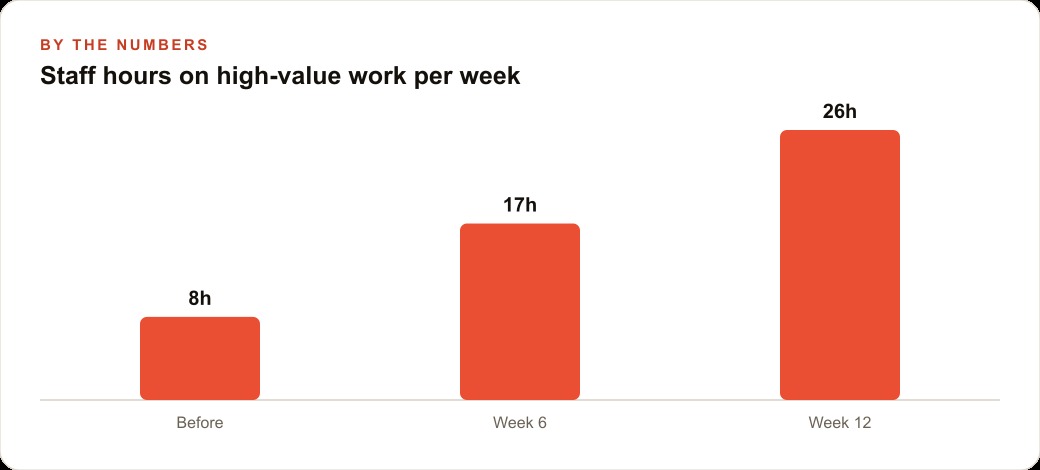
The redesigned junior role routes all the transaction matching and formatting to AI, with the junior person reviewing and approving the output rather than producing it. The reclaimed hours go to supervised tax situation review: the junior person analyzes each client's position with the senior partner present, explains what they see, and receives corrective feedback on their reasoning. Over six months, the junior person handles ten times more complex cases than they would have if the hours had gone to data entry. Their development toward senior capability accelerates, and the firm ends up with more capable people, not people who have merely kept pace with their own job descriptions.
Illustratively, a junior accountant who spends 20 hours a week on AI-handled tasks and devotes the reclaimed 10 hours to supervised client analysis and presentation practice develops client-advisory skills in 18 months that would otherwise take four or five years of gradual exposure alongside the routine work. The firm benefits not just from lower cost on the automated tasks but from a faster pipeline of capable people, which is the compounding advantage that deliberate redesign produces.
The Markers That Show Whether Upskilling Is Actually Happening
The difference between an upskilled team and a deskilled one is measurable, but only if you measure the right things. Counting how many hours the team spends using AI tools tells you nothing about whether upskilling is happening. It only tells you that the tools are in use.
The markers of genuine upskilling are different. Junior staff spend more of their time on the work that senior staff currently own. The complexity of the cases that junior people handle increases over a six-month period rather than staying the same. Client-facing conversations involve junior people more frequently rather than less. The evaluation of each person's performance centers on judgment calls and outcomes rather than output volume and task completion.
The markers of deskilling, by contrast, are easy to read once you know what to look for. Junior people spend most of their time checking AI output and handling the administrative tasks that AI left behind rather than engaging with the work that requires judgment. The gap between what junior and senior people do narrows at the bottom rather than the top, meaning junior people are doing less of the complex work rather than more. Turnover among junior staff increases because the work is less interesting than what they expected.
The businesses that catch these markers early, within the first few months of AI tool adoption, can still make corrections. The businesses that notice them only after a year or two have a much harder redesign problem on their hands, because the patterns and expectations are already set.
The First Decision Before Any AI Tool Goes In
Before any AI tool goes into a role, the first decision to make is what the human in that role will do with the time the tool frees. Not what they might do. Not what seems natural. What they will specifically do, with a plan for training them to do it well, and a metric for evaluating whether they are actually doing it.
That decision, made before the tool goes in, is the difference between upskilling and deskilling. It is not a technology decision. It is a management decision, and it requires taking seriously the responsibility of redesigning work rather than just automating it.
The businesses that make this decision carefully will end up with teams that are more capable, more engaged, and more valuable to clients than they were before AI arrived. The businesses that skip it will look up in three years and find that their teams are doing a smaller, duller version of the work they used to do, at a lower cost, and not much else. The window to choose which of those outcomes you are building toward is open right now and will not stay open indefinitely.
That is exactly what we do at AI DOERS. Book a private 30-minute call with Madhuranjan Kumar and we will map the fastest path to it for your specific business.
Book your call →
Madhuranjan Kumar
Madhuranjan Kumar brings 20 years of performance-marketing experience and has managed over $200 million in Facebook ad spend for brands across the United States and beyond. His expertise spans the full modern marketing stack: Meta, Google Ads, TikTok, email automation, CRM, and the websites that hold it together. At AI DOERS he turns that track record into lead-generation systems for businesses across every industry.